MMW 3.2 - Fractals in Nature
 Studied by 1 person
 Call Kai
 Learn
Learn Practice Test
 Spaced Repetition
 Match
Match Flashcards
 Knowt Play
1/18

There's no tags or description
Looks like no tags are added yet.
Name | Mastery | Learn | Test | Matching | Spaced | Call with Kai |
|---|
No analytics yet
Send a link to your students to track their progress
19 Terms
Fractal
derived from latin word “fractus” meaning fragmented or broken
a rough/fragmented geometric shape that can be split into parts, each of which is a reduced size copy of the whole (Benoit Mandelbrot)
Characteristics of a Fractal
Self Similarity
Fractal Dimension
Nowhere Differentiable
Self Similarity
Parts have the same form or structure as the whole.
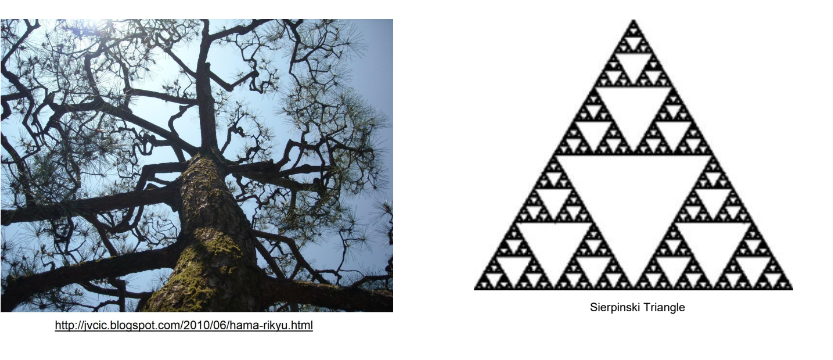
Fractal Dimension
Associated degree of complexity of shape, structure, and texture of fractals are quantified in terms of fractal dimension
Measure the space-filling capacity of a pattern that tells how a fractal scales differently than the space in which it is imbedded.
Does not have to be an integer.
The bigger the fractal dimension-
the more rough is the structure
When a process is repeated over and over, each repetition is called?
iteration
Samples of Geometric Fractals
Cantor Set
Sierpinski Triangle
Sierpinski Carpet
Menger Sponge
Koch Snowflake
Cantor Set
Discovered in 1874 by Henry John Stephen Smith
Introduced by German mathematician Georg Cantor in 1883
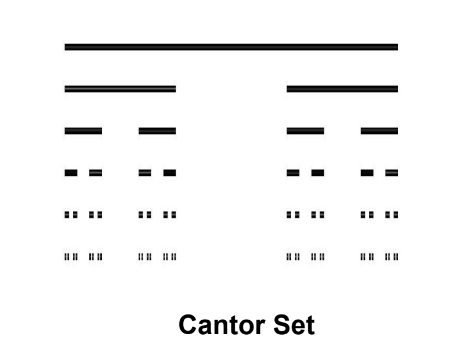
Cantor Set Derivation

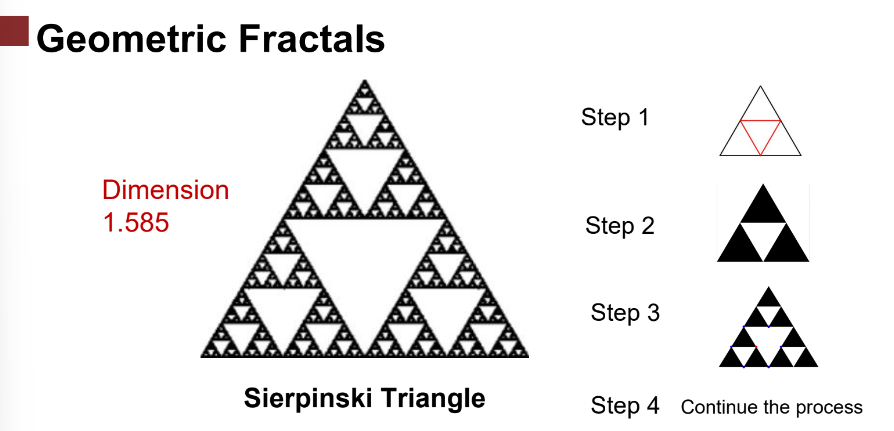
Sierpinski Triangle
After Polish mathematician Waclaw Sierpinski who discovered and investigated it in 1915
Dimension: 1.585
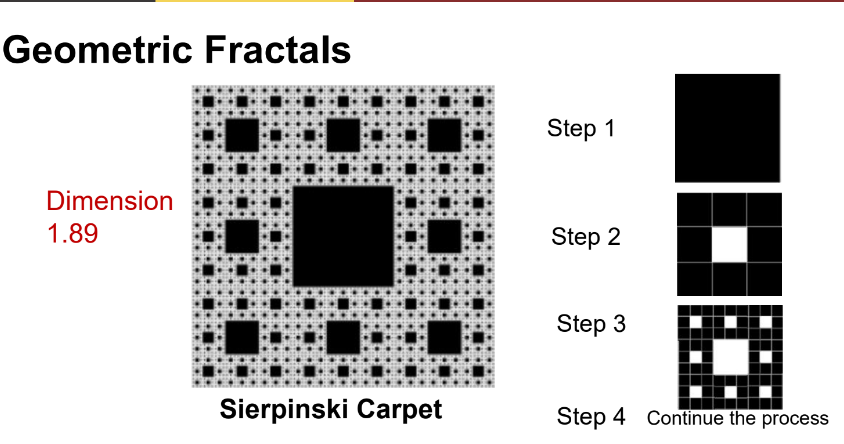
Sierpinski Carpet
Famous fractal first describe in 1916 by Waclaw Sierpinski (1882-1969)
Used in designing antennas in cell phones as the number of scales allows for a wide range of receptions
Dimension: 1.89 (log8/log3)
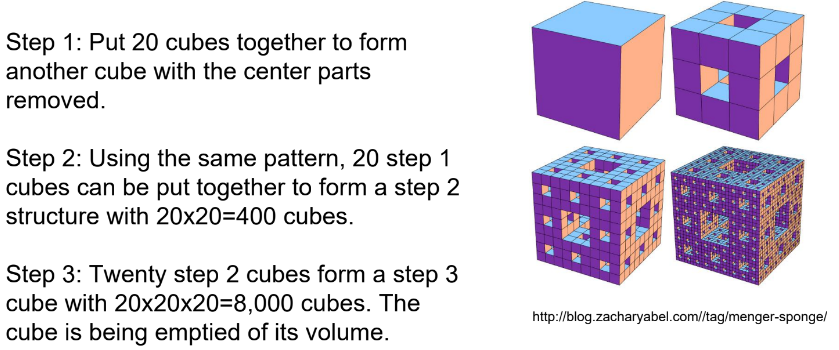
Menger Sponge
famous fractal solid, 3D equivalent of 1D Cantor Set and 2D Sierpinski Carpet
First described by Karl Menger in 1926
Dimension: 2.73 (log20/log3)
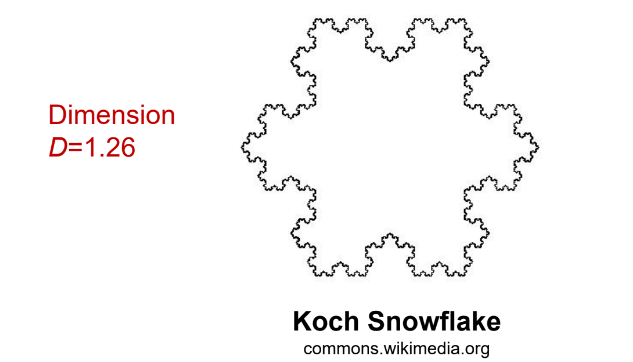
Koch Snowflake
first appeared in paper published by swedish mathematician Niels Fabian Helge von Kolch in 1996
Dimension: 1.26 (log4/log3)
Bifurcation
the never-ending process observed in branching algebraic fractals
Fractals in Algebra
Mandelbrot Set
Julia Sets
Mandelbrot Set Origin
Discovered by Benoit Mandelbrot in 1980, responsible for the dev’t of fractal science.
Discovered shortly after the invention of personal computer and Mandelbrot began his research in IBM
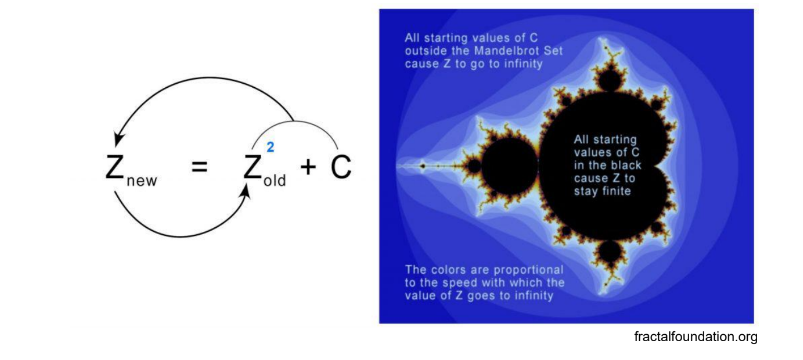
Mandelbrot Set
Set of points in the complex plane, boundary of which forms a fractal.
Can be generated using quadratic recurrence equation (Zn+1= Z²n+C)
Julia Sets
Discovered by Gaston Maurice Julia, closely related to Mandelbrot set
The iterative function used to produce them is the same as that of the Mandelbrot set (differ only in the way the formula is used)
In every Mandelbrot, is an infinite number of Julia sets.
 Note
Note  Flashcards (35)