astro 353 exam 2
 Call Kai
 Learn
Learn Practice Test
 Spaced Repetition
 Match
Match Flashcards
 Knowt Play
1/19

There's no tags or description
Looks like no tags are added yet.
Name | Mastery | Learn | Test | Matching | Spaced | Call with Kai |
|---|
No analytics yet
Send a link to your students to track their progress
20 Terms
what are the seven main telescope designs
Gregorian, Cassegrain, prime focus, Newtonian, Ritchey Chrétien (RC), Schmidt, Schmidt-Cassegrain
what are the two kinds of telescope mounts
equatorial, alt-az
prime focus: name an advantage and disadvantage
advantage: simple optical system
disadvantage: detector/observer blocks incoming light, mechanical/access challenges
newtonian: name an advantage and disadvantage
advantage: simple cost-effective design (good for amateur telescopes)
disadvantage: mechanical / access challenges
cassegrain: advantage + disadvantage
advantage: compact design for long focal length, convenient viewing position
disadvantage: central obstruction, complex and costly
gregorian: advantage + disadvantage
advantage: convenient viewing
disadvantage: central obstruction, reduced compactness
RC: advantage + disadvantage
advantage: no coma (most large observatories use this)
disadvantage: complex and expensive to make
catadioptic (schmidt/schmidt cassegrain): advantage + disadvantage
advantage: easy to make, no aberration
disadvantage: lost light, corrector plate reduces transmission
explain the equatorial mount and its advantages and disadvantages.
the RA axis is tilted to match earth’s rotation, while the declination axis moves north/south in the sky. it moves the same way the sky appears to move with earth’s rotation.
advantage: simple tracking, only one axis rotates to counteract earth’s rotation.
disadvantage: can’t support larger telescopes
explain the Alt-Az mount and its advantages and disadvantages.
the mount moves up and down (altitude) and left to right (azimuth).
advantages: structural stability, highly cost effective
disadvantage: complex tracking, cannot track stars within 5 degrees of zenith.
telescopes do what two things?
collect light and focus light
what is a refractor telescope?
uses a lens to bend and focus light to the eye piece. massive, and not used anymore for large telescopes, instead for instrument optics.
what is a reflector?
light enters a tube and uses a mirror to reflect light to a focus, with a secondary mirror redirects light to the eyepiece. much smaller size. not used much for professional observational astronomy.
explain the basic optics for telescopes (photons, flux, wavefront)
we treat light (photons) as geometric rays. the flux of photons is important for recording light as an electronic signal. the wavefront is the perpendicular surface to the ray.
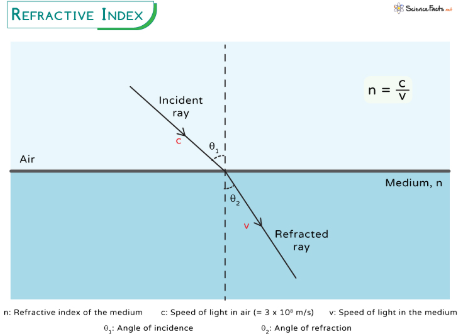
what is index of refraction and its formula?
the change in speed and bend of a ray of light when entering a material.
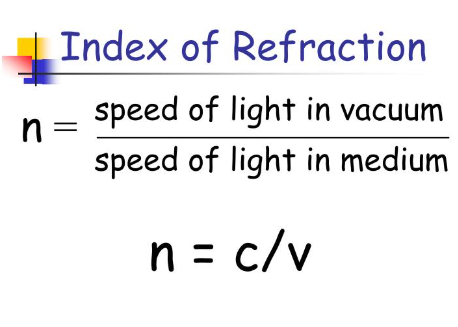
what is the diagram for index of refraction?
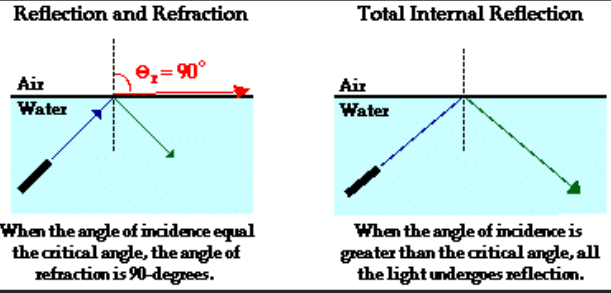
what is a critical angle?
the angle of incidence in a denser medium where the refracted ray in a less dense medium is 90 degrees, marking the point where total internal reflection occurs in the denser medium.
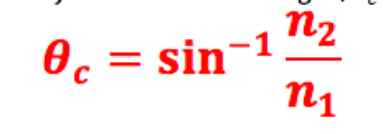
what is the formula for the critical angle?