Latin II Midterm study ALL
 Studied by 2 people
 Call Kai
 Learn
Learn Practice Test
 Spaced Repetition
 Match
Match Flashcards
 Knowt Play
1/414

Name | Mastery | Learn | Test | Matching | Spaced | Call with Kai |
|---|
No study sessions yet.
415 Terms
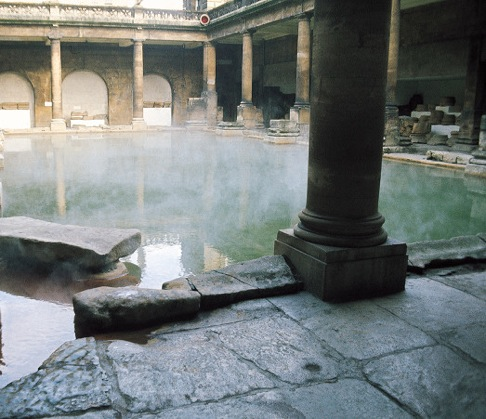
The largest of the three plunge baths at Bath: it is now called the Great Bath. Notice the steam rising from the naturally hot water.
The largest of the three plunge baths at Bath: it is now called the Great Bath. Notice the steam rising from the naturally hot water.
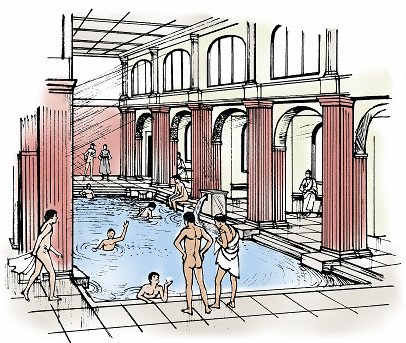
How the Great Bath probably looked around the time of our stories, late first century AD. Bathers with and without towels bathe and chat.
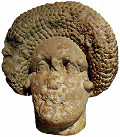
A carved stone portrait of a lady with fashionable hairstyle and earrings. From her tomb at Bath.
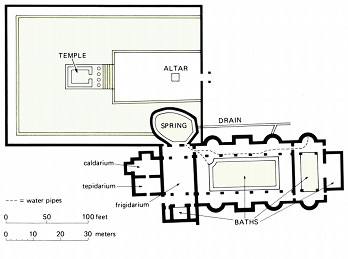
Plans of the baths and the temple at Bath, England, around 100 AD.
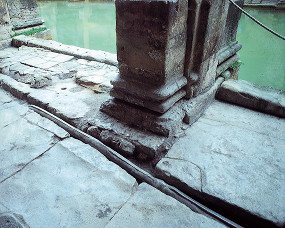

Water ran from the spring to the baths through lead pipes.
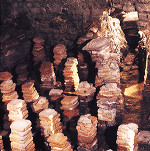
In addition to the pools of natural hot water, there was a set of baths heated by a hypocaust in the Roman mannet, with a caldarium, tepidarium, and frigidarium. Part of the hypocaust.
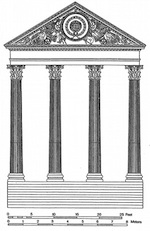
Reconstruction of the temple front. Four Corinthian columns standing above a flight of steps support a large decorated triangular pediment.
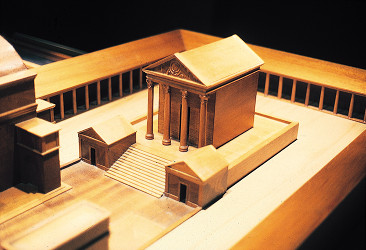
A model of the temple and the courtyard.
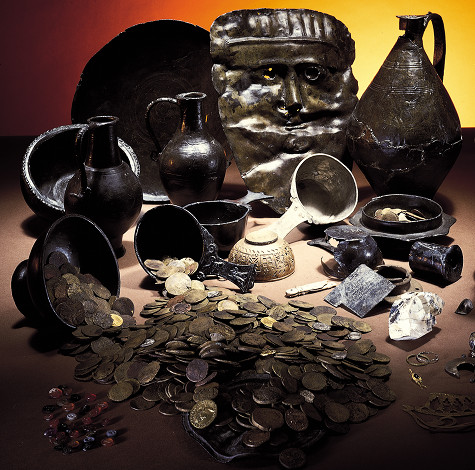
Some of the objects (coins, bowls, jugs, seal stones, a mask, and other items) people threw into the springs.

A red cornelian seal stone shows a goddess, perhaps Fortuna, holding a horn of plenty, poppy head and rudder. Thrown into the springs.

A dark agate seal stone is carved with the bust of a woman, a Maenad, looking to the left, her hair tied behind her head by a band. Thrown into the springs.

A cornelian seal stone is carved with a discus-thrower and a palm of victory in a vase. Thrown into the springs.
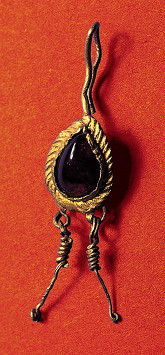
Gold earrings with pear-shaped garnet found in the springs.
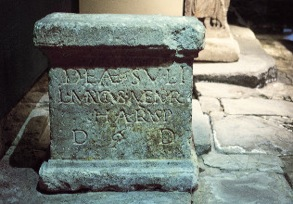
Memor set up a statue near the altar of the goddess Sulis. The statue has disappeared, but this is the statue base with his name on it. The altar is in the background.
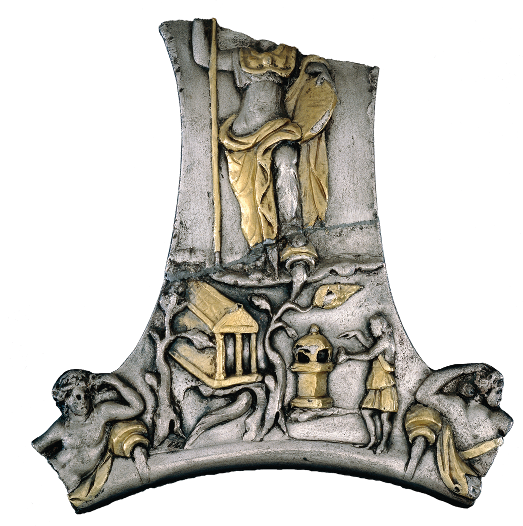
Gold and silver relief from the handle of a serving dish showing a worshipper making an offering at an altar outside a temple by a spring.
Location
Bath, UK, near Avon River, at a bend in the river
What is it?
Hot mineral springs, hot water under the earth
Amount of water produced
250,000 gallons (1,000,000 liters) of water per day
Water temperature
104-121 degrees Fahrenheit (40-49 degrees Celsius)
Where is the water from?
Water from today was rain from 10,000 years ago, sank into the Earth, rose as hot springs
Minerals
Calcium, magnesium and sodium primarily
What the Celts believed about Aquae Sulis
Sacred, home of goddess Sulis (goddess of healing), should be worshipped, believed special waters could cure and heal as well
Roman views on Aque Sulis
Saw the potential of the place - being used as pilgrimage, gained trust from the locals, built a huge public bathhouse thermis, dedicated to goddess Minerva
Sacred Spring
Most significant part of the bathhouse
Wall
Around the reservoir of water, built by Romans, lined with lead sheets, stone railing surrounds reservoir atop the wall
Roman engineering
Impressive (architecture, hypocaust, etc.), survives 21st century
thermae building shape
long and rectangular
Three primary baths (“plunge baths”) in the complex had _ ________ ______ __ ____ _______ _____
a constant source of warm, pleasant mineral water. The pool nearest to the spring had the warmest water
Traditional suite of bathhouse rooms
caldarium, tepidarium, frigidarium. hypocaust heated them.
Who built it?
Military engineers and hired plumbers - showed skill and quality - reminders of the high standards of Roman engineering
Woman’s tombstone
58 years old, from eastern gaul, died from illness she sought to remedy in Aquae Sulis.
Julius Vitalis tombstone
soldier in 20th legion, only served for 9 years, got sick and military sent him to Aquae Sulis, died at age 29
Temple constructed by Romans
Dedicated to Minerva, not Sulis; designed in Roman style with a cella, Corinthian columns, decorative pediment
How do we know Aquae Sulis was important?
A Roman Official had come. A statue was dedicated by a haruspex (Lucius Marcius Memor). Base of the statue of Minerva reveals a lot about Romans belief.
What other building were built around?
Basilica, theater, houses for residents/workers, inns for visitors
Tourism conducted by Romans
souvenir shops, employing retail workers, craftsmen could create and sell their wares (eg carved gemstones, good luck charms, jewelry, things to throw in the sacred springs)
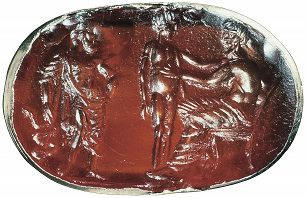
A sealstone carved with a picture of a doctor examining a patient, supervised by Asclepius, the god of healing.
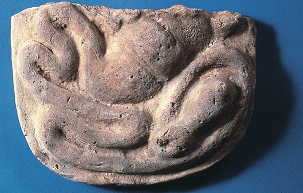
Alexandrian doctors were particularly expert about the inside of the body, although others had some knowledge. This clay model of the intestines, and models of other body parts, were dedicated to the gods by patients at a healing shrine in Italy.
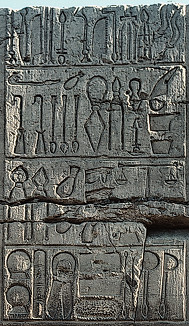
A set of metal instruments carved on the walls of an Egyptian temple about twenty-five years after Quintus’ visit to Alexandria. In the third row notice the scales for weighing medicines, and the forceps. THe cups in the bottom left corners were used to draw off blood.
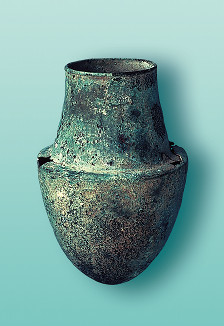
A bronze cup was heated and its mouth was applied to a patch of skin whose surface had been cut or scratched. As the air in the cup cooled, blood was gently sucked out.
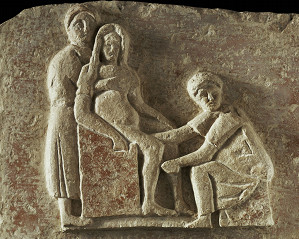
During childbirth, the mother would sit in the birthing chair with female supporters around her and the midwife seated in front of her.
The blade of a saw used by doctors for cutting through bone.
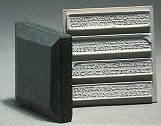
A stamp for labeling cakes of eye ointment and a plaster cast of the impressions of the four sides.
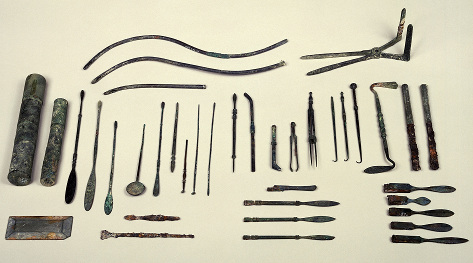
A Roman doctor had a wide range of instruments at his disposal, from spoons and tweezers to knives.
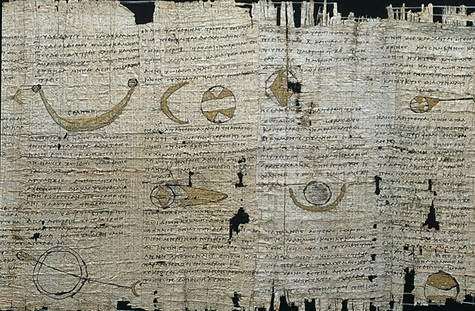
Part of a papyrus treatise on astronomy, Written in Greek at Alexandria in the second century BC.
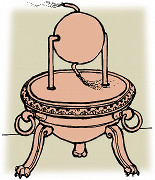
A drawing of Hero’s steam engine which consists of a hollow, metal sphere and a boiling pot of water.
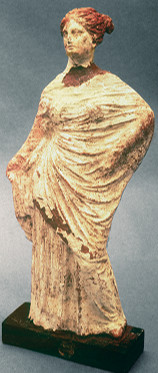
A model of Hypatia of Alexandria wearing a white stola.
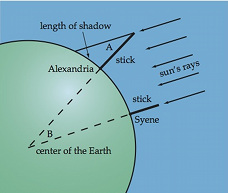
A diagram of Eratosthenes’ experiment: Eratosthenes discovered that at Syene (modern Aswan) in southern Egypt the sun was directly overhead at noon on the day of the summer solstice so that a vertical stick case no shadow. At the same moment, the sun in Alexandria (which Eratosthenes believed was due north of Syene) was not directly overhead, so a stick in Alexandria cast a shadow. Eratosthenes measured this shadow and used his measurement to calculate the angle A between the sun’s rays and the stick. Since the sun’s rays are parallel, angle B is the same size as angle A. Knowing angle B and the distance between Syene and Alexandria, he calculated the Earth's circumference. His conclusion was only 198 miles off.
Alexandria
famous as a center of science and learning - had the Musem and its Library where scholars from around the world came - new discoveries
Part of Hippocratic oath
Into whatever houses I enter, I will go into them for the benefit of the sick, and I will abstain from every voluntary act of mischief and corruption. Whatever in my professional practice I see or hear, which ought not to be spoken abroad, I will not divulge.
Hippocrates
tried to remove magic + superstition from treatment of disease by observing his patients’ symptoms carefully and trying to discover their causes - regarded as founder of medical science
Greek knowledge
surface of the body - dissecting a body was disagreeable and perhaps wicked
Alexandrian knowledge
because of mummifying corpses, they knew about anatomy
Herophilus
most famous Alexandrian anatomist - gave detailed description of the brain, explained difference of tendons vs nerves and arteries vs veins, described optic nerve and eye including the retina, measured frequency of pulse + used that to diagnose fever, laid great stress on importance of hygiene, diet, exercise, and bathing
Use of drugs
experienced doctors would use them to treat minor ailments - juice of wild poppy contains opium (relieve pain)
Unwashed sheep wool (lanolin)
often applied to wounds and swellings to soothe the irritation
Boiled turnips
Useless prescription for chilblains - what helped was either the heat from the turnips of the patient’s own belief that the turnips would do them good
How to remove a decayed tooth
Put a piece of peppercorn between the decayed tooth and a healthy one, and that would push the tooth out at some point
Surgery and other procedures
Tonsillectomies, tying veins/arteries, reset broken bones, stitches on incisions, sometimes difficult/delicate operations attempted (such as one the eye), amputations (last resort)
Women in medicine
Midwives were the only roles (assisting in childbirth). Methods: olive oil, herbs, sponges, woolen bandages, and birthing stool
Doctor Hygiene Standards
Greek doctors insisted on high standards of cleanliness to reduce the risk of infections
Museum at Alexandria
Famous for the study of math
Euclid
worked at Alexandria, wrote book called Elements and summarized all previous knowledge of geometry
Astronomy
developed in Alexandria- people trying to calculate the distance between the Earth and the sun, between the Earth and moon, idea that Earth is round, rotated on axis, circled the sun with other planets. Heliocentric model of the universe not very well accepted though.
Hero of Alexandria
made a steam turbine that made steam cream a force that made a ball spin around, made a hollow altar that when fire was lit, hot air made puppets dance
Maria Hebraea
Mary the Jewess - contributed to alchemy by inventing scientific instruments including the double boiler (“bain-marie”) for gentle heating
Hypatia of Alexandria
wrote and taught about mathematics, philosophy and astronomy, wrote a commentary on Euclid’s Elements with her father
Why did Alexandrian not build stuff with machines?
They had slaves. The large workforce made them not need to build machines, maybe regarded trade and manufacturing less dignified than research and investigation, maybe prevented from developing machines bc of a lack of technical skills
nominative translation
the thing
genitive translation
of the thing
dative translation
to/for the thing
accusative translation
(verb) the thing
ablative translation
(preposition) the thing
1st declension, singular, nominative
-a
1st declension, singular, genitive
-ae
1st declension, singular, dative
-ae
1st declension, singular, accusative
-am
1st declension, singular, ablative
-ā
1st declension, plural, nominative
-ae
1st declension, plural, genitive
-crum
1st declension, plural, dative
-īs
1st declension, plural, accusative
-ās
1st declension, plural, ablative
-īs
1st declension is always ________
feminine
2nd declension, singular, masculine, nominative
-us
2nd declension, singular, masculine, vocative
-e
2nd declension, singular, masculine, genitive
-ī
2nd declension, singular, masculine, dative
-ō
2nd declension, singular, masculine, accusative
-um
2nd declension, singular, masculine, ablative
-ō
2nd declension, plural, masculine, nominative
-ī
2nd declension, plural, masculine, genitive
-ōrum
2nd declension, plural, masculine, dative
-īs
2nd declension, plural, masculine, accusative
-ōs
2nd declension, plural, masculine, ablative
-īs
2nd declension, singular, neuter, nominative
-um
2nd declension, singular, neuter, genitive
-ī
 Note
Note  Flashcards (25)