Developmental yr 2
 Studied by 0 people
 Call Kai
 Learn
Learn Practice Test
 Spaced Repetition
 Match
Match Flashcards
 Knowt Play
1/130

There's no tags or description
Looks like no tags are added yet.
Name | Mastery | Learn | Test | Matching | Spaced | Call with Kai |
|---|
No analytics yet
Send a link to your students to track their progress
131 Terms
define intersubjectivity
interactions between baby and mother - can be primary or secondary
Phonology
combining small units to create language
semantics
language conveying meaning
syntax
linguistic rules about how words go together
i.e.:
a bites the dog man
the dog bites a man
the man bites a dog
primary intersubjectivity
first few months of baby’s life
characterised by eye contact, attention to faces, vocalisations, imitating sounds and gestures
secondary intersubjectivity
older infants - 9 months
more sophisticated, intentional, interactions
pointing, turn taking, shared attention, social referencing
define dyadic interactions
interaction focussed on the baby and mother (as opposed to the environment)
primary intersubjectivity - dyadic mimicry study
Meltzoff and Moore 1997
newborns mimic facial expressions
3-4 month olds mimic sounds
show no understanding of others’ intentions
shows infants have a motivation to interact with others
primary intersubjectivity - preference for faces study
Goren et al 1975
infants show a preference for face-like objects
spoon-like figures presented
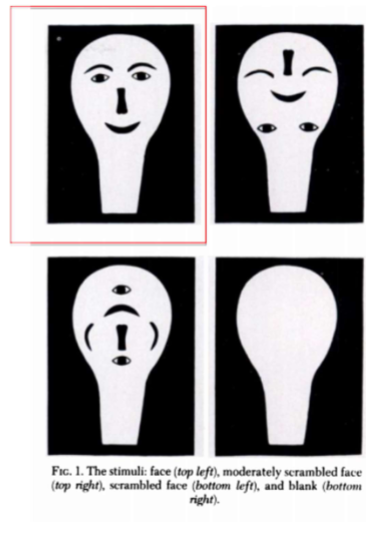
primary intersubjectivity - attention to faces and eye gaze
newborns prefer to make direct eye contact
Senju and Csibra 2008:
infants will only follow someone’s gaze if they make direct eye contact first
define triadic interactions
interaction that involve mother, baby and now something in the environment i.e. a toy
secondary intersubjectivity - still face experiment
shows how infants coordinate their emotional responses with others, and what happens when that coordination breaks down:
parent freezes their responses to infant - indicating something is wrong
interaction breaks down
baby attempts to repair interaction through social engagement cues
secondary intersubjectivity - visual cliff experiment
shows how infants use social referencing
infants look to parents for emotional cues to see how to proceed
positive cues increase likelihood the child will walk over the cliff
demonstrates transfer of information and shared attention skills
secondary intersubjectivity - intentional communication begins
this is signified by:
eye contact and pointing
consistent vocalisations to indicate a specific goal
evidence of waiting for a response
persistence if not initially understood
what are the two key modes of communication important for language acquisition
Turn-taking
Joint attention
Sharing a focus of attention
Following attention
Directing attention
turn taking
3 months - infants begin to alternate vocalisations with caregiver
12 months - few overlaps between speakers
what is a proto-conversation
a type of early turn taking vocalisations that are similar to later conversation
joint attention
sharing a focus of attention
joint interactions are triadic
there is shared awareness of the shared attention (both know they are both attending to the object)
joint attention skills predict later language skills
discuss the importance of routines
routines create shared context - so children can know what will come next
routines create scaffolding for language learning
joint attention
following attention timeframes
9 months - can follow someone’s point
12 months - begins to check back with the pointer
14 months - can follow a point across a line of sight
gaze following
a form of joint attention, as we track where someone else is looking and join them in looking
9 months - infants will follow an adult’s gaze and share an object of attention - Scaife and Bruner
studies on gaze following
Brooks and Meltzoff:
found at 12 months, infants will follow a head turn even if the turner is blindfolded (indicating they aren’t following gaze specifically)
however, 12 month olds won’t follow a gaze if the eyes are visible but closed
14 months - only follow when the eyes are visible (suggesting they are now following gaze)
what did moll and tomasello discover about infants and gaze following
infants will follow a gaze behind barriers
joint attention
directing attention - imperative and declarative pointing
imperative pointing = to get an adult to do something - infant learns this gets them what they want
declarative pointing = to direct an adult’s attention to something - infant learns this gets them attention
timeframes for directing attention
9 months - child points to an object and checks the mother is watching
18 months - child check the mother is watching before pointing
directing attention - criticising evidence
at 12 months (so not 18 as other evidence suggests):
infants can indicate when adults find the wrong object - Liszkowski
infants respond negatively when adults attend to them and not the object - Boundy et al
the mapping problem - Quine
it is difficult to know which words link to which meanings because often there is lots of solutions the evidence could point towards
specific reference to pointing at things and naming them
under extension
using a term too narrowly i.e. only using dog for family pet, not all dogs
over extension
using a term too broadly i.e. calling all 4 leg animals a dog
error made until 2.5 yrs old
why do over extensions happen
category error - they have placed an item i.e. lion into the wrong category of dog
vocabulary limitations - they lack the word for lion so choose a close enough word they do know
give dates for language comprehension
comprehension comes before production
6 months - can comprehend nouns
10 months - can comprehend verbs
10-24 months - improvements on looking-while-listening tasks
18 months - don’t need the full word to know which object to look at
give dates for language production
12 months - first word
24-30 months - 500 words
what does it mean to say first words are often isolated
they lack articles like a and the
what is early noun bias
first words are often nouns
natural partitions hypothesis
children learn the words for objects (nouns) easier than verbs or prepositions because objects are physical and more visible
it is harder to give a label to a more abstract concept
name 3 mechanisms for word learning
innate constraints
structural cues in language
the social-pragmatic approach
innate constraints on early word learning
how children know what a word refers to
object constraint
whole-object constraints
principle of contrast
mutual exclusivity
object constraint
assumes a word relates to an object
whole-object constraints
assumes a word relates to a whole object, not its parts
principle of contrast
no two words can have the exact same meaning
explains how children overcome over extension
mutual exclusivity
no object has more than one name
helps overcome the whole-object constraint as they learn that new labels must mean new parts
issues with constraint theories
it just describes learning happens as opposed to explaining it
limited research on infants - so we don’t know if constraints are innate or learned
structural cues in language
structural cues for nouns are learned early and later for other words
structural cues for adjectives are learned at 18 months and beyond
syntactic bootstrapping hypothesis - structural cues
we rarely hear words in isolation
so we use this syntactic context to help give meanings to words
what did Waxman and Booth’s blicket study find regarding structural cues
children can extend nouns to category but not property.
children don’t extend adjectives to either category or property (showing they understand it isn’t a noun)
what did Gelman and Markman’s study show regarding structural cues
nouns refer to objects and categories, adjectives refer to properties (the differing ways they are used in sentences can indicate what kind of word it is)
how do structural cues relate to verbs
they are used to narrow down verb meanings
issues with using structural cues to narrow down word meanings
we know children are sensitive to word structure - but we don’t know exactly what aspects or at what age
we need some knowledge of words and their categories to understand structure, so how can structure teach us about word categories
experimental studies might just be showing us short term problem solving, not long term word learning
explain tomasello’s social-pragmatic approach
children use pragmatic clues from the environment to learn words
learning words is constrained in two ways:
the social world is structured - we have routines and patterned interactions
social-cognitive skills the infant has - whether they engage in joint attention, or intention reading
explain social cognitive skills further + brooks and meltzoff
word learning occurs when infants try to interpret the utterances from others
eye gaze and joint attention help with this process
gaze following at 10 months predicts language skills at 18 months - brooks and meltzoff
explain intention reading within the social-pragmatic approach
infants use the intentions of the speaker to work out the meaning of words
children can anticipate actions and then associate words with those actions
they can also differentiate between intentional and accidental actions
issues with the social pragmatic approach
it doesn’t account for how children learn more abstract words that don’t correlate to objects or actions
it is unclear when different aspects of this theory are used at which stages of development
what is syntax
the way different languages allow words to be combined into sentences
what are the characteristics of early word combinations
mainly content words
conveys most important parts of a sentence
present tense
observes adult word order i.e. truck gone not gone truck - suggesting there are some organising principles known at this stage
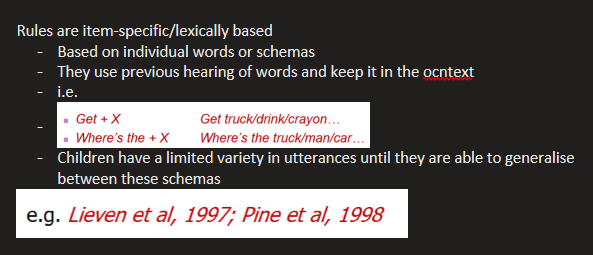
lexical (word based) rules
syntactic rules
grammatical rules
rules are innate
the constructivist/usage based approach
grammar is used for communication
infants are motivated to learn to communicate
grammar is learned using the following mechanisms:
intention reading
drawing analogies - similarities between groups of words and types of sentences and their functions
distributional learning - bits of language we always hear together
what role does routine play in learning language
it allows children to predict what happens next and deduct what the language they are hearing might refer to
evidence for the constructivist approach
high frequency items (heard the most) are learned easily - supporting routine
the verb island hypothesis:
children are generally unable to generalise between verbs with similar meanings or used in similar sentence types
NOT FULL INFO UNSURE
what 3 ways do children build up their lexically-based constructions to be more adult
structure combining
semantic analogy
distributional learning
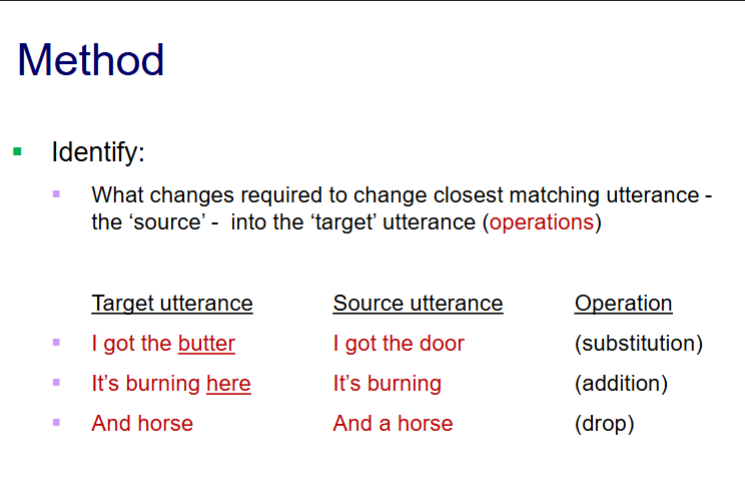
outline structure combining - Lieven et al
explains how children’s utterances build on what they have previously said
children identify what changes (operation) is required to go from the source (previous) utterance to the target (current) utterance
the study found many utterances are based on small changes and repetitions of previous utterances
common operations are substitutions, additions, or drops
outline semantic analogy
ALSO NOT SURE ARGHHHHH
outline distributional learning
noticing patterns between words that often appear together
i.e. verbs usually end in ‘ing’ or ‘ed’, nouns normally end in ‘s’
what is phonology
language is made of combined small units
what is semantics
language conveys meaning
what types of studies are used to asses infant language
preference studies - no training, what do they want to listen or look at
habituation studies - infants are trained, then we see what they prefer
change detection studies - infants are trained to respond to a change (measures whether they can tell a difference between two things)
prosody
patterns of stress and pitch in a language and how this can change the meaning of the same sentence
phonemes
smallest units of distinct sound in a language
evidence that infants have prosody
Mampe et al found that infants cry with an accent - they have different pitches at different points in the cry
Nazzi et al found infants can distinguish between languages with different prosody i.e. german and spanish but not languages with similar prosody i.e. english and dutch
what age can infants discriminate between all sounds and what age does this change
1-2 months - this includes foreign ones, which adult’s can’t even do
7-11 months this declines for other languages and increases for the target language
what can infants do regarding word syllables
they can track syllables that often co-occur and know that these syllables are likely to be part of the same word
i.e. hap - ppy, or pre - tty
what did saffran et al investigate
infants listening to syllables in a made up language of whole words and part words (where two syllables that aren’t usually together have been mashed)
infants listened longer to the part words indicating novelty
infant directed speech - christa 2013
higher pitched
slower speaking rate
important words are usually exaggerated and at the end
boundaries between phrases are exaggerated and so easier to separate
infants prefer people who use IDS
what is the use of having high frequency salient (important)/linguistic words
salient - mummy/your name
linguistic - he, she, the
it acts as an anchor - giving at least one boundary between words in a speech stream and helping them segment the speech
what age do infants use articles to segment nouns
8 months
specific article is ‘the’
explain how different infants learn their own language rules
at 8 months, infants are sensitive to the structures of sentences used in their language i.e. italian is frequent-first, and japanese is frequent-final
firugemu vs rugemufi
constructivist argument to child acquisition of language
children actively engage in their environment to construct their knowledge
nativist vs constructivist views on creative utterances
nativist = children’s utterances are creative because they have access to innate grammatical rules
constructivist = children’s utterances are creative because they use lexical frames from language they have already heard and insert new variables into the slots
nativist vs constructivist views on observing adult word order
nativist = children observe adult word order because they use their innate rules to put words into the same order as adults
constructivist = children observe adult word order because they pick up on frequently used terms and structures
nativist vs constructivist views on generalisations
nativist - generalisations provide evidence of their innate rules
constructivist - generalisations demonstrate that they learn language gradually from their environment
state and explain 3 nativist assumptions
grammar is like algebra - it is a computational system
grammatical categories and rules are present since birth (universal grammar)
learning particular aspects of grammar is all or nothing - once you know one rule you can apply it to everything
Radford’s general nativist predictions
children learn these innate aspects of grammar early on
children show consistent use of the same rules
universal grammar
all rules for language are innate and apply to all languages
when rules do differ between languages, they are highly constrained by parameters
children learn which parameters apply to the language they are learning at the time
english vs japanese language parameters
object comes after the verb:
i eat sashimi
vs japanese when the object comes before the verb:
i sashimi eat
theoretical advantages of universal grammar
avoids the issue of explaining how children acquire complex grammatical rules
explains unified acquisition of language across languages (while also explaining how they differ)
evidence to support universal grammar
some studies show children understand the rule of word order (verb-object vs object-word) from 2 yrs old - with preferential studies suggesting even earlier
preferential studies supporting universal grammar
children aged 1
they can identify the correct monkey and frog picture that represents the sentence ‘the monkey is gorping the frog’.
shows they understand word order parameters
theoretical issues for universal grammar
bilingualism - if children learn the correct parameters for the language they are learning, how can they apply different parameters for different languages
the concept of parameters is vague - we don’t know how many there are of what they are
studies against universal grammar parameters
chan et al
children show limited knowledge of subject - verb - object word order in production and act out tasks
what is the maturation model main theory
children’s language develops over time - so they don’t start out with innate universal grammar
explain Radford’s maturation model
at 20 months (lexical stage), children’s words consist of content words only (nouns, verbs, adjectives)
at 24 months (functional stage), their innate grammar matures and parts that control more complex grammar switch on
what complex grammatical components switch on
auxiliary verbs - mark certainty i.e. will, might
determiners - distinguish definites and indefinites i.e. a, the
inflections - mark tense and agreement i.e. watch/watched, i watch/he watches
lexical vs functional utterances
lexical = content heavy i.e. mummy doing? hands dirty
functional = adding in grammatical glue to content words
theoretical advantages of maturational models
explains why early utterances aren’t fully grammatical
fits more empirical data that suggests language develops over time
theoretical and empirical issues with maturational models
it is hard to identify exactly when in development maturation switches on
in early stages of development, children’s use of grammatical functions is inconsistent and varies across languages - not universal
what is the linking problem
how do children link their innate knowledge of grammatical categories with the words they hear (because we don’t label words as nouns/verbs etc when we say them)
semantic bootstrapping
a proposed solution for the linking problem
children have innate linking rules that they use to map the words they hear into the correct categories as and when they hear them
explain what agent and patient are
agent = the person carrying out the action, the subject of the sentence
patient = the person/thing affected by the action, the object of the sentence
 Note
Note  Flashcards (35)