Test 2 - Database Management
 Studied by 0 people
 Call Kai
 Learn
Learn Practice Test
 Spaced Repetition
 Match
Match Flashcards
 Knowt Play
1/126

There's no tags or description
Looks like no tags are added yet.
Name | Mastery | Learn | Test | Matching | Spaced | Call with Kai |
|---|
No analytics yet
Send a link to your students to track their progress
127 Terms
SDLC
Systems Development Life Cycle
Five stages of the SDLC
System definition, requirements analysis, component design, implementation, and system maintenance.
Purpose of a data model
To document data requirements and show how data are organized and related in a database.
Original E-R model creator
Peter Chen in 1976.
Main components of the E-R model
Entities, attributes, identifiers, and relationships.
Entity
A thing or object in the real world that users want to track.
Entity class
A collection of entities of the same type (e.g., all CUSTOMER records).
Entity instance
A single occurrence of an entity (e.g., Customer #12345).
Attribute
A characteristic that describes an entity, such as Name or HireDate.
Identifier
An attribute (or set of attributes) that uniquely identifies each entity instance.
Types of identifiers
Unique and non-unique identifiers.
Relationship in an E-R diagram
An association among two or more entities.
Types of binary relationships
1:1 (one-to-one), 1:N (one-to-many), and N:M (many-to-many).
Cardinality
The number of entity instances that may participate in a relationship instance.
Minimum cardinality
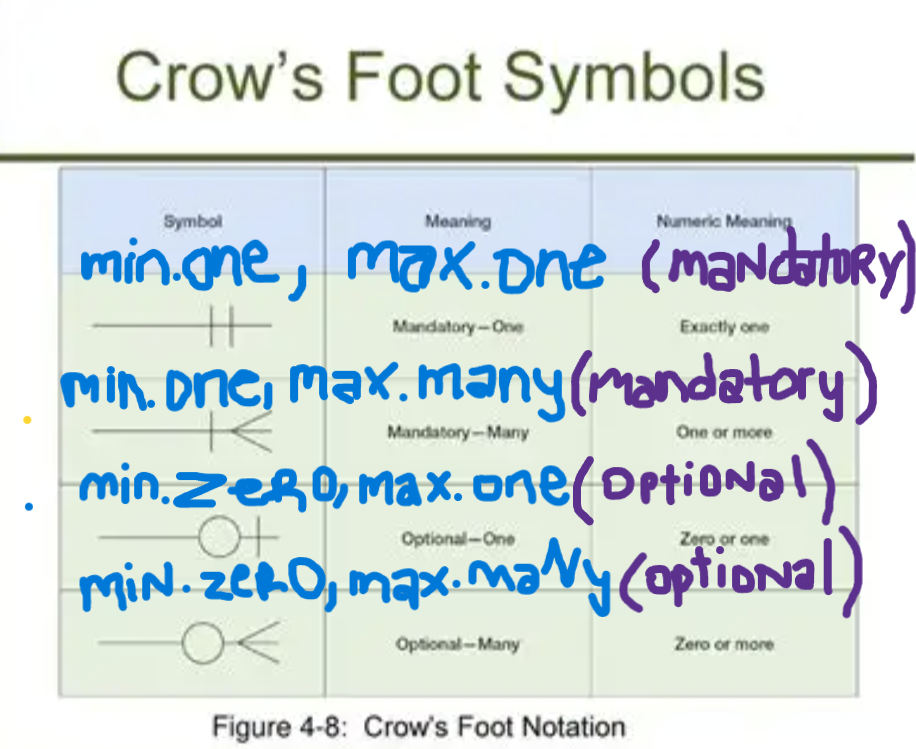
Indicates whether participation in a relationship is optional (0) or mandatory (1).
Notation using 'crow's feet'
Information Engineering (IE) notation.
1:N relationship representation in Crow's Foot
A single line from the "1" side to a crow's foot symbol on the "many" side.
Weak entity
An entity that cannot exist without being associated with another entity (a strong entity).
Strong entity
An entity that can exist independently of other entities.
ID-dependent weak entity
A weak entity whose identifier includes the identifier of its parent entity.
Identifying relationship
A solid line linking a strong and weak entity when the weak entity is ID-dependent.
Non-identifying relationship
A dashed line used when the relationship is not ID-dependent.
Associative (association) entity
An entity created to represent a many-to-many relationship and store attributes about that relationship.
Subtype entity
A special case of a supertype entity; shares the same identifier and represents a subset of instances.
Connection between subtypes and supertypes
An IS-A relationship.
Discriminator
An attribute in a supertype that indicates which subtype applies.
Recursive (unary) relationship
An entity related to itself (e.g., EMPLOYEE supervises EMPLOYEE).
Deliverable of data modeling
A validated E-R diagram showing entities, attributes, and relationships.
Validation of a data model
Show it to users and compare against use cases and requirements.
Database design
The process of transforming a data model into a relational database structure.
Three levels of database design
Conceptual design, logical design, and physical design.
Design level covered in Chapter 5
Logical design.
Normalization
Organizing data to reduce redundancy and avoid update anomalies.
Three most common normal forms
1NF (eliminate repeating groups), 2NF (eliminate partial dependencies), 3NF (eliminate transitive dependencies).
Denormalization
Combining tables to improve performance at the expense of redundancy.
When is denormalization used?
When faster query performance is needed and redundancy is acceptable.
Weak entity representation in relational design
Include the primary key of the parent entity as part of its own primary key.
1:1 relationship representation
By placing the primary key of one table as a foreign key in the other; either side may hold the foreign key.
1:N relationship representation
By placing the primary key of the '1' side as a foreign key in the 'many' side.
N:M relationship representation
By creating a new intersection table that contains the primary keys of each related table as a composite primary key.
Intersection table
A table created to represent an N:M relationship and link two tables together.
Referential integrity
A rule that ensures foreign key values match existing primary key values in the related table.
Recursive relationship in relational design
A relationship where a table references itself through a foreign key (e.g., Employee → ManagerID).
Determining foreign key side
The maximum cardinality of the relationship.
Composite key
A primary key made up of two or more attributes.
Importance of normalization
It reduces data redundancy and ensures data integrity and consistency.
Functional dependency
A relationship where one attribute depends on another for its value.
Purpose of specifying column properties
To define data type, size, null status, default values, and constraints for each column.
Foreign key
An attribute in one table that references a primary key in another table.
Surrogate key
A unique identifier added to a table when no natural key is suitable.
Data anomaly
An error that occurs when data are not properly normalized, causing update, insert, or delete problems.
1NF requirement
Each cell in a table contains a single atomic value and each record is unique.
2NF requirement
All non-key attributes must depend on the whole primary key, not just part of it.
3NF requirement
No non-key attribute depends on another non-key attribute (no transitive dependencies).
Trade-off in denormalization
Reduced complexity and faster queries versus increased redundancy and update anomalies.
Steps for transforming a data model into a design
Create tables for each entity, add primary keys, represent relationships with foreign keys or intersection tables, and define column properties.
Crow’s Foot Notation Chart
 Note
Note  Flashcards (39)