Higher Level Cognition (Thinking, Problem Solving, Reasoning, Making Decisions)
 Call Kai
 Learn
Learn Practice Test
 Spaced Repetition
 Match
Match Flashcards
 Knowt Play
1/18

There's no tags or description
Looks like no tags are added yet.
Name | Mastery | Learn | Test | Matching | Spaced | Call with Kai |
|---|
No analytics yet
Send a link to your students to track their progress
19 Terms
How is problem solving studied
Presenting participants w/ problems, where features of those problems might be manipulated and examining how individuals perform on these problems
Well-defined vs Ill-defined problems
Well-defined
Have a clear goal
Only one correct solution
Have to follow a set procedure to get the answer
E.g math problems
Ill-defined
Goals arent clearly defined
Multiple solutions or not solutions at all
No procedures
Solutions can involve getting evidence etc.
E.g dealing w climate change
Key point: Problem solving depends …
Problem solving depends critically on how a problem is mentally represented; suboptimal problem representations can lead to impasses, and restructuring the representation can help overcome these impasses.
Define insight problems vs non-insight problems
Insight problems
a problem that requires re-structuring the way the problem is represented in order to get the solution
can’t solve them using your usual approach.
E.g nine dot problem
Involves aha moment
non-insight problems
Involves a gradual realization that you are approaching the solution
E.g tower of Hanoi
Metcalfe & weibe study on insight and non insight problems
Warmth feeling: getting close to the answer
Insight problems:
People did not feel like they were getting closer to the solution.
Warmth feelings stayed low until the end when they got the answer
Non-insight problems (e.g., algebra):
People’s “warmth” ratings gradually increased over time.
They could sense steady progress toward the solution.
Mental set
Tendency for people to stick w/ whatever they are familiar with to solve problems —> using the same strategy/ method bc it worked before but this can prevent you from solving other problems
Functional fixedness
Tendency to think a object cant be used for other functions/ purposes. Rather it can only be used for its usual function
E.g A knife → you think it’s only for cutting
(but it could also be used as a screwdriver in a pinch)Prevents you from seeing a better or correct use of the tool in a situation —> restricting our problem solving ability
Duncker’s candle problem + 5,6,7 years old in preutilization and non-utilization condition
People are given a candle, matches, and a box of tacks and must put the candle to a wall.
Many people fail to solve the problem because of functional fixedness.
They see the box only as a container for tacks, not as something they can use to hold the handle on the wall
Thus, ppl get stuck
5,6,7 years old in preutilization and non-utilization condition
Preutilization condition: match box used for matches
Non-utlization condition: match box not used
preutilization condition
5 years old performed better bc they have less experiences w/ objects —> more flexible thinking so wasnt stuck
6–7 years old were affected by functional fixedness bc they have more experience
Non-utilization condition
5 years old perfomed worse
6-7 years old performed better
4 strategies in solving problems
Generate and test
Come up w all the possible solutions and then test each solution
Good if theres a limited number of possibiltieis
Con:
Too many possiibltieis
no guidance over generation
cant keep track of possibiltiies tested
Means-ends
Solving a problem by breaking a big problem into smaller steps
Initial state: where u start
goal state: Where u want to reach
intermediate states: the diff steps u go through when solving a problem
operators: actions u take to achieve goal
Pros:
Reduces difference b/w initial and goal state
Involves generating a goal and then sub goals
reasoning by analogy
Problem solving by finding comparisons between two situations and apply
the solution from one situation to the otheruse knowledge in one domain to help us solve problems in other domains
requires being able to “see” the structural similarities between the problems
incubation
taking a break leads to a sudden solution or increased ease of solving, suggesting unconscious mental processing —> solution randomly pops up in your mind while you take a break
Limited evidence
Incubation - Smith and blankenship puzzle study
Were given a harder puzzle + a clue to solve the puzzle but the clue was to guide them to the wrong answer so mislead them
Participants improved with delays (5 and 15 min delays) —> Supporting incubation
This improvement is b/c the breaks caused participants forgot abt the misleading cues
Define reasoning
inferences or conclusions drawn from other information
Types of reasoning
Deductive reasoning
goes from the general to the specific
deductive validity -> if the premises are true,
and one follows the dictates of logic, then the
conclusion will be trueE.g
All university students like pizza (premise)
Terry is a university student (premise)
Therefore, Terry likes pizza (conclusion)
Inductive reasoning
Goes from specific to general
we cannot be certain of our conclusion
conclusion will vary in inductive strength
E.g
Brian is a university student (premise)
Brian lives in a dormitory (premise)
Therefore, all university students live in
dormitories (conclusion)
Propositional reasoning
Drawing a conclusion from premises in the form of propositions
Propositions: can be true or false
E.g “Today is Tuesday”
“If Today is Tuesday, then we have class”
Confirmation bias Watson selection task + Social version of watson task
Most people choose E and 2 ❌ (wrong)
Correct answer is E and 5 ✅
People prefer to look for evidence that shows the rule is true rather than try to disprove —> trying to confirm the proposition rather than disprove it
Social version of watson task
Rule is framed as a social contract→ “If you take a benefit (drink beer), you must meet a condition (be over 21)”
Ppl performed better in this ver —> less reasoning mistakes
Shows how the social ver is easier bc ppl use real life reasoning
Confirmation bias
People tend to seek confirmatory evidence for a hypothesis
Key point: When reasoning, people tend to seek …
When reasoning, people tend to seek evidence that confirms their beliefs rather than evidence that would test or falsify them.
Eliminative strategy
Successful reasoning involves falsify your hypotheses, and thus eliminate incorrect beliefs —> prove your hypothesis is wrong
Dual process theory
Says we have 2 processing systems thats used in reasoning:
1.Intuitive process: fast, automatic, more mistakes
2.Reflective process: Slow, requires effort, more accurate
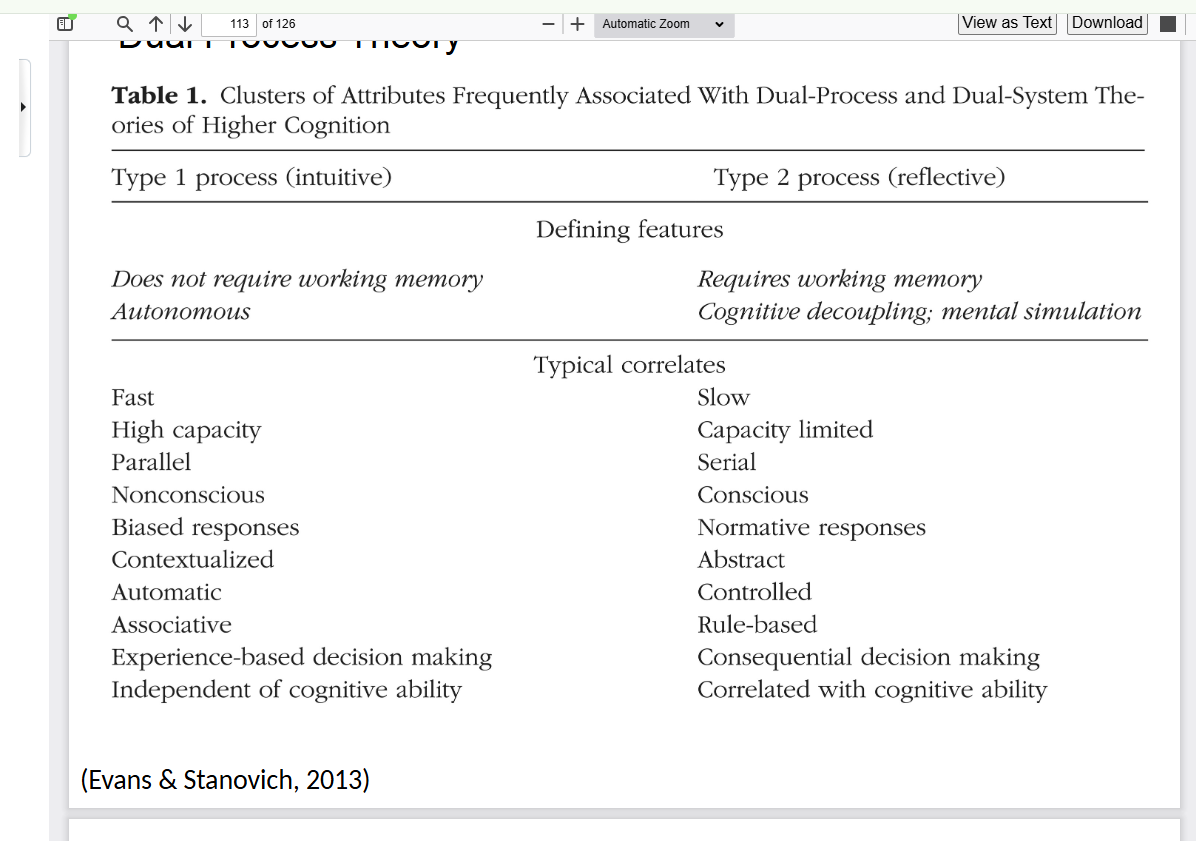
Key point: Reasoning is often described in terms of …
Reasoning is often described in terms of two broad types of processes: fast, automatic, intuitive processes (Type 1) and slower, controlled, analytic processes (Type 2).
Recognition-Primed Decision Making (RPD)
Experts make quick decisions by recognizing patterns and acting on experience, rather than comparing multiple options.

