Lecture 34 - (Moons) Asteroids & Comets
 Studied by 0 people
 Call Kai
 Learn
Learn Practice Test
 Spaced Repetition
 Match
Match Flashcards
 Knowt Play
1/20

There's no tags or description
Looks like no tags are added yet.
Name | Mastery | Learn | Test | Matching | Spaced |
|---|
No study sessions yet.
21 Terms
Saturn’s Moons
Second largest moon in the solar system with an atmosphere - Titan
Titan is the only moon in the solar system with an atmosphere
Based off gravity and gases
Titan is large enough to gravitationally maintain an atmosphere if gas existed around it
Very cold
Slower gases move
Easier for something with weak gravity to hold onto
Titan has methane gas to be held onto
Ganymede has no atmosphere
Enceladus
Medium-sized moon on Saturn
Iapetus is largest of medium moons
Active breaks in the ice sheet that’s actually releasing some of the water from beneath the surface
Shows some tectonic activity
Medium Moons of Saturn
Ice fountains of Enceladus suggest it may have a subsurface ocean
Stuff is being emitted outside of Enceladus, beyond the surface
Result of what we call a volcano
Volcano of rock
Crack in the ice sheet of Enceladus
Bring water beneath the surface up to the surface
On the Earth, where there is water, there is ice
Enceladus does the work for us - send a spacecraft and fly thru plumes and collect up some of the water
Liquid water underneath the surface thru cryovolcanos
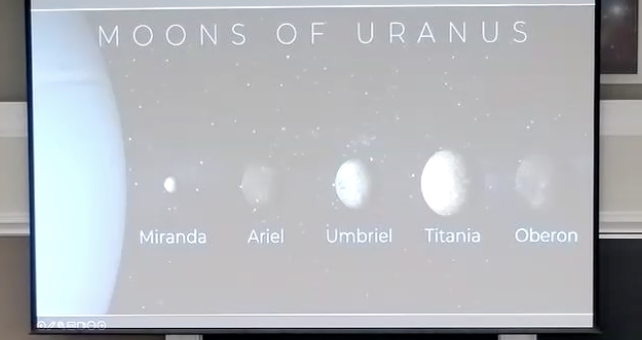
Moons of Uranus
Uranus has tens of moons
Biggest ones - Miranda, Ariel, Umbriel, Titania, Oberon
Named after Shakespeare characters
Uranus discovered by William Herschel
The Largest Moon of Uranus
Titania - smaller than Earth’s moon
Moons of Neptune
Triton - largest moon
Neptune is a CAPTURED object
Triton is captured Kuiper Belt object
Orbits Neptune in the wrong direction of rotation
Made of icy bodies
Similar to Pluto
Evidence of past geological activity
Triton is different from most major moons
Rocky Planets Versus Icy Moons
Rocky planets are driven from geological activity - hot, rocks melt at some certain temperature
Harder to maintain geological activity
Enceladus is geologically active because it has an external source of heat
Ice heating drives a little bit more of the geological activity
Space Rocks are Heavier
Space Rocks are heavier
densest material sank towards the center
Asteroid Facts
Rocky leftover planetesimals in the early solar system
Asteroids haven’t changed that much because not geologically active
Ceres is largest asteroid - dwarf planet
First 8th planet
All the asteroids exist between Mars and Jupiter - handful called Trojan before and after Jupiter
Hundreds and thousands of them
Harder to hit an asteroid than miss it - average distance between asteroids is huge
Wouldn’t be anywhere close to the mass of a planet
Many of the biggest asteroids - Ceres and Vesta are spherical
Majority are lumpy potatoes.
Aren’t big enough to have become spherical in the solar system
Some asteroids have moons
Can measure the density of asteroid to know what they are made of
Asteroid Ida has a tiny moon named Dactyl
Moons can be used to calculate density
DART MISSION
Have to be near the asteroid in order to view the details
Send a spacecraft
Which explanation for the belt seems the most plausible?
The belt is where all the asteroids happened to survive
Asteroids formed everywhere beyond the frost line - don’t sum up to the size of the planet
Orbital Resonances
Asteroids in orbital resonances with Jupiter experience periodic nudges
Nudges move asteroids out of resonant orbits, leaving gaps in the belt
Jupiter’s gravity stirred up asteroid orbits and prevented their accretion into a planet
Jupiter create gravitational barriers that you can’t go in between these regions - asteroids didn’t build up
Get rid of Jupiter, no asteroid belt
Why are there very few asteroids beyond Jupiter’s orbit?
Ice could form in the outer solar system
Rock accessed iced —> comets (ice forms in the outer solar system)
Comet Facts
Formed beyond frost line
Icy counterparts
Dirty snowball
No tails
Perpetually frozen
Only comets in inner solar system get tails
Brahe first measured them
Halley’s Comet
Edmund Halley, in 1705, predicted the reappearance of this comet in 1758
Predicted a period of about 75.3 years based on Kepler’s laws and Newton’s new understanding of gravity
Next appearance: 2061
Comets can reappear again
Periodic comet
Once-in-a-lifetime comet
Period of 76 years
If the period of Halley’s comet is 76 years, what is its average distance from the Sun?
P² = a³
18 AU
Sun-Grazing Comet
Smallest ones can get gravitationally destroyed by the sun
Comets in the sky - big size - Halley’s comet - not destroyed by the sun
Nucleus of Comet
Icy and rocky - “dirty snowball”
Sources of material for comet’s tail
Characteristic of sun that creates this tail
Couple of comets we’ve explored
Watching a Comet Become Active
Rosetta mission to Comet 67P
Comets stuck together - not dense objects, gravity is not strong
What determines the direction of a comet’s tail?
Tail extends AWAY from the direction of the Sun
Sunlight or energy from the sun - charged particles, sun smacks into them, pushing it away from the sun - ENTIRELY away from the sun as a result
Appearance of comets in the sky - no different from any other object
Rise in the east, set in the west
Tail always extends away from the sun
 Note
Note  Flashcards (44)