Unit 2 Psych Test Review
 Studied by 0 people
 Call Kai
 Learn
Learn Practice Test
 Spaced Repetition
 Match
Match Flashcards
 Knowt Play
1/73

There's no tags or description
Looks like no tags are added yet.
Name | Mastery | Learn | Test | Matching | Spaced | Call with Kai |
|---|
No analytics yet
Send a link to your students to track their progress
74 Terms
Perception
process of organizing, identifying, and interpreting sensory information (from sight, sound, touch, etc.) to understand and make sense of the world, turning raw data into meaningful experiences
Bottom-Up Processing
data-driven approach to perception where you start with raw sensory information (features, colors, shapes) and build up to a complete understanding or perception
Top-Down Processing
when our existing knowledge, expectations, context, and past experiences influence how we interpret incoming sensory information
Inattentional Blindness
people fail to see a fully visible, unexpected object or event because their attention is focused on another task
Signal Detection Theory
a framework explaining how we make decisions to detect a faint signal (meaningful info) amidst distracting noise (background stimulation), separating our actual sensory ability (sensitivity) from our personal decision-making bias (criterion)
Binocular Disparity (aka Retinal Disparity)
slight difference in the images received by the left and right retinas due to the eyes' horizontal separation
Interposition
an object that blocks or overlaps another is seen as as being closer
Perceptual Set
the readiness to perceive something in a particular way based on one's expectations, experiences, motivations, and emotions
Perceptual Constancies
the tendency to perceive familiar objects as stable and unchanging in size, shape, color, and brightness, despite variations in sensory information or viewing conditions
Perceptual Adaptation
ability for brain to adjust its sensitivity and interpretation of sensory input over time, allowing us to get used to new or constant stimuli, filter distractions, and maintain stable perception
Apparent Motion
perceptual illusion where a series of still images or stationary lights, presented in rapid succession and at slightly different locations, are perceived as a single, continuous moving object
Phi Phenomenon
visual illusion where the brain perceives continuous motion between two or more stationary lights or images flashed in rapid succession
Autokinetic Effect
visual illusion where a stationary, small point of light in a dark, featureless environment appears to move, often erratically, because the brain lacks reference points
Cognition
Metacognition
thinking about thinking
Concept
mental grouping or representation of similar objects, events, ideas, or people, forming an abstract category
Prototype
the mental "best example" or idealized average of a category, representing the most typical features of things within that group, helping us quickly classify new items and make sense of the world
Artificial Concepts
a mental category defined by a precise, formal set of rules or characteristics (opposite of natural concepts like dog or snow). Example: a triangle must always have 3 sides
Schema
mental blueprint or framework that organizes our knowledge, beliefs, and expectations about the world, helping us interpret information, make quick judgments, and guide behavior
Cognitive Script
a mental blueprint or schema for a sequence of actions or events in a specific context
Assimilation & Accommodation
assimilation is fitting new information into existing mental frameworks (schemas) without changing them, while accommodation involves modifying or creating new schemas to incorporate new experiences that don't fit existing ones
Heuristic
a mental shortcut or "rule of thumb" that allows people to make quick judgments, decisions, and problem-solving assessments efficiently, without needing extensive analysis, by focusing on easily accessible information or familiar patterns
Mental Set
the tendency to approach problems using strategies or frameworks that worked in the past, even when they're no longer effective, hindering creativity and the ability to find novel solutions
Functional Fixedness
a cognitive bias that makes it hard to see an object as having uses beyond its typical function, blocking creative problem-solving by limiting you to conventional roles
Anchoring Bias
a cognitive bias where people overly rely on the first piece of information (the "anchor") they receive when making decisions, using it as a reference point even if it's arbitrary, and failing to adjust sufficiently as new information comes in, leading to skewed judgments in areas like pricing, negotiations, and even medical diagnoses. It's a mental shortcut (heuristic)
Representativeness Heuristic (AKA Representativeness Bias)
a mental shortcut where people judge the probability of something belonging to a category by how similar it is to their mental prototype or stereotype of that category, often ignoring actual statistical data. ie: Assuming a person in a fleece jacket is a store employee because it fits the stereotype of a store uniform.
Availability Heuristic
a mental shortcut where people estimate the likelihood of an event based on how easily examples or instances come to mind
Framing
the cognitive bias where people's choices are influenced by how information is presented (framed) rather than by the objective facts
Nudge (aka choice architecture)
a subtle environmental change (part of Choice Architecture) that predictably steers people's decisions toward better outcomes without forbidding options or changing incentives, leveraging cognitive biases to encourage choices for health, wealth, or happiness
Encoding
the crucial first step in memory, where sensory information from the environment is converted into a usable mental format (a neural code) that the brain can store and later retrieve, involving processes like visual, acoustic, and semantic processing to transform experiences into lasting memory traces
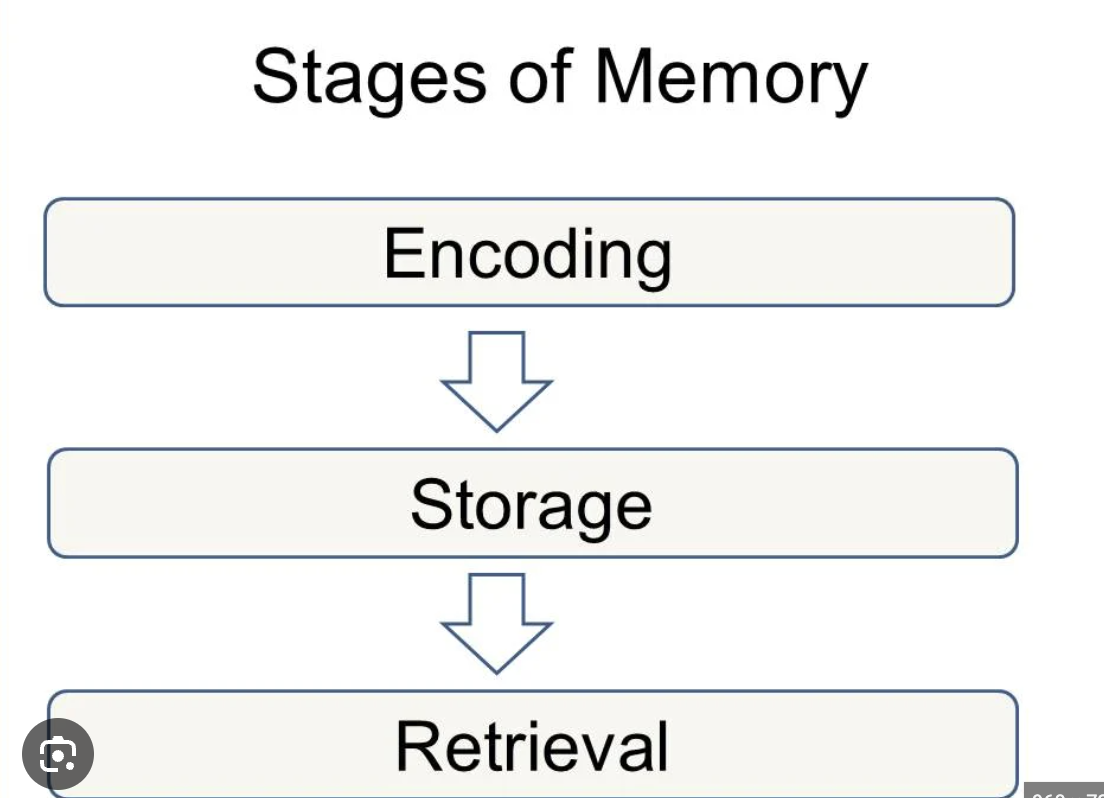
Storage
process of maintaining encoded information in the brain over time for later retrieval
Retrieval
the cognitive process of accessing and bringing stored information from memory back into conscious awareness
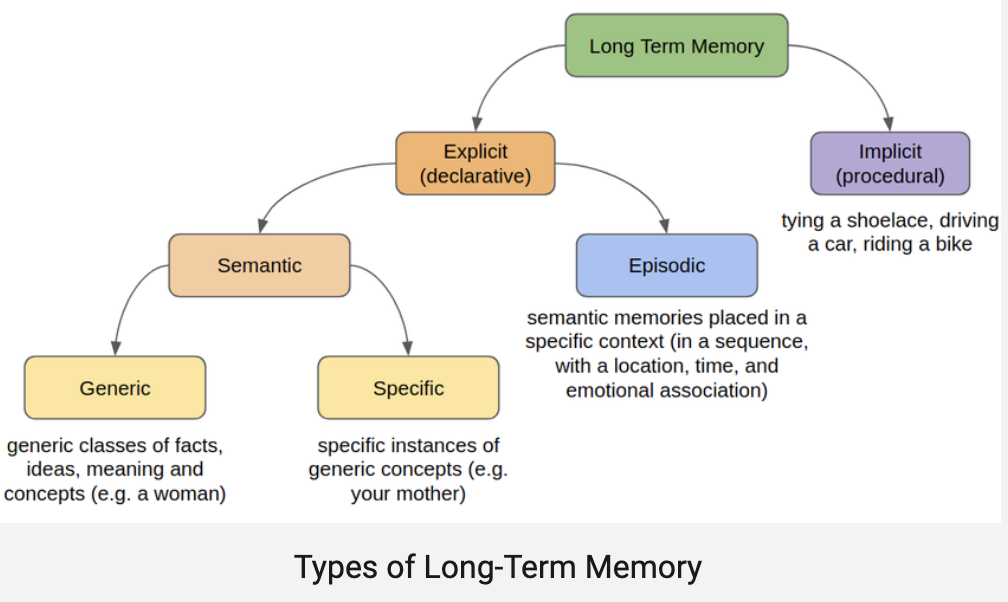
Semantic Memory
the deep cognitive ability to understand and derive meaning from words, sentences, and concepts by connecting them to stored knowledge, allowing for comprehension, reasoning, and problem-solving. unlike shallower processing (like just hearing sounds).
linking linguistic input to our rich network of world knowledge, enabling deeper encoding
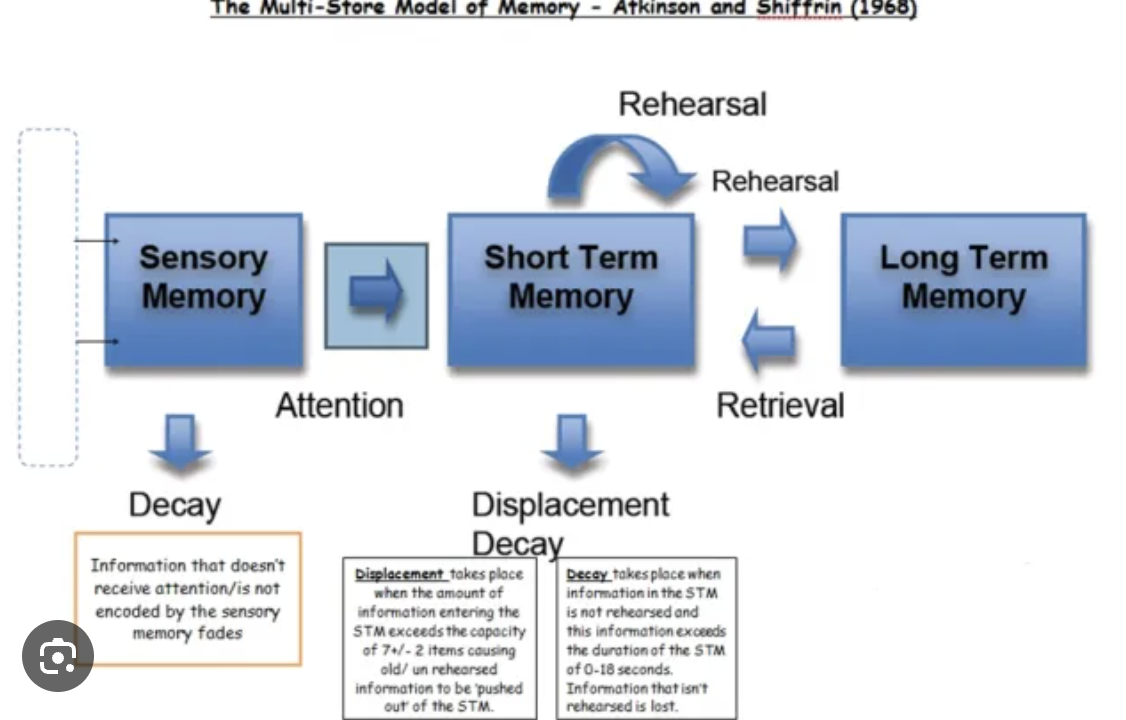
Sensory Memory
Short Term Memory (STM)
(sights, sounds, smells, tastes, touch) for a fraction of a second to a few seconds, acting as a fleeting buffer before it's either discarded or transferred to short-term memory
iconic memory (visual) and echoic memory (auditory).
Long Term Memory (LTM)
the brain's vast, relatively permanent storage system for information, experiences, and skills, holding data for extended periods (days, years, or indefinitely)
Priming
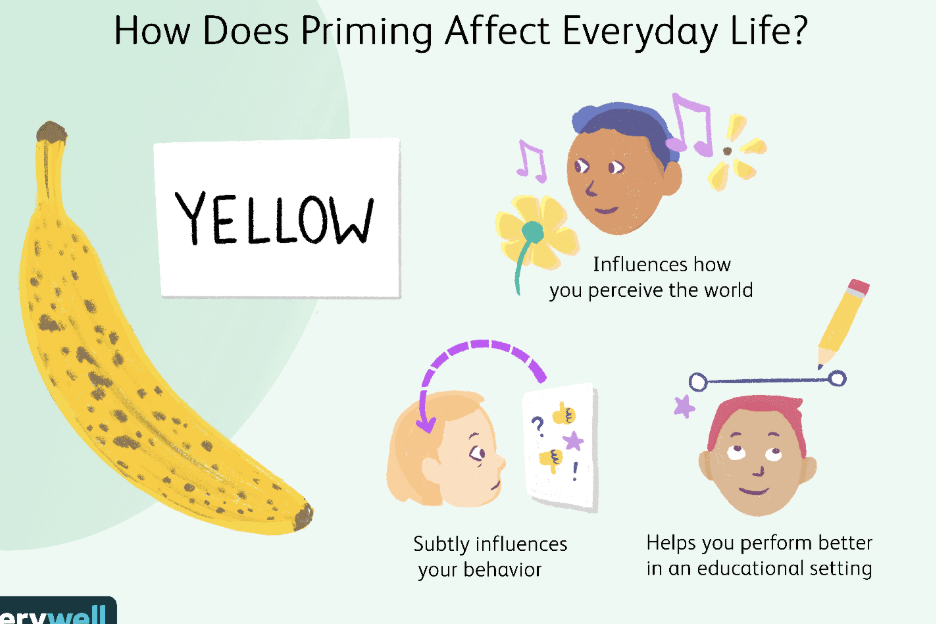
the unconscious effect where exposure to one stimulus (a "prime") influences a person's response to a subsequent, related stimulus, making associated thoughts, memories, or behaviors more accessible without conscious awareness
Procedural Memory
long-term, implicit memory for "knowing how to do things," enabling automatic performance of skills and habits (like riding a bike or typing) without conscious effort, developed through repetition and practice
Recall
Retrieval is the overall process of accessing stored memories, while recall is a specific type of retrieval that involves pulling information from memory without cues
Prospective Memory
the ability to remember to perform a planned action or intention at a future time
Long Term Potentiation
the persistent strengthening of synapses (connections between neurons) due to repeated stimulation
Multistore Model
a cognitive psychology theory suggesting memory has three distinct, sequential stores: the Sensory Register, Short-Term Memory (STM), and Long-Term Memory (LTM), with information flowing from senses through STM (requiring attention and rehearsal) into LTM for permanent storage, and back from LTM to STM for retrieval
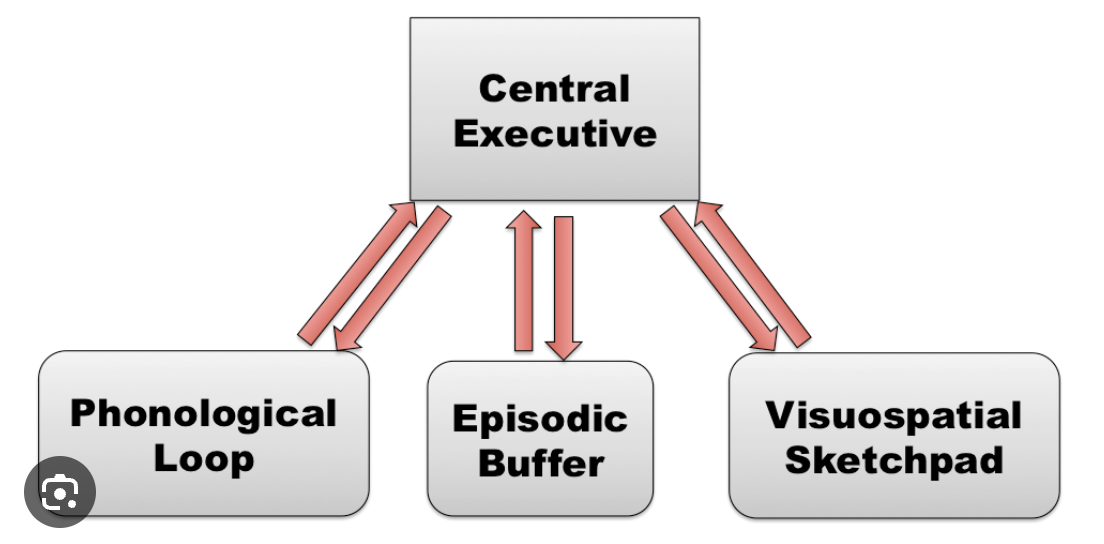
Central Executive
the attentional control system in Baddeley's Working Memory Model, acting like a supervisor that directs cognitive resources, manages information flow, and coordinates subsystems (phonological loop, visuospatial sketchpad, episodic buffer) for tasks like planning, problem-solving, and multitasking, essentially controlling what we focus on and how we process information
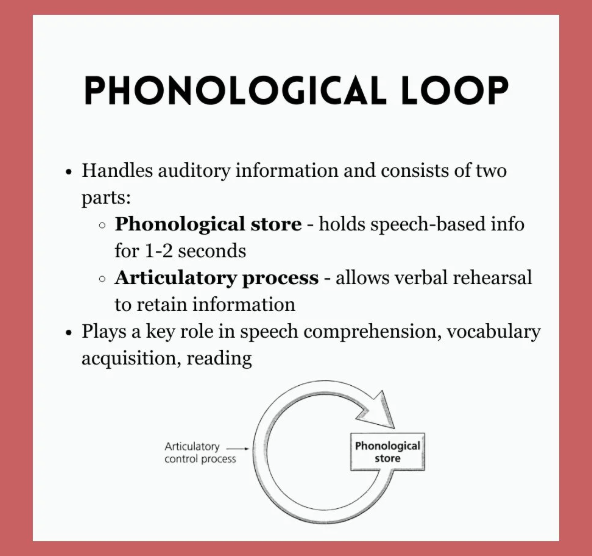
Phonological Loop
a key component of working memory, responsible for temporarily holding and manipulating auditory information, like sounds and spoken words, using an "inner ear" (phonological store) and an "inner voice" (articulatory rehearsal) to prevent decay, crucial for language learning, reading, and following instructions
Visuospatial Sketchpad
a temporary mental workspace within working memory that holds and manipulates visual (images, colors) and spatial (locations, movements) information
Iconic Memory
a type of sensory memory that briefly holds a precise, high-capacity visual image of everything seen, lasting only milliseconds to a second before fading or transferring to short-term memory
Echoic Memory
a type of sensory memory that briefly holds auditory information (sounds, speech) for about 2 to 4 seconds, acting as a temporary buffer to allow the brain to process the continuous flow of sounds, understand speech, and recognize auditory patterns, even if attention wavers
Shallow Processing
the quick, superficial encoding of information focusing on its sensory or physical features (like font, color, or sound) rather than its meaning, leading to weaker, short-term memories
Deep Processing
a learning strategy where you actively engage with information by connecting it to existing knowledge, analyzing its meaning, and exploring its implications, leading to stronger, more durable memories compared to shallow processing (rote memorization)
Structural Processing
appearance, physical qualities. shallow processing.
Semantic Processing
the deep cognitive ability to understand and derive meaning from words
Equipotentiality Hypothesis
suggests that other, undamaged parts of the brain can take over the functions of damaged areas, especially for complex processes like memory, meaning functions aren't strictly localized but distributed, with the severity of deficit depending on the amount of damage, not the specific spot
Memory Consolidation
the brain's crucial process of converting fragile, short-term memories into stable, long-lasting long-term memories, making them resistant to interference and forgetting
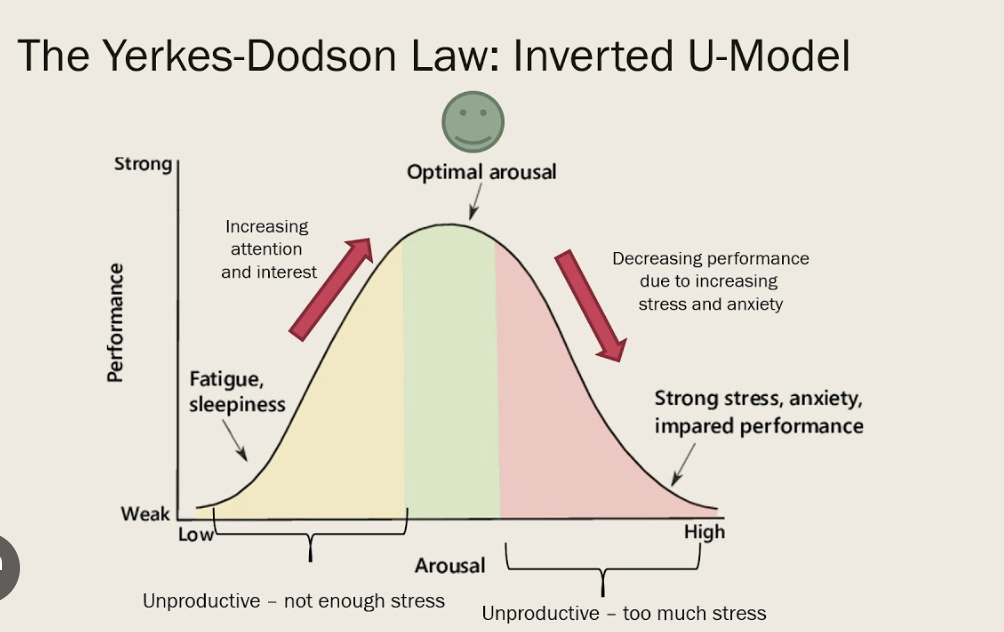
Arousal Theory
proposes people are motivated to maintain an optimal level of alertness or arousal, not too bored (low arousal) and not too stressed (high arousal)
Flashbulb Memory
a remarkably vivid, detailed, and enduring memory of the moment one learns about a surprising, emotionally significant, or shocking public event (like 9/11 or a major tragedy).
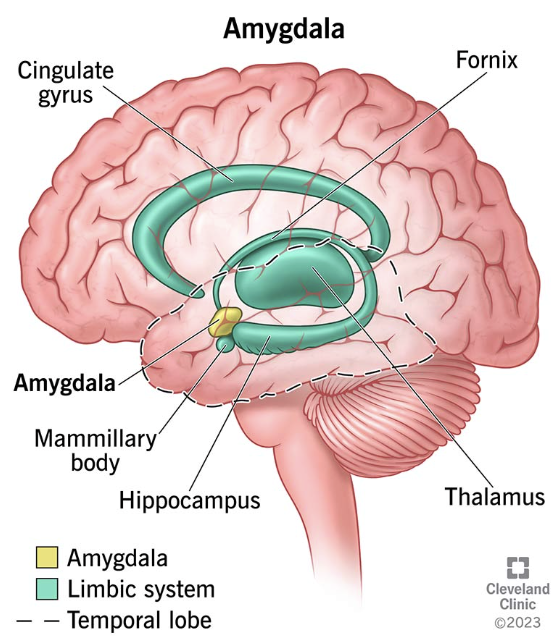
Amygdala
amygdala's connection to memory involves its crucial role in forming and strengthening emotional memories, acting as a hub that links emotions to memory systems, especially the hippocampus
Cerebellum
crucial for procedural (implicit) memory, skill learning (like blinking to a puff of air), and enhancing emotional memories
Hippocampus
forming and consolidating new explicit memories (facts and events, or declarative memory), linking associated details (like people, places, emotions) into coherent experiences, and creating spatial maps for navigation
Constructive Memory
the theory that recalling past events isn't like replaying a video but an active process where the brain rebuilds memories, filling gaps with general knowledge, beliefs, and new information, often leading to distortions, errors, or false memories, making memory a flexible, adaptive, and sometimes unreliable reconstruction rather than a perfect recording.
Reconsolidation
the process where a retrieved, long-term memory becomes temporarily unstable and vulnerable to modification, requiring it to be restabilized (reconsolidated) before it's stored again, allowing for updates, strengthening, weakening, or integration of new information
Encoding Failure
when information never makes it into long-term memory because the brain fails to properly process and store it from short-term memory
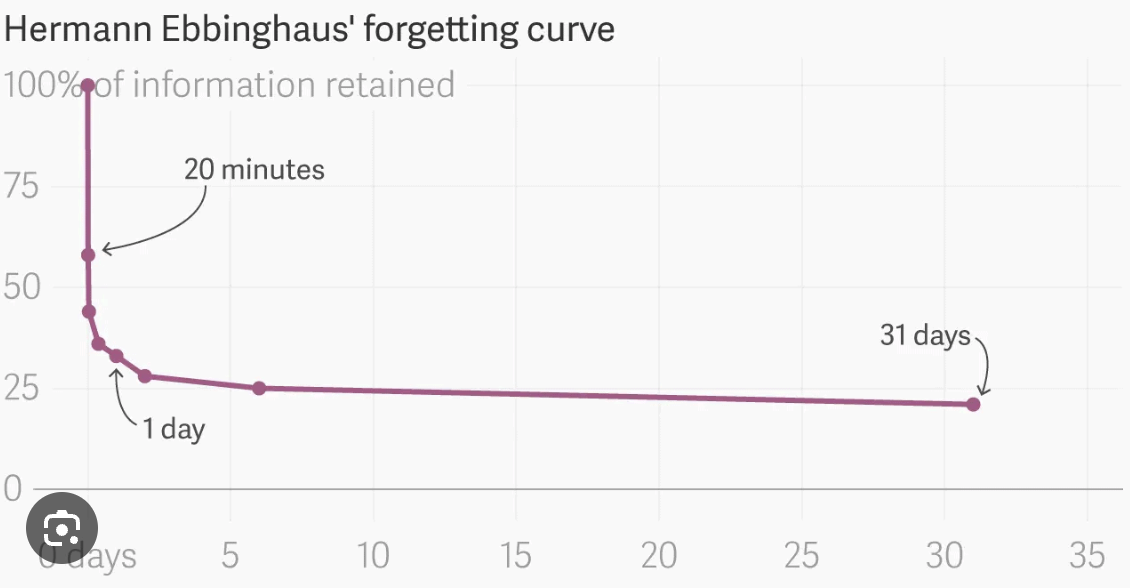
The Forgetting Curve [Ebbinghaus]
memory retention declines rapidly after learning, with most forgetting occurring soon after, then slowing to a gradual decay over time unless information is actively reviewed or reinforced
Misattribution
the cognitive error of incorrectly identifying the source, cause, or context of a memory, feeling, or behavior, leading to mistaken judgments about ourselves or others
Chunking
a memory strategy where the brain groups small, individual pieces of information into larger, more meaningful "chunks," making them easier to remember by overcoming the limited capacity of short-term/working memory
Elaborative Rehearsal
a memory strategy that strengthens long-term retention by actively connecting new information with existing knowledge, adding meaning, context, and personal associations
Levels of Processing Theory
memory retention depends on the depth of mental processing during encoding, not just repetition
The Spacing Effect
the finding that learning is significantly better and leads to better long-term memory when study sessions (or repetitions) are spread out over time (distributed practice) rather than crammed into a single session (massed practice)
Retrieval Cues
Encoding Specificity Principle
hints or stimuli, both internal (emotions, thoughts) and external (sights, sounds, smells), that help access stored information in long-term memory, acting as triggers to bring memories into conscious awareness, making recall easier and more successful, especially when cues match those present during encoding
Context-Dependent Memory
a memory phenomenon where recall of information is enhanced when the physical or mental environment (context) during retrieval matches the context present during encoding (learning)
State-Dependent Memory
drunk/sober/drowsy memories are recalled best in same-state.
Testing Effect
actively recalling information through testing significantly boosts long-term memory retention, often more effectively than simply re-studying the material
Interleaving
mixing different subjects, topics, or problem types within a single study session, rather than focusing on one thing at a time (blocked practice), to improve long-term retention and problem-solving by forcing the brain to retrieve and differentiate between concepts
Alzheimer’s Disease
a progressive neurodegenerative disorder causing significant decline in memory, thinking, and reasoning, leading to impaired daily functioning, personality changes (like depression, apathy, aggression), and eventual loss of independence, stemming from brain cell death, amyloid plaques, and tau tangles
 Note
Note  Flashcards (35)