Weathering processes
 Studied by 5 people
 Call Kai
 Learn
Learn Practice Test
 Spaced Repetition
 Match
Match Flashcards
 Knowt Play
1/13

Earn XP
Description and Tags
Physical and chemical weathering processes definitions
Name | Mastery | Learn | Test | Matching | Spaced | Call with Kai |
|---|
No analytics yet
Send a link to your students to track their progress
14 Terms
Physical (mechanical) weathering
Physical weathering is the disintegration of rock into smaller particles (such as scree or talus) through mechanical processes without a change in chemical composition of the rock.
Freeze-thaw weathering
Freeze-thaw weathering occurs when water in joints and cracks in rocks freeze at 0C and expand by approx. 9%, so exerting pressure on the rock. When the water melts, for example: during the day or summer, the water penetrates further into the enlarged rock or crack. Eventually after repeated freezing and thawing, rock chippings will shatter off from the main body of rock.
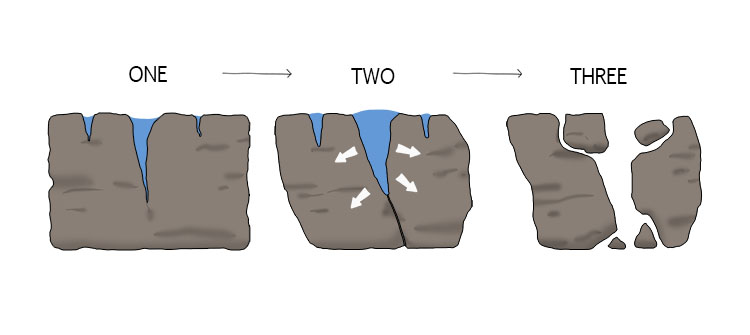
Frost shattering
If freeze-thaw weathering operates on porous rocks (chalk) then the rock will shatter because of internal stresses being caused by freezing and thawing.
Salt crystallisation
This results from the expansion of salt particles that have entered pore spaces within the rock. This may occur in several ways:
1) In areas where temperatures fluctuate around 26-28C, sodium sulfate (Na2SO4) and sodium carbonate (Na2CO3) expand by approx. 300%, creating pressures on joints and cracks forcing them apart.
2) When water evaporates, salt crystals may form. As temperatures rise, the salts expand and exert pressure on the rock. This may occur in inter-tidal zones of a coastline where sea cliffs are exposed to sea spray with a high concentration of salt and where evaporation rates may be high.
Thermal expansion
Occurs when outer layers of rock are heated and expanded during the day then cool and contract at night. Rock is a poor conductor of heat, so stresses only occur on the outer layers of the rock. This frequent process causes stresses to occur, resulting in exfoliation or peeling.
Dilation/Pressure release
This occurs after overlying rocks have been removed by erosion. Rocks are formed under very high pressures in confined spaces (in the Earth’s interior or the weight of overlying layers of rocks), which forces the rocks to contract. However, erosion of the upper layer of rock exposes the lower layers, allowing them to expand, therefore fracturing. This can be identified by large faults and joints (pseudo bedding planes).
Chemical weathering
Chemical weathering is the decomposition of rock resulting from a chemical change. This is often as a result of the interaction between rock and water.
Carbonation
Dissolved carbon dioxide in rainwater produces a weak carbonic acid. The carbonic acid reacts with calcium carbonate in the rocks (limestone and chalk) to form calcium bicarbonate, removed by percolating water.
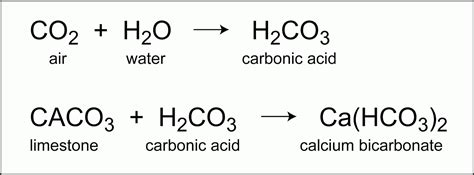
Hydrolysis
This is the process by which chemical bonds are broken and the components partner up to form different elements.
e.g. Hydrolysis occurs on rocks with orthoclase feldspar, particularly granite. Feldspar reacts with acid water and forms kaolin, potassium hydroxyl and silicic acid. Silicic acid and potassium hydroxyl are removed in solution, leaving kaolin behind.
Hydration
This is the process by which certain minerals in rocks absorb water, expand and change, e.g. anhydrite → gypsum (expanding by 0.5%), clay minerals in shale absorb water and expand by 1600% - also mechanical weathering.
Oxidation
Oxidation occurs when rocks become exposed to air (regolith removed through mass movement)
Iron rich soils may appear grey/blue, however when exposed to air they oxidise and change to a ferric state, turning rusty orange.
Chelation
Chemical weathering of rocks by humic (organic) acids and molecules.
Its organic material decomposes, it forms humic acid (chelating agents), which attacks clay etc. releasing iron and aluminium. The cations of iron and aluminium join chelating agents to form organic-metal compounds (chelates), which are soluble and removed in water.
Organisms can also influence the moisture regime and enhance weathering.
Limestone (Malham, North Yorkshire)
Horizontal bedding planes and right angled joints
Pervious
Carbonation, solution, chelation, freeze-thaw and biological
Granite (Tors on Dartmoor)
Pressure release, hydrolysis, freeze-thaw, granular disintegration, biological weathering
Intrusive igneous
Quartz, mica and feldspar
Impermeable but permeable in some areas
Joints
 Note
Note  Flashcards (39)