Aerobic respiration
 Studied by 0 people
 Call Kai
 Learn
Learn Practice Test
 Spaced Repetition
 Match
Match Flashcards
 Knowt Play
1/12

There's no tags or description
Looks like no tags are added yet.
Name | Mastery | Learn | Test | Matching | Spaced | Call with Kai |
|---|
No analytics yet
Send a link to your students to track their progress
13 Terms
What is respiration in general
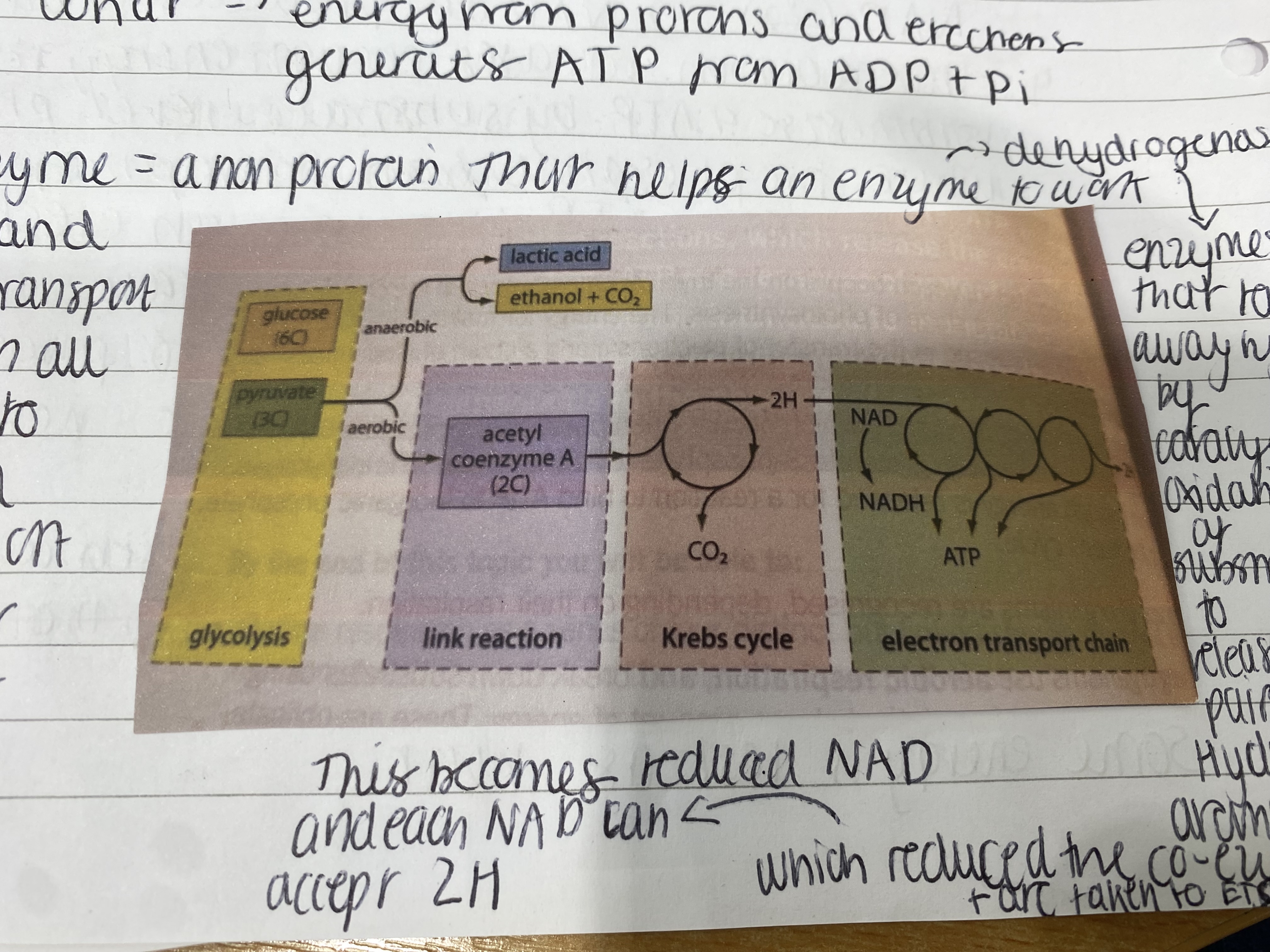
Respiration is a metabolic pathway of catabolic reactions (requiring energy) where glucose or lipids or proteins oxidise their bonds to lower energy bonds and this energy difference phospholylate ADP to ATP.
What are the different types of Phosphorylation in respiration
Oxidative phosphoylation - The addition of phosphate to ADP when energy is available through Redox reactions in the transfer of electrons in the ETC to form ATP in the presence of oxygen
Substrate-level phosphoylation - The addition of phosphate from a donor molecule to ADP to form ATP - in Krebs and Glycolysis.
What is aerobic respiration
The release of energy in the form of ATP by the breakdown of catabolic reactions of glucose and other organic molecules with oxygen as the final electron acceptor. Its done by aerobes, some bacteria and some yeast.
Briefly outline the 4 stages of aerobic respiration - where they take place and molecules synthesised
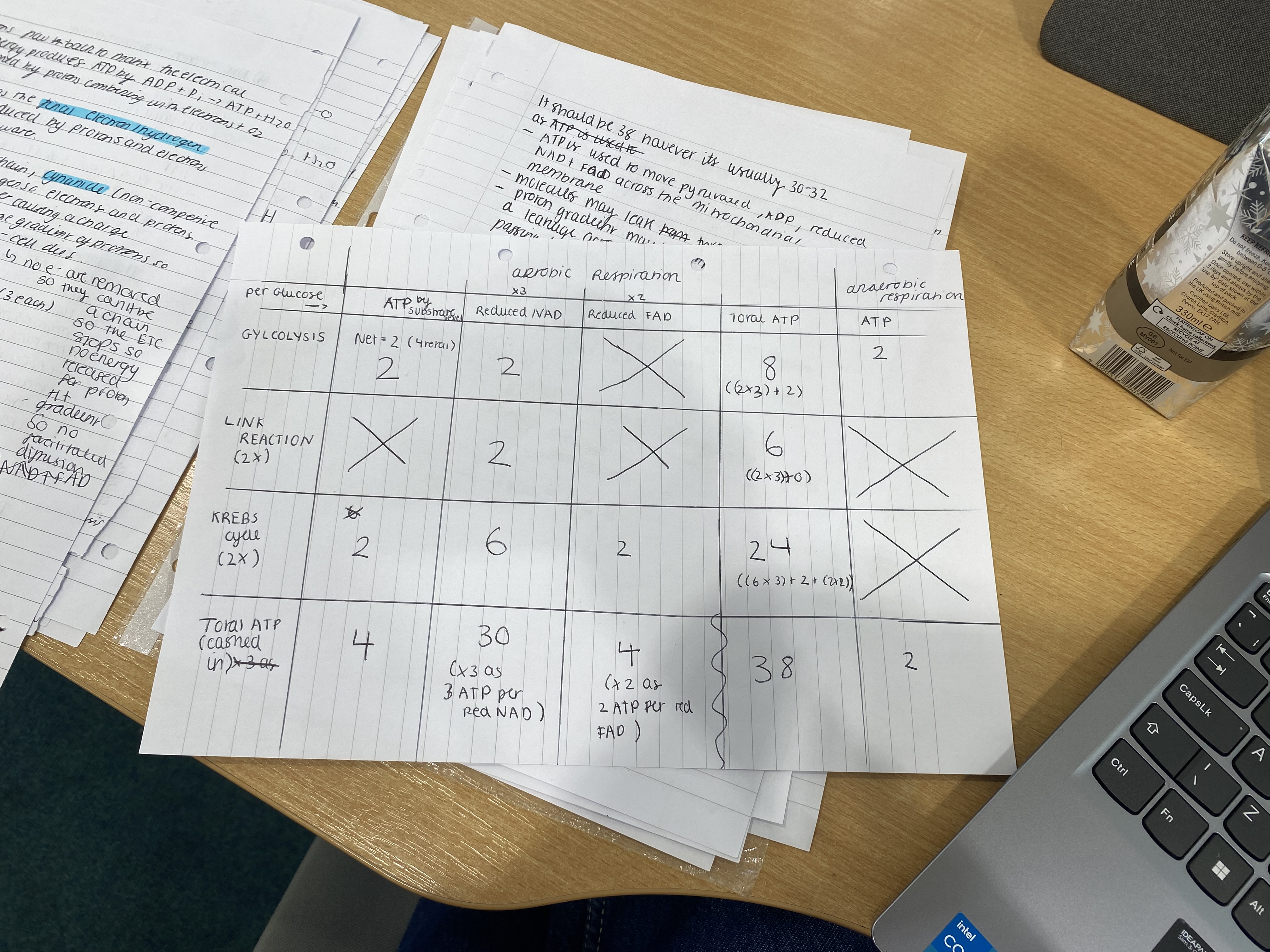
Glycolysis - occurs in cytoplasm and produces reduced 2 NAD and 4 ATP (2 net) and 2 pyruvate
Link - in matrix of mitochondria and produces 2 acetyl coA
Krebs - Occurs in mitochondria matrix and produces 2 x Co2 and 3 (6 per glucose) reduced NAD and 1 (2 per glucose) FAD and 2 ATP
ETC - occurs across cristae and produces ATP (24) and water (2 per glucose)
What are the types of Co-enzymes and enzymes in respiration
the enzyme dehydrogenase catalises the oxidation of the substrate in one the respiration reactions to release hydrogen pairs which then are accepted and reduce NAD and FAD which are CO enzymes (help the enzyme work) that accept the hydrogen and carry it to the ETC
What is glycolysis and explain the steps and draw it out
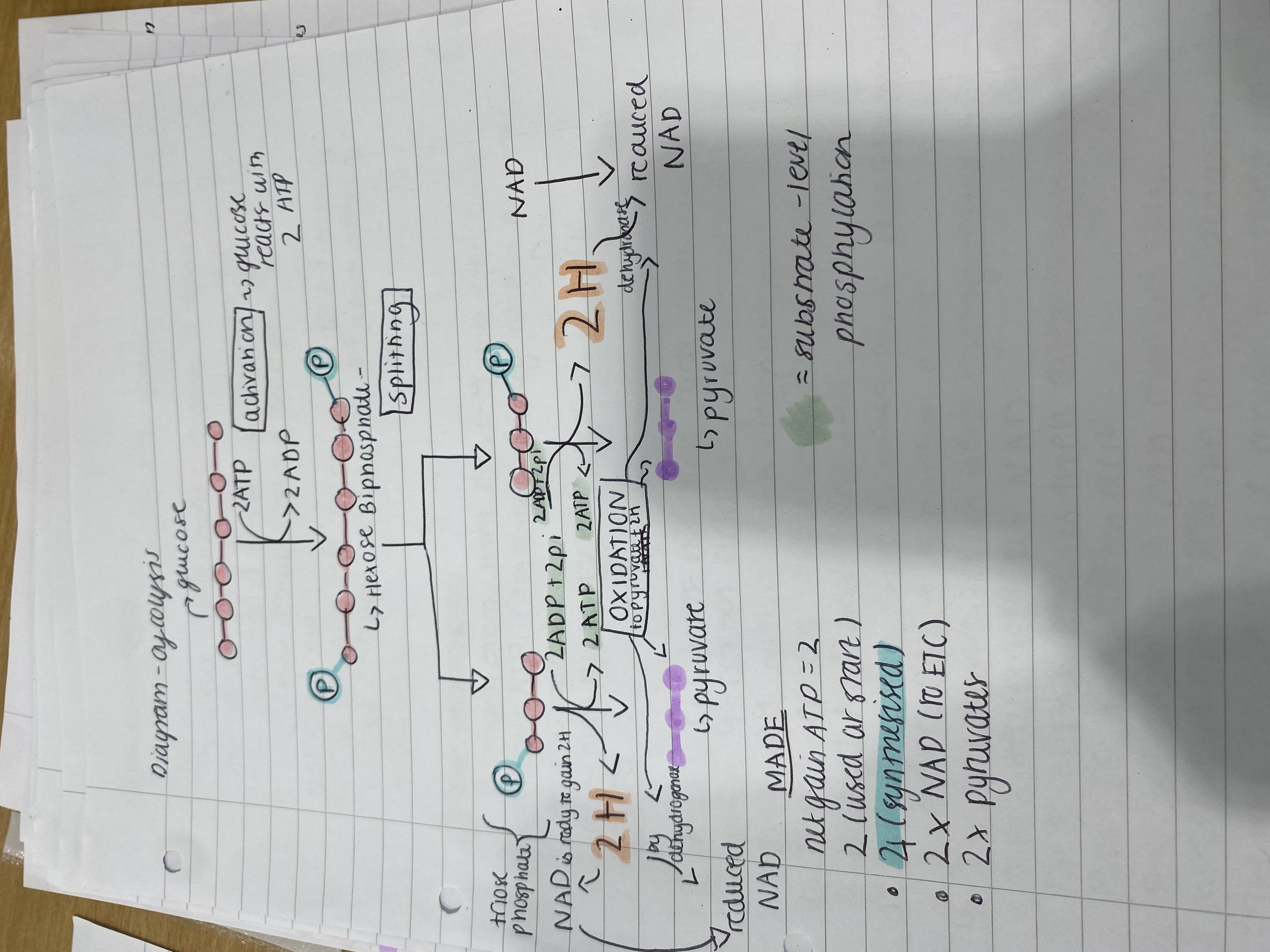
Glycolysis is the splitting of glucose without oxygen in the cytoplasm as glucose cant diffuse across into mitochondria and there are no enzymes
Steps
Glucose is phosphorylated (added phosphate) by reacting with 2 ATP to form 2 ADP and hexose biphosphate which is more reaction and less polar (can’t diffuse out of cell)
Hexose biphosphate splits into 2 × triose phosphates which are 3 carbon mols with a glyceraldehyde 3- phosphate.
The triose phosphate is then oxidized to pyruvate by dehydrogenase to release 2H per triose phosphate and this energy makes 4 ATP ( 2 per triose phosphate) by substrate-level phosphorylation with the phosphate from the triose phosphate. The 2H reduce NAD to reduced NAD x2 which goes to the electron transport chain.
What is the link reaction and give the steps and draw it out
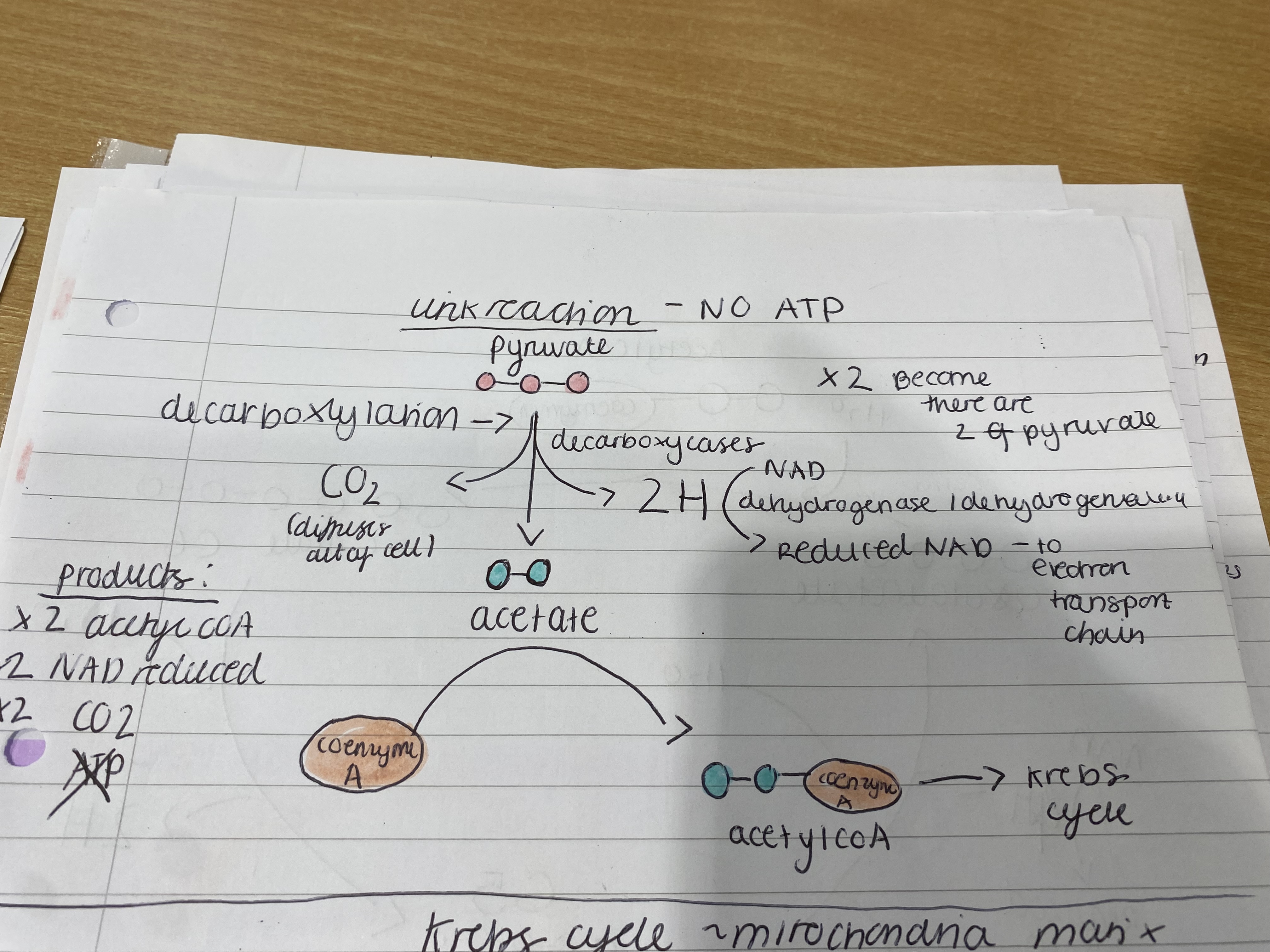
The link reaction takes place in the matrix of mitochondria and links glycolysis to the krebs cycle.
Pyruvate diffuses into the matrix
Pyruvate is decarboxylated and oxidized by decarboxylase to remove CO2 as a product and release 2H to reduce NAD to reduced NAD with travels to ETC. This produces acetate
Acetate combines with CO enzyme A to enter krebs.
This occurs twice for each pyruvate
What is the Krebs cycle and what are the steps
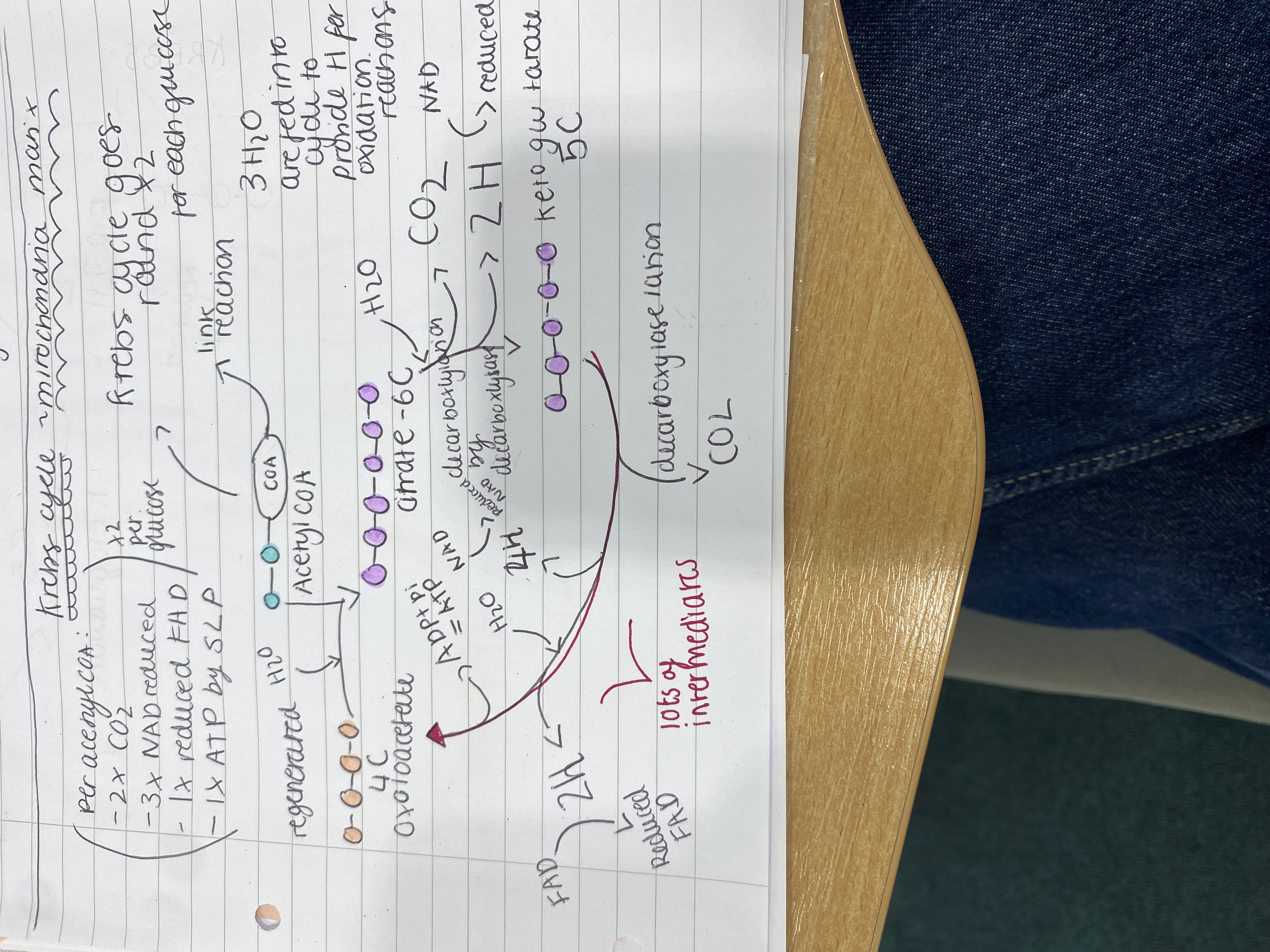
The Krebs cycle takes place in the mitochondria matrix and makes ATP, NAD and 3 mols of water are used
steps
Acetyl COA enters the Krebs and combines with a 4 carbon molecule to produce a 6 carbon molecule called citrate using water.
This 6 carbon molecule using water is dehydrogenated/oxidised by dehydrogenase to produce 2H which reduce NAD to reduced NAD. It is also decarboxylated to release CO2 by decarboxylase. This produces a 5 carbon molecule.
This 5 carbon molecule using water is dehydrogenated/oxidised by dehydrogenase to produce 6H which reduce 2 NAD to reduced NAD and 1 FAD to reduced FAD. It is also decarboxylated to release CO2 by decarboxylase. It also phosphorlyates a ADP to ATP in presence of oxygen.
This produced the original 4 carbon molecule to continue the cycle
COA goes back to link and acetate is broken down to CO2 and water.
This occurs twice per glucose
Explain the electron transport chain and its steps
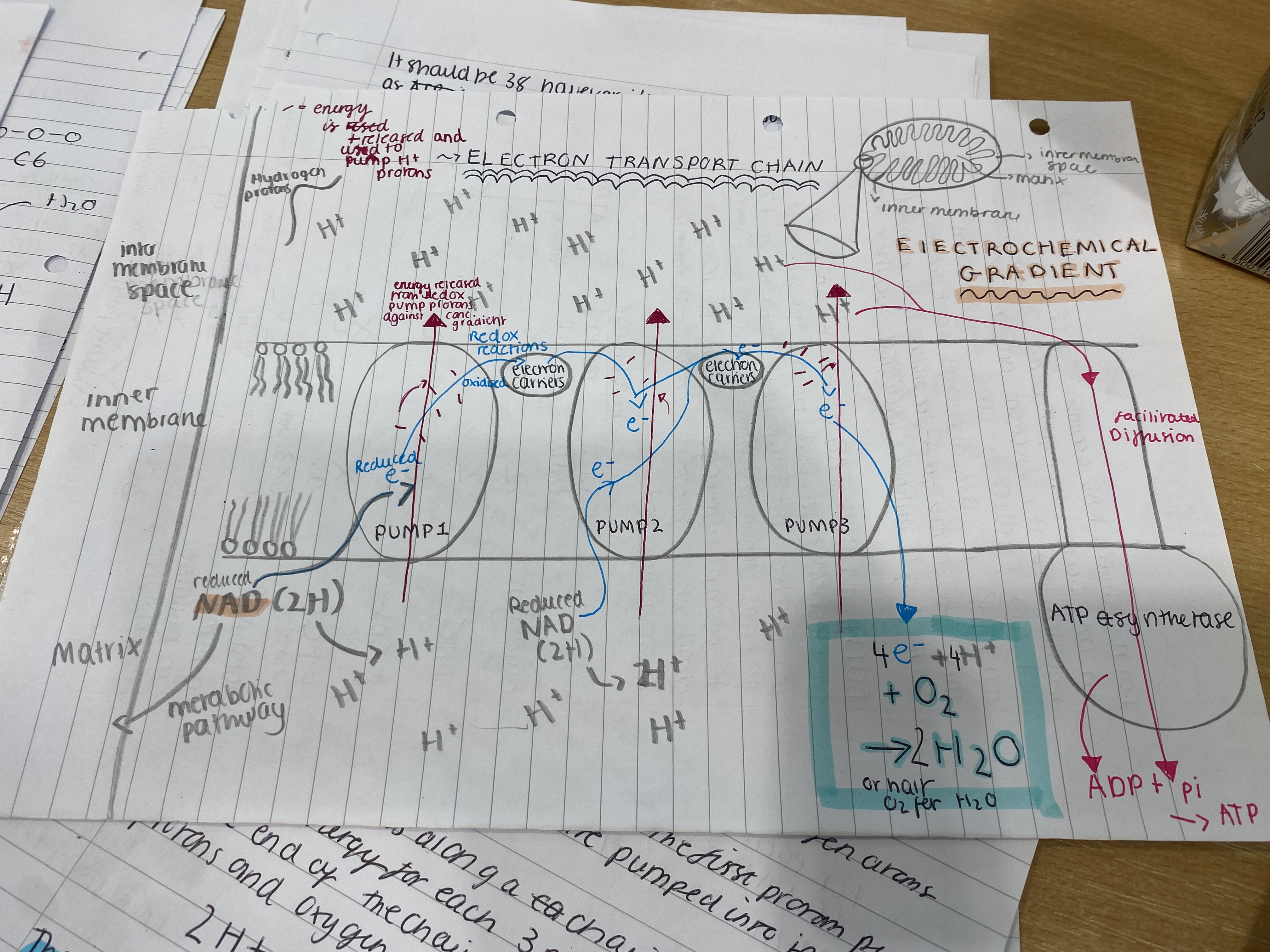
The ETC is a series of enzyme reduction and oxidation reactions in pumps and carriers from transfer of electrons from donor to acceptor mol.
Reduced NAD arrives at the Cristae membrane and is oxidised by oxygen to release electrons and protons
The electrons enter the first pump where they are involved in a series of redox reactions to release energy from the electrons
This energy pumps the hydrogen ions in the matrix against their conc. grad. into the inner membrane space across the membrane.
The electrons move to electron carriers and pumps 2 and then another electron carrier to pump 3. Along here they are involved in a series of redox reactions to release energy from the electrons to pump the hydrogen protons to inner membrane space
reduced FAD releases its electrons at pump 2 by oxidation so releases less energy through its redox reactions so produces less ATP
This builds up an electrochemical gradient that generates a potential energy causing the protons by facilitated diffusion to diffuse down conc. grad. via the stalked particle from the inner space to matrix. The stalked particle also contains ATP synthetase where the potential energy from the proton gradient oxidative phosphorylates ADP to ATP.
The protons combine with oxygen and the electrons from The ETC to produce water - ½ O2 + H + E- = H2O. This is why oxygen is the final electron acceptor.
Why is oxygen so important in respiration?
It is the final electron acceptor so without O2 there would be a build up of H Protons which would destroy the concentration gradient so no potential energy to synethsise ATP. Also no electrons are removed so ETC can’t continue so no energy for pumping of protons. - why cyanide is so dangerous
Explain why not all ATP is made
leaky membranes - eg. not all protons may diffuse through stalked particle
Energy needed to move pyruvate and NAD AND FAD
Explain the effiency equation for ATP
energy made available through ATP (30.6KJ-1 × 38) divided by energy released in combustion x 100
 Note
Note  Flashcards (35)