N10: work interchangeably with terminating decimals and their corresponding fractions (such as 3.5 and 7/2 or 0.375 or 3/8); change recurring decimals into their corresponding fractions and vice versa
 Call Kai
 Learn
 Practice Test
 Spaced Repetition
 Match
 Flashcards
 Knowt Play
1/7

Earn XP
Description and Tags
8 Terms
What is a terminating decimal?
A decimal where there is a complete end to the decimal places, such as 0.35
A recurring decimal never terminates
What is 0.35 as a fraction?
35/100=7/20 (divide both by 5)
What is a recurring decimal?
A decimal which has no end, such as 0.3 recurring
It is shown with a dot above the recurring numbers
How is a recurring decimal written?
With a dot above the recurring numbers; either as 0.3(.), 0.4(.)5(.), or 0.8(.)964(.)
Each (.) represents a recurring dot
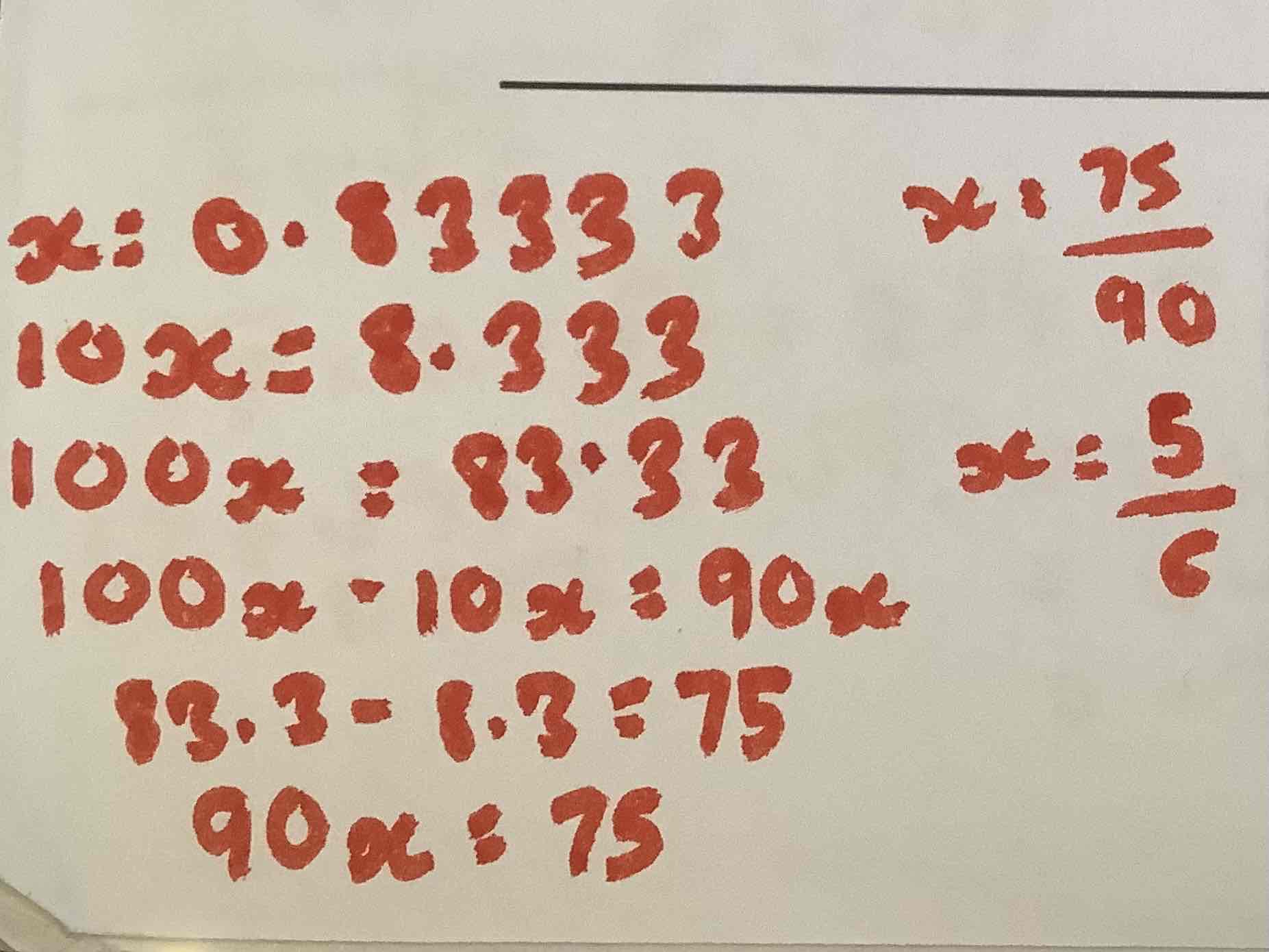
How to change recurring decimals into their fractions
Example: Write 0.147 as a fraction in its simplest form.
Step 1: Make your number equal to x. x = 0.147
Step 2: Multiply both sides by 10 for each decimal place that isn't recurring (If there are none, it stays as Step 1). x = 0.147
Step 3: Multiply both sides by 10 for each number that is recurring. 1000x = 147.147
Step 4: Subtract the equations in steps 2 and 3 so that the numbers after the decimal point cancel, then solve for x. 147.147-0.147=147 999x=147 x=147/999
Step 5: Simplify the fraction if required. 49/333 (divided by 3)
How to convert a fraction to a decimal
Use the bus stop method to solve and find the recurring decimal
Write 7/33 as a decimal
0.21 recurring
Write 0.83(.) as a fraction
X=5/6