Meteorology 3
 Studied by 0 people
 Call Kai
 Learn
Learn Practice Test
 Spaced Repetition
 Match
Match Flashcards
 Knowt Play
1/16

There's no tags or description
Looks like no tags are added yet.
Name | Mastery | Learn | Test | Matching | Spaced | Call with Kai |
|---|
No analytics yet
Send a link to your students to track their progress
17 Terms
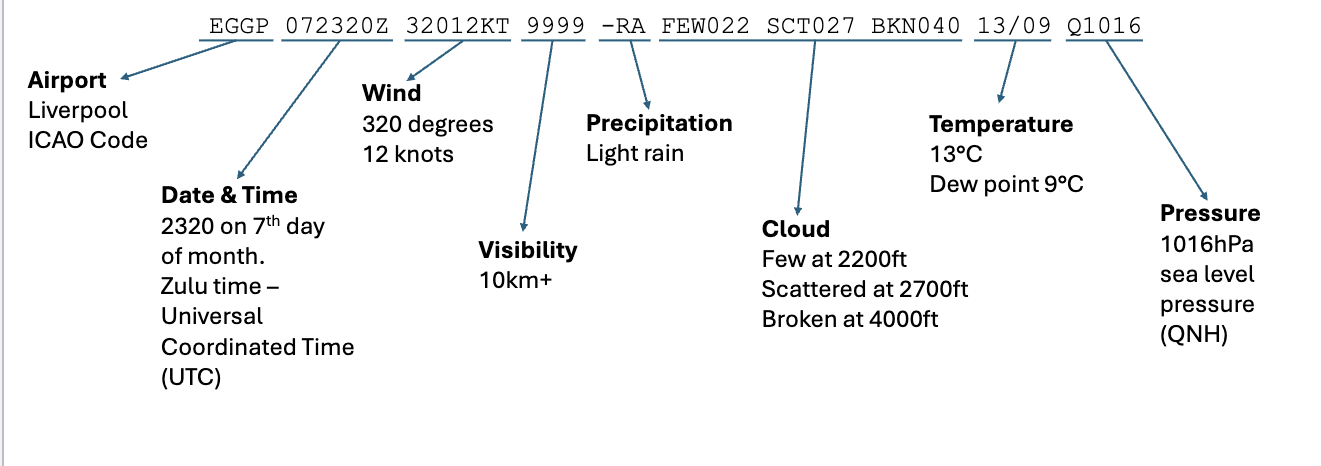
Weather reports
An observation of the actual state of the weather at a specific time is a report
Most commonly used report in aviation is the METeorological Aerodrome Report (METAR)
Formalised report of key information
Wind
Visibility
Precipitation
Cloud
Temperature
Pressure

METAR
METAR Date & Time
Format:ddhhmmZ
dd - day of the month
hh - hour in 24 hour time
mm - minute
Represents the time at which the report was valid
Immediately out of date as soon as it’s published
No month or year given as reports are typically only useful over short timescales
Z - Zulu Time
Universal Coordinated Time (UTC)
Equivalent to Greenwich Mean Time (GMT)
Does not change with British Summer Time (BST)
METAR Wind
Default format: dddssKT
ddd - direction the wind is blowing from relative to true north
May be given VRB (variable) if wind speed is low
ss - speed of wind in knots
May include gusts: dddssGggKT
gg - speed of wind gust in knots
May be followed with variable wind direction: aaaVbbb
Direction varying between aaa and bbb
METAR visibility
Horizontal visibility reported in metres
Always reported as 4 digits
9999 means “at least 10km”
May also include Runway Visual Range (RVR) information
Not relevant to (most) PPL flying
May be omitted if CAVOK reported
METAR Precipitation
DZ - Drizzle
RA - Rain
SN - Snow
SG - Snow grains
IC - Ice crystals
PE - Ice pellets
GR - Hail
GS - Small hail
BR - Mist
FG - Fog
HZ - Haze
Modifiers
SH - Showers
TS - Thunderstorm
FZ - Freezing
VC - …in the vicinity
- Light
+ Heavy
METAR Clouds
Format: ccchhh
ccc - amount of cloud cover
hhh - height of cloud base above aerodrome level in hundreds of feet
Amounts given as
1 okta = 1/8th of the sky
FEW - few, 1-2 oktas
SCT - scattered, 3-4 oktas
BKN - broken, 5-7 oktas
OVC - overcast, 8 oktas
Cumulonimbus (CB) or Towering Cumulus (TCU) clouds may be mentioed specifically
METAR Temperature
Format: tt/dd
tt - Temperature in degrees Celsius
dd - Dew point in degrees Celsius
Either may be preceded by M to indicate minus
METAR Pressure
Format: Qpppp
pppp - sea level pressure in hectopascals
Q refers to QNH
METAR CAVOK
Visibility and cloud reports may be omitted and replaced by CAVOK
Cloud And Visibility OK
No clouds below 5000ft, no CB or TCU
No significant weather in the vicinity
Visibility of at least 10km
Weather forecasts
A prediction of the weather at some future time
Forecasts are either textual or graphical
Textual forecasts
Terminal Aerodrome Forecast (TAF)
General Aviation METeorological forecast (GAMET)
Graphical
Synoptic chart
Form 214
Form 215
TAF
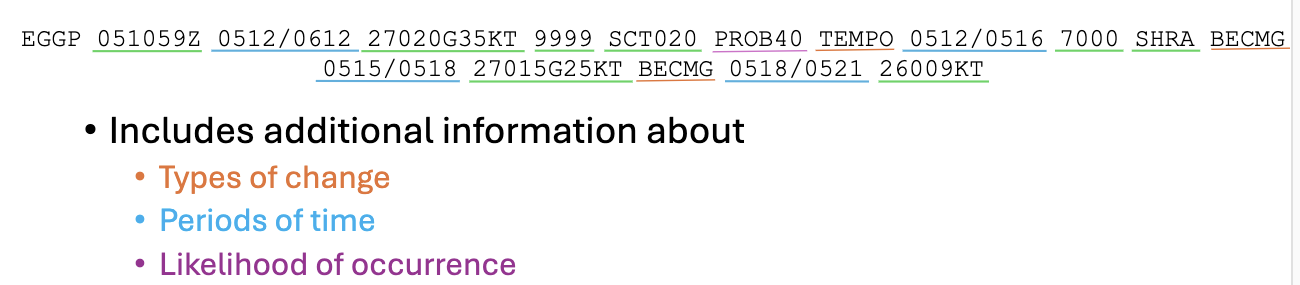
TAF - Period of Time
The Zulu time given at the start of the forecast indicates when the forecast was published
It does not mean the forecast is accurate at this time
Periods of time are formatted: aabb/ccdd
aa - day of the week the period starts
bb - hour of the day the period starts (UTC)
cc - day of the week the period ends
dd - hour of the day the period ends (UTC)
Short term forecasts may just use bbdd
First period indicates duration of validity of the forecast
Subsequent periods indicate a change
TAF - Types of change
BECMG - Becoming
Between the specified time period the weather will change from that preceding to that following
TEMPO - Temporarily
During the specified time period the weather may change temporarily to that following
TAF - Likelihood of occurrence
PROB - probability
Indicates a particular probability that the following change will occur
PROB30 - 30% probability
Form 214
Met Office provided spot wind forecast
Forecast at various altitudes for specific locations
Wind speed
Direction
Temperature
Extremely useful for flight planning purposes
Form 215
Met Office provided low altitude significant weather forecast
Shows weather fronts and areas of similar weather
Forecasts surface visibility, precipitation, cloud and freezing level
Also forecasts turbulence and icing potential inside cloud
Notation is broadly similar to TAFs with some spatial terms
ISOL - `Isolated - present in only a small part of the area
OCNL - Occasional - occurring occasionally throughout the area
WDSPR - Widespread - Likely to be encountered throughout the area
 Note
Note  Flashcards (35)