linguistics terms
 Studied by 0 people
 Call Kai
 Learn
Learn Practice Test
 Spaced Repetition
 Match
Match Flashcards
 Knowt Play
1/106

There's no tags or description
Looks like no tags are added yet.
Name | Mastery | Learn | Test | Matching | Spaced | Call with Kai |
|---|
No analytics yet
Send a link to your students to track their progress
107 Terms
phonetics
the study of individual sounds in spoken languages, or handshapes in signed languages
morphology
study of internal structures of words and how they are formed from smaller units
change meaning through inflexion (adding -ed to make a word past tense) and derivation (adding -ness to make a noun)
relationships between words’ form and function/meaning
phonology
study of sound system and how speech sounds are organized, patterned, and used to create meaning
how sounds interact within the larger context of words, syllables, and language’s rule to create to meaning
specific to a language
syntax
study of rules that show how words, phrases, and clauses are combined to form meaningful sentences and larger grammatical structure
looks at word order
semantics
study of meaning in a language, looking at how words, phrases, sentences, and texts convey meanings and how meaning is constructed, interpreted, and understood
relationship between senses and references (to the world)
pragmatics
how context influences meaning and interpretation of a language
looking beyond literal meanings of words/phrases to understand implied meanings, intentions, and how language is used in social settings
“can you pass the salt?” is not about your physical ability to pass it
mental grammar
what language is
words are assigned meanings to try and understand the message
a shared system
a generative system
governed by systematic principles
prescription
if the word ‘should’ is used
it can be not obvious
not a description, it is advice
“bad grammar” is a prescription
when is prescriptivism acceptable
language class
accent/dialect coach
house style guide
learning a particular genre
when language does harm (ie a sports team’s name)
being a parent
vocal fry assumptions
airhead
valley girl
detached, dry, bored
Kardashians
low effort
white
female
matched-guise study
researchers present participants with the same stimuli and change the guises. if a change in rating occurs, it is because of the guises
stimuli
constant
a set of resumes
guises
changed
the name at the top of the resume
how L1 affects L2
your accent in your L2 is shaped by the phonology of your L1
your L2 grammar is shaped by your L1 experience
modality of a language
how the language is produced and perceived
vocal-auditory
modality for spoken languages
vocal (articulated with the vocal tract)
acoustic (transmitted by sound waves)
auditory (received and processed by the hearing system)
manual-visual
modality for signed languages
manual (articulated by the hands and arms)
photic (transmitted by light waves)
visual (received and processed by the visual system)
manual-somatic
modality for tactile signing
feeling signs
used by deafblind
tight vocal folds
vibrate faster
higher pitch
loose vocal folds
vibrate slower
lower pitch
whispering
holding vocal folds open and continuing to do articulation; no voicing
classification labels for vowels
tongue backness
tongue height
lip rounding
tense and lax vowels
how to know if a vowel is lax
the symbols don’t look like english letters
major diphthongs
[aɪ]
[aʊ]
[ɔɪ]
minor diphthongs
[eɪ]
[oʊ]
joints
shoulder
elbow
radioulnar
wrist
base knuckles
interphalangeal knuckles
most sonorous to least sonorous
vowels
nasals
approximants
fricatives
flaps
plosives
what is likely to be nucleus of a syllable
high sonority sounds
vowels
nasals
approximants
variationist sociolinguistics
a methodological and analytical approach to understanding the relationship between language and its context of use
dialect
ways of speaking that people perceive to be substandard, low status, associated with working class, non-prestigious, geographically-isolated, or some derivation or aberration from ‘standard’ version of the language
cross-linguistic variation
different ways of doing the same thing in different languages or varieties
sociolinguistic variation
two or more ways of doing the same thing within a language, variety, and individual
prosody
sound information that is “above” the level of the segment; controlled independently from phones
perceived relative to other parts of an utterance
speed, pitch, loudness, length, etc
think of a salad
the lettuce is the same but the dressing (prosody) adds flavour and changes it up a bit
lexical tone
variation in pitch leads to differences in (lexical) word meaning
english does not have this but mandarin does
intonation
variation in pitch can signal discourse-level information
distributions
the environments where certain phones appear
complementary distribution
contrastive distribution
complementary distribution
two allophones of a single phoneme
Clark Kent and Superman, can’t occur at the same time
one set of environments for one phone and a completely different set of environments for the other
the occurrence of one predicts the absence of the others
mutually exclusive
contrastive distribution
two different phonemes
two sounds appear in the exact same spot in a word and change the meaning
minimal pairs are evidence of this type of distribution
allophones
variations of a single phoneme that don’t change the word meaning; its various physical realities as phones
pronouncing the ‘t’ differently in “top” and “stop”
a phoneme is a set of allophones, with each one connected to certain specific positions
underlying representation
one allophone appears in several different environments (elsewhere)
becomes the surface representation in a predictable environment
surface representations
one allophone appears only in a specific, predictable environment
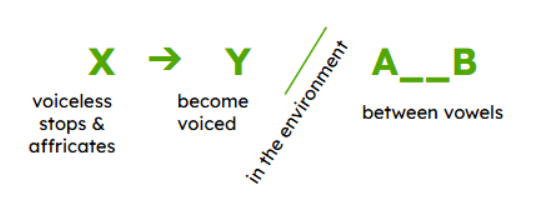
phonological rules
oralism
belief that spoken language is better than signed language
6-8 weeks
cooing
16 weeks
laughter and vocal play
6 months
babbling; reduplicated CV syllables
easiest sounds for babies to make
low
voiced
plosives
perceptual narrowing
not a loss of ability
happens most easily between 0;6 and 1;2
declarative knowledge
knowing about something
facts
memorized information
conscious
procedural knowledge
knowing how to do something
physical processes or sensations
cognitive processes
positive transfer
when similarities between your native language and the new language help you learn faster
negative transfer
when differences between your native language and new language cause errors
ways that language acquisition of L2 can be made easier with L1
substitution with a phone from the L1 phonetic inventory
adaptation to L1 phonotactic constraints
bilabial
obstruct at lips
p, b, m
labiodental
top teeth on bottom lip
f, v
alveolar
tongue to ridge above and behind top teeth
t, d, n, ɾ, ɹ, s, z, l
dental
tongue in between teeth
θ, ð
post alveolar
move tongue further back from ridge
ʃ, ʒ
velar
back of tongue up against back of alveolar palate (velum)
k, g, ŋ
glottal
fricative made at the larynx
h, ʔ
plosives/stops
obstruct air flow completely; pressure builds in vocal tract and is released in a burst
p, b, t, d, k, g, ʔ
nasals
obstruct air flow in mouth but allow it through nasal cavity
m, n, ŋ
fricatives
obstruct air flow a little bit, allow air to flow turbulently
f, v, θ, ð, s, ʃ, ʒ, h
approximants
bring articulators close together but air flows smoothly
ɹ, j, w
lateral approximant
l
flaps/taps
bring articulators together and vibrate them quickly
ɾ
affricates
tongue is in the position to make a different sound but a slight adjustment (ie not letting out all the air) results in a different sound
ch and j
tease vs cheese
dam vs jam
tongue height
moves from high to low
ee → i → ai → e → a
tongue backness
moves from front to back
oo → o → aw
lip rounding
only occurs in 4 back vowels for english
boot, book, boat, bore
u, ʊ, o, ɔ
tenseness
tense vowels have greater muscle tension than lax ones
look like english letter
rhotics
unusual class of phonemes named after the greek letter rho <p>; the reason why <r> is pronounced very differently
are voiced sounds on the left or right (in ipa chart)
right
manual articulators
arms
hands
fingers
nonmanual articulators
torso
head
facial features
shoulder articulation
abduction → upward and outward (jumping jacks)
adduction → downward and inward
flexion → raising
extension → lowering
rotation → keep upper arm in fixed position and change position of forearm
elbow articulation
flexion → bending forearm up to upper arm
extension → bending opposite way
radioulnar articulation
radius (thumbside of forearm) and ulna (pinky side)
superior radioulnar joint at the elbow
inferior radioulnar joint at the wrist
medial radioulnar joint inside the forearm
wrist articulation
abduction → sideways toward thumb
adduction → sideways toward pinky
extension → bending backwards
flexion → bending forwards
base knuckle articulation
joints where fingers connect to palm
abduction → spreading fingers apart
adduction → putting fingers back together
flexion → bending fingers down
extension → putting fingers flat/straight
interphalangeal articulation
joints in the fingers (thumb has one, others have two)
flexion → bend finger
extension → unbend finger
4 parameters of describing signs
handshape: how base knuckles and interphalangeal joints are configured
orientation: direction the hand is facing due to the configuration of the other 4 joints (wrist, radioulnar, elbow, shoulder)
location: where in space or on body a sign is articulated
movement: how the manual articulators move
open syllable
a syllable with no coda (see and owe)
CV or V
closed syllable
a syllable with a coda (hat and eat)
CVC or VC
onsetless
a syllable with no onset
V or VC
onset vs coda
ons: left of nucleus
cod: right of nucleus
phonotactics
language-specific restrictions on what combinations of physical units are allowed in which environments
natural class
a set of phones that share some phonetic properties (ie place or manner of articulation) and also share some phonological behaviour (ie being governed by the same restriction)
must be exhaustive (including every relevant phone in the language)
executive function
the set of mental processes that govern your attention and control your impulses
when learning two languages, you have to have your attention on the one you are intending on listen to so you inhibit attention from going to other language
lexicon
vocabulary of a person; a complete set of meaningful units in a language
abduction
articulators move apart
adduction
articulators move together
rotation
articulators rotate
flexion
angle of joint gets smaller
extension
angle of joint gets bigger
sonority
sound energy
prosody in signed languages
speed, pauses, overall timing
repetition of a sign
size of signing space
non-manual markers like facial expressions
stressed syllables
longer, louder, and higher than other syllables
deterministic
allophonic variation
predictable depending on linguistic environment
aka categorical alternation
probabilistic
sociolinguistic variation
can index social information
 Note
Note  Flashcards (38)