Exam 1: Social Determinants of Health
 Studied by 0 people
 Call Kai
 Learn
Learn Practice Test
 Spaced Repetition
 Match
Match Flashcards
 Knowt Play
1/24

There's no tags or description
Looks like no tags are added yet.
Name | Mastery | Learn | Test | Matching | Spaced | Call with Kai |
|---|
No analytics yet
Send a link to your students to track their progress
25 Terms
Social determinants of health
-non-medical circumstances that impact health factors
-influenced by socio-economic political policies and socio-cultural norms
-related to how people live, grow, and work (e.g., housing, education, income) that affect health outcomes
-can lead to health disparities
Non-medical circumstances that impact health factors that are influenced by socio-economic political policies and socio-cultural norms. Related to how people live, grow, and work (e.g., housing, education, income) that affect health outcomes and lead to health disparities.
social determinants of health
Health disparities
health difference that is closely linked with social, economic, and/or environmental disadvantage
tied into:
-socio-economic status
-racial or ethnic group
-gender (sexual orientation)
-age
-disability
Health difference that is closely linked with social, economic, and/or environmental disadvantage
health disparity
SDH's affect...
-economic stability
-education
-access to healthcare services
-environment (housing, transportation, neighborhoods, work conditions)
-social and community support
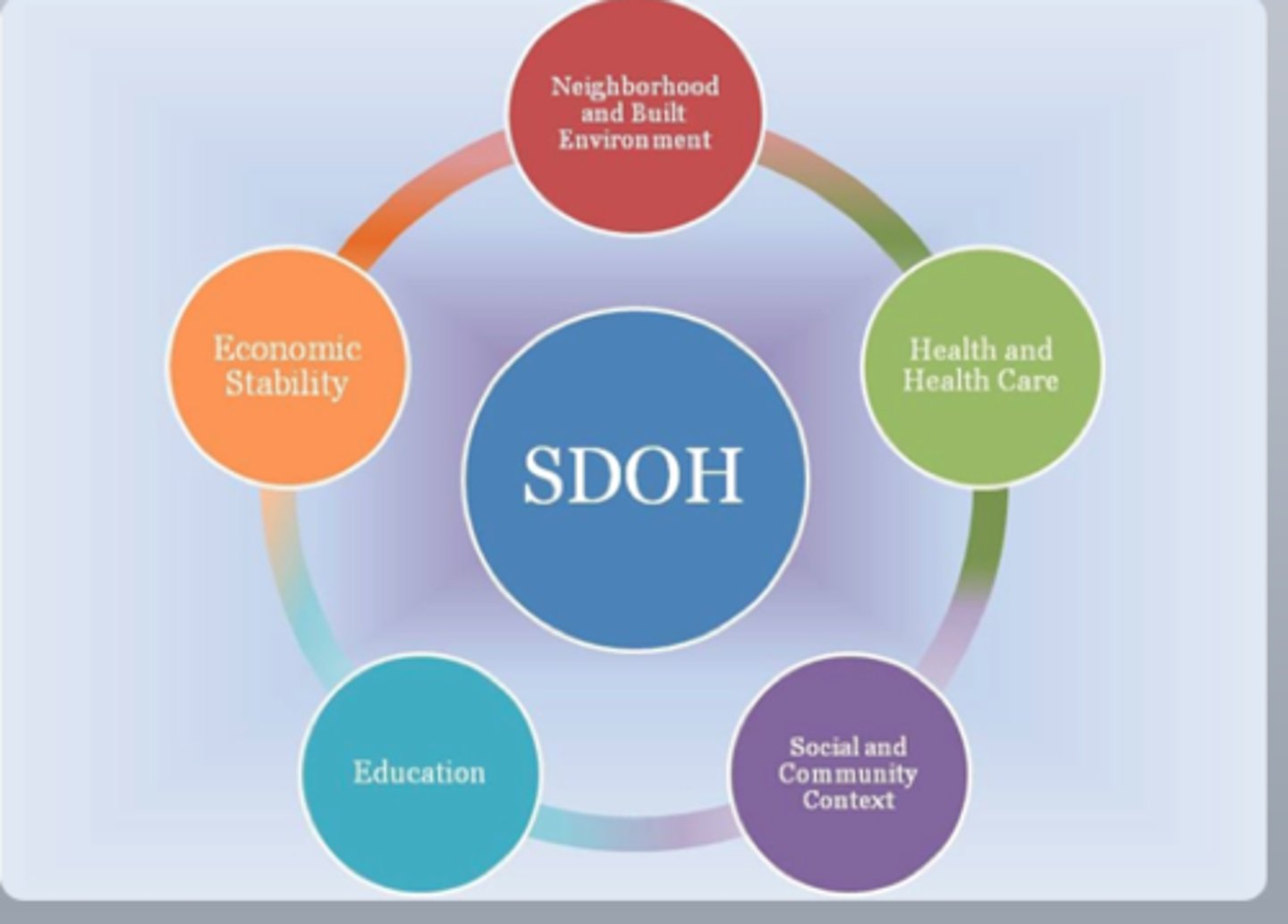
Poverty and income insecurity impact overall health. This is important to recognize because....
poverty and income insecurity limits access to quality education, healthy food, safe environments
T or F: SDHs create systematic disadvantages and poor health outcomes that continue to proliferate.
true
T or F: SDHs impact the available choices and what a person can choose to do, or envision doing.
true
T or F: SDHs affect marginalized populations.
true
What are marginalized populations?
a subgroup of the population that tends to be hidden, overlooked, or on the outer edge
Marginalized populations include
-people with disabilities
-refugees and asylum seekers
-children
-people with mental illness
-indigenous people
-older adults
What is culture?
-those learned behaviors characterizing the total way of life of members within any given society
-the most salient aspect of any culture typically involves behavior
-distinctive actions, mannerisms, and gestures characteristics of a culture
According to the OTPF, culture impacts...
impacts values, roles, activity patterns, behavior standards and expectations, etc.
Culture
-everything that characterizes people's lives
-includes knowledge, belief, morals, law, and any habits acquired by people as members of a society
-basic cultural knowledge is passed from parents to children
-our capacity to learn culture is innate (need to be open)
-shapes our views (gives us a framework for interpreting actions around us)
-the particulars of culture vary from place to place but the possession of culture is universal
Cultural humility
ongoing process of building relationships and trust through honest self-reflection of one's own culture to increase one's knowledge of other cultures
ongoing process of building relationships and trust through honest self-reflection of one's own culture to increase one's knowledge of other cultures
cultural humility
How to practice cultural humility?
-be humble
-self-reflect on biases
-admit that we don't know everything
-be open to learn and open to new experiences
Cultural responsiveness
capability to respond to others with consideration, respect, and sensitivity due to an increased awareness of the need to recognize and validate interpersonal/cultural differences
capability to respond to others with consideration, respect, and sensitivity due to an increased awareness of the need to recognize and validate interpersonal/cultural differences
cultural responsiveness
How to practice cultural responsiveness?
1) have a greater awareness of client's personal and environmental factors
-personal: age, gender identity, sexual orientation, cultural background, social background, education, health literacy, etc.
-environment: individual and societal attitudes, including discriminatory practices; social norms and ideologies
2) actively practice client-centered care and support an individual's rights to participate in shared decision-making
3) provides culturally responsive care – an intentional effort from OT to explore, reflect, adapt and collaborate in all aspects of their client's care
4) use and advocate for professional medical interpreters when needed
5) acknowledge one's privilege and implicit biases and how they impact your practice
-preferred language, name, pronouns
-unbiased language: avoid generalizations, biases toward specific gender identity, religion, or ethnic groups
6) policies and procedures
7) advocate to minimize disparities
Occupational justice
The right of every individual to be able to meet basic needs and to have equal opportunities and life chances to reach toward her or his potential but specific to the individual's engagement in diverse and meaningful occupation
Access to and participation in the full range of meaningful and enriching occupations afforded to others, including opportunities for social inclusion and resources to participate in occupations to satisfy personal health, and societal needs
occupational justice
A justice that recognizes occupational rights to inclusive participation in everyday occupations for all persons in society, regardless of age, ability, gender, social class, or other differences
occupational justice
Why is occupational justice important in OT?
-it promotes collaboration between client and practitioner
-allows client-centered interactions and interventions
-it ensures accurate assessment
-it increases equality and trust in the therapeutic relationship
Why are social determinants of health critical to occupational therapy practice?
a) they define a client's physical abilities
b) they influence a client's overall health, participation, and engagement in meaningful activities
c) they provide an idea of how the client will adhere to treatment
d) they influence how the client accesses care
b) they influence a client's overall health, participation, and engagement in meaningful activities
 Note
Note  Flashcards (39)