Pharmacy Practice Management Exam 1
 Call Kai
 Learn
Learn Practice Test
 Spaced Repetition
 Match
Match Flashcards
 Knowt Play
1/136

There's no tags or description
Looks like no tags are added yet.
Name | Mastery | Learn | Test | Matching | Spaced | Call with Kai |
|---|
No analytics yet
Send a link to your students to track their progress
137 Terms
What are some recent healthcare news you’ve seen or heart about?
US spends much more per person on healthcare than other countries, as well as a larger percent of Gross Domestic Product
Drug Pipeline development
rare/orphan disease states
expansion of indicaiton
targeted therapies
accelerated approvals
HCP adminstered → self admin
new delivery systems
combination/ER products
vaccines
Specialty Pharmacy Trends
1-2% of Americans use them but it represents 40% of total drug cost
largest driver: specialty drugs
top concerns for payers: gene and cell therapies and oncology
pipeline continues to be filled with drugs in specialty categories
medication related problems contributing to growing healthcare cost
off label use
fraud and waste
improepr drug selection (under/overprescribing)
wrong dosage
adverse drug rxn
drug disease interaction
inadequate drug monitoring
lack of adherence
breakdown at the transition of care
Impact on Healthcare
reevaluating tradiational processes
focus on appropriate utilization
focus on customer patient need s
focus on outcomes and ROI
data analytics
transition to value based care goal
reduce duplication of services, improve health outcomes and decrease cost of care
pay for performance, at risk shared savings, penalties
focus on quality of services
balancing length of stay and readmission reductions
episode of care, long term focus
population utilization and cost
SEQ Payer’s Perspective
provide access to quality healthcare
clinical gap closure/programs
opportunities for collaboration and innovation
improve health outocmes
manage total cost of care
what are challenges for health plans?
become a trusted health wealth advisor
better access to information by providers and consumers
reward safety, quality and innovation
“wholesale” (business to business) → retail (business to consumer) mindset
invest in data; to be progressive
what are challenges for providers?
focus on wellness and prevention rather than treating acute conditions
provide personalized care
consistently provide cost effective care
What is consumer centric care?
right care at the right place at the right time
MD/patient relationship is enhanced by anticipating timely interventions to prevent or mitigate the impact of otherwise serious events
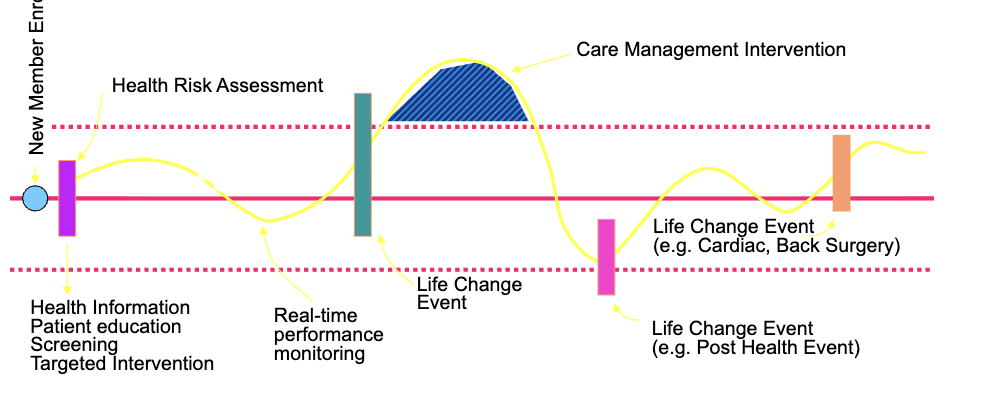
What the 4 qualities of population health management?
facilitate car delivery across an entire population or group of individuals
goal: improve outcomes and reduce cost/utilization for pt populations at highest risk
involves strong analytical approach to stratify patients and identify actionable opportunities for intervention
multistakeholder approach among payers, providers, employer groups and pharmaceutical companies
What are the pharmacy management trends to watch in 2026?
patient care and services
health care affordability
digital technology
push to recognize and act on social determinants
increased patients’ connectivity to behavorial health services
leveraging applied analytics
alternative sites of care and virtual care
patient care and services
personalized medicine
direct to consumer trends
ex[anded clinical services
improved patient access
health care affordability
medication cost burden shifting to members
increased federal actions to manage healthcare
increased regulatory focus on drug transparency
Digital technology
increased offerings focused on clinical care management (wt loss, BH)
wearable health technology
growth in AI and automation
augmented and virtual reality
telepharmacy
push to recognize and act on social determinants
address socioeconomic stressors like housing instability, food insecutiy and transportation
circumstance w direct effect on mental and physical health
increased patients’ connectivity to behavorial health services
more partnerships between traditional medical and behavioral health carriers on smaller, targeted and personalized solns; aligned incentives
leveraging applied analytics
actionable data will facilitate the major trends
need for practical data sets presented in a simple, actionable framework to be used to assess opportunities
alternative sites of care and virtual care
health care servies that are accessed digitally at home and outside the traditional 9-5
increasingly important to consumers as they prioritize convenience
what will healthcare continue to look like?
more patient centric, value based healthcare system
collaboration with providers for integrated healthcare/stronger ecosystem collaboration
safety, quality and innovation will be reawarded
operational and administrative processes will be optimized
information technology will be improved
During the mid to late 20th century, what did professional norms limit? what changed after the PharmD in the late 20th century?
limited counseling which reinfoced the product dispender identity
new barriers emerged, making managements skills essential
From pharmaceutical care → MTM → CMM/CoMM. what happened in the early 2000s?
pharmaceutical care emphasized responsibility for managing drug therapy to resolve/prevent medication related problems
What is important about management skills?
converts intent into reliable systems: workflow, staffing, documentation, and quality
bottom line: good patient care and good business are mutually dependent
define business management
use technicians to free pharmacist time; billing reimbursement opportunities
What are the realities of business vs patient care?
ethical practice and sustainability can align
business functions ar egoverned by rules and regulations
wuality enables trust, outcomes, and viability
management constraints affect clinical effectiveness
in operations management, what is the first step in workflow?
define tasks, roles and handoffs to reduce bottlenecks and error risk
What is the human resources management cycle (HRM)?
job analysis
hire
train
motivate
appraise
reward
what is the difference ebtween classical and modern management styles?
classical era: hierachial comand and contorl in mass production settings
Modern era: service economy + highly educated workforce; managers may have less technical expertise than staff
What are the 4 emphases of modern management?
energize: create vision and momentum
empower: provide training/resources, then trust execution
support: coach, give feedback, remove barriers
communicate: build trust and choose the right channel for the message
What are the 3 dimensions of the management process?
activities managers perform: plan, organize, lead, control, repeat
resources managers manage: money, people, time, materials, info
levels where decisions occur: self, interpersonal, organizational
Define planning vs organizing as management activities
planning:
predetermine actions based on goals and environment
set goals and objections: consider internal/external nevironemnt
formal (strategic/business) or informal (daily workflow choices)
Organizing:
determine and arrange activies and resources to accomplish plan
define roles, task relationships, and timing (who/what/when/where)
Define Leading/Directing vs controlling/evaluating as management activities
leading/directing
bring about purposeful action by doing work and/or guiding others
motivate self and others toward desired outcomes; required communication
requires coaching and empowerment
Controlling/evaluating
review progress toward objectives and determine why results occurred
compared reselts to goals and as what happened and why
use results/feedback to improve the next planning cycle (continuous improvement
what are the 5 components of resource management?
money: measures performance and enables acquisition of other resources
people: staff, pts, interprofessional partners — collaboration is essential
time: most limiting; self management supports managing others
materials: medications, supplies, equipment, control and availability
information: technology and data support safe dispensing and clinical decisions
What are the 3 levels of management? top to bottom
organizational (group/policy decisions)
interpersonal (one to one; counseling, training)
self management (personal priorities and time)
Given the scenario, what is the level, activity and key resource? choose education to advance career ladder
level: self
activity: planning
key resources: time information money
Given the scenario, what is the level, activity and key resource? train a med rec technician on initial patient interview data
level: interpersonal
activity: leading, organizing
key resources: people, information, time
Given the scenario, what is the level, activity and key resource? review financials for diabetes care center goals
level: organizational
activity: controlling
key resources: money, information
What is leadership vs management?
Leadership: sets direction
Management: executes plans
positional vs non positional leadership
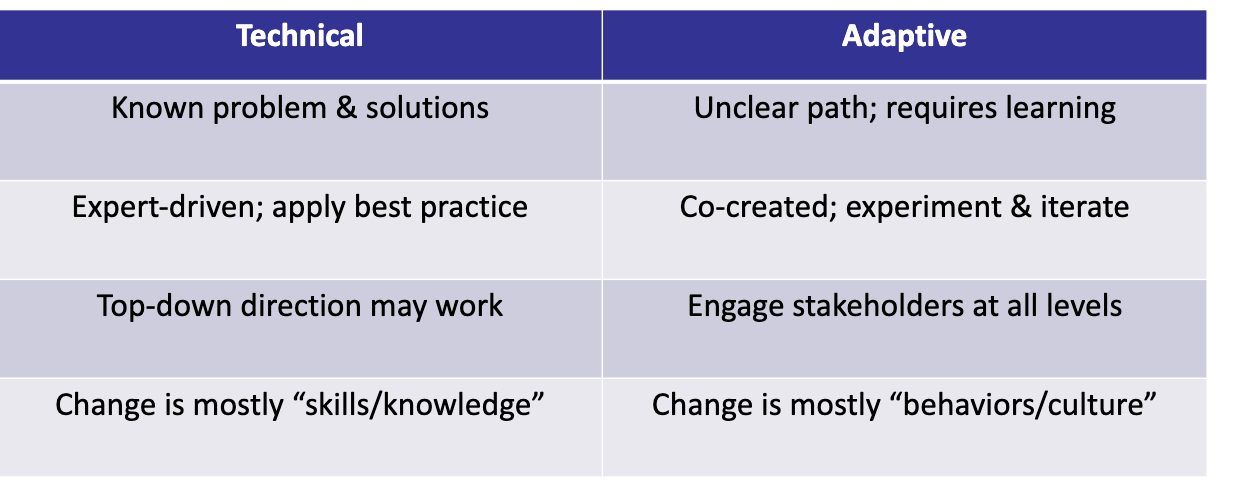
leadership does not require a title
What is the difference between technical and adaptive
Kotter’s 8 steps for leading change
create urgency
build guiding coalition
form vision and strategy
communicate the vision
remove barriers
generate short term wins
sustain acceleration
institute change
what are the keys for sustainability?
coalition
communication
barrier removal
culture reinforcement
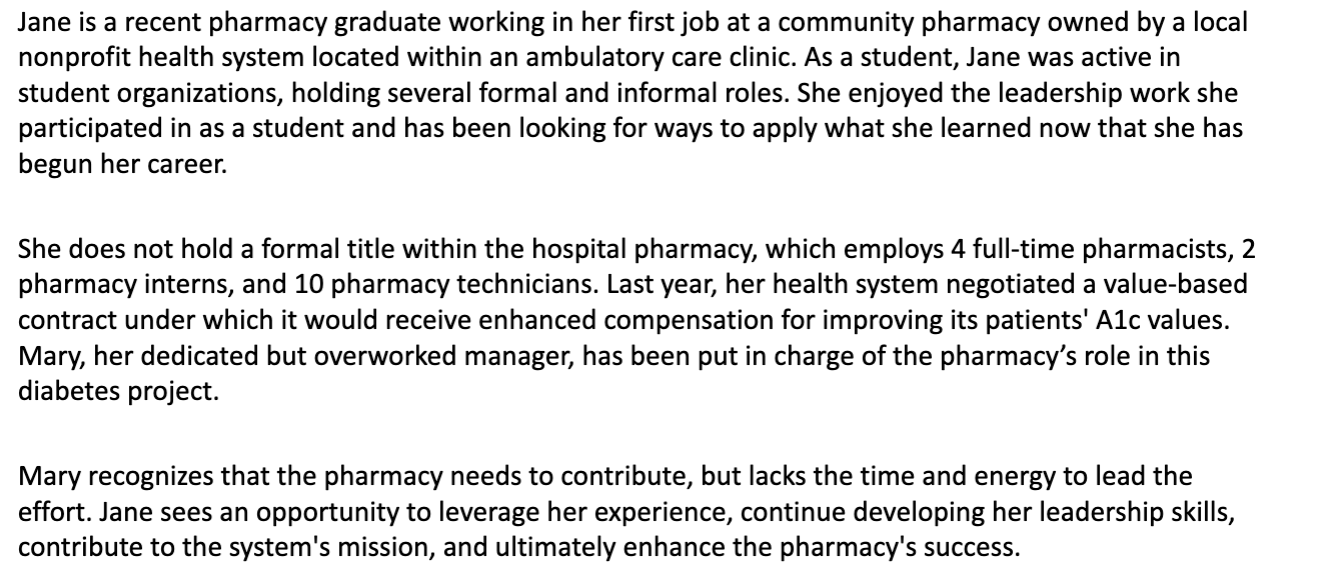
apply kotter to management case
urgency: link HbA1C outcome to contract and patient impact
coalition: pharmacy, clinical leadership, techs, nursing, prescribers
short term wins: early HA1C improvement, adherence gains, visit completion
culture: embed workflows for ongoing CMM/diabetes management
What are the 4 clifton strengths leadership domains?
executing: turn ideas into action, deliver results
influencing: advocate and persuade, gain buy in
relationship building: create connection, build cohesion
strategic thinking: see patterns/options plan ahead
What is emotional intelligence (EI)?
self awareness, self regulation, empathy, motivation, relationship skillls
support trust and psychological safety—preconditions for teaming
What are the 5 dysfunction fo a team (lencioni) building from the bottom?
trust
conflict
commitment
accountability
results
what are examples of trust building behaviors?
talk straight: honest feedback, avoid spin
demonstrate respect: assume dignity, address issues not people
create transparency: explain decisions, share data
keep commitments: reliable follow through
listen first: seek to understand before responding
practice accountability: own outcomes; avoid blame
Why is creating value important?
pharmacist job growth has increased in recent years
hired by past work experience, communication skills, problem solving, ability to work effectively with others
articulating value, market yourself
How will the profession of pharmacy serve the needs of patients, health care prof, the health care system and society?
***
Relative Value Theorem Equation
RV = (P + S) (PV)
V = value
PV = perceived value
P = price
S = Service
What does P, S, and PV stand for?
P = price; monetary and non monetary factors
S = service; quality and marketing of service
PV = perceived value; what you get vs what you give up to obtain
benefits of drug vs cost/time to obstain
services vs salary
Define Value
desire to obtain high quality goods and services to meet our needs and wants and what we need to sacrifice to obtain them (money, time, etc)
RV = what is the desire to obtain a good/service compared to its alternatives
Describe 5 healthcare stakeholders
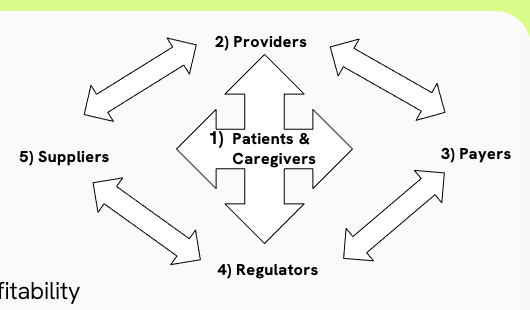
Patients and caregivers:
focused on quality of care at an affordable price
Med counseling, accessible point of care, immunizations, preventative meds, patient advocates
Providers:
focus on patients, practice and profitability
provide drug regimen recs, prevent med errors
Payers:
focus on cost-effectiveness of providing care to overall group
formulary, prior auth, outcomes based eval
Regulators:
write and enforce rules/laws to protect public interest
drug safety surveillance, REMs, controlled med report, policy development
Suppliers:
affect cost and productivity of healthcare workers
clinical trial design and execution, drug development, scientific communication, medical information
What are the 3 parameters of medication taking behavior? How can you improve PV?
initiation
implementation
discontinuation
How can you increase PV?
P: willing to spend money/time/effort on med adherence
S: patient understands what they get in return
PV: patient values med adherence
What is a service based pharmacy? When does it work?
pharmacists provide professional services, less profitability of dispensing prescriptions
works if service is consistently high quality: high emotional patient satisfaction → high PV → higher profit
con: pricing

Define RVT
P = salary
S = clinical skills, work ethic
PV = does the employer believe James’ service will outweigh the price of salary
What is BPS? What makes you eligible?
Board of Pharmacy Specialties: certification in a specialty area
Eligibility: within the 7 years… (any of 3)
PGY2
PGY1 and >2 yrs of practice experience
>4 years of practice experience
Must take exam
Ethical Dilemma
choice betw competing ethical standards to determine the morally appropriate action or decision
What are the 10 steps for individual decision making
could decision hurt someone?
is it legal question?
facts of case?
who has a stake in the outcome?
what are the options?
what can we learn with ethical considerations in mind?
which option is best in this situation?
what would a respected critic say about my choice?
what will the implementation of the decision look like?
what did i learn from this situation?
What are the 7 steps of the PLUS EDM model?
Define the problem in terms of outcomes
seek guidance on policies and statutes
ID alternatives
evaluate alternatives (apply PLUS filters)
Make the decision
implement
evaluate
What does PLUS stand for?
Policies: consistent with organizational policies?
Legal: consistent w law/regulation?
Universal: aligns w organizational values?
Self: satsifies personal definition of right, good and fair?
What does PLUS vs Markula ensure?
PLUS ensures ethical elements aren’t lost in bureaucratic processes
Markula ensures personal integrity isn’t lost in compliance
What are the 3 stages in the psychology of ethics
Stage 1: preconventional
Stage 2: conventional (Law & Order, follow HIPAA)
Stage 3: post-conventional (universal principles, protect privacy to respect human dignity)
(stage 1 bottom of pyramid, stage 3 is top)
What is the implication of the non-rationalist (intuitionist) approach?
be aware of your gut rxn but verify it against facts to avoid bias
What should you use sensemaking?
Rational models (PLUS/MARKULA) work for puzzles with clear rules
mysteries (ambiguity)
goal: create a mental model to define the problem before trying to solve it
What are the 4 tactics to improve sensemaking?
emotional regulation: mange fear/anger to maintain clear judgement and avoid impulsive rxns
Self reflection: analyzing past outcomes, “what do i take away from this experience?”
Forecasting: envision multiple futures to offset bias (alternative outcomes)
Information Integration: reassess new data, take broad perspective
Descibe the Learn Plan Act Cycle for developing your professional identity
learn (sensemaking): seek diverse data, consult others, avoid predetermined assessments
plan (decision making): create new schemes, use EDM models to create plan
Act (implementation): implement w care and attention to stakeholders, feedback loop (did it work/what did we learn)
What are 3 foundations of organizational structure?
span of control: (how big teams are, how many people pharmacists oversee)
Centralization: standard protocols, high efficiency
Decentralization: pharmacists integrated into med teams
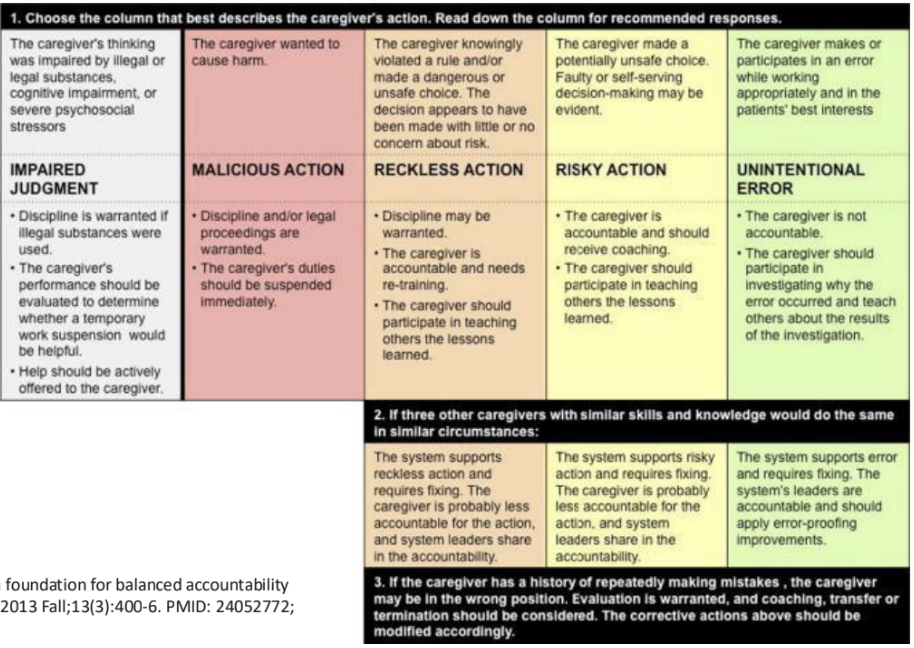
What is the Just culture model?
Distinguish between:
human error: managed through system changes
at risk behavior: managed through coacing
reckless behavior: managed through discipline
Review Just Culture Model
What is the Thomas Kilmann Model?
a conflict resolution style that involves competing, collaborating, compromising, avoiding, and accomodating
Organizational structure must be ____ to survive
Adaptable
focus: dynamic mvt over time
drivers: internal and external factor s
process: top down, bottom up, reciprocal
What are 3 types of environment shifts that change organizational structure?
Market & Industry: shift in consumer demands, competitive pressure
Regulatory & Political: new laws need new structure
Technology: adoption of new systems
What are the 3 internal drivers of change in organizational structure?
Resources: scarcity(force efficiency); ambulance (allows expansion)
Strategy: shift from volume based dispensing to value based care requires new reporting lines and teams
Structure: start ups add hierarchy to manage growth, mature systems reduce hierarchy to gain agility
How does increasing vs. decreasing formalization change organizational structure?
Increasing formalization: Adds structure (e.g., M&A, more hierarchy levels, modularization).
Decreasing formalization: Removes layers (e.g., delayering, downsizing, simplification) to improve agility and communication speed.
What is the Top-Down Process (Directive)?
senior leadership
design
execution
assessment
initiated by senior leadership: planned discrete phases often used for major strategic pivots
What is the Bottom Up (Emergent) Process?
Frontline staff
localized behaviors
cascading traces
formalization
initiated by frontline staff: gradual, rooted in social networks
ex. technician invents new inventory workflow that gets adopted globally
What are the 3 parts of inertia forces
cognitive barriers: staff view that current structure is only way to practice safely
external sources: board of pharmacy says…
internal sources: founder’s original design persisting despite market reality
organizations with high inertia have reorganization speed slower than rate of environmental change: very bad
How can you build adaptable structures in organization?
structured flexibillity: embed things that guide adaptive change wo chaos
simplification cycling: add/eliminate structure to prevent bloating when coping with contingencies
modular design: units that can be activated or dissolved (pop up clinics)
constraining factors
personal, situational, or environmental factors that can impede sensemaking
have negative fx on ethical decision making like personal bias, time stress, unethical work culture
Moral Reasoning
type of developmental process that shapes ethical decision making, representing the cognitive steps taken to resolve an ethical situation
moral disengagement
process where an individual convinces themself that professional ethical standards do not apply to them → lack of awareness of an ethical issue
Organizational structure
defined by Daft 2015, multi-faceted concept that:
designates formal reporting relationships
ID grouping of individuals into departments
includes design of systems for effective communication, coordination, and integration
Founder imprinting
lasting influence of a founder’s experiences, vlaues, and design principles on an organization’s structure, which can either enable or inhibit future structural changes
What is reactive panning (survival mode) vs proactive planning (control)
reactive: response to rapidly changing environment. Necessary but leaves organization controlled by external forces
proactive: gold standard that enables organization to control its environment and define its own future
Strategic Planning (purpose, time horizon, scope, perspective)
purpose: direction, positioning, survival/thrive (effectiveness)
time: 3-5+ yrs
scope: entire organization
perspective: external environment + internal capabilities
Business planning (purpose, time horizon, scope, perspective)
purpose: feasibility of a specific program/project (effiiciency)
time: 1-5 yrs
scope: single service/product/program
perspective: market, operations, financials for the proposal
What is the importance of strategic planning?
clarifies what the organization should be
sets priorities for resource deployment within environmental constraints
provides the framework that guides all other plans (including business plans)
What is the difference between mission and vision statement?
mission statement (present purpose): defines what the organization does today, tells story of current operations
vision statement (future): defines what the organization wants to become, must be concise, inspiring and momentum building
What are the SMART objectives?
Specific: state exactly what is to be achieved
Measurable: capable of measurement, must be able to determine if it was achieved
Aggressive but attainable: should challenge team but not impossible
Results-oriented: specify a result not just an activity
Time-bound: specific realistic deadline
What are 6 common barriers of why plans can fail?
lack of leadership/endorsement
insufficient time/resources
people: internal politics, power struggles, resistance to change
communication: jargon/plan-speak prevents staff understanding and buy in
implementation: most common poor monitoring and measurment, analysis no action
lack of long term priorities (management by crisis)
When is SWOT analysis done during strategic vs business planning?
strategic: early to define current situation and inform strat
business: later, after market research and financial projections inform assumptions
What is SWOT analysis?
Internal Origin (Controllable):
positive: strengths
negative: weaknesses
External origin (uncontrollable):
positive: opportunities
negative: threats
What is the purpose, audience, key components, and output of a business plan (for a specific program/service)?
Purpose: Decide whether to start, expand, modify, or terminate a specific program/initiative.
Audience: Decision makers (e.g., CEO, CFO):
focus on viability & ROI (avoid heavy technical jargon).
Core Question: “Should we invest in this proposed business?”
Typical Components: Target market, value proposition, staffing/workflow, budget/pro forma, risk assessment.
What are the key elements of an operations plan?
staffing: FTEs and Board Certification requirements
Reporting: lines of authority
Workflow
Cost analysis
component of financial plan that is fixed (do not change with volume vs variable)
What does the Gantt chart signify? (chat)
A Gantt chart visually represents the project timeline by showing tasks, their duration, sequencing, and key milestones over a set period.
How long should the wait time be for monitoring signs?
>30 minutes and increasing
What are the 4 questions you should ask in operations management?
what must be done right now?
who needs to be doing it?
what resources do they need?
when is the work finished?
What does command intent focus on?
it focuses on the desired end state and adapts to the battlefield
(micromanagement focuses on specific steps, fails when battlefield changes)

