Cellular Respiration
 Studied by 6 people
 Call with Kai
 Learn
Learn Practice Test
 Spaced Repetition
 Match
Match Flashcards
 Knowt Play
1/29

There's no tags or description
Looks like no tags are added yet.
Name | Mastery | Learn | Test | Matching | Spaced | Call with Kai |
|---|
No study sessions yet.
30 Terms
Steps of aerobic cellular respiration
Glycolsis
Krebs cycle/ citric acid cycle
Electron transport chain
What does Glycolysis do?
Glucose is broken down into pyruvate, producing ATP and NADH. This occurs in the cytoplasm
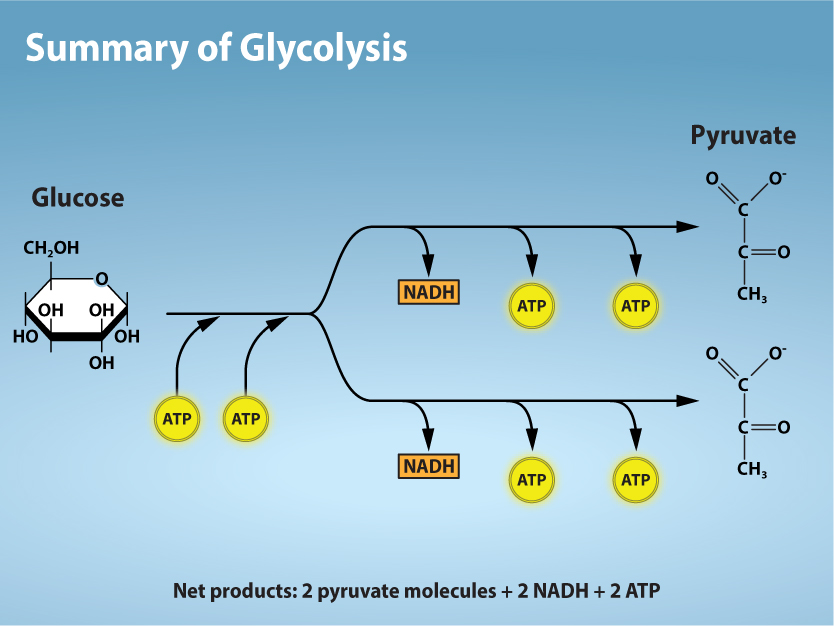
How much ATP is produced in Glycolysis?
nets 2. (total is 4)
How much NADH is produced in glycosis
2 NADH.
what is NADH
an electron and proton carrier that helps produce ATP during cellular respiration.
Amount of pyruvates after being broken?
2 pyruvates are produced from one glucose molecule.
What does the Krebs cycle do?
the 2 pyruvates from glycolsis get broken down in the mitochondria into acetyl-CoA, producing NADH and FADH2, which are used in the electron transport chain to generate ATP.
Krebs cycle process
pyruvate enters mitochondria and is converted into acetyl-CoA
Acetyl-CoA combine with 4-carbon compound producing 6-carbon molecule (citric acid)
energy is generated in the form of NADH, FADH2, and ATP while carbon dioxide is released as a waste product.
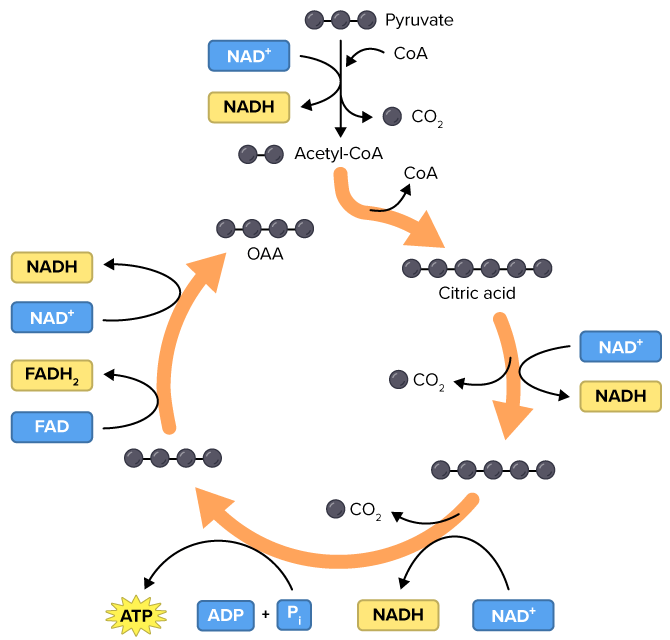
How many FADH2 is produced
each turn produces 1
2x turns produces 2 FADH2 molecules.
How many NADH carries are produced in the citric acid cycle
per turn is 3 NADH
2x turns are 6 NADH molecules
FAD →
FADH2
NAD+ →
NADH
whats the waste product in the Krebs cycle
Carbon dioxide (6)
How much ATP is produced in Krebs cycle?
2 ATP
whats the enzyme that breaks down the pyruvate?
Acetyl-CoA carboxylase
Where does the Krebs cycle take place?
mitochondria
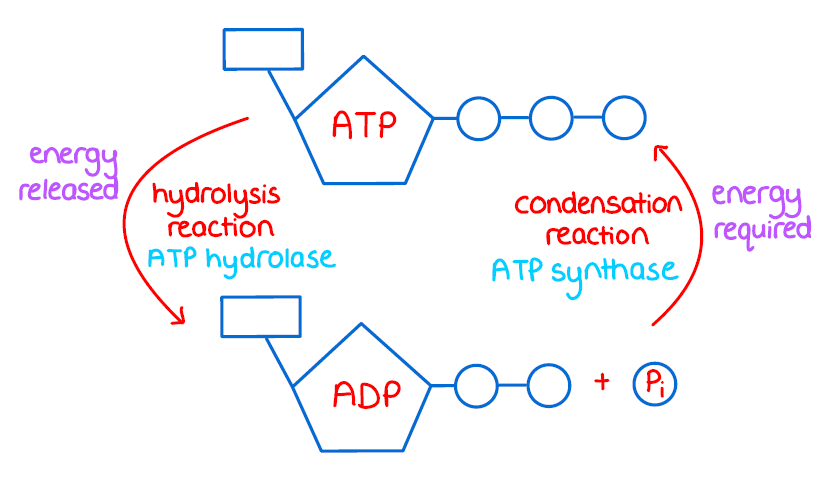
How does ATP → ADP
a phosphate is broken off through dehydration synthesis
What is the electron transport chain (ETC)?
final step in the breakdown of glucose where the most ATP is produced
Where does the ETC occur?
In the mitochondria membrane
ETC process
oxygen combines with electrons(e-) and hydrogens(h+) to form water and makes ATP
How is ATP produced in the electron transport chain
when the hydrogen ions flow through the ATP synthase, driving the conversion of ADP to ATP
How much ATP is produced in ETC
32 ATP
Whats anaerobic respiration?
A process that produces energy without oxygen, resulting in lactic acid or ethanol and fewer ATP compared to aerobic respiration.
Lactic Acid fermentation
pyruvite and NADH→lactic acid + NAD+
used in muscles and for some food production
What happens to muscles during lactic acid fermentation?
because of low oxygen the muscles become sore and painful.
Alcoholic fermentation
pyruvate and NADH→ethanol + NAD+ CO2
used to make bread and brewing industry.
Cellular respiration equation
C6H12O6 + 6O2 → 6CO2 + 6H2O + ATP
How much ATP is produced in aerobic respiration
36 ATP
In eukaryotes most ATP is produced in the..
mitochondria
In prokaryotes most ATP is produced in the..
cytoplasm
 Note
Note  Flashcards (36)