Bio Module 3 Exam
 Call Kai
 Learn
Learn Practice Test
 Spaced Repetition
 Match
Match Flashcards
 Knowt Play
1/63

There's no tags or description
Looks like no tags are added yet.
Name | Mastery | Learn | Test | Matching | Spaced | Call with Kai |
|---|
No analytics yet
Send a link to your students to track their progress
64 Terms
Primary cell wall
Thin flexible, allows for growth
Secondary cell wall
Thick, rigid contains lignin, provides strength
Middle Lamella
sticky layer between cells, how plants connect to one another works as an adhesive to bind to other cells
Plasmodesmata
Tiny holes on the cell wall that allow for cells to communicate to each other
Parenchyma Cells
Most common plant cell, thin and flexible walls
Function: photosynthesis, storage, metabolism
can divide and become other cells (most cells start as parenchyma and “evolve” into the other cell types)
Collenchyma Cells
Has a thick cell wall, does have a secondary cell wall
Provides flexible support
Find it in young plants or the tip of the root because we have active mitotic growth (also in the tips of leaves)
Sclerenchyma Cells
Thick secondary cell wall (which is strengthen with lignin) —> very strong and rigid (think skeleton of the plant) lignin and cellulose is like reinforced concrete
aids in support of plant
Dies once it is mature
There are two types Fibers and Sclereids
Sclerenchyma Fiber cells
Long and slender cells usually arranged in bundles for support and protection of stem and roots (think like when you break a peanut and the long fibers stick out those are fibers)
Sclerenchyma Sclereids cells
shorter then fiber cells have thick irregular and very hard secondary walls (kinda like the exterior of nuts)
Water-Conducting cells (Xylem)
Moves water and minerals upward through the plant, have thick lignified walls
Dead at maturity
two types
Two types Tracheids and Vessel elements
Water-Conducting Tracheids cells
Protection and support (rigid, lignin within the secondary wall), movement of water in upward direction, smaller than the vessel elements, dead at maturity
Water-Conducting Vessel elements cells
Rigid, lignin within secondary walls, dead at maturity
moves water faster up the Xylem because they are larger “holes” or vessels
also pits that allow water to move in and to other cells
Food-Conducting Cells (Phloem)
Transport sugars and some water (sugary sap water kinda)
two types Sieve-tube elements and Companion Cells
Sieve-tube elements
Remain alive at maturity, lack organelles
Has sieve plates (pores) that allow fluid to flow from cell to cell along the sieve tube
needs the companion cells to support it (proteins, nutrients etc.)
Companion Cells
At least one of these by every sieve cell, connected to surrounding sieve tubs by plasmodesmata, produce and transport proteins to the sieve tubes
Name the 3 plant tissues
Vascular Tissue (Xylem and Phloem)
Dermal Tissue (epidermis, stomata)
Ground Tissue
Vascular Tissue
Made up of Xylem (transports water and minerals, made of dead cells) and Phloem (moves sugar, made of living cells)
Dermal Tissue
Outer protective layer includes the epidermis, stomata (opening for gas exchange, which is controlled by guard cells)
What are the three plant organs
Stems
Roots
Leaves
What do plants have in their cells that animals don’t
Chloroplasts (which produces sugar that mitochondria use to make atp), rigid cell wall, plasmodesmata, large central vacuole
Ground Tissue
“Filler” stuff within the cell, everything in the cell that isn’t vascular or dermal tissues
Meristematic tissue
Rapidly dividing tissue, there is apical meristem(found in root tips and shoot tips primary growth), lateral meristem(secondary growth for girth, found on sides on plants)
Characteristics of Dicots
2 leaves when it grows
vascular bindles are well arranged typically in a circle
taproot root structure (straight down root)
Net venation pattern on the leaves
NO endosperm
leaves are usually in multiplies of 4 or 5
Characteristics of Monocots
1 leaf (grass)
Scattered vascular tissues (kinda look like alien heads scattered around)
Fibrous root structure (roots kinda spread all over the place)
Parallel leaf venations
Does have endosperm (endosperm is the seeds first food source as it grows)
Where is Mesophyll located and what does it do
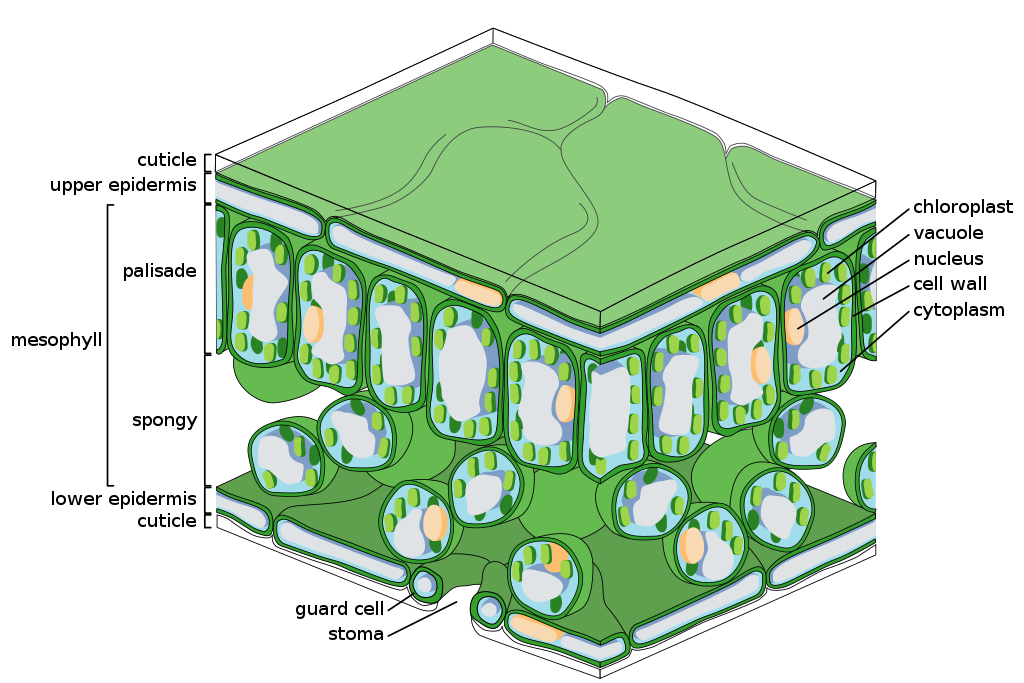
Located in between the upper and lower epidermis, full of chlorophyll rich ground tissue, Primary site of photosynthesis, two parts palisade(elongated and densely packed), and spongey(located lower down and irregular circular shaped)
What is a node on a plant
The point on the stem where the leaf starts to develop
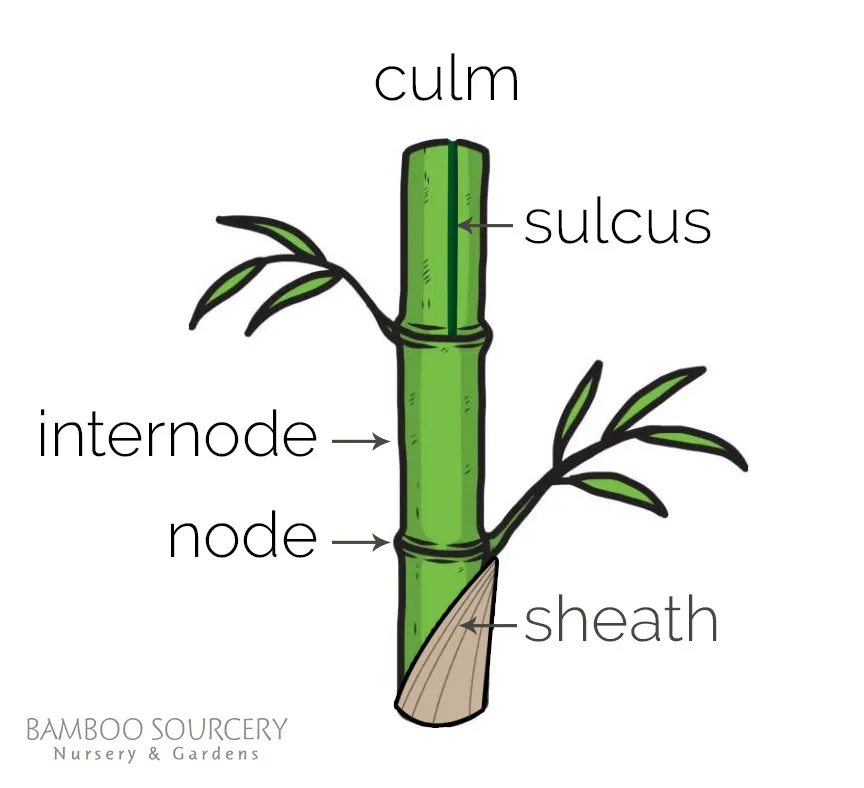
What is the internode
Space on the stem between 2 nodes
What is Axillary bud
The bud/growth on the stem where the leave will grow out of
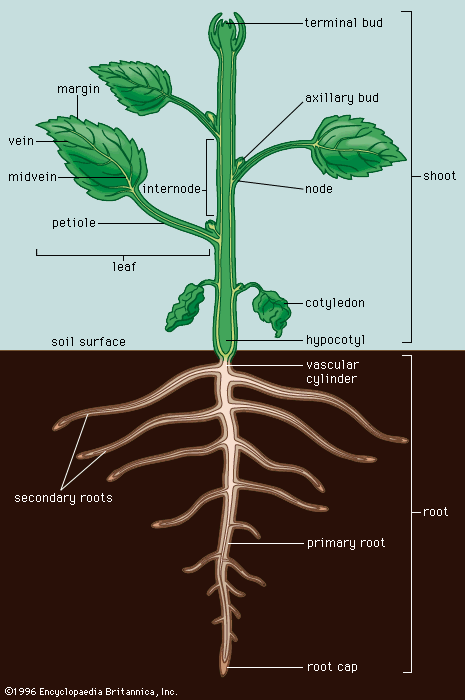
Why do leaf modifications occur
many plants evolved(like carnivorous plants) because they lived in a Nitrogen poor environment, so they need supplemental sources of nutrients
Primary Growth
Shoots growing up, and roots growing down (lengthening of the plant)
Secondary Growth
Measured in girth widening of the plant (think the bark on trees the rings are growing out which is secondary growth)
What is Determinate Growth
The organism stops growing after a certain size (animals, us!)
What is indeterminate Growth
Organism continues to grow (plants) categorized in:
Annuals - complete life after 1 year
Biannual - Complete life after 2 years (second year pant seeds)
Perennials - Live for many many years
How does secondary Xylem grow
secondary xylem grows towards interior of the plant (inward)
How does secondary Phloem grow
Secondary Phloem will be responsible for the bark so it grows outward (towards exterior of plant) (phloem flows out of plant, to remember)
What is sap-wood
outer most of the wood, it is new cells just grown so it is alive, nutrients are actively flowing through
What is heart-wood
inner most of the plant wood, dead so not providing any nutrients for the plant but it is helping support the plant
What is seed dormancy
Period of time where the seed does not grow, it waits until the condition are ideal for it to grow (hormones play a role in this)
What does the fruit and flowers do for the plant
Fruits and flowers are the “ovaries” of the plant, also aid in seed dispersal the fruit is so it attracts seed dispersers (animals) so they can take the seeds and “plant” them elsewhere
How many elements are essential for plants to survive
17 different ones a plant needs, 9 macronutrients and 8 micronutrients
What are macronutrients
Elements that are required in large amounts 9 of them in plants (C, N, O, H, K, Ca, Mg, P, S)
What are Micronutrients
Elements that are required in small amounts 8 of them (Mo, Fe, Mn, B, Zn, Cu, Ni, Na-only sometimes for this one)
What macronutrients make up 98% of the plants bio mass
C, H, O, N, S, P (Carbon, Hydrogen, Oxygen, Nitrogen, Sulfer, Phosphorus)
What is Eutrophication
When there is excessive run off of fertilizers and pesticides which end up in water and cause an algae bloom. When the algae starts to die it sinks to the bottom however when it decomposes it decreases the amount of O2 in the lower levels of the water, ultimately resulting in fish death
What is nitrogen fixation
When Nitrogen fixing bacteria takes N2 and creates NH3
What is ammonifying bacteria
Bacteria that takes NH3 and creates NH4+
What is Nitrifying bacteria
bacteria that takes NH4+ and creates NO3-
True or False
Plants cant use nitrogen gas as N2
True
What is phototropism
The plants response to light (light energy from the sun)
What is gravitropism
The plants response to Gravity
What is thigmotropism
The plants response to Touch
What is positive tropism
When a plant moves toward a specific stimulus
What is negative tropism
When a plant moves away from a specific stimulus
What are the five major hormones found in plants
Auxins, Cytokinins, Gibberellins, Abscisic acid (ABA), Ethylene,
What are Auxins responsible for
stimulating stem, and seed elongation, produced in apical meristem (tip of root and tip of shoot) aids in apical dominance → basically tells the plant to get longer (shoots go higher and root go lower)
What do Cytokines do
Cell division (cytokinesis) stimulates girth (widening of the plant)
What hormones work in antagonistic pair?
Auxins with Cytokinins, and Gibberellins with Abscisic acid
What does the Giberellin hormone do
Promotes cell elongation, and cell division at the same time used to increase growth at a specific region (i.e the fruit)
can take seeds out of dormancy
usually if you find high concentrations of it, it is from us not natural
What does Abscisic acid (ABA) do?
Inhibits growth opposite of what gibberellin says for the plant to do.
stress hormone comes into play especially when plant is dehydrated
has to be removed in order for plant to come out of dormancy
What does the hormone ethylene do
Ripens the fruit and programed cell death with bananas
Can happen naturally think bananas on counter or we can pump a warehouse with ethylene to ripen fruit faster
How does ethylene effect trees growth process
There is ethylene that is getting produced at the abscission layer which is found at the connection point of the node (connection of stem to leave) will produce ethylene and cause the leaves to fall
Circadian rhythms within plants
the plant will put its leaves down at night, hormones will put it to sleep (dictated by photoperiod→duration of light exposure (how long it was exposed to light)
What are short-day plants
flowers when daylight is shorter than the critical length
What are long-day plants
Flower when daylight is longer than critical period

