GEL- Fossils and Time
 Studied by 0 people
 Call with Kai
 Learn
Learn Practice Test
 Spaced Repetition
 Match
Match Flashcards
 Knowt Play
1/14

Earn XP
Description and Tags
Week 1-module 6
Name | Mastery | Learn | Test | Matching | Spaced | Call with Kai |
|---|
No analytics yet
Send a link to your students to track their progress
15 Terms
When did life first appear on Earth?
Around ~3.8 billion years ago
What were the first forms of life on earth?
Singular celled organisms
When did lifeforms evolve?
Around 700 mil. years ago, life evolved and became more complex (multicellular life evolved)
Fossils
Remnants, or traces of once living organisms, are often preserved in sedimentary rocks.
Why are fossils not found in other kinds of rock?
Fossils are not found in other kinds of rock due to heat
What are fossils useful for?
They are useful for relative age determination; act as time markers
Fossil sucession
Species evolve, exist for a certain time, then go extinct (order to which they live)
How common are fossils?
Most fossils are very rare. The formation is difficult, and fossils must be left undisturbed to develop
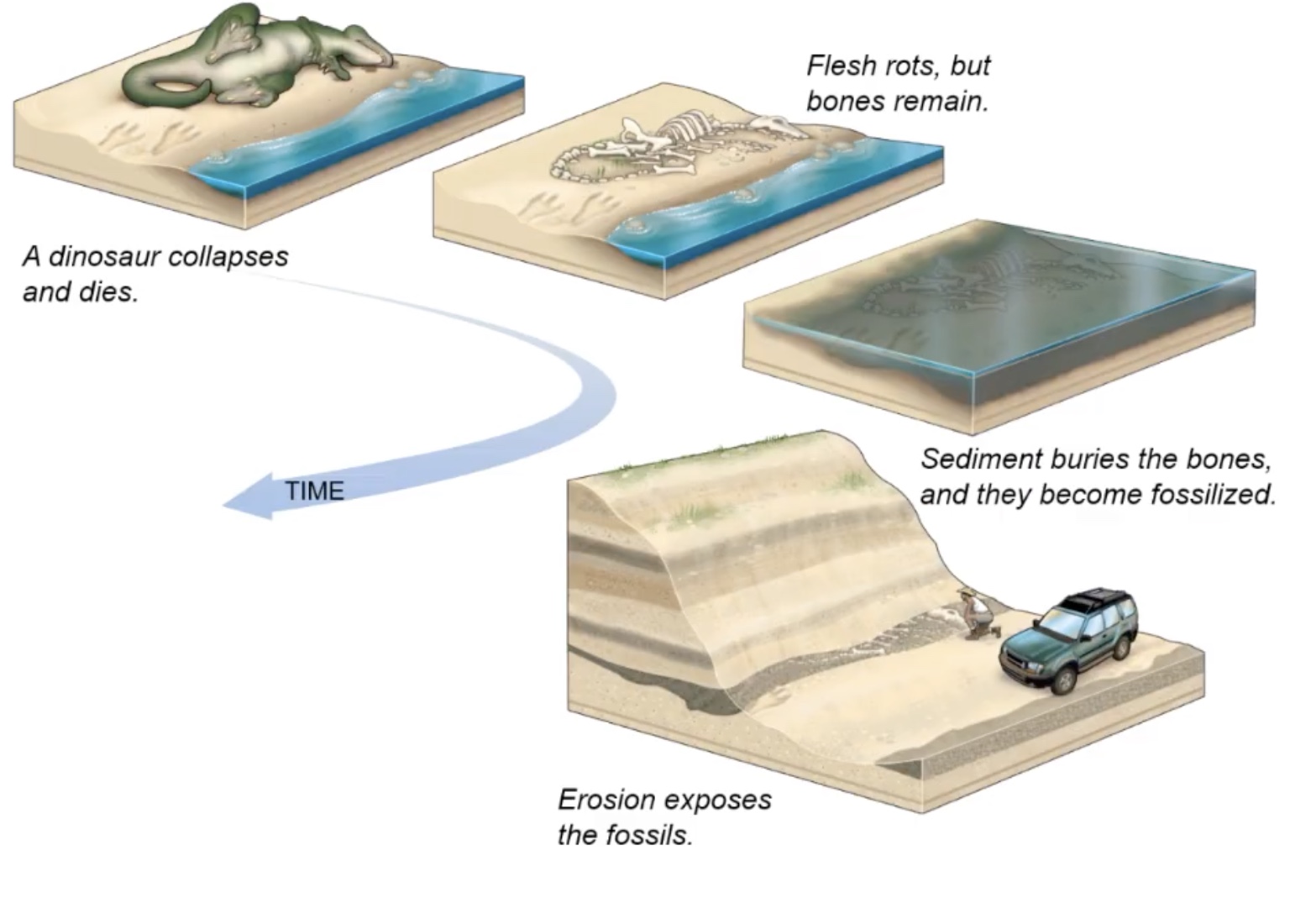
How do fossils form?
1- dinosaur dies
2- flesh rots, bones remain
3-sediment buries the bones; they become fossilized
4- erosion exposes the fossils
Why are marine fossils better for analysis?
Fossils of marine animals are much more common. They are preserved more quickly; there are more of them
Fossil range
First and last appearance of that fossil in rocks. Each fossil has a unique range; overlapping ranges provide time markers.
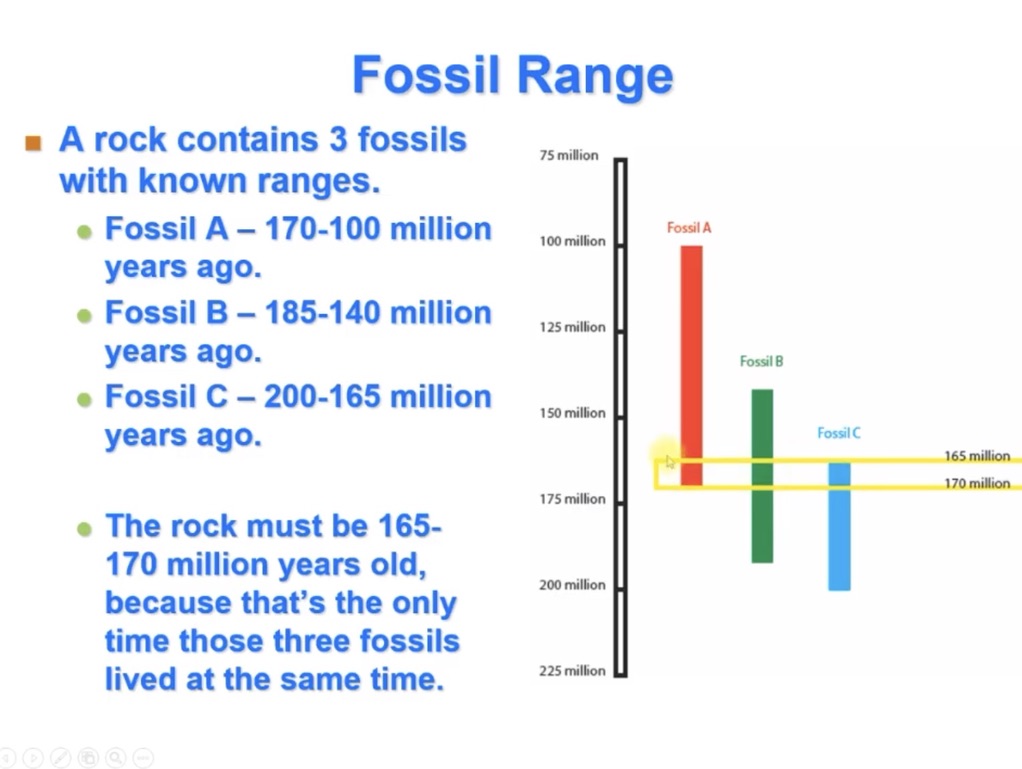
How do we determine the fossil ranges of multiple fossils in the same rock?
The correct range can be determined by analyzing the period of time in which all fossils were alive
Why is fossil range important?
Fossil range allows for correlation of strata (layered rock). You can learn specifc things about what is inside the rock
The geologic column
A record of the history of the Earth; constructed from incomplete sections across the globe. It brackets almost all of Earth’s history
How are the chapters in the geologic time column based?
Time blocks are based on life during that time
 Note
Note  Flashcards (126)