ECON 1102 Midterm 2
 Call Kai
 Learn
Learn Practice Test
 Spaced Repetition
 Match
Match Flashcards
 Knowt Play
1/77

There's no tags or description
Looks like no tags are added yet.
Name | Mastery | Learn | Test | Matching | Spaced | Call with Kai |
|---|
No analytics yet
Send a link to your students to track their progress
78 Terms
saving
income that is not spent on consumption goods
investment
the purchase of new capital goods
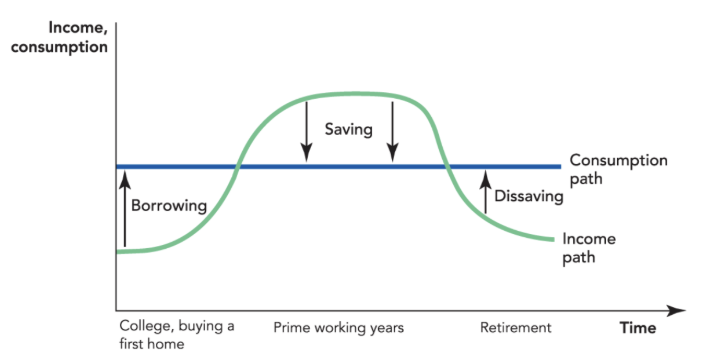
lifecycle theory of savings
by borrowing, saving, and dissaving, workers can smooth their consumption over their lifetime
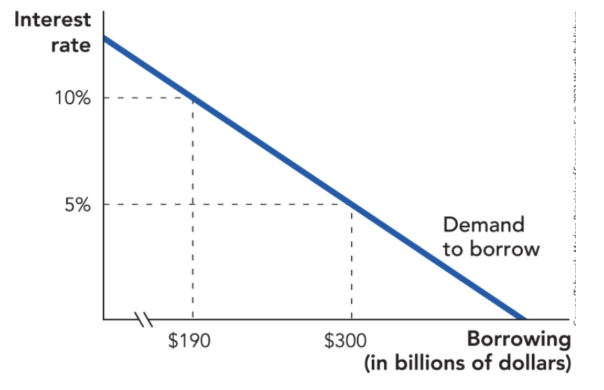
demand to borrow
the lower the interest rate, the greater the quantity of funds demanded
markets for loanable funds
occurs when suppliers of loanable funds (savers) trade with demanders of loanable funds (borrowers)
equilibrium in the market for loanable funds
the quantity of funds supplied equals the quantity of funds demanded
financial intermediaries
they reduce the costs of moving savings from savers to borrowers and investors
entities such as banks, bond markets, and stock markets
bond
a sophisticated “I owe you” that documents who owes how much and when payment must be made
maturity date
date at which the face value is received
face value (V)
cash amount received at the maturity date
coupon payment
amount that bond pays until the maturity date
T-bonds
30-years bonds; they pay interest every 6 months
T-notes
maturities range from 2 to 10 years; they pay interest every 6 months
T-bills
maturities range from a few days to 26 weeks; they pay only at maturity
zero-coupon bonds
“discount bonds”; they pay only at maturity
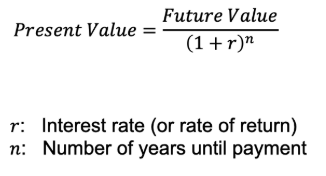
present value
the discounted value of a stream of payments
collateral
something of value that, by agreement, becomes the property of the lender if the borrower defaults
arbitrage
the buying and selling of equally risky assets
ensures that equally risky assets earn equal returns
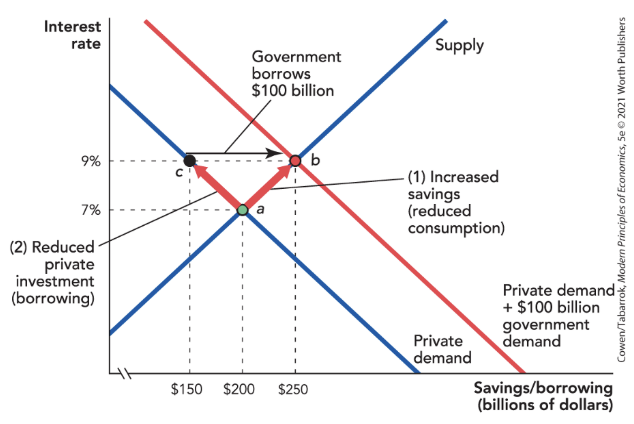
crowding out
the decrease in private consumption and investment that occurs when government borrows more
stock
a certificate of ownership in a corporation
also called a share
initial public offering (IPO)
the first time a corporation sells stock to the public in an effort to raise capital
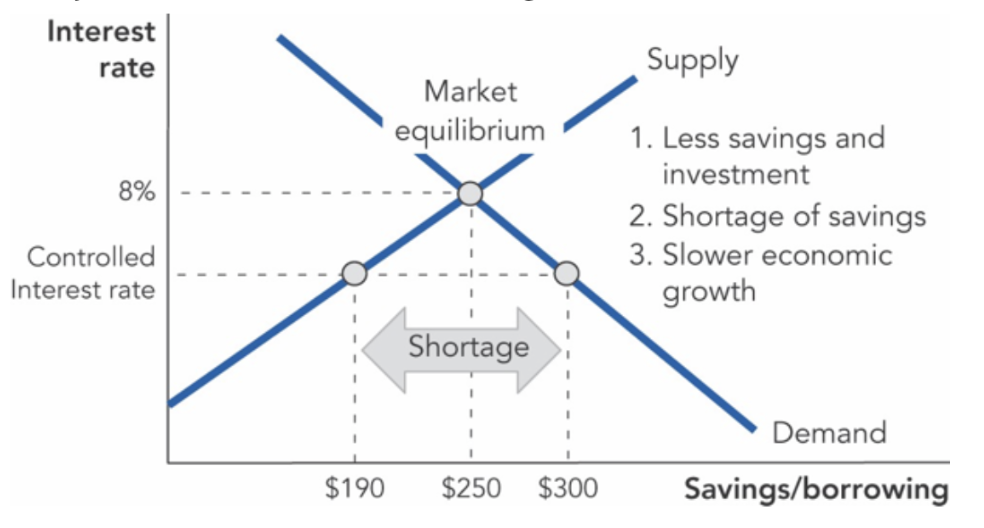
usury laws
impose a maximum ceiling on the interest rate that can be charged on a loan
owner equity
the value of the asset minus the debt
E = V - D
leverage ratio
the ratio of debt to equity
D/E
insolvent
when a firm has liabilities that exceed its assets
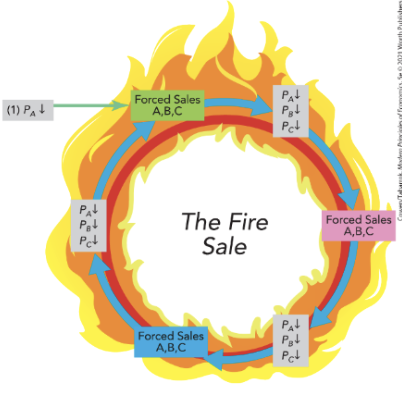
fire sale
the forced sale of a financial asset drives down the price of related assets, forcing more sales, further driving down the price
stock exchanges
people trade stocks in organized markets
interest rate
the cost of borrowing money and the reward for saving
essentially the number of dollars per dollar (%)
commercial banks
funded themselves largely through deposits that are insured by the Federal Deposit Insurance Corporation (FDIC)
always has some source of legally guaranteed funding
shadow banking system
financial institutions that act like banks but are traditionally less heavily regulated and monitored than banks; funded largely by investors and are not insured through the Federal Deposit Insurance Corporation (FDIC)
includes investment banks, hedge funds, money market funds, etc.
unlike deposits, their short-term sources of funds are not government-guarenteed
securitization
bundling individual loans into a single asset to be sold to investors
active funds
run by managers who try to pick stocks
passive funds
attempt to mimic a broad stock market index
buy and hold
the practice of buying stocks and holding them for the long run, regardless of what prices do in the short run
risk-return trade off
higher returns come at the price of higher risk
technical analysis
an approach that looks for patterns and trends in stock and asset prices
efficient markets hypothesis
the prices of traded assets reflect all publicly available information
speculative bubbles
arise when stock prices rise far higher, and more rapidly, than the fundamental prospects of the company
e.g., price of a stock continuously rises because people expect it to, not because the company is actually making more money
herd
investors buy when others are buying and sell when others are selling
can result in increased stock prices, followed by big decreases
unemployed
adults who do not have a job, but who are looking for work
unemployment rate
the percentage of labor force without a job
labor force participation rate
the percentage of adults in the labor force
discouraged workers
workers who have given up looking for but who would still like a job
underemployment rate
A Bureau of Labor Statistics measure that includes part-time workers who would rather have a full-time position and people who would like to work but have given up looking for a job
frictional unemployment
short-term unemployment caused by the ordinary difficulties of matching employee to employer
structural unemployment
persistent, long-term unemployment caused by long-lasting shocks or permanent features of an economy that make it more difficult for some workers to find jobs
unions
an association of workers that bargains collectively with employers over wages, benefits, and working conditions
employment at-will doctrine
an employee may quit or an employer may fire an employee at any time and for any reason
most basic U.S. employment law
active labor market policies
policies such as work tests, job search assistance, and job restraining programs that focus on getting unemployed workers back to work
cyclical unemployment
unemployment correlated with the business cycle
natural employment rate
the rate of structural plus frictional unemployment
inflation
an increase in the average level of prices
disinflation
a reduction in the inflation rate
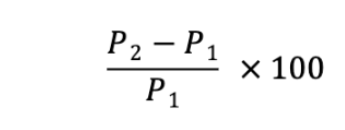
inflation rate
percentage change in a price index from one year to the next
consumer price index (CPI)
measure the average price for a basket of goods and services bought by a typical American consumer
covers 80,000 goods and services, and is weighted so that major items count more
GDP deflator
the ratio of nominal to real GDP multiplied by 100
covers finished goods and services
producer price index (PPI)
measure the average price received by producers
includes intermediate and finished goods and services
real price
a price that has been corrected for inflation; used to compare the prices of goods over time
quantity theory of money
sets out the general relationship between money, velocity, real output, and prices
helps to explain the critical role of the money supply in determining the inflation rate
SAYS the growth rate of the money supply will be approximately equal to the inflation rate
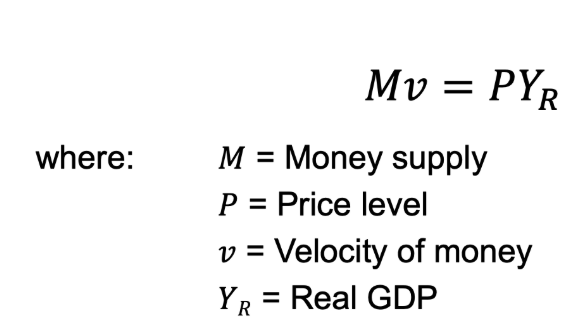
velocity of money
the average number of times a dollar is spent on finished goods and services in a year
essentially, how fast money passes from one holder to another
deflation
a decrease in the average level of prices
money illusion
when people mistake changes in nominal prices for changes in real prices
real rate of return
the nominal rate of return minus the inflation rate
nominal rate of return
the rate of return that does not account for inflation
Fisher effect
the tendency of nominal interest rates to rise with expected inflation rates
monetizing the debt
when the government pays off its debts by printing money
business fluctuations
fluctuations in the growth rate of real GDP around its trend growth rate
recession
a significant, widespread decline in real income and employment
aggregate demand curve
shows all the combinations of inflation and real growth that are consistent with a specified rate of spending growth
Solow growth rate
an economy’s potential growth rate; the rate of economic growth that would occur given flexible prices and the existing real factors of production
long-run aggregate supply curve (LRAS)
a vertical line at the Solow growth rate
real shocks
rapid changes in economic conditions increase or decrease the potential growth rate
e.g., wars, weather, major new regulations, tax rate changes, mass strikes, terrorist attacks, and new technologies
negative real shocks
LRAS curve moves left
bad weather
higher price of oil or another input
productivity/technology slump
higher taxes
disruption of production by war, earthquake, or pandemic
positive real shocks
LRAS curve moves right
good weather
lower price of oil or another input
productivity/technology boom
lower taxes
smooth production without disruption
short-run aggregate supply curve (SRAS)
shows the positive relationship between the inflation rate and real growth during the period when prices are and wages are sticky
aggregate demand shock
a rapid and unexpected shift in the AD curve (spending)
positive aggregate demand shocks
increases aggregate demand (shifts upward + right); higher growth rate of spending
A faster money growth rate
Confidence
Increased wealth
Lower taxes
Greater growth of government spending
Increased export growth
Decreased import growth
negative aggregate demand shocks
decreases aggregate demand (shifts downward + left); lower growth rate of spending
A slower money growth rate
Fear
Reduced wealth
Higher taxes
Lower growth of government spending
Decreased export growth
Increased import growth

