Mel's photosynthesis flashcards
 Studied by 0 people
 Call Kai
 Learn
Learn Practice Test
 Spaced Repetition
 Match
Match Flashcards
 Knowt Play
1/27

There's no tags or description
Looks like no tags are added yet.
Name | Mastery | Learn | Test | Matching | Spaced |
|---|
No study sessions yet.
28 Terms
What are photoautotrophs?
Organisms that synthesise their own organic molecules from inorganic molecules by photosynthesis (using light energy).
What energy transductions (changing energy from one form to another) take place in photosythnesis?
Light energy is transduced into electrical energy (in the form of excited electrons) which is then transduced into chemical energy (in the form of ATP).
Why do plants look green ?
Plants reflect green light (into the eyes of the viewer).
What wavelengths of light do plants absorb best ?
Blue (wavelength 400-450nm) and red light (650-700nm)
What is an absorption spectrum ?
An absorption spectrum is a graph showing how much light of different wavelengths is absorbed by photosynthetic pigments.
What is an action spectrum ?
An action spectrum is a graph showing the rate of photosynthesis at different wavelengths of light.
What is the relationship between an absorption spectrum and an action spectrum - and what does this show ?
1.The wavelengths of light absorbed the most by pigments are also the same wavelengths that the rate of photosynthesis is highest at.
2. This suggests that these are the pigments involved in harvesting light for light dependent reactions.
State precisely where a photosystem if found.
In the thlakoid membrane of a chloroplast.
Name three photosynthetic pigements
1. Chlorophyll a or chlorophyll b
2. Carotenoids
3. Xanthophylls.
Describe the arrangement of pigments in the thylakoid membrane
1. The pigments are arranged in photosystems.
2. The antenna complex is made up of of antenna pigments (which may be chlorophylls, carotenoids or xanthophylls. Together these absorb a wide range of wavelegths of light.)
3. The reaction centre at the bottom of a photosystem contains the primary pigment which is one of two types of chloropyll a.
4. In photosystem I, chlorophyll a which absorbs light best at 700nm is present. In photosystem 2, chlorophyll a which absorbs light best at 680nm is present.
Describe the role of a photosystem in photosynthesis
The pigments in a photosystem ABSORB light energy.
The antenna pigements funel photons of light down to the reaction centre.
The primary pigment in the reaction centre (cholorophyll a) contains a pair of electrons which are EXCITED and EMITTED by the light energy.
Light energy has been TRANSDUCED into electrical energy.
What do hydrogen atoms split into during the light dependent reactions ?
One hyrogen atom can split into one electron and one proton/hydrogen ion.
What are the electrons from the reaction centre used for?
1. They are used in the light-dependent reactions.
2. They pass along an electron transport chain and release their energy.
3. Their energy is used to by the proton pump to actively transport protons back into the thylakoid space from the stroma (to maintain the concentration gradient of protons)
4. These protons can then be used in chemiosmosis - so the end result is that the electrons are used to synthesise ATP.
5. Finally, the electrons are picked up by NADP (final electron acceptor) along with two protons. These form two hydrogen atoms which reduce NADP to reduced NADP.
During the light dependent reactions, how are protons supplied in high concentration to the thylakoid space ?
By the photolysis of water.
In the presence of light, water is split into protons, electrons and oxygen gas.
The protons remain in the thlakoid specae and build up to a high concentration.
How are electrons which were emitted from photosytem I replaced ?
By the electrons emitted from photosystem II
How are the electrons emitted from photosystem II replaced ?
By the electrons generated from photolysis of water
What is the final electron acceptor in the light dependent reactions?
NADP
NADP picks up the 2 electrons at the end of the electron transport chain plus a couple of protons entering the stroma to produce reduced NADP
What are the two types of light dependent reactions on the thylakoid membranes ?
1. Non-cyclic photophosphorylation
2. Cyclic photophosphorylation
What are the final products of non-cyclic photophosphorylation ?
1. Oxygen
2. reduced NADP
3. ATP
How does cyclic photophosphorylation differ form non-cyclic photophosphorylation ?
1. Cyclic only produces ATP (not reduced NADP or oxygen)
2. Cyclic only uses photosystem I (not I and II)
3. Cyclic does not involve photolysis.
Could you explain cyclic photophosphorylation in the light dependent reactions ?
1. Cyclic photophosphorylation only involves photosystem I (P700).
2. Light is absorbed by photosystem I and excited electrons are emitted.
3. The electrons pass down an electron transport chain and release energy which is used to pump protons into the thlakoid space.
4. Chemiosmoisis occurs as a result and ATP is generated.
5. The electrons are passed back to photosystem 1
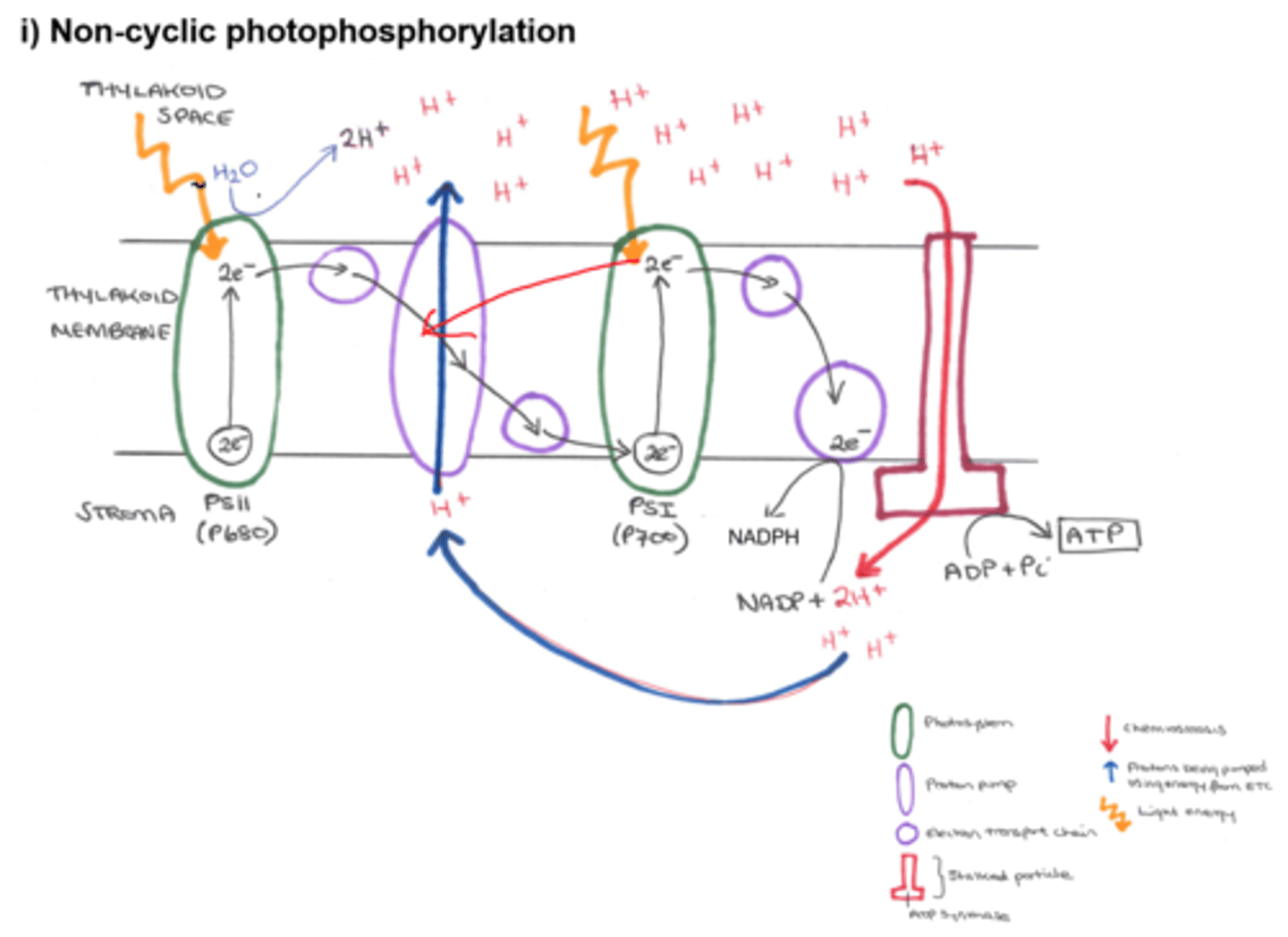
Could you explain the whole of non-cyclic photophosphorylation in the light dependent reactions ?
1. Light energy is absorbed by the pigments in photosystem I and II. The light energy is transferred by the antenna pigments to chlorophyll a in the reaction centres.
2. The light energy is used to excite pairs of electrons (in the chlorophyll a) which are emitted.
3. The electrons are passed to primary electron acceptors which pass the electrons to an electron transport chain.
4. The electrons lost from photosystem II are replaced by electrons released during photolysis (in the thylakoid space).
5. The protons (H+) released during photolysis remain in the thylakoid space to produce a high concentration of protons in the thylakoid space.
6. The protons (H+ ) flow/diffuse down their electrochemical gradient (from the thylakoid space into the stroma) through the stalked particles and ATP synthase. This generates ATP from ADP and Pi. This is chemiosmosis.
7. The electrons emitted from PSII pass down a series of electron carriers in the electron transport chain and replace the electrons lost from photosystem I.
8. These electrons release energy as they go along the ETC which is used to pump the H+ back from the stroma into the thylakoid space to maintain the electrochemical gradient.
9. These electrons are then picked up by NADP (the final electron acceptor) together with two protons from the stroma, to form reduced NADP
10. The ATP and reduced NADP are the two products of the light dependent reactions. They now pass to the light independent reactions or Calvin cycle.
How is carbon dioxide obtained for photosynthesis?
Diffusion through the leaf (stomata) and into the mesophyll cells.
What is the name of the enzyme that catalyzes the addition of carbon dioxide to ribulose bisphosphate?
Ribulose bisphosphate carboxylase (RuBisCO).
What is the name of the 5 carbon compound that combines with carbon dioxide?
Ribulose bisphosphate (RuBP).
What is the process called when carbon dioxide is added to RuBP?
Carboxylation (fixation of carbon).
During the calvin cycle - what happens to glycerate phosphate to convert it into triose phoisphate ?
* Glycerate phosphate is REDUCED to triose phosphate.
* The hydrogen atoms added to glycerate phosphate comes from the reduced NADP (made in the light dependent reactions)
* The energy required to add the hydrogen atoms to glycerate phosphate comes from the hydrolysis of ATP into ADP and Pi (also made in the light dependent reactions)
What is triose phosphate produced in the calvin cycle used for ?
1. The regeneration of RUBP
2. The production of glucose which can then be used to make :
3. Cellulose, sucrose, starch etc
4. Amino acids and proteins (with the addition of nitrogen from nitrates taken up from the plant roots).
5. The production of ATP by using glucose in respiration.
6. DNA, RNA etc
 Note
Note  Flashcards (50)