physcs- dynamics- scalers and vectors
 Call Kai
 Learn
Learn Practice Test
 Spaced Repetition
 Match
Match Flashcards
 Knowt Play
1/5

There's no tags or description
Looks like no tags are added yet.
Name | Mastery | Learn | Test | Matching | Spaced | Call with Kai |
|---|
No analytics yet
Send a link to your students to track their progress
6 Terms
Define vectors and scaler quantities
scalers: has only magnitude
Vectors: has magnitude and direction
Know if: forces, speed, velocity, distance, displacement, acceleration, mass, time, energy, are scalar or vectors
Scalers: speed, distance, mass, time, energy
Vectors: force, velocity, displacement, acceleration,
Calculate the resultant of tow vectors: in one dimension, or at a right angle

Determine displacement, distance, velocity and/or speed using a calculation
•add the vectors head to tail
•remember to include the compass point (eg. east of south)
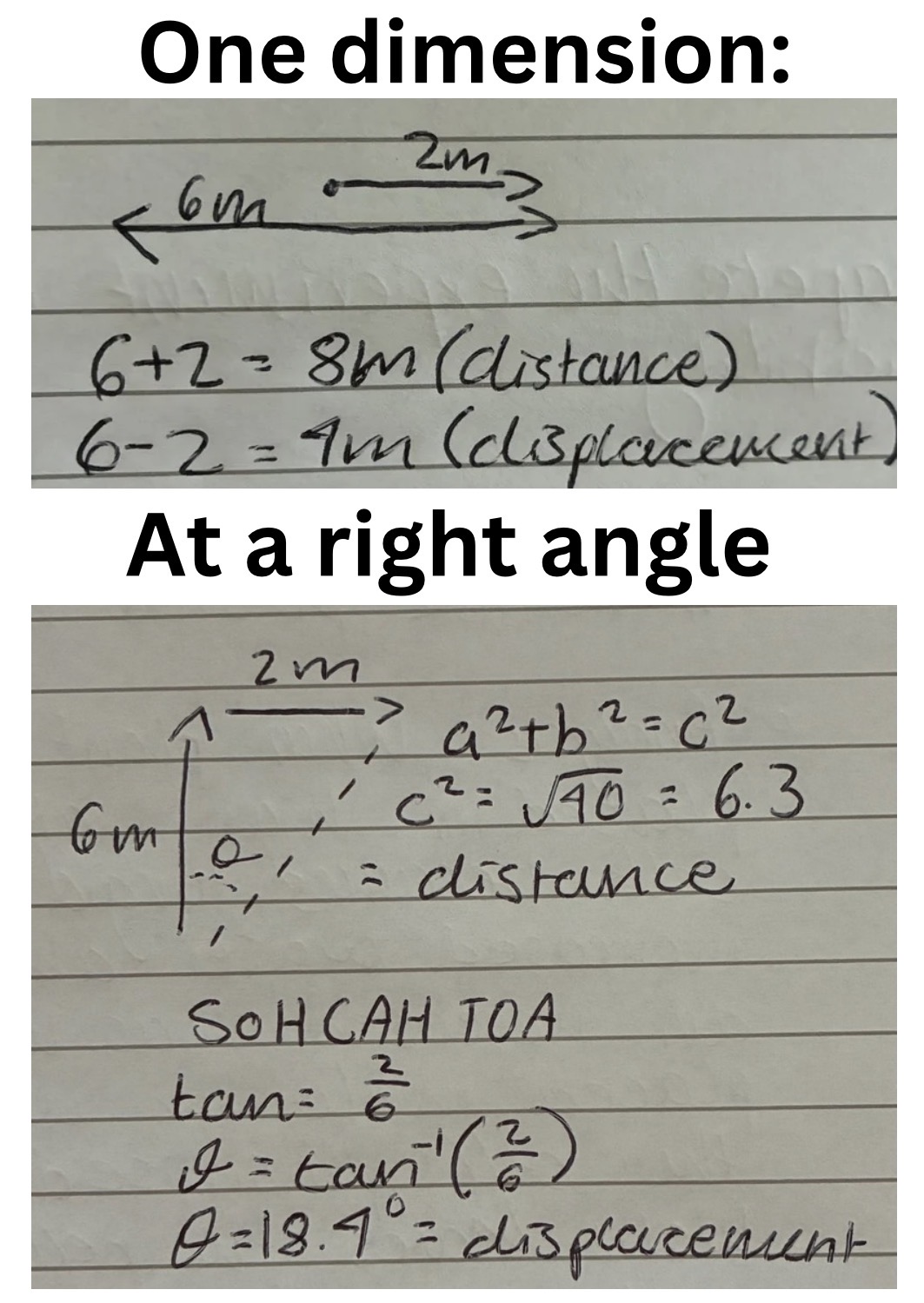
Use appropriate relationships to solve problems: s= vt, d= Vt, s=Vt

Describe experiments to measure average speed and instantaneous speed
To measure average speed
1. Choose a Distance: Select a straight path of a known length. For example, you could use a 10-meter track.
2. Measure Time: Use a stopwatch to measure the time it takes for an object (like a toy car or a person walking) to travel the chosen distance.
3. Calculate Average Speed: Use the formula: average speed = total distance / total time.
For measuring instantaneous speed,
1. Using Light Gates:
* Set up two light gates connected to a data logger at a very short distance apart
* As an object passes through the first light gate, the timer starts, and it stops when the object passes through the second light gate.
* The data logger records the time taken.
* Calculate instantaneous speed using: instantaneous speed = distance between light gates / time recorded.

