Lecture 5: Cellular Reproduction
 Studied by 0 people
 Call with Kai
 Learn
Learn Practice Test
 Spaced Repetition
 Match
Match Flashcards
 Knowt Play
1/74

There's no tags or description
Looks like no tags are added yet.
Name | Mastery | Learn | Test | Matching | Spaced | Call with Kai |
|---|
No study sessions yet.
75 Terms
Cell division causes no change in
Allele frequency
What does cell division occur for
Growth
Cell replacement
Healing
Reproduction
What are the 3 main steps of cell reproduction
Copy genetic information
Separate copies
Cell division
Define DNA replication
The process by which a single parental molecule of DNA produces two daughter molecules
What process do prokaryotic cells divide by
Binary fission
What is the circular genome of bacteria attached to and what by
The cell membrane, by proteins
What is the first step of binary fission - where is this initiated
DNA replication - initiated at the origin of replication
How does replication occur, resulting in what
In opposite directions around circle, results in 2 molecules of DNA attached to the cell membrane at a different site
What happens when the cell then elongates
The two attachment sites start close and move further apart
When the DNA molecules are well separated, what forms
A constriction forms at the midpoint
What is the result of this
Two genetically identical daughter cells, identical also to the parent
Where are the highly expressed genes in a bacterial genome located
Near the origin of replication (Ori)
What are the main differences in genomes and DNA locations between eukaryotes and prokaryotes
Eukaryotes - Large genome, linear - DNA in nucleus
Prokaryotes - Genome small, circular - DNA in cytoplasm
What is the general structure of a chromosome
Telomere at top and bottom
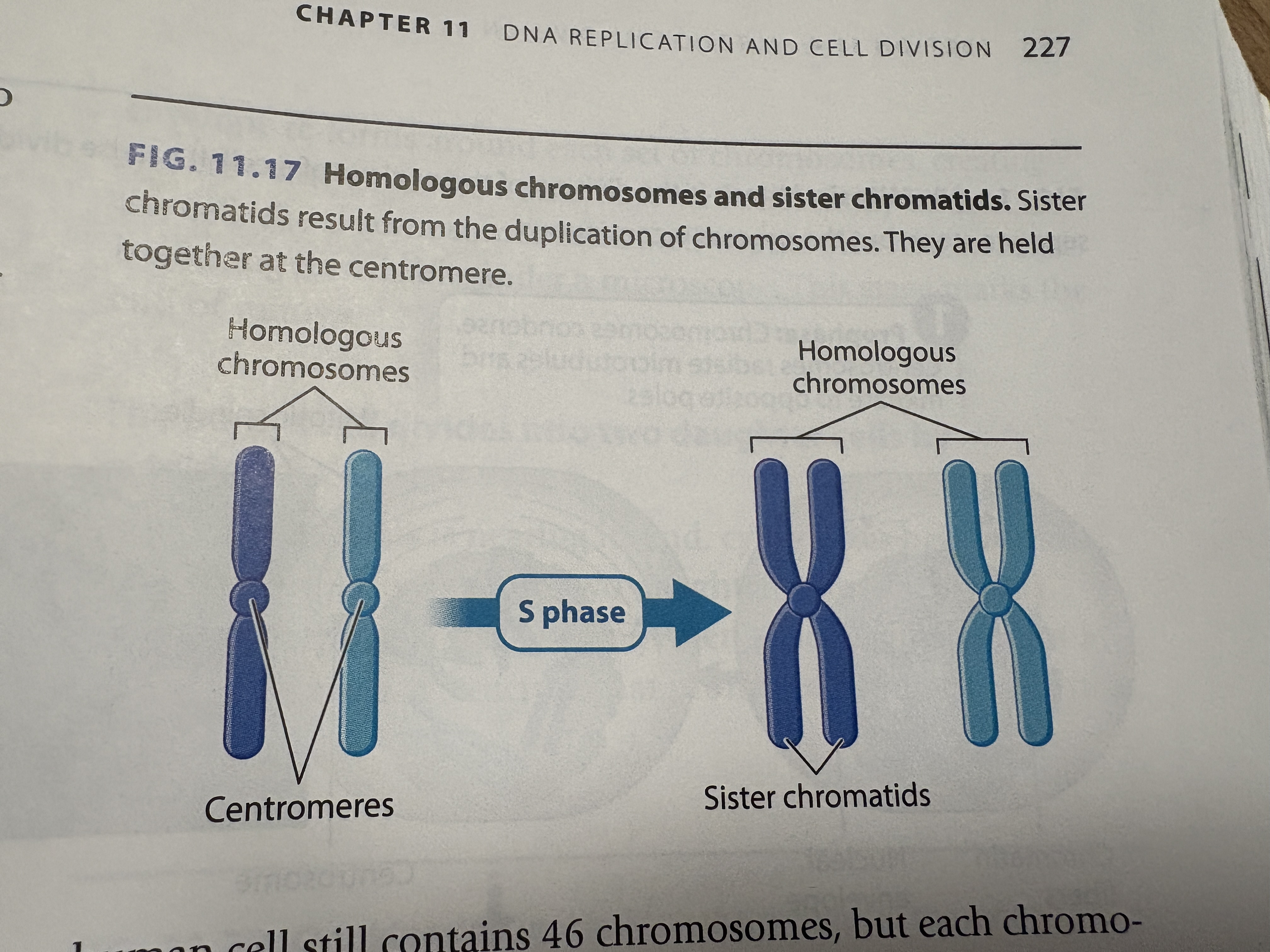
Centromere in middle (connects sister chromatids)
1 chromosome can either consist of 1 chromatid or 2 sister chromatids - both are still ONE chromosome
What is the centromere
Constricted region of the chromosome where the kinetochores form and the spindle microtubules attach
Draw the cell cycle
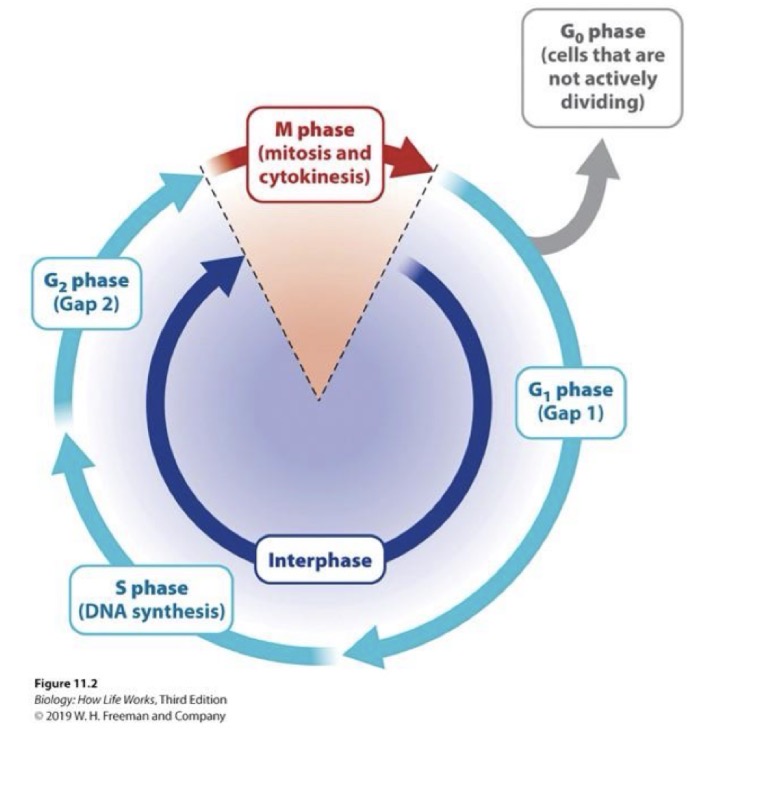
What 2 stages does the M phase consist of
Mitosis (chromosome separation) and cytokinesis (cell division)
What is interphase
The time between 2 successive m phases
What 3 phases is interphase divided into
S phase (synthesis)
G1 phase
G2 phase
What happens to the centrosome in the S phase, what forms around it
Duplicates and migrate to opposite poles, tubulin dimers assemble around them, forming microtubules radiating from each centrosome
What important molecules are synthesised in G1
Regulatory proteins like kinases, which activate enzymes to synthesise DNA
What are the man functions of G1 and G2
G1 - preps the cell for DNA synthesis
G2 - preps the cell for mitosis and cytokinesis
How is G0 distinguished from G1
The absence of preparations for DNA synthesis
Why do cells enter G0
If they are not actively dividing - means they exit the cell cycle and division is dormant (i.e. liver cells)
What are the stages of mitosis
Prophase
(prometaphase)
Metaphase
Anaphase
Telophase
What are homologous chromosomes
Pairs of chromosomes, matching in size and appearance and carrying the same set of genes
One inherited from mother, one from father
Main process in prophase
Chromosomes condense and become visible
What is the change in structure that chromosomes undergo to become visible
From long, thin to short and dense
What happens in the cytoskeleton during prophase
Reorganised - microtubules assemble the mitotic spindle which radiate from the centrosome (microtubules-organising plant for animal cells)
What happens in prometaphase
Chromosomes attach to the microtubules of the mitotic spindle at their centromeres after the nuclear envelope breaks down
What are kinetochores
2 protein complexes on either side of the centromere of each chromosome, they form the site of attachment for a spindle microtubule which eventually pull each sister chromatid to the opposite cel
What is the fundamental of metaphase
Chromosomes align at the equator as a result of dynamic changes in the mitotic spindle
How does this occur
Once each chromosome is attached to the mitotic spindles, the microtubules of the spindle lengthen/shorten to move the chromosomes to the centre of the cell (the equator)
What happens in anaphase
Sister chromatids fully separate
What happens to the centromere
It splits, as the spindle microtubules shorten and pull the chromosomes to opposite poles of the cells
What happens in telophase
Nuclear envelopes re-form around newly segregated chromosomes
What happens to the microtubules in this stage
They break down and disappear
What is formed during telophase, what happens to the chromosomes after
New nuclear envelope forms around each set of chromosomes, creating 2 new nuclei - chromosomes then decondense and become less visible.
What is the process of cell splitting called
Cytokinesis
What forms in order for the cells to split, how does it split the cells
A contractile ring forms against the inner face of the cell membrane
The ring contracts to divide the cytoplasm
What drives the constriction of the contractile ring
Motor proteins that slide bundles of actin filaments in opposite directions
Since plant cells have a cell wall, how does telophase differ
Instead of a contractile ring, a phragmoplast forms (overlapping microtubules which guide vesicles of cell wall components to the centre of the cell)
What are the products of mitosis
2 diploid, genetically identical daughter cells
How are gametes (egg/sperm cells) formed
Meiotic cell division
What is fertilisation
The fusion of 2 haploid gametes to form a diploid zygote
How many rounds of DNA replication are there in meiosis, how many cell divisions
1, 2
What is separated in meiosis 1, what effect does this have on the total number
Homologous chromosomes, reduces the total number of chromosomes by half
What is separated in meiosis 2
Sister-chromatids (like in mitosis)
What happens in prophase 1
Same as in Prophase of mitosis, with the addition of bivalents forming between non-sister chromatids
The chromosomes then undergo synapsis, what is this?
The precise pairing of homologous chromosomes, where they lie side-by-side
What does synapsis allow to occur
Crossing over and the formation of a bivalent (the structure formed when 2 pairs of homologous chromosomes cross over)
What do non-sister chromatids result from
The replication of homologous chromosomes, so have same set of genes in the same order, but aren’t genetically identical
What do sister chromatids result from
Replication of a single chromosome, so are genetically identical
What is the site of crossing over called, why can this result in genetic variation
Chiasma, the position of chiasmata on a chromosome is random
Why does crossing over increase genetic variation
Recombinant chromatids carry different combinations of partially paternal/maternal genes
What happens in prometaphase I
Spindles attach to kinetochores on chromosomes after nuclear envelope breaks down
What happens to the bivalents in metaphase 1, why does this cause genetic variation
They line up so the two centromeres lie on opposite sides of the plane, but it is random which pole the maternal homolog/paternal homolog is taken to
What happens to these bivalents in anaphase 1, why does it differ to mitotic anaphase
The 2 homologous chromosomes of each bivalent separate and are pulled to opposite poles
The main difference is that the centromeres don’t split so the sister chromatids remain attached
What is the number of chromosomes at each pole in anaphase 1
23 (haploid number)
Why is meiosis 1 called reduction all division
Number of chromosomes in the daughter cells reduces as each chromosome consists of 2 chromatids attached to a single centromere
(i.e. there are 2 bivalents in prophase 1, each bivalent gets carried to either pole, so there are only 2 chromosomes in each daughter cell)
What is the main difference between mitotic telophase and meiotic telophase
In meiotic telophase, the nuclear envelope only briefly reappears and the chromosomes do not completely decondense
Meiosis 2 is the same as
Mitosis
What is meiosis 2 often called, why
Equational division - as the cells have the same number of chromosomes at the beginning and the end
What is produced in meiosis
4 genetically different, haploid daughter cells
Draw mitosis/meiosis
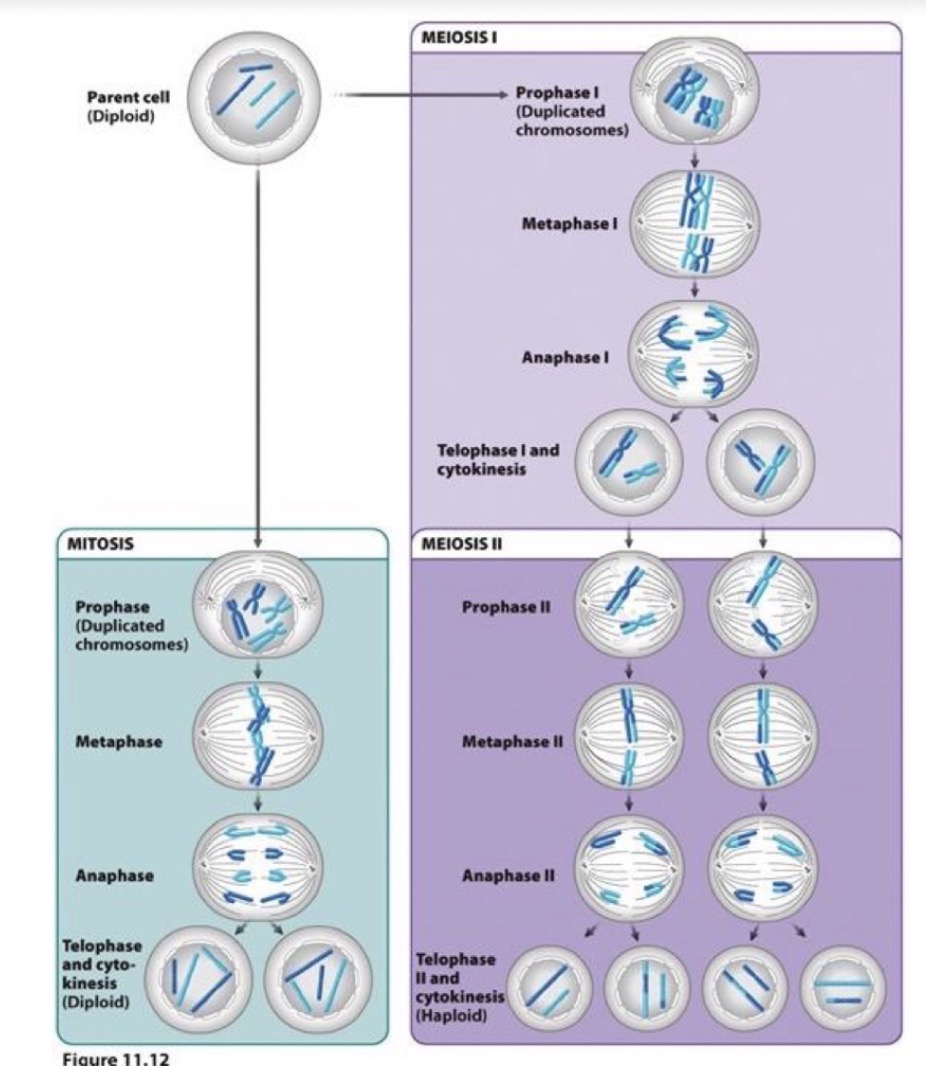
What are the 3 sources of genetic variation in meiosis
Crossing over, Independent segregation, Random gamete fusion in fertilisation
What does it mean that meiosis is fair
½ the haploid gametes from each diploid allele
No change in allele frequency
How do cyclin-CDK complexes regulate the cell cycle
The level of cyclins (regulatory proteins) rises and falls during the cell cycle, activating kinases which target and phosphorylate proteins promoting cell division
What are these kinases called, when are they active
Cyclin-dependent kinases, activate when bound to appropriate cyclin
What are the 4 types of cyclin, when do they activate CDKs and what do they do
Cyclin A - Levels rise during S phase, activating CDKs which help to initiate DNA synthesis
Cyclin B- Levels rise in G2, activating CDKs which help to prepare the cell for mitosis (i.e. targeting proteins which trigger the breakdown of the nuclear envelope and formation of mitotic spindle)
Cyclin D and E - levels rise in G1 and prepare the cell for DNA replication by activating transcription factors and DNA polymerase
What else is used for the regulation of the cell cycle
Checkpoints
What are these checkpoints/ where
DNA damage checkpoint - between G1 and S
DNA replication checkpoint - between G2 and M
Spindle assembly checkpoint - before anaphase in M
How do these checkpoints work
If damage/incomplete replication is detected, cyclin-CDK activity is blocked and the cell cycle is halted until issue is fixed
When DNA is damaged by radiation, what protein is activated and how
p53, an activated protein kinase phosphorylated p53
What does p53 do
Binds to DNA and turns on expression of several genes one of which blocks cyclin-CDK complexes between G1 and S, arresting the cell here until fixed
 Note
Note  Flashcards (36)