ASTR 100 Midterm 2
 Studied by 0 people
 Call Kai
 Learn
Learn Practice Test
 Spaced Repetition
 Match
Match Flashcards
 Knowt Play
1/179

There's no tags or description
Looks like no tags are added yet.
Name | Mastery | Learn | Test | Matching | Spaced | Call with Kai |
|---|
No analytics yet
Send a link to your students to track their progress
180 Terms
Light
made of photons
Photons
Particles, produced when charged particles accelerate (shake)
Light is also an
electromagnetic wave
light can travel through a
vacum
Interference
Light behaves like a wave, creating (blank) patterns where waves add up to make brighter spots or cancel out to make darker spots.
Photoelectric Effect
demonstrated that light sometimes behaves like a particle
Longer wavelength
lower frequency
Shorter wavelength
higher frequency
Wavelength
distance between adjacent peaks of the wave.
Frequency
The number of peaks going by you every second.
Speed
wavelength x frequency
• Color of the visible light is determined by
frequency
Blue
Shorter Wavelength; Higher Energy
Red
Longer Wavelength; Lower Energy
Visible light
only a small part of what we call the electromagnetic spectrum
The EM spectrum includes
radio waves, infrared, visible, ultraviolet, x-rays, and gamma rays
Sir Frederick William Herschel
discovered Infrared Light and Uranus
Completely transparent
light goes through without being changed.
Opaque
Does not transmit light (absorbs it).
The darker a surface
the more sunlight it absorbs
The lighter a surface
the less sunlight is absorbed
Albedo
Amount of reflection
Albedo = 0
means no reflection (all light absorbed)
Albedo = 1
means total reflection (no absorption)
Earth’s albedo
0.39
Moon’s albedo
0.07
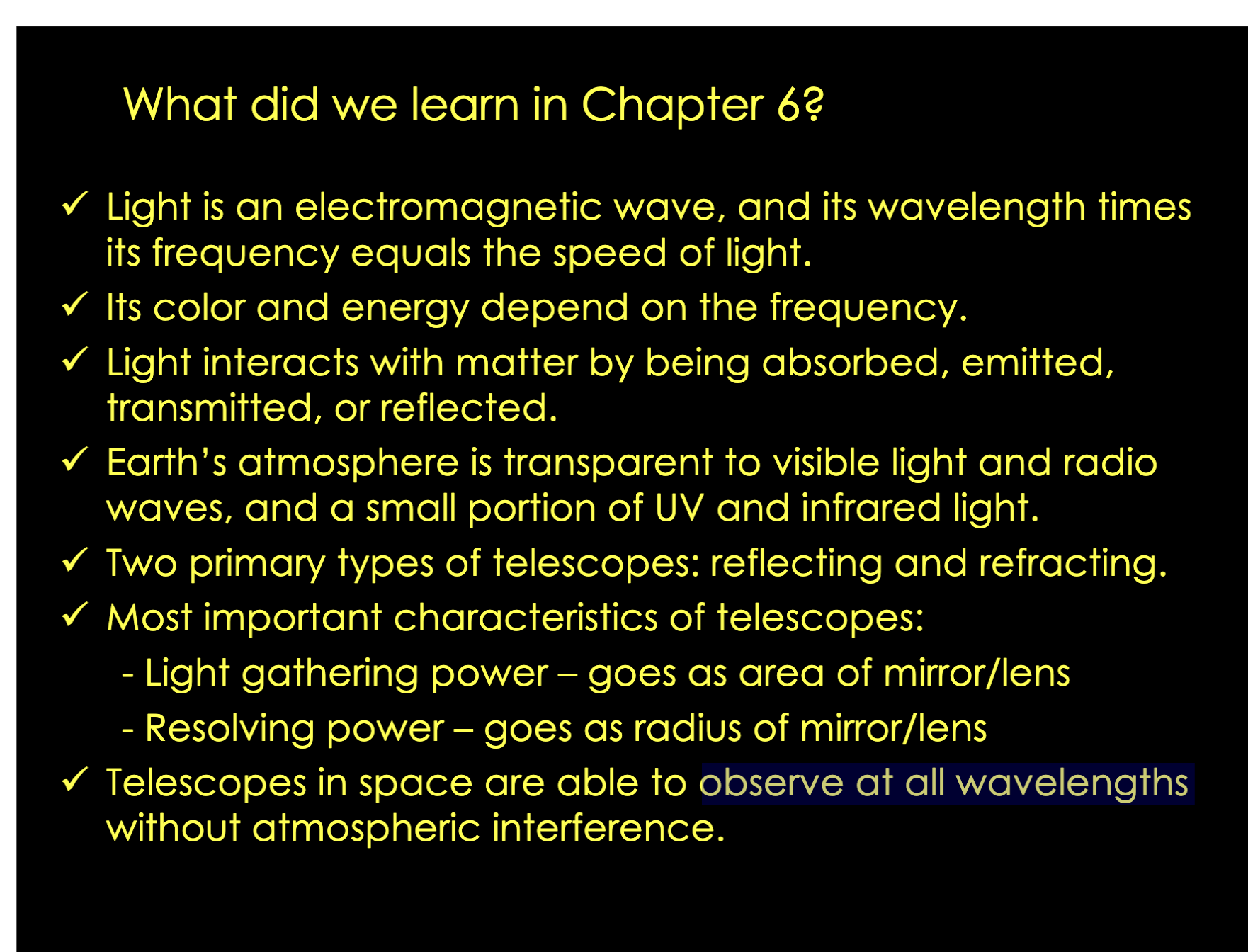
Telescope
a tool used to gather light from objects in the universe
Refracting
telescope uses a glass lens to concentrate incoming light
reflecting
telescope uses mirrors to concentrate incoming light
Refractors
The largest refracting telescope ever built is 40” (100 cm) in diameter.
They suffer from “chromatic aberration” and are no longer used for astronomy.
Main functions of a telescope
Gather as much light as possible,
Resolve objects, Magnify images
A larger objective lens provides a
brighter (not bigger) image
Light gathering power
is proportional to area of mirror or lens, proportional to R2
Resolving power
is the ability to see detail, or to resolve two
objects near one another
The angular resolution
of a telescope is determined by the diameter of the
mirror or lens (smaller number for resolution=better resolution
Earth’s atmosphere limits resolving power to
1” (arcsecond)
Twinkle
Temperature and density differences in Earth's atmosphere bend starlight
Radio telescopes
“sees” radio waves, and can locate sources of radio waves from space.
Radio astronomy
Radio waves are not blocked by clouds of gas and dust and allow us to peer inside the center of the Milky Way.
Bigger wavelengths
need bigger telescopes
Luminosity
is the total energy (light) emitted by an object in each second.
Luminosity Equation
Luminosity = A x T 4
Big and Hot objects have
greater luminosity than small cool objects.
Blackbody Curve
a graph of an object’s energy output per wavelength. The peak of this curve tells us about the object’s temperature and color.
Color
when the lights are off
Wein’s law
Relates the temperature of an object to the wavelength of the peak in the black body curve. Hotter objects have shorter peak wavelength.
Protons, Electrons, and Neutrons
carry positive charge, carry negative charge, neutrons neutral
Charges create electromagnetic radiation
light
Elements
has a unique atom that is a combination of neutrons and protons in the nucleus, surrounded by a cloud of electrons.
Matter is made up of
atoms
Atomic Number
number of protons
Mass number
total number of nucleons
Hydrogen
one proton + one electron
Helium
two protons, two neutrons, two electrons
Carbon
six protons, six neutrons, six electrons.
Composition of the Universe
75% H + ~25% He (most of it produced in the Big Bang) + trace of heavier elements (most of it produced in stars).
Isotopes
Atoms of same element with extra neutrons.
• Adding a neutron to hydrogen atom gives
deuterium. Adding two gives tritium.
• Carbon has three natural isotopes, one of
which is unstable (and very important in determining age of fossils).
Molecules
When two or more atoms bond together.
• One atom of oxygen plus two atoms of
hydrogen give a molecule of water.
Organic Molecules
Contain C and H and are often complex chains of atoms
Gas
a collection of atoms and/or molecules in random motion, without a definite shape and volume
Plasma
ionized gas in which some or all of the electrons aren’t bound to atoms.
Emission of a photon
Photon is emitted from an atom when an electron moves from a higher energy level to a lower energy level.
Absorption of a photon
When a photons is absorbed by an atom, its electron moves from a lower energy level to a higher energy level.
Atomic energy levels
Structure of atomic levels determines which energies of photons are possible for the atom to absorb or emit.
Atomic “fingerprints”
Each chemical element produces its own unique set of spectral lines when it is excited!
Continuous Spectrum
Uninterrupted rainbow of wavelengths
Emission Spectrum
Specific wavelengths emitted
Absorption Spectrum
“Missing” wavelengths tell us about the gas cloud.
Doppler effect
the perceived frequency of a wave (like sound or light) changes depending on whether the source of the wave is moving towards or away from you
Redshifted
moving away
Blueshifted
moving toward us
The Sun
5800 K; Accounts for 99.86% of the total mass of the Solar System (1000 times more mass than all planets combined).
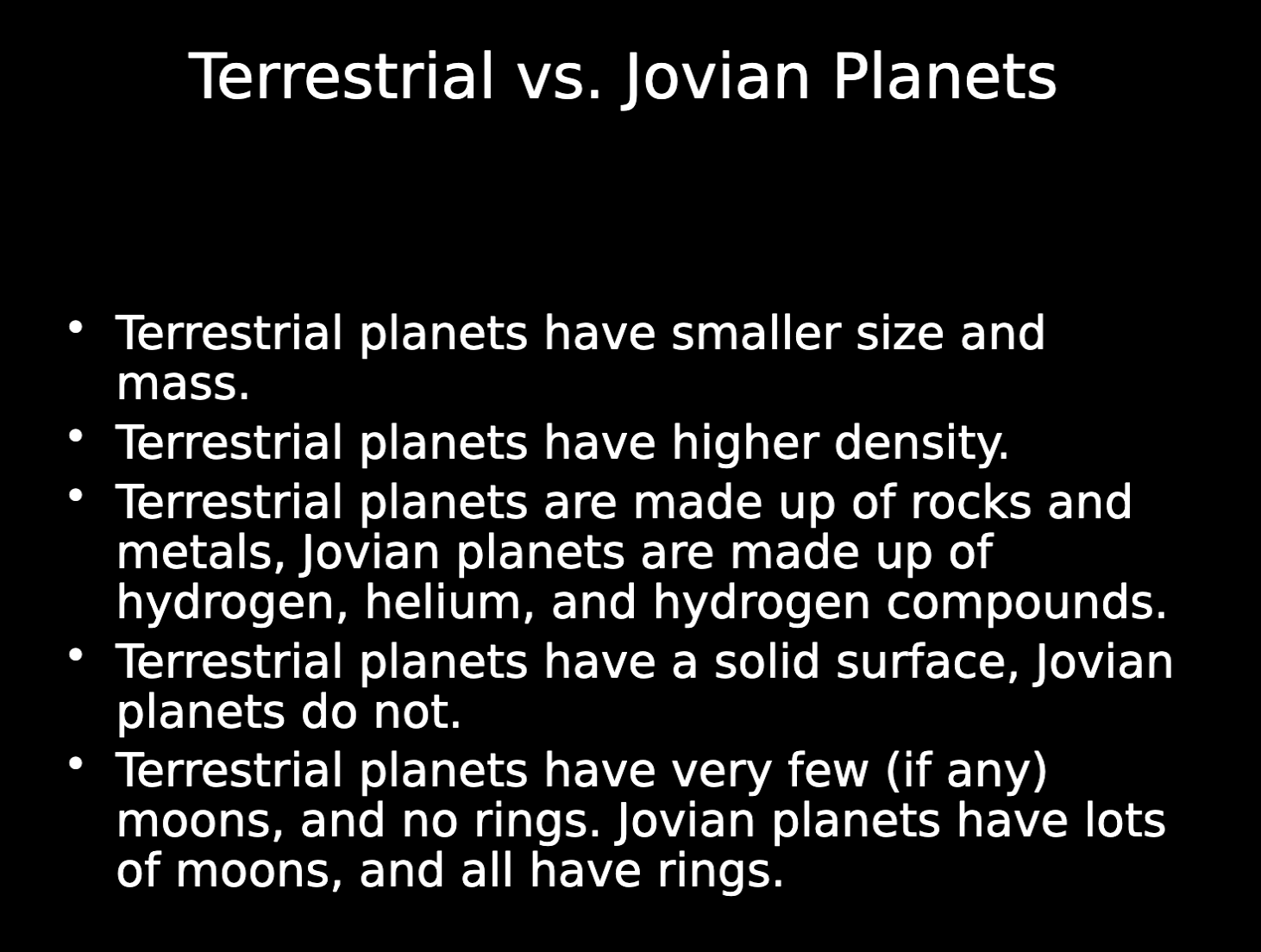
Terrestrial planets
Four planets closest to Sun (Mercury, Venus, Earth, Mars).
Jovian planets
Next four planets are “Gas Giants,” (Jupiter, Saturn, Uranus, Neptune).
Terrestrial vs. Jovian Planets
smaller size, higher density, solid surface, few moons
discovered uranus
William and Caroline Herschel
Discovery of Neptune
Le Verrier and Galle
Percival Lowell
constructed the Lowell Observatory to find Pluto (unnamed atp)
Who found Pluto?
Clyde Tombaugh
Sedna
86 AU (twice the distance to Pluto), the size of Charon.
Eris
More massive (but slightly smaller) than Pluto and has a moon Dysomnia.
Asteroid belt
Mars and Jupiter
Kuiper Belt
extends beyond the orbit of Neptune and includes a number of dwarf planets, including Pluto. About 10 times the mass of the Moon
Oort Cloud
a distant cloud of comets
Planetesimals
leftovers from planet formation
Asteroids
Rocky/Metallic planetesimals formed close to the Sun
Comets
Icy planetesimals formed outer planets
Definition of a planet
orbits the sun, round shape, cleared the neighborhood around its orbit
Solar Nebula Theory
Solar system formed from the collapse of an interstellar nebula (a cloud of gas). Proposed by Kant and Laplace (18th
century).
Condensation
is the formation of solids from the cooling gas of the solar nebula
Accretion
is the sticking together of solid particles to make bigger particles.
What Happens to the Solar Nebula as it
Collapses
Spinning: Solar nebula contracts and spins up –
conservation of angular momentum.
• Heating: temperature of solar nebula increases as it collapses – gravitational potential energy converted into thermal energy.
• Flattening: collisions result in orderly motion of its
components (while conserving momentum), the gas radiates away some energy, and the nebula flattens into a protoplanetary disk.
Frost Line
cold enough for icy planetesimals to form, and for planets to hold on to gases. Inside the frost line, only rocky and metallic
planetesimals formed.
Differentiation
the separation of material according to density
Nebular theory
the gas giants formed their own accretion disks, forming their moons
Nice Model
Neptune and Uranus formed closer in and migrated outward due to repeated interactions with the two gas giants
The Age of the Solar System
4.5 billion years old
Four Eons
Hadean, Archean, Proterozoic, and Phanerozoic.
Hadean
(hellish) Earth (till 3.85 billion years ago) during late heavy bombardment, continents just beginning to form
 Note
Note  Flashcards (31)