Introduction to Media Studies
 Call Kai
 Learn
Learn Practice Test
 Spaced Repetition
 Match
Match Flashcards
 Knowt Play
1/105

Earn XP
Description and Tags
Theories learnt Introduction to Media Studies + Examples of each one
Name | Mastery | Learn | Test | Matching | Spaced | Call with Kai |
|---|
No analytics yet
Send a link to your students to track their progress
106 Terms
Media and environment
Media is an enabling environment that provide habitats for diverse forms of life, including other media.
John Durham Peters
Media and Power
Media are civilisational ordering devices (p.5)
ordering devices: influence how civilisations evolve and function
media can guide people’s attention (insta: what people view, think is the real world)
John Durham Peters
New Media Definition
Means of mass communication using digital technologies such as the internet (hyper immediacy and immediacy)
New Media Theory
use of computer, distributed and exhibition, rather than production
computerisation of media
computerization word is too limiting, computers are also a part of storage and production
Media being interactive, you can edit within the new media, which is independent, but you can add video and audio
popular definition of new media identifies it with the use of computer for distribution and exhibition, rather than, with production
Lev Manovich
New Media Revolution
Printing press → distribution of media
photography → still images
New media revolution affects all stages of communication, including acquisition, manipulation, storage, and distribution; also affects all types of media - text, still images, moving sounds, sound spatial constructions
Lev Manovich
New Media Principles
Numerical Representation
Modularity
Automation
Variability
Cultural Transcoding
New Media: Numerical Representation
Number 1
All new media objects composed of digital code;
Consequences:
New media objects can be described mathematically
New media object is subject to algorithmic manipulation
media becomes programmable
Numerical representation occurs through digitisation of (traditional) media
Step 1: Sampling, continuous signal → discrete signal
Example: Digitising music continuous sound wave → a series of discrete values
Step 2: Quantification, sample – numerical values (binary code)
Examples: images - colour
New Media: Modularity
Number 2
Assemblage of discrete units
Units
independently stored and alterable
are assembled together into large-scale objects
can be altered, removed, replaced, used elsewhere, etc. without compromising the whole.
they maintain their separate identity.
Example:
Code (same code can make different things)
New Media: Automation
Number 3
Numerical representation + modularity → automation
Algorithms: create, modify, analyse media. Database become important.
Examples:
Google image search, photo editing tools
Low level (ex. photoshop, Van Gogh filter)
High level (ex. AI, machine learning)
New Media: Variability
Number 4
Many versions of the same object – not any longer all same copies
Old media (logic of industrial mass society)
New media (logic of personal variability)
Examples:
Newspaper VS News website
Many versions of the same object - not any longer all same copies - on the same website
New Media: Cultural Transcoding
Number 5
New media has computer layers and cultural layers which influence each other
Cultural layer: What we want
Computer layer: What the computer can do
Example:
filter-inspired cosmetic surgeries
(Double logic or) Remediation
they posit a digital paradox: using mediating technology to attempt immediacy.
the way in which one medium is seen by our culture as reforming or improving upon another
Hyper immediacy
Makes the viewer aware of the medium or media
We can see the medium, not invisible
If we have this, we have the option of engagement points and enhance interaction
Examples:
TV news programs with multiple video streams, split-screen displays, with graphics and texts
Netflix, HBO Max, News, etc.
Immediacy
The medium itself should disappear and leave us in the presence of the thing represented
Examples:
VR headset, you are seeing the medium, immersing without knowing you are in the medium
Photography, you do not see the medium, the camera, but you do see the media
Printing Press
Manuscript (6th - 15th century)
handwritten
unique
hand-copied
time-consuming
expensive
transcription mistakes
private hands, usually upper class
Print (15th century - present)
more durable material
easier duplication, mass-reach
identical, comparable copies
standard text, without mistakes
The invention of the printing press
“Gutenberg did not invent the book itself […] He invented a special way of duplicating the book by means of moveable type and by developing the printing press”
Wireless Communication
Use of communication without cables and connections
Radio Golden age: late 1920s
Examples:
Titanic Distaster (1912)
World War I (1914-1918): Military communication
millions into research - helped advance the industry
Ham radio
the use of radio frequency spectrum for non-commercial purposes
Radio
Tribes (oral cultures) → Print media → detribalisation → electronic media → re-tribalization
demands attention
can stir emotions (orality)
collective consciousness
same emotions
feel the same when listening to news
bring together nations
sense of belonging
shared national identity, collective experience
The War of the Worlds (Orswon Welles, 1938)
Sound media
Was broadcasted like the news, so they thought it was real and thought war were invading
so intense, orality, believed it, immediacy
radio, source, credibility
Edison’s kinetoscope (1891)
Screen media
forerunner of the motion-picture film projector
The kinetoscope enabled one person at a time to view moving pictures.
The Roundhay Garden Scene
First moving picture
Lumière cinématographe
Cinema’s Golden Age
Early and Mid 1930s
“Golden Age of Hollywood”
During the 1930s and the 1940s, cinema was the principal form of popular entertainment
Aura and Authenticity
unique existence in time and space
Aura - experience
mechanical reproduction destroys it
Walter Benjamin
Democratization of Art
accessibility but comes with the loss of aura
Walter Benjamin
Film
A revolutionary art form -can present reality in ways that the human eye cannot perceive
Cult Value VS Exhibition Value
Mystery VS Art for the masses
Walter Benjamin
Concentrated VS Distracted Consumption
Art demands a deep contemplative focus VS Audiences absorb the artwork in a state of distraction
Walter Benjamin
Capitalism (in art)
Art becomes commodified - determined by market forces
Walter Benjamin
Politics (in art)
Fascists used art to produce certain reactions in the masses
Communists use art to produce knowledge
Walter Benjamin
“Media as a shaper” approach
Media influences Society
“Media as a mirror” approach
Society influences Media
Uses and Gratification Theory
Low Impact: audience controls media use
Medium for individual purposes
People not passive, actively use media for gratification
What they do for people, not can do to people
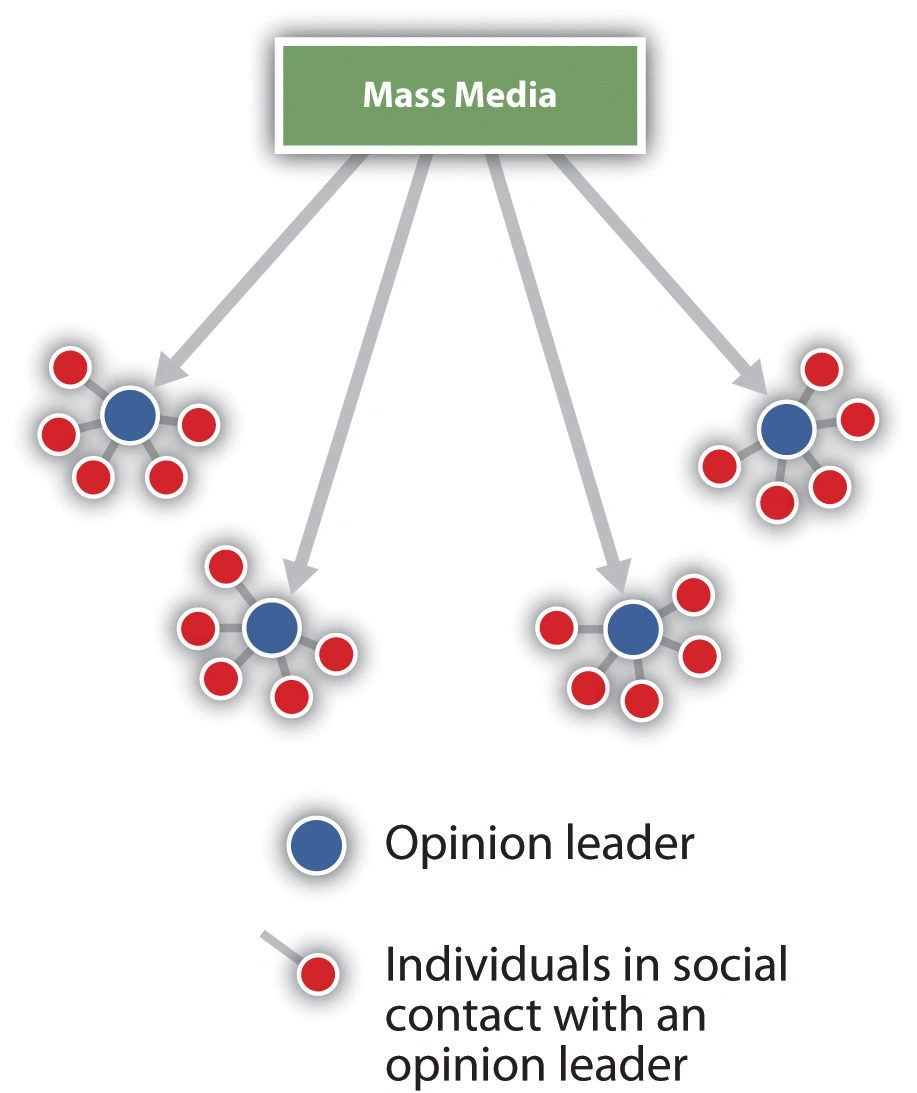
Multiple Step flow Model
Media effects are indirect
Shows role of personal influence in changing human attitudes and behaviour
Opinion leader: a person who is (or considered) an expert in a field can spread information to others (Opinion leader is impacted and spreads the message)
Agenda setting theory
Between Low and High Impact
ability to influence the importance placed on the topics of the public agenda: media structures what we care about
Basic assumptions:
Press and the media filter and shape reality; They do not make it
Media concentration on subjects leads to the public to perceive these issues as more important
The Third-Person Effect: individuals will perceive media messages to have more effect on other people than themselves
Spiral of Silence Theory: Don’t speak up because individual is scared that others may disagree
About cognition (what) not direct attitude or opinion (how)
Ubiquity: media everywhere so messages are accessible by all in most contexts
Cumulation: repetition of certain perspectives, topics, trends or themes have a cumulative effect
Consonance: convergence of opinions or viewpoints given in diverse media outlets
All 3 make powerful in shaping public opinion
Hypodermic needle theory
High impact: audience directly controlled by media
Media directly shape audience opinions/actions, media messages are irresistible
“The media said it therefore it must be true”
Developed in 1930s
Discredited today
People have agency
Propoganda vs. Persuasion
Persuasion: Open, interactive and transparent exchange of ideas seeking voluntary change
Propaganda: Deliberate yet disguised intent of manipulation, systemic plan to achieve a purpose
Propoganda (Defintion + examples)
the deliberate, systematic attempt to shape perceptions, manipulate cognitions, and direct behaviour to achieve a response that furthers the desired intent of the creator
ethical criteria: deceptive in its aims, does not tell the whole truth
Examples:
Political -> political campaigns, public relations
Commercial -> advertisements
Religious -> proselytism
Propaganda Characteristics
Well-being of audience is secondary (at best)
Promotes intention of propagandist
Eliminates nuance in perspective
Often conceals purpose
May conceal or mis-state identity (of creator; information sources)
Propoganda Forms
White
Comes from a source that is identified correctly. The information in the message tends to be accurate (maybe on-side of the argument)
Gray
The source may or may not be correctly identified, and the accuracy of the information is uncertain
Black
When the source is concealed or credited to a false authority and spreads lies, fabrications, deceptions.
Propaganda Techniques
Use of images and certain words (ex. glittering generalities, bandwagon, etc.)
Controlling the flow of information (media <-> society)
Propaganda Today
Algorithms + data
Algorithmic Power
Black Box
Receive an input, process in a way we don’t know, and then produce an output
low opacity
technical opacity
When the process is not transparent, we cannot control algorithms
Necessary and natural mediators
Example: Google, an impartial search engine, playful and neutral to make it so that everyone thinks that they can reach all information, which is not neutral and does not invite critical thinking
Cambridge Analytica
Used facebook likes to infer people’s personalities and interests.
to identify issues that people would support
to identify the way in which relevant arguments should be presented
Use Value
Used in advertising
Relates to the utility a product or service provides to a user.
Symbolic Value
Used in advertising
What products might mean and say about their consumers
Advertising products to produce symbolic value that signals to what group one belongs, or to what sub-culture etc.
Advertising in the digital world
Shift from traditional spot advertisement (print media, television, radio) to digital media
Surveillance capatlaism
economic system based on data
our private human experience is the raw material for behavioural data
predictive data about us but not for us
The aim is profit through targeted advertising
What does representation have to do with culture and meaning?
How something is presented to an audience
Meaning is constructed and produced through the process of representation and exchanged between members of a culture
It does involve the idea of language of signs and images which stand for or represent things. But this is a far from simple or straightforward process…
It does involve the use of language, of signs and images which stand for or represent things. But this is a far from simple or straightforward process
How does the concept of representation connect meaning and language to culture?
The reflective: relation between representation and thing being represented
The intentional: connects meaning and language to culture by emphasising role of the creator’s intentions and cultural connect, shaping representations
The constructionist: representation not direct reflections of reality but are created through cultural and social processes
Stuart Hall’s concept of representation
Representation as Reflection of Reality → Representation as Constitutive (*representations play an active role in constructing and giving meaning to realities)
shaped by forces of culture and power
Signs
Iconic signs
Indexical signs
Symbolic signs
How we understand and communicate about the world through signs and symbols
Iconic signs
Physically resembles what it stands for

Indexical signs
There is a causal relation between the sign and that for which it stands
Related to other senses: smell, sound, etc.

Symbolic signs
Symbolic signs rely on conventions, agreements, and shared cultural meanings
Arbitrary: no similarity or cause-effect

Signs: Saussure (Example of apple)
Signifier
the physical form (word, sound, image)
Example: apple
Signified
the concept or mental image
Example: fruit, freshness, healthy, etc. Brand? Original sin?
Signs: Semiotics
the study of signs, symbols and their interpretation
Signs are not only words or images but objects themselves as well!
Examples:
Clothes operate as signs of taste, status...
Having a MacBook → status
Denotation
literal meaning / basic, surface-level meaning
Connotation
emotional, cultural associations / Additional layers of meaning
Systems of representation: Concept, Signs, Codes
Conceptual system: Concepts in our head
Shared language/language system: organised system of signs that carry and express meaning
Relation between the two is secured by codes
Codes are historical and cultural: they are not stable - meaning is unstable
The “code” in semiotics refers to a system of conventions, and rules that govern how signs are used and interpreted within a particular cultural or social context
Examples:
Red light means stop
a tree we recognise as a tree in our language
Why should we care about semiotics and representation?
Provide insight how meaning is created, conveyed, and interpreted in human communication.
Critically analyse media messages → hidden meanings and biases
Understanding representation helps us recognise and challenge stereotypes and misrepresentations
The media theorists job is to find the ideology expose it and critique it
Marketing and advertising: representation and semiotics play vital role in shaping consumer behaviour
Art and Aesthetics: how artists use symbols and signs to convey their artistic visions.
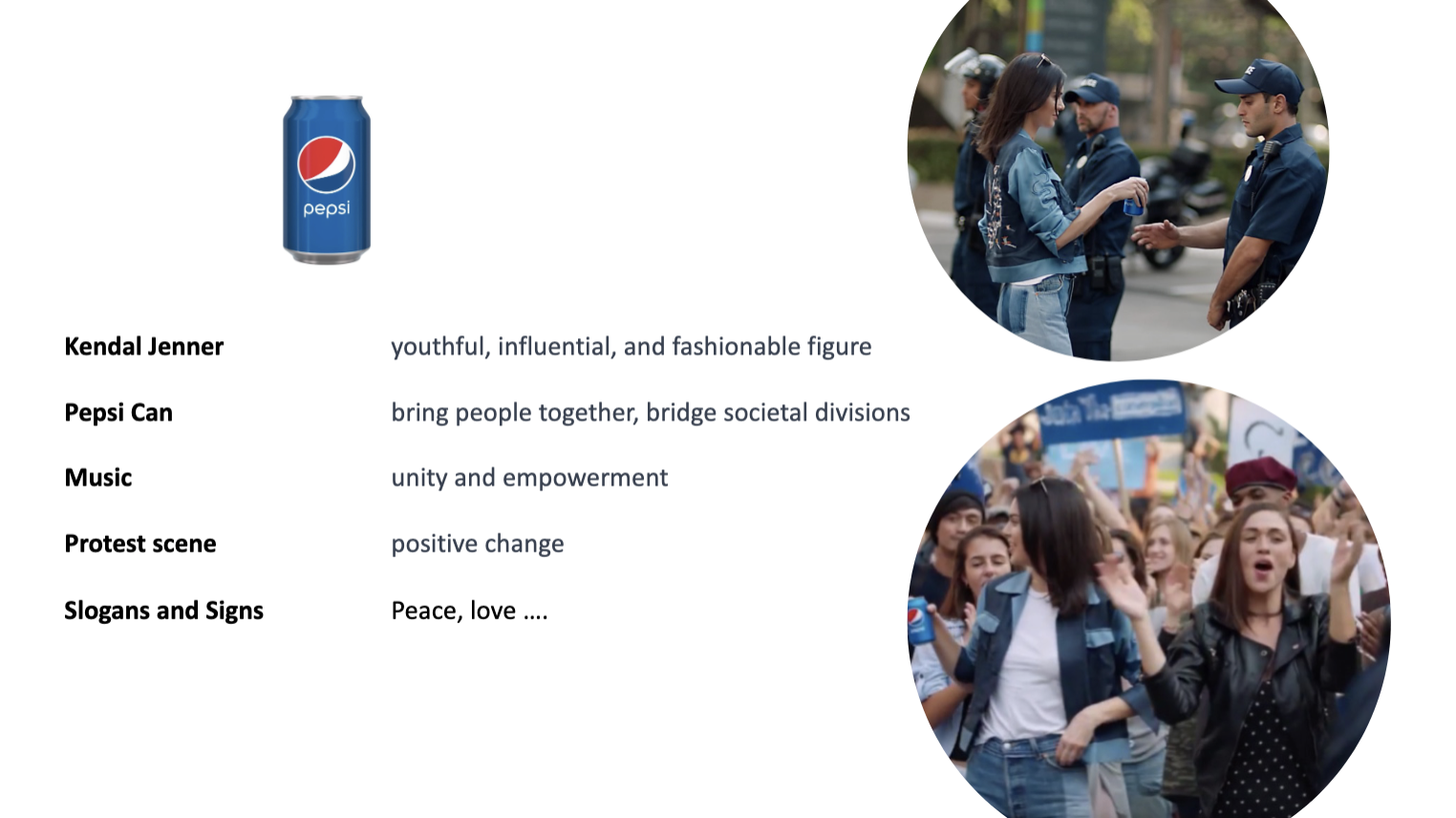
Media content
Mass media as a site for struggle over meaning
Media products/texts
Semiotic constructs: specific ways of seeing the world
Ideological: shape our perception of the world
Concealed coding
Representations become “common sense”
Culture
Learned at an early age
Media
make ideological representation look objective, natural audiences no longer question or challenge them
they are presented as “common sense”
Example:
Avengers all posing, no one notices how sexualised the woman is posed
Encoding/Decoding Model
The Dominant Position
Agree and accept what the media encodes
the “preferred reading”
The Negotiated Position
Readers partially agree with the encoded messages
Readers accepts preferred reading but sometimes resists and modifies, reflect personal interests and experiences, local/regional readings, etc.
The Oppositional Position
Reader understands the preferred reading
They reject this reading
They decode the text differently
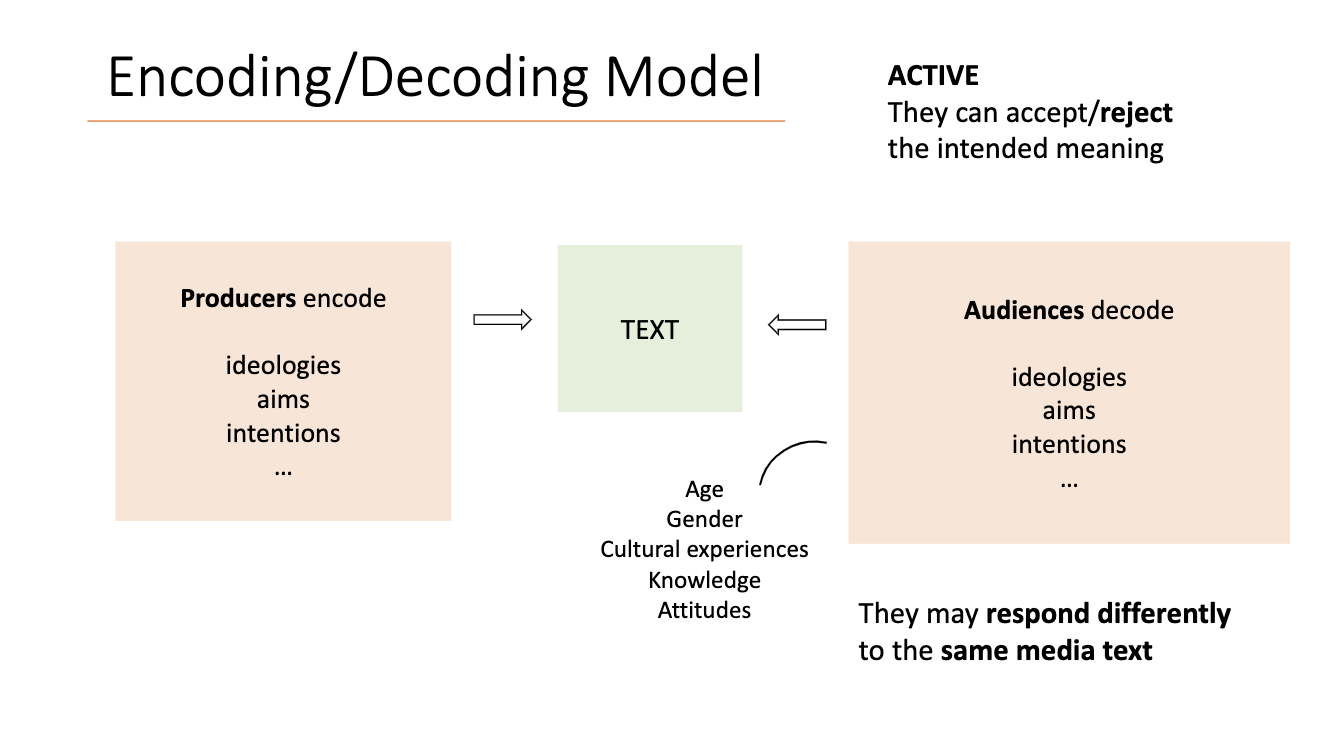
Notes on Encoding/Decoding Model
! The codes of encoding and decoding may not be perfectly symmetrical
Hegemonic code:
try to define meanings
'natural', 'inevitable’
! The dominant group - advantages
Ideology actively intervenes in the meaning making
without excluding the resistance of the audience
deconstruct the 'naturalness' of representation to reveal the ideological
constructions
Ideology: Marx
Media as purveyors of dominant ideology
Bourgeoisie/the ruling class VS Proletariat/working class
Dominant ways of thinking/ideology: reflect the interests of the ruling class emerged from capitalist relations
“False consciousness”: people in a capitalist societies accept the system, even though the ideological messages contradict their actual living conditions
they present the world as it is (ie the subordination of the lower class) as natural, there fore as correct and acceptable
Ideology: Frankfurt School
The ideological role of consumerism and mass media
Culture industry and art → mass commodity (under capitalism)
content: standardised, predictable
consumption: simple, repetitive, effortless
content of culture industry is superficial and fake uniqueness and individuality → impression of freedom of choices and originality of meaning
Art: become a mass commodity
“false needs”: provide motivation to work even harder for the system, while distracting people from their true needs
Pseudo-individualisation: standardised commodity objects presented as “different”
eg. “unexpected” twists within standardised plots
Distraction: free time → easy and effortless entertainment
pacify the masses
eg. candy crush during breaks at work to distract people from critical thinking
Standardisation of consumers
Main critique of Frankfurt School: Overgeneralisation
Cultural Appropriation
The dominant system would respond and adapt in the face of challenges
Example: Punk
Originated in the US and UK
Aimed to challenged mainstream culture
Advocating for political and social change
Political Economy
emphasis upon the commercial structures of media ownership and control
ownership and profit orientation: media are controlled by a small number of highly powerful corporate industries
media consolidation
imperative to attract and retain advertisers
extensive influence on media of a range of other wealthy and powerful groups
Cultural imperialism
the globalisation of culture as a highly unequal process dominated by powerful capitalist interests based in wealthy countries
involves systematic exploitation and cultural domination of small countries by powerful transnational companies based in wealthy parts of the world
the whole world → market
unable to compete
money is transferred out of such countries
Homogenisation: loss of national and local identity
and the threat of the local culture's extinction
Global spread of capitalism/ideology
National productions but with foreign formal elements
Critiques:
Εmergence of international mediums in countries outside the West (e.g., China, India, Brazil, Turkey)
Local appropriation/the role of agenct: how is the meaning of the programs decoded?
Comparison, and criticism of the dominant way of life?
Local Adaptation
Media, Ideology, and Representations of Race →
Reflect hegemonic ideologies
invite consumers to accept whiteness as the norm
Media, Ideology, and Representations of Race
Exclusion (under-representation)
Stereotypical representation
Assimilation
“Othering”
Gender, Race, Sexuality: Exclusion
the process by which various cultural groups are “written out of history”
Example:
Latinos in the USA (50.5 million in 2010 or 16% of the total US population)
but their presence in the media is small (especially as lead characters)
Even main characters who are supposed to be Latino are not played by Latino actors
the lives and issues of Latin American people are largely absent
Gender, Race, Sexuality: Stereotypical representation
Misleading representations – define members of a group by a small number of characteristics
positive racial stereotypes
Example: the “smart Asian”
negative
Example: “Arab terrorist”
Gender, Race, Sexuality: Assimilation
Visibility - overlooks the cultural identities of minorities and their real-life conditions.
Representations (sitcoms, family shows): family, professional, or romantic issues but ignore matters of social power and oppression
Superficial diversity: Multiracial casting that gives the impression of acknowledging diversity
Example:
“success is open to all those who are talented and hard-working“, related to The Cosby Show
Gender, Race, Sexuality: “Othering“
the process of marginalising minorities by defining them in relationship to the (white) majority (the norm or the natural order)
Example:
“black comedians”
A generic “comedian” is assumed to be white
Gender
culturally constructed differences
Feminism
is a political project that explores the diverse ways women are socially empowered or disempowered
Dominant gender representations (Masculinity vs. Femininity) / Stereotypes
stereotypes of masculinity: power, significance, agency, social influence
stereotypes of femininity: powerlessness, insignificance, passiveness, limited control
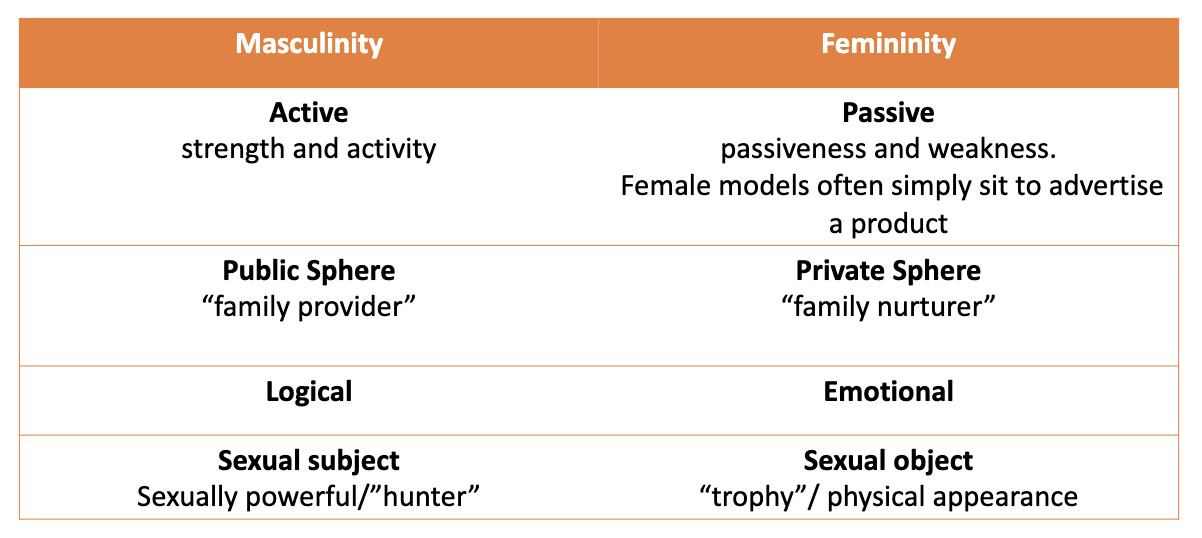
Postfeminism
Feminism had “done its job,” “equal” place in society
Any remaining feminist project should turn attention to women’s “individualism”
the body and attractiveness can be used as a tool for empowerment
Applicable to:
Beautiful, white, and successful media personalities
Privileged wealthy groups
Consumerism
For example:
#StrongIsTheNewSkinny
Feminist, postfeminist, and anti-feminist at the same time
Algorithmic Identities: Profiling and Personalization
The statistical management of user data to infer and assign to users categories of identity, based on profiles that are created for them by collecting and combining information
personalised content
targeted advertisements
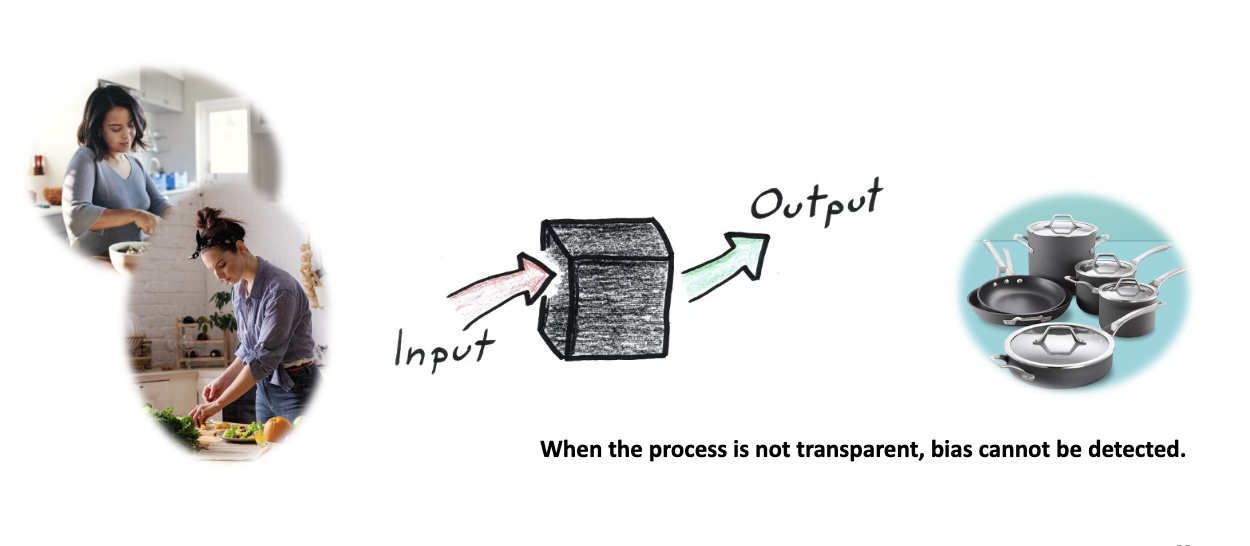
Black Box and Gender bias
When the process is not transparent, bias cannot be detected.
Algorithmic Identity
losing control in defining who we are online, or more specifically we are losing ownership over the meaning of the categories that constitute our identities
Algorithmic Identity in respect to gender
Bucher (2017):
experience and make sense of algorithms
“ads for wrinkle cream and fat loss” reflects the stereotypical assumptions about how the typical middle-aged woman is like.
Datta & Tschantz & Datta (2015)
biased ad content that perpetuates gender inequality
fewer ads related to high paying jobs shown to female users
Living within media
Paradoxes:
Visible and invisible
Media everywhere and nowhere [Deuze]
Together and alone
Being free and mediated
Humans and computers
Private / Public
difficult to keep things private
Impose power and control – without making guard’s presence apparent.
The Panopticon Effect: we are always
being watched – proper behaviour
The “threat of invisibility”
The problem is not the possibility of constantly being observed, but the possibility of disappearing, of not being considered important enough.
Metrics
[Numbers showing on media platforms (made this definition up because not shown, but keep the term in mind)]
Media Everywhere and Nowhere
Media becomes invisible (used to naturally that it becomes seamless)
Example:
(Possibly) Facebook
Lightbulb
Media as everyday practices
Adapt everyday routines
Example: Cooking a meal to post on Instagram
Users as producers
Example: Influencers, people taking photos and posting them, etc.
Mark Deuze suggests an ontological turn
How we can live within media
Not make media all-powerful nor decenter media
“Network Society” and globalisation
network society is globalisation
Alienation
Technology isolates.
Technology leads to destruction of jobs.
Surveillance is getting out of hand.
Etc.
Technological Utopia
Technology helps us connect.
Technology helps us work more efficiently.
Technology makes us safer.
Etc.
Networked Publics
Ethnographic analysis
Publics that rely on network technologies and network people → communities
Teens engage in social media and other technologies in a way of engaging with their broader social world
To BE Public and to be IN public
Persistence: online expressions are automatically recorded and archived (accessible)
Visibility: information shared in networked publics can potentially reach a wide audience (makes interaction public by default)
Spreadability: viral nature of content, the ease with which content can be shared (low bar for creating and duplicating)
Searchability: the ability to find content
Positive aspects
Magnify teens voices
Gather Audiences
Connect
Protests
Agency with Technology
Technology corners people to do what we want them to do
Example:
Use sounds to tell people to wear seatbelts, or use shock advertising to convince people to wear seatbelts
affordances
high-level affordances
dynamics and conditions enabled by technical devices, platforms and media
connectivity, visibility, persistence, accessibility, social feedback
low-level affordances.
typically located in the materiality of the medium, in specific features, buttons, screens and platforms
suggest, enable and constrain users’ actions
affordances exist in the environment to demarcate the possibilities of action, to constrain and control behavior and not to cause a specific one
Ideal User
affordances as a text
Designers/Developers/Producers highlight the desirable actions and downplay the undesirable ones
Users can “read” them in their own unique way the possibility for negotiation and resistance on the part of users.
Analyzing an interface
why does a specific feature appear and not another?
on what beliefs/norms is it based?
who is the Ideal User that is shaped?
what are the consequences of these design choices?
Functional: possibilities, what a user can do with a site/app
Cognitive: how users know what they can do with a site/app
Sensory: close to an aesthetic analysis of the interface
The passive recipient of content
1. Endless and constantly renewed content – trigger prolong consumption
endless opportunities to come across new images
interfaces displaying unseen images and videos
new content: stories, posts and personalized advertisements
posts - active links leading to new sources of fresh content.
older images are replaced by recent ones
it is very difficult to come across a certain image again (*users’ action is required)
timestamps are present in all content (see Grosser, 2014)
2. Content for passive consumption - repetitive, brief view of images
small size of photographs
story: lasts only for a few seconds
users cannot save images in their mobile devices.
zoom - restricted
3. “Trained” towards a repetitive and instinctive use: specific gestures
hidden affordances (location stamp, filters-story)
passive and standardized actions are promoted
“Like”: a quick double-tap on an image
comments: accompanied by predetermined responses
Example:
Netflix
continuous consumption
Example: Resume, or next episode, button
Provides data and consume
Example: Dislike, like and love button
the interface reinforces the continuous consumption of new, trends (mainstream, easy to consume content)
Example: “Trending Now”, “Most Liked”, “Top 10 TV Shows ___”
Filter bubble
Algorithmic selection (filtering) based on usage history news/information is automatically filtered out
Passive Formation
Echo chamber
We are overexposed to news we like or agree with e.x. forum
Active Participation. Individuals actively seek out and engage with viewpoints like their own.
Personalisation
From the user
explicit personalisation or self-selected personalisation
From the system
implicit personalisation or pre-selected personalisation
Filter Bubbles and Politics
Ferguson protest on Twitter vs ice bucket challenge on Facebook
Twitter – chronological order
Positive aspects
Filters help us make sense of the vast amount of information available
Case Study
‘Filter bubbles’ provide shelter for Chinese LGBTQ communities on social media
visibility to conventionally underrepresented LGBTQ individuals
The capacities of social movements
Narrative capacity
Electoral capacity
Disruptive capacity
Social Movements: Narrative capacity
The ability of the movement to frame its story in its own terms, to spread its worldview
persuade people
“legitimacy”
Example: Black Lives Matter movement

