Ambulatory Monitoring
 Studied by 0 people
 Call Kai
 Learn
Learn Practice Test
 Spaced Repetition
 Match
Match Flashcards
 Knowt Play
1/8

There's no tags or description
Looks like no tags are added yet.
Name | Mastery | Learn | Test | Matching | Spaced | Call with Kai |
|---|
No analytics yet
Send a link to your students to track their progress
9 Terms
Ambulatory Monitoring
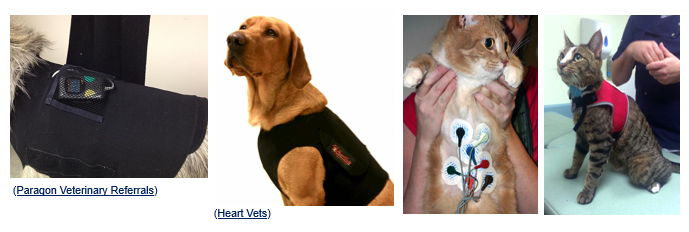
Holter monitoring can record an ECG for up to 7 days
Non-invasive and lightweight
Easy to operate - may have an ‘event’ button
Usually well tolerated by dogs
Less tolerated by cats - may require hospitalisation but this may produce inaccurate results due to stress within the hospital
The event button ..
Can be pressed when the client witness the episode of collapse
This will highlight the event on the ECG recording got enable easier assessment
Why is ambulatory monitoring performed?
To record heart rate, rhythm and electrical activity over a longer period compared to static ECG machines - Enables documentation whilst the patient preforms their normal activities away from the veterinary practice
Indications for use
Intermittent collapse
Syncope
Exercise intolerance
Breed screening (those at high risk of arrhythmias)
Arrhythmia assessment
Monitoring the efficacy of antiarrhythmic treatment
Hospitalised or critical care patients
Adhesive electrodes are used ..
These must be secured correctly and firmly in place to prevent poor contact artifacts
An ECG is a ..
Diagnostic tool used to assess and record the rhythm, rate and electrical activity of the heart and there are various indication for use in veterinary patients
A sinus complex originates from the ..
Sinoatrial node
When analysing an ECG, you should assess the ..
Heart rate
Heart rhythm
Whether there is a QRS complex for every P wave
Whether thee is a P wave for every QRS complex
If ECG waves are consistently and reasonably related
The morphology of the QRS complex
Patient preparation is vital to ensure ..
A diagnostic and artifact-free ECG trace
 Note
Note  Flashcards (27)