Horse Management (12-13
 Call Kai
 Learn
Learn Practice Test
 Spaced Repetition
 Match
Match Flashcards
 Knowt Play
1/48

There's no tags or description
Looks like no tags are added yet.
Name | Mastery | Learn | Test | Matching | Spaced | Call with Kai |
|---|
No analytics yet
Send a link to your students to track their progress
49 Terms
Previous uses/history
early 1900s: 25 mil horses and mules in the US
1960s: 3 million horses and mules
2000s: 9 mil horses in us
72% personal use/pleasure
43% recreation
29% show
28% ranching, racing, breeding, commercial use
18% rodeo, polo, ranching
10% racing
Breeds
Classification
height and weight
draft, light, pony
temperament
coldblood, warmblood, pony
Review horse breeds and
water
check twice daily
ave 1000 lb horse drinks 10-12 gall a day
depending factors
temp
stage of life
lactation
preg
housing
protect from weather extremes
provide ventilation/air flow
be clean and dry
be safe and well-maintained (fencing)
Have space for exercise: paddock, corral, pasture
types of housing
Barns: if box stalls - 12’ x8’ or 10’ x 10’
flooring - well-drained, solid-footing surface with some give when horses lie down
clay, sand, rubber mats
3-sided shed:
face south away from the prevailing wind
located on an elevated, well-drained site
Accessible for feeding and manure handling
manure management
ave 1000lb horse produce ~50 lb or manure/urine/day
Manure should be picked up regularly from teh horses stall (daily) or paddock (frequency)
store it-spread it-compost it-sell it-transport it
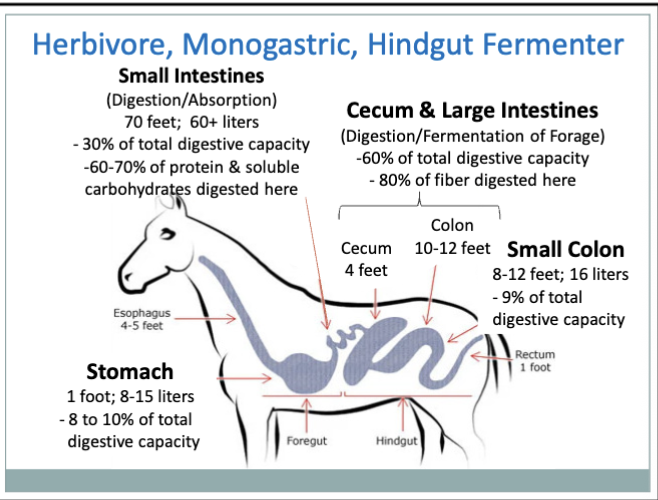
Herbivore, monogastric, hindgut fermenter
know this slide
Nutritional mgmt: Feeding horses
evolved using speed as a survival mechanism
how?
sleep standing up and use continuous grazer strategy of consuming small amts frequently and moving from place to place between grazing up to 18 hrs a day
Feeding horses
weight
BCS
age
use/activity level
Repro stage
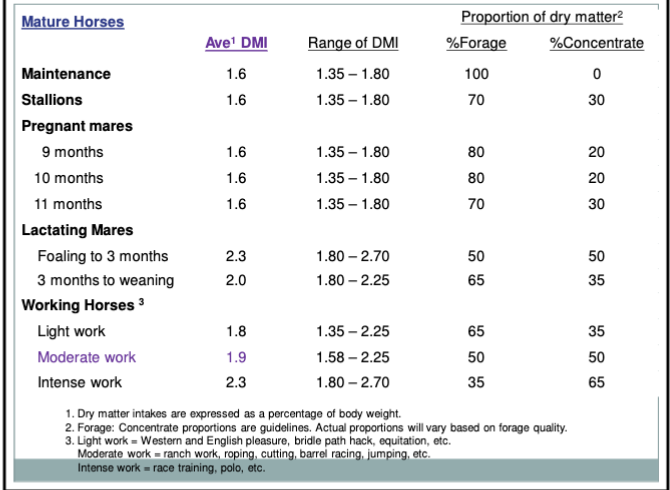
Generally, horses require min of .75 to 1% of their body weight daily in roughage on a dry matter basis but can change..
Body condition scoring
emaciated
very thin
thin
moderately thin
moderate
moderate to fleshy
fleshy
fat
obese
Amt of pasture per horse
what type of pasture
pasture management
supplemental feed
it depends
rule of thumb 1-2 acres per horse, they graze unevenly (over/undergraze certain areas), and they tear up sod
For re-growth, leave abt 1/3 of the grass uneaten. Subdivide pasture so horses graze a paddock for no more than 7 days. Leave about 3’ of grass and allow it to grow to 8’ before it is grazed again
Haym silage, grain, protein, pelleted, and minerals
Health Plan
Hoof care - adult hoof grown to ½ to <1/2 in per month
Parasite control
Dental care
Vaccination
Biosecurity protocol
Veterinary care:
if badly ill or injured, access to trailer is a must
Health Management Protocols
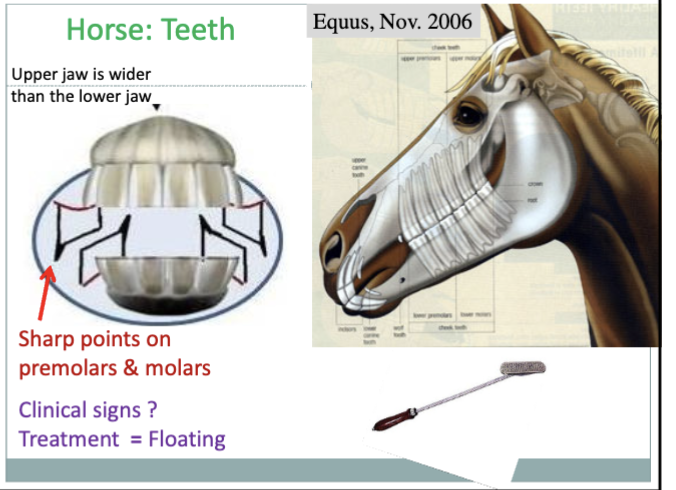
float teeth - at least yearly
Hoof trim - farrier visits every 6-8 wks
Groom
Deworm - continuous or strategic
Goals
Limit the negative effect of parasite infection
control parasite egg shedding
Avoid the development of anthelmintic resistance
Vaccinate - annual (often called spring shots)
CORE Vaccines
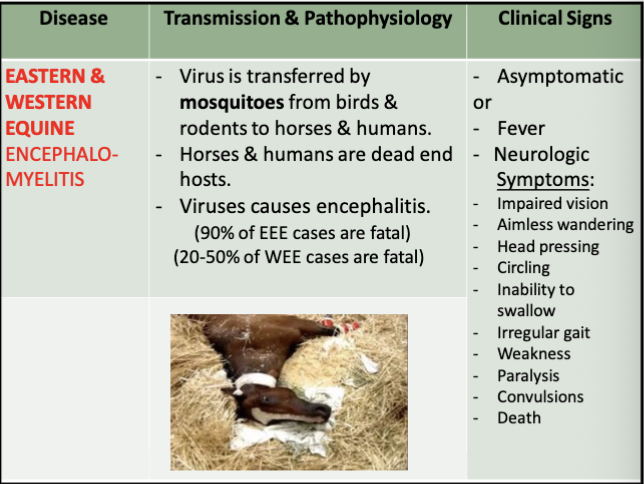
Eastern and Western Equine Encephalomyelitis (EEE/WEE)
Tetanus
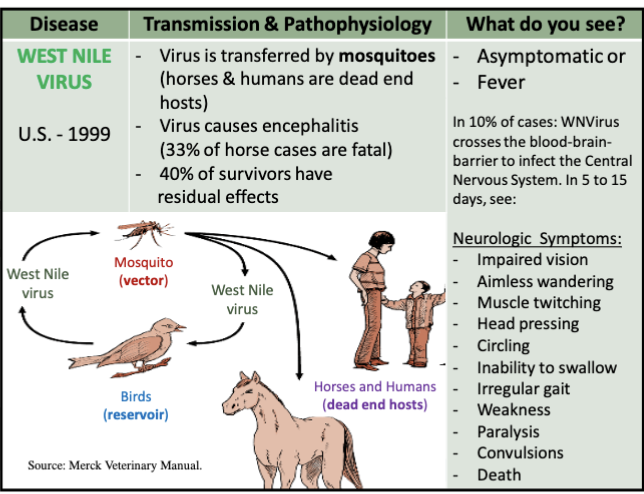
West Nile Virus (WNV)
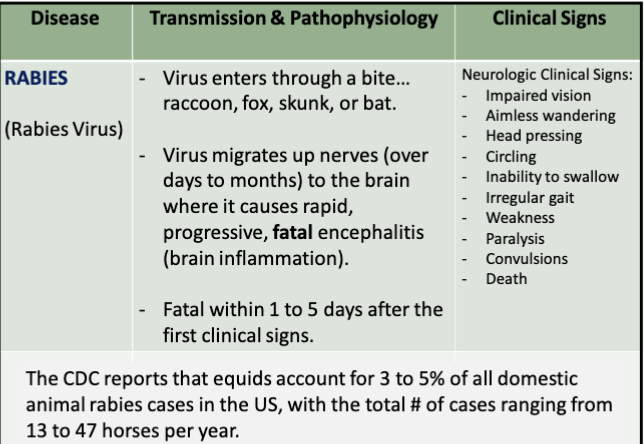
Rabies
West Nile Virus
Eastern and Western Equine Encephalomyelitis
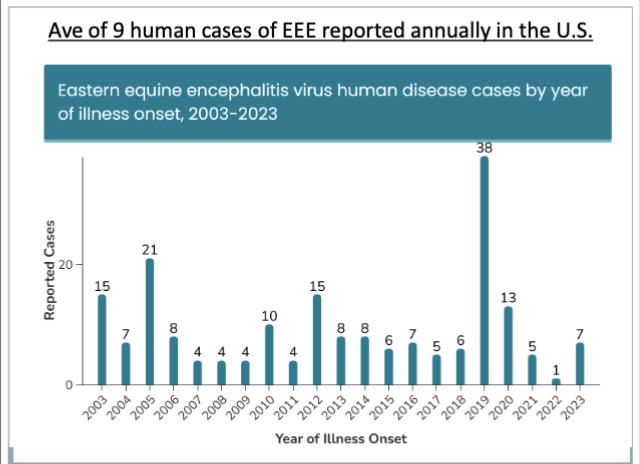
Ave of 9 human cases of EEE are reported annually in the US
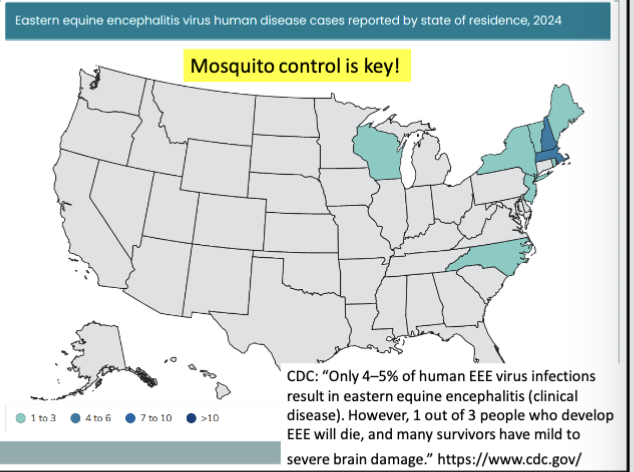
Mosquito control is key
Rabies (Rabies Virus)
Risk-Based Vaccines
Vary regionally, from population to population within an area, or between individuals within a given population
equine herpesvirus (type 1 and 4) (Rhinopneumonitis)
Equine Influenza
Botulism
Strangles
Potomac Horse Fever
Equine Viral Arteries, EVA
Rotaviral Diarrhea
Anthrax
Snake Bite
Equine Infectious Anemia (EIA)
Retrovirus transmission
Transmitted by
Blood-sucking insects (horse flies, deer flies, mosquitoes)
Contaminated needles, or
in utero from mare to foal
Equine Infectious Anemia (EIA)
Virus reproduces inside the horse’s white blood cells
the white blood cells may attack and destroy red blood cells = anemia
Most infected horses show no symptoms, but they are CARRIERS that remain contagious for life
What do we see in horses that become symptomatic
EIA Clinical Signs (After 7-60+ days)
fever ± sweating
Depression and weakness
anorexia and rapid weight loss
rapid breathing and heart rate
yellow, pale, or spotted mucous membranes
Edema (swollen legs, lower chest and abdomen)
Bleeding from nose
Colic
Abortion
Equine Infectious Anemia (EIA)
EIA = Retrovirus transmitted via blood-sucking insects (horse flies, deer flies, and mosquitoes), contaminated needles, or in utero from mare to foal.
EIA virus (EIAV) reproduces inside the horse’s white blood cells. The horses WBCs may attack and destroy red blood cells = anemia
Most infected horses show no symptoms —> Carriers and remain CONTAGIOUS FOR LIFE
Equine Infectious Anemia = Swamp Fever (Warm and/or humid areas)
2024
1.3 mil horses tested; 147 positive horses
Estimated national prevalence of 0.004%
U.S. = 40-150 new cases diagnosed per year
Diagnosis of EIA
identify antibodies in the blood
The agar gel immunodiffusion (AGID) method is the “gold standard” and is commonly known as the Coggins Test
developed in 1970 by Leryo Coggins
Neg coggins - no detectable antibodies at the time of the test
pos coggins - horse is infected and a carrier of the virus
Positive Coggins
By law, EIA = REPORTABLE DISEASE
all pos mus be filed with the state vet and a federal Animal and Plant Health inspection service of the USDA
State-state requirements
many states require proof of neg coggins before they can be exhibited, shown, raced, or even trained near other horses
some states require a negative Coggins before horse can be sold
few states req neg for horse to be moved within the state
few states req all horses within the state be tested once a year
Mare: Seasonally Polyestrus Long-Day Breeder
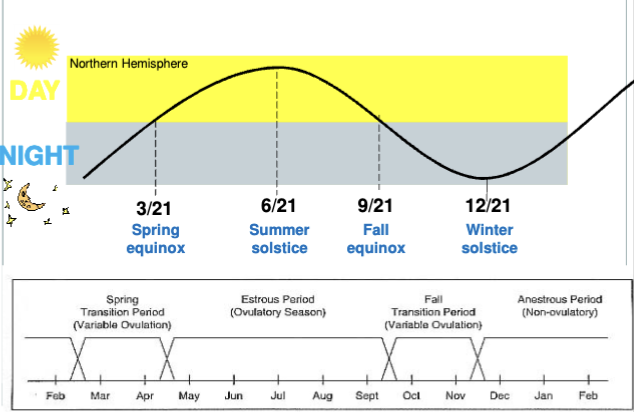
Estrus Cycle
Fillies enter puberty around their 2nd spring
range = 12-18 months (ave = 15 months)
Fillies are usually not bred before 2-3 years of age
Ave estrous cycle length: 21 days (18-24d)
Follicular Phase = Estrus = 4-7 days
short at peak season = 3 days
Estrus behavior depends on low progesterone
ovulation occurs 2 days before the end of behavioral estrus
Luteal phase = Diestrus = 14-15 days
Breeding Season and Hormones
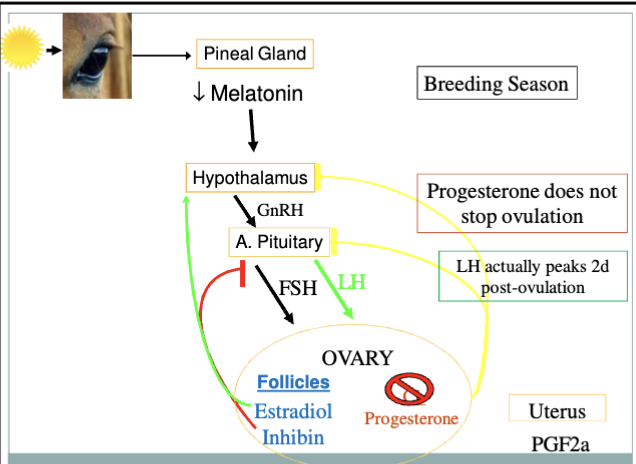
Transition: Before & After the Breeding season
Spring transition - Gradual “activation” of HPO axis
Ends - with the 1st ovulation of the year
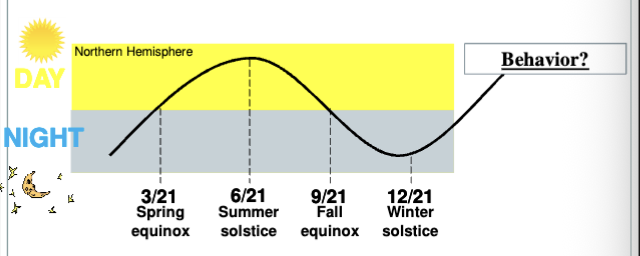
After Fall Transition: Winter Anestrus
GnRH - low/baseline
FSH - random fluctuations
Estradiol - baseline (small follicles)
LH - baseline
Progesterone - baseline
Estrus behavior - absent or erratic
15-20% of mares will cycle throughout the year
Pregnancy
length + other things
335-345 (340 ave) days
Preg may be as short as 305 or as long as 400
Foals born less than 320 days of gestation are premature, with survival rate of 70-75%
Most mares (>70%) foal between 10pm and 2am
Management of Pregnancy
mild exercise/normal activity through preg
proper diet (inc during last trimester) - ideal BCS = 5 to 6/9
Vx (EHV-1) at 7&9 months
Vx booster (EWT, WNV) at 10 months
Deworm at 10 months
Caslicks removed > 2 weeks before foaling
Shoes pulled
Foaling kit prepared
Prep for Foaling
foaling area = quiet, clean, stress-free, well-bedded, and Draft-free
Ideally, familiarize the mare with her new area 4-6 wks before foaling
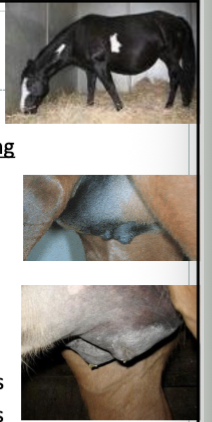
Familiarize yourself with mare (freq obervation to detect changes with emphasis on udder, abdome, tailhead, vulva)
Why monitor so closely?
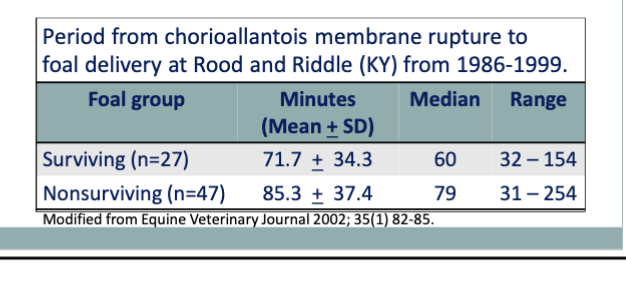
The equine placenta detaches readily from the uterus, so foals rarely survive extended labor
ideally, foaling should be attended so that help can be given quickly, if needed
Physiologic changes before foaling
clinical sign - prefoaling
clinical sign
appetite change (variable)
body shape (variable)
ventral and hindlimb edema (variable)
Udder development (2-6 weeks)
Perineal relaxation (1-3 233kw)
Engorgement of teat ends (1wk)
Waxing (1-3 days)
Waxing (1-3 days)
Vulvar elongation (0-1 days)
Physiologic changes before foaling
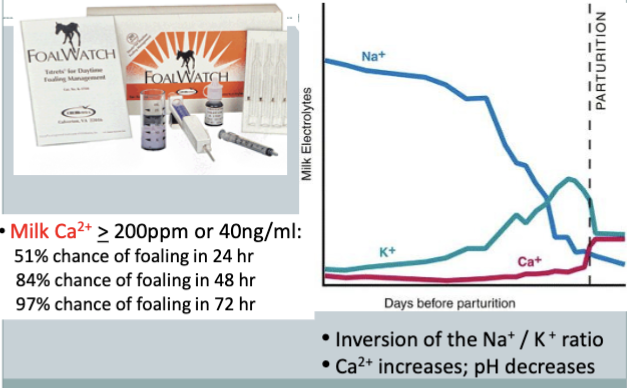
milk Ca 2+ >200ppm of 40ng/ml
51% chance of foaling in 24 hr
84% chance of foaling in 48 hr
97% chance of foaling in 72 h
Stages of Foaling
1-3
preparation (30-6hr)
foal delivery (<20mins)
Passage of Fetal Membranes (<3h)
Stage 1: Mare prep
myometrial contractions
cervical dilation
physical discomfort
anxious
colicky
sweaty
lift tail
leak colostrum
restless
sweaty
roll
up and down
posturing
paw at the ground
frequent urination/defecation
Fetail signal = up cortisoll
Maternal response = hormone cascade = up uterine contractions
fetal response = adoption of the “birth position”
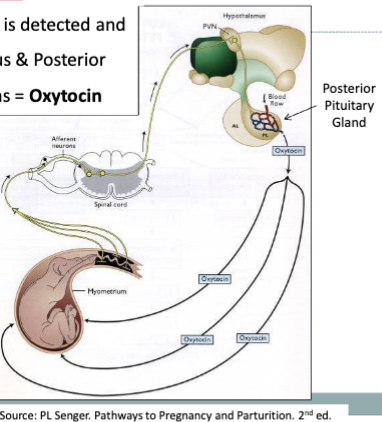
Fergusons Reflex
fetal pressure on the cervix is detected and relayed to the hypothalamus and posterior pituitary via sensory neurons = oxytocin
Stage 1
fetus is in the birthing position in the mare uterus is contracting. = rupture of the allantochorion (placenta) at the cervix
stage 1 ends when the water breaks (2-5 gallons of allantoic fluid is expelled), note the time
Stage 2: Foal Birth
After water break —> see foals forelimbs within 5-10 min in the white amniotic sac (ave 20 mins)
one foot appears first with the other foot 4-6 in behind (soles down)
the head follows the feet
strong uterine and abdominal contractions
ends when the foal is delivered
Tear away the amnion
clear fluid form foals’ nasal
make sure foal breathing and in sternal recumbency
let mare rest
do not break the umbilical cord
let it break naturally, allows for blood vessel spasm for closure
After breakage, coat the umbilicus in 2-3% iodine or 25% chlorhexidine
stage 2 after umbilicus
be aware of the mare’s attention to the foal
1-2-3 rule
foal stands within 1 hour
foal nurses within 2 hours
mare passes placenta within 3 hours
make sure the foal passes meconium
Stage 3 - Fetal membranes passage
typically within 1 hours; mare may appear colicky
do not manyally remove the placenta
tie it up
retained if not passed within 3 hours
medical emergency
2-10% of mares
Retained placenta or retained fecal membranes predispose mare to metritis, endometritis, lamanitis, sepsis and death
Post-Foaling Management
Mare: Feed for lactation
breed her back…when?
1st post-partum estrus or FOAL HEAT = 5-12 days
1st post-partum ovulation = 6-18 days
Mare uterus requires 15 days for repair to support another preg
Post-Foaling Management
Foal: Nurse, then slowly transition to hay and grain (@ 10 days to 3 weeks of age)
reach about 50% of adult weight during the 1st year
Wean foals @4-6 months of age
Castrate colts @1-2 years of age

