(16) blood suppy
 Call Kai
 Learn
Learn Practice Test
 Spaced Repetition
 Match
Match Flashcards
 Knowt Play
1/45

There's no tags or description
Looks like no tags are added yet.
Name | Mastery | Learn | Test | Matching | Spaced | Call with Kai |
|---|
No analytics yet
Send a link to your students to track their progress
46 Terms
Medial Striate Artery (from ACA)
Target: Anterior Limb of the internal capsule(ALIC).
Clinical Fact: The most famous branch here is Heubner’s Artery
Damage here can cause personality changes or complex motor planning issues because it hits fibers heading to the frontal lobe
Lenticulostriate Arteries (from MCA)-internal capsule
Target: Anterior Limb (ALIC) and the Posterior Limb (PLIC).
Clinical Fact: These are often called the "Arteries of Stroke."
They are very thin and prone to bursting in people with high blood pressure (hemorrhagic stroke) or clogging (ischemic stroke)
Internal Carotid Artery (Direct Branches)— internal capsule
Target: The Genu (the "knee" or bend of the capsule).
Clinical Fact: The Genu contains the Corticobulbar tract (muscles of the face and tongue)
A stroke here specifically causes facial drooping and speech issues
Anterior Choroidal Artery (from ICA)—internal capsule
Target: Posterior Limb (PLIC) and the Retrolenticular part.
Clinical Fact: This is a "silent killer" artery
Because the PLIC contains the Corticospinal Tract (body movement) and the Somatosensory Tract (feeling), a stroke here causes a "Pure Motor" or "Sensorimotor" stroke———-
total weakness and numbness on the opposite side
Which artery supplies the Anterior Limb (ALIC) via its medial striate branches?
Anterior Cerebral Artery (ACA).
Lenticulostriate arteries arise from which major vessel?
Middle Cerebral Artery (MCA)
A stroke in the Anterior Choroidal Artery would primarily damage the:
Posterior Limb (PLIC)
Which part of the internal capsule is supplied directly by the Internal Carotid?
Genu
Which artery would likely be involved if a patient has only facial weakness?
Direct branches of the Internal Carotid
(supplying the Genu)
Quadrigeminal Artery (from PCA)
provides crucial lateral branches to the Crus Cerebri
If this is blocked, it can affect the Lateral part of the CST (the Leg fibers)
Posterior Choroidal Arteries (from PCA)
supply the crus cerebri
Weber Syndrome
blood supply to the Crus Cerebri is compromised
causes Contralateral Hemiparesis (weakness of the opposite arm and leg)
Oculomotor Nerve (CN III) (right next to the crus cerebri so it is often damaged)
Weber Syndrome result
patient has a "down and out" eye on the same side as the stroke
but weakness on the opposite side of the body
what supplus the pons
Branches of the basilar
"Locked-In" Syndrome
Cause: A massive stroke or blockage of the Basilar Artery
Result: The CST is destroyed on both the left and right
The patient is completely paralyzed from the neck down (quadriplegia) and cannot speak (corticobulbar loss)
Why is a patient still fully conscious in Locked-in Syndrome?
Because the "Tegmentum" (the back of the pons) is supplied by different vessels
the patient remains fully conscious and can usually still move their eyes vertically (controlled by the Midbrain)
what supplies the medulla
anterior spinal artery
Medial Medullary Syndrome
the Anterior Spinal Artery is blocked
Contralateral Hemiparesis
Contralateral Loss of Proprioception/Vibration
Ipsilateral Tongue Weakness: Because the CN XII (Hypoglossal) nerve fibers exit right through this area
Why would you have contralateral loss when there is damage to the medulla?
This is where the fibers primarily cross
the pyramids are located here
What is the Pyramidal Decussation?
site where 85–90% of fibers cross: These become the Lateral Corticospinal Tract
10–15% do NOT cross: These become the Anterior Corticospinal Tract
Why is it said that "only CST fibers remain" after the decussation?
Because all Corticobulbar fibers have already exited to hit brainstem nuclei
finbers for face and tongue movements have left so all that is left are fibers for body movments
If a patient has a lesion below the decussation, which side of the body is affected?
Ipsilateral (same) side
fibers are still on their "home" side
If you damage the left side of the brain, the signal hasn't crossed yet, so the Right side of the body is affected (Contralateral)
If a patient has a brainstem tumor above the medulla, is the weakness opposite or same-side?
Opposite side (Contralateral)
A stab wound to the Right side of the Spinal Cord causes weakness on which side?
Right side (Ipsilateral)
A stroke in the Right Internal Capsule causes weakness on which side?
Left side (Contralateral)
Where do the CST fibers physically terminate?
Ventral Horn of the spinal cord gray matter
At the point of Termination, what cell does the CST synapse with?
Lower Motor Neuron (Alpha Motor Neuron)
What is the course of the Corticospinal Tract?
Corona Radiata
Internal Capsule
Midbrain
Pons
Medulla
The Decussation
Spinal cord
Medial Motor Pools (The Center)
control your Proximal muscles (shoulders, hips) and Axial muscles (back, neck, trunk)
Lateral Motor Pools (The Edges)
control your Distal muscles (elbows, wrists, and especially fingers and toes)
Anterior CST → Medial Pools
Anterior CST (which didn't cross in the medulla) stays near the midline of the cord to talk to the Medial motor pools
This is why it controls your core and posture.
Lateral CST → Lateral Pools
Lateral CST (which crossed in the medulla) travels in the side of the cord to talk to the Lateral motor pools
This is why it controls your hands and feet
What kind of movements do the midline (medial) pools control?
Bilateral/Axial movements (walking, swimming, standing up)
What kind of movements do the lateral pools control?
Skilled, peripheral movements (fine motor skills of the hands)
What is the primary permanent deficit of a "pure" pyramidal lesion?
Loss of fractionated finger movements (dexterity)
can not move fingers IND
ONLY damage to the pyramids
Why can a patient still walk after a "pure" pyramidal lesion?
Because Extrapyramidal tracts (Vestibulo/Reticulospinal) are still intact
they can pick up the slack
Does a pure pyramidal lesion cause Spasticity or Hypotonia?
It causes Hypotonia
(the spasticity comes from damaging "other" tracts)
Why are real-world stroke symptoms more "extensive" than pure pyramidal lesions?
Strokes usually damage the CST plus surrounding tracts (like Corticoreticular)
Which tract is the "backup" for gross arm movement when the CST is gone?
Rubrospinal tract
Extrapyramidal system as a bulldozer (it can move big things and get you from A to B) and the Corticospinal tract as a scalpel (it's for precise, delicate work)
If you lose the scalpel, you can't perform surgery, but you can still move the dirt!
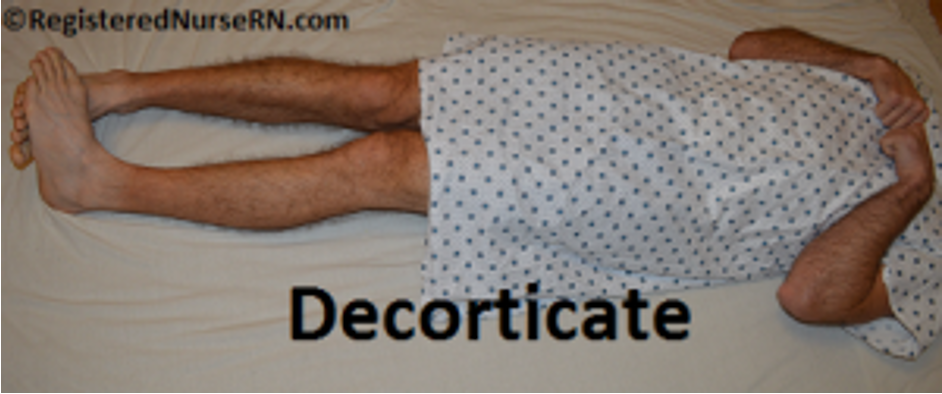
Decorticate Posturing
Lesion: Occurs ABOVE the Midbrain
Corticospinal Tract (CST) is cut (The "brakes" from the cortex are gone)
Rubrospinal Tract is still intact
Result: * Arms Flexed:
The Rubrospinal tract's main job is to flex the arms
Without cortical inhibition, it goes into overdrive, pulling the arms toward the chest (the "core")
Decerebrate Posturing
Lesion: Occurs BELOW the Midbrain
Both the Corticospinal Tract AND the Rubrospinal Tract are cut
Vestibulospinal and Reticulospinal tracts (in the Pons/Medulla) are the only ones left
Result: Arms Extended/ Legs Extended
Since the "flexor" (Rubrospinal) is gone, the "extensor" tracts take over completely
Which posture has a worse prognosis?
Decerebrate (it indicates deeper brainstem damage)
near the centers that control breathing and heart rate
Abnormal Flexion to pain
decorticate
Extensor Response to pain
decerebrate
If a patient shifts from Decorticate to Decerebrate, what does it mean?
brain is herniating (the damage is moving down the brainstem)

