glycolysis, fermentation, respiration (aerobic, anaerobic, cellular)
 Studied by 0 people
 Call with Kai
 Learn
Learn Practice Test
 Spaced Repetition
 Match
Match Flashcards
 Knowt Play
1/40

There's no tags or description
Looks like no tags are added yet.
Name | Mastery | Learn | Test | Matching | Spaced | Call with Kai |
|---|
No study sessions yet.
41 Terms
what are the main reactants and products of glycolysis, and how many steps?
reactants: glucose (C6H12O6) + 2ADP + 2Pi + 2NAD+
products: 2 pyruvate (C3H3O3) + 2 ATP + 2NADH
(notice how we are using energy to make useable energy— when the bonds of the products break, energy will be released)
there are 10 steps in glycolysis
how does glucose enter cells, where does glycolysis occur in, and how many major phases?
glucose enters cells via a specific carrier or an active transport system. glycolysis occurs in the cytoplasm, particularly in the cytosol, and has 2 major phases (energy investment phase & energy payoff phase)
can glycolysis occur even without oxygen?
yes, glycolysis is both aerobic and anaerobic
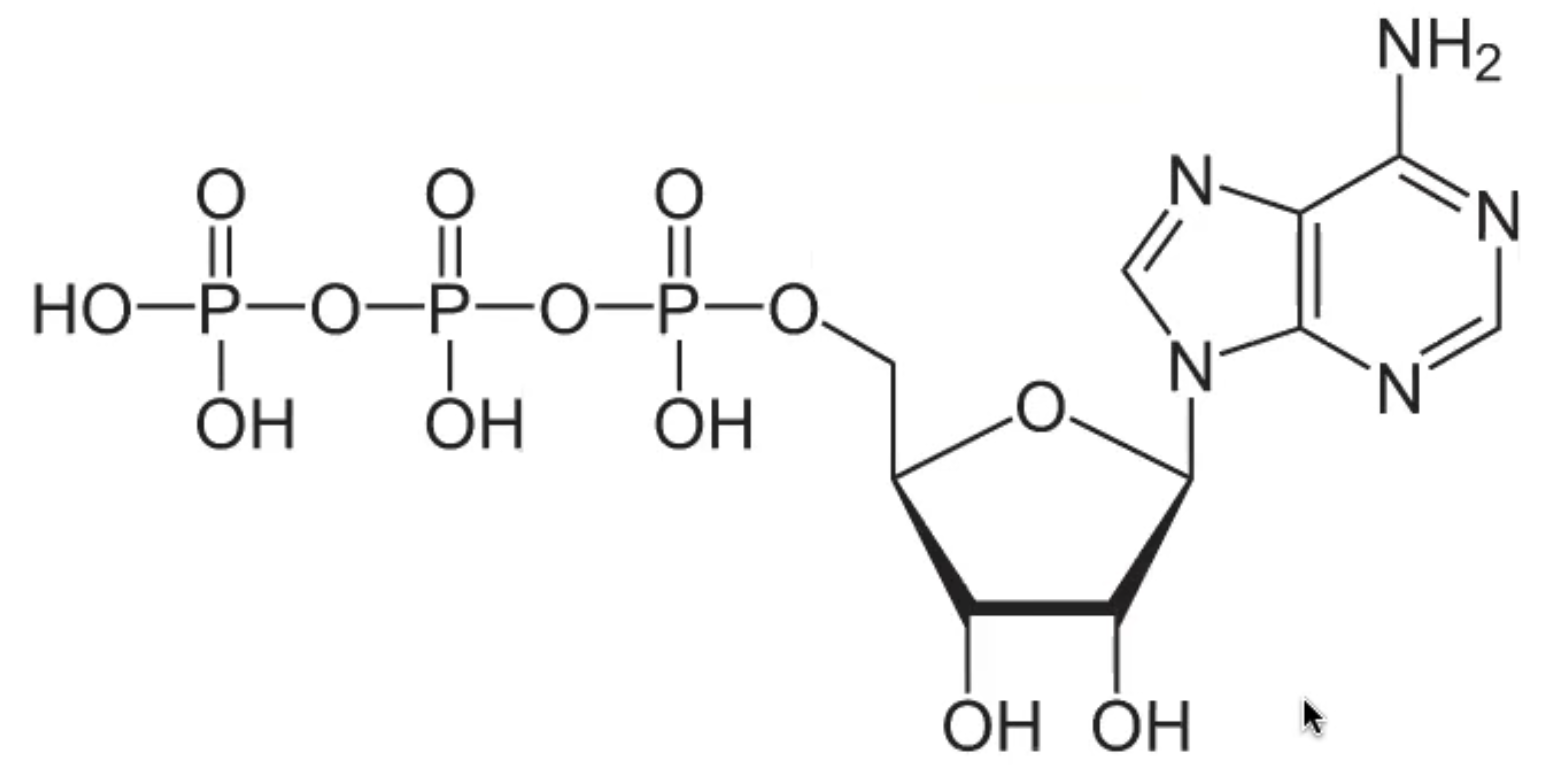
what are the phosphoanhydride bonds? How many are there in this image?
the bonds connecting the phosphate groups. there are 2 bonds.
how is ATP broken?
ATP is hydrolyze to form ADP + Pi + energy
importance of phosphoanhydride bonds
the breaking of phosphoanhydride bonds are what releases/gives energy
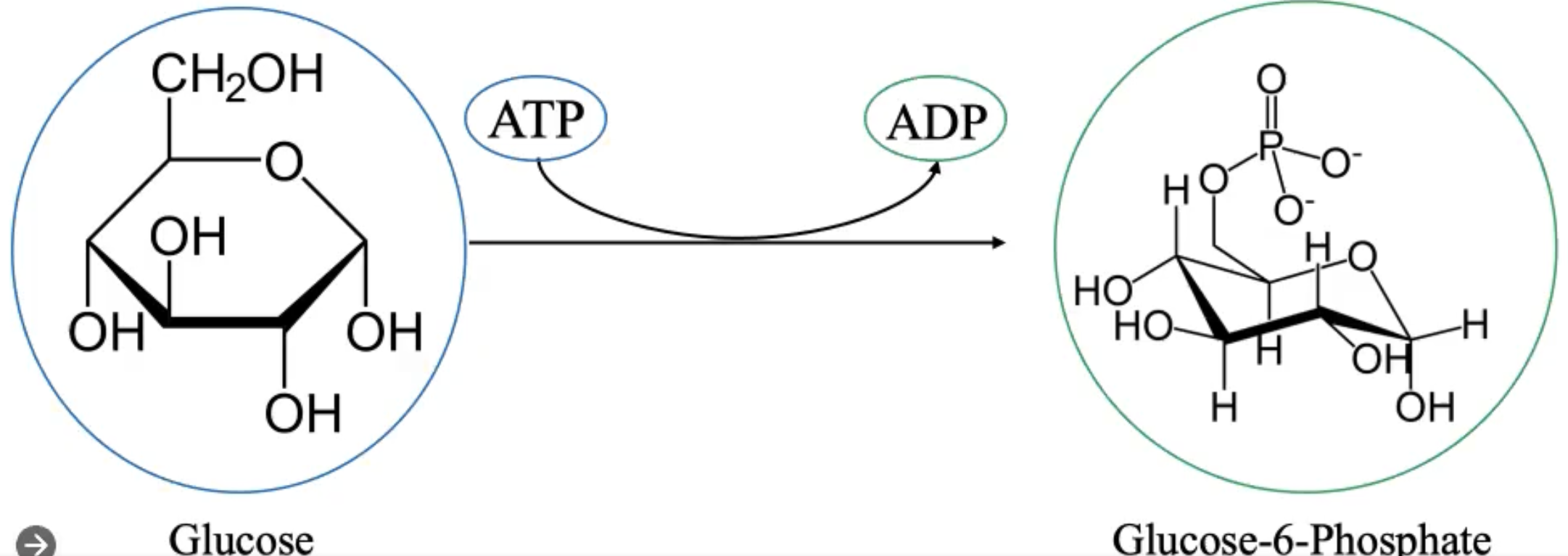
what are the reactants, products, endergonic reactions, and exergonic reaction?
reactants: glucose, ATP
products: G6P, ADP
exergonic reaction: ATP → ADP (the hydrolysis of ATP will provide the energy for the endergonic reaction)
endergonic reaction: glucose → G6P (it takes energy to convert glucose to G6P due to addition of phosphate group)
what main enzyme group phosphorylates and what dephosphorylates?
enzyme kinase catalyzes phosphorylation and enzyme phosphatase catalyzes dephosphorylation.
what steps in glycolysis (1-10) are irreversible?
steps 1, 3, and 10 are irreversible
defining characteristic of substrate level phosphorylation
substrate level phosphorylation requires phosphate from one substrate to attach to ADP to make ATP (phosphate groups attaches to ADP or GDP)
defining characteristic of oxidative phosphorylation
in oxidative phosphorylation phosphate is taken from phosphate pool to generate proton gradient using redox reaction(s), which is used to power ATP synthase to attach phosphate group to ADP, creating ATP.
process in which ATP is formed as electrons are transferred from NADH or FADH2 to O2 by electron carriers
defining characteristic of photophosphorylation
in photophosphorylation, light excites electrons to generate a proton gradient which will power ATP synthase
what are common among all types of ATP phosphorylation?
all three types of phosphorylation require ADP and produce ATP
what occurs in step 1 of glycolysis?
glucose is phosphorylated into G6P (facilitated by enzyme hexokinase and ATP)
what occurs in step 3 of glycolysis?
F6P is phosphorylated into F1,6-diphosphate (facilitated by phosphofructose kinase and ATP)
what occurs in step 6 of glycolysis
G3P produces 1,3-BPG and NADH via a redox reaction (facilitated by dehydrogenase enzyme and NAD+)
what occurs in step 7 of glycolysis?
3-Diphosphoglycerate becomes 3-phophoglycerate and ATP is created via substrate level phosphorylation (facilitated by kinase enzyme and ADP)
what occurs in step 10 of glycolysis?
phosphoenolpyruvate becomes pyruvate and ATP is created via substrate-level phosphorylation (facilitated by kinase enzyme and ADP)
if ATP is part of the reactants and ADP is part of the products, is the reaction exergonic or endergonic? Is this reaction phosphorylation or ATP phosphorylation?
exergonic because energy is released. The reaction is just phosphorylation because glucose is the one being phosphorylated.
how many molecules of ATP are generated in the conversion of glucose into pyruvate? explain.
in steps 1 and 3 2 ATP molecules are used. in steps 7 and 10 4 ATP molecules are made → net gain of 2 ATP molecules
what is the purpose of fermentation? why is it important?
to regenerate NAD+ in pyruvate reduction so glycolysis can continue. Step 6 of glycolysis requires NAD+, and without NAD+, glycolysis will not continue.
In fermentation, what can pyruvate be converted to?
ethanol (yeast), lactate, or acetaldehyde
what are the step-by-step reaction(s) in transforming pyruvate into lactate?
pyruvate and NADH react to make lactate and NAD+.
what are the step-by-step reaction(s) in transforming pyruvate into ethanol?
pyruvate becomes acetaldehyde. acetaldehyde then reacts with NADH to form ethanol and NAD+.
what occurs during pyruvate oxidation and what is the reducing agent and what is the oxidizing agent? where does pyruvate oxidation occur in?
pyruvate is converted into acetyl CoA by reacting with NAD+ and CoA. pyruvate is the reducing agent and NAD+ is the oxidizing agent. pyruvate oxidation occurs in the mitochondrial matrix
what is the main function of acetyl CoA?
the main function of acetyl CoA is to start the TCA cycle
after pyruvate is produced in glycolysis, what are its two choices.
pyruvate can undergo fermentation to regenerate NAD+ and continue glycolysis or pyruvate can be oxidized to enter the TCA cycle
what will happen to the acetyl unit after TCA cycle?
it will become completely oxidized into CO2
where does the TCA occur?
In the mitochondrial matrix
In the TCA cycle, what steps involve redox? What are the important products?
steps 4 (iso → glutarate), 5 (glutarate → succinyl CoA), 7 (succinate → fumarate), and 9 (malate → oxaloacetate) perform redox in TCA cycle. In steps 4 and 5 CO2 and NADH are produced. In step 7 FADH2 is produced. In step 9 only NADH is produced.
does the TCA cycle perform substrate level phosphorylation? If so, what step and what are the important products?
yes, step 6 of the TCA cycle undergoes substrate level phosphorylation in which GTP (not ATP) is produced (succinyl CoA → succinate)
what are the electron carriers in metabolism? Do they become reduced or oxidized?
NAD+, FAD, NADP+; they become reduced as they accept electrons to be carried through the metabolic processes
what is the net reaction of the citric acid cycle?
acetyl CoA + 3NAD+ + FAD + GDP + Pi + 2H2O → 2CO2 + 3NADH + FADH2 + GTP + 2H+ + CoA
does molecular oxygen participate directly in the citric acid cycle?
no, but the cycle can only occur in an environment with oxygen
How many ATP molecules are formed when glucose is completely oxidized to CO2 and H2O, and how many of them are generated by oxidative phosphorylation?
36 molecules of ATP are formed when glucose is completely oxidized to CO2 and H2O and 32 of them are generated by oxidative phosphorylation
where does oxidative phosphorylation occur?
oxidative phosphorylation occurs in respiratory asemblies that lie in the inner membrane of the mitochondria
what are the two main components of oxidative phosphorylation?
electron transport chain and ATP synthase
what is the electron donor in oxidative phosphorylation?
NADH and/or FADH2 (succinate)
what is the main difference between aerobic and anaerobic respiration?
in aerobic respiration the terminal electron acceptor is O2; in anaerobic respiration, the terminal electron acceptor is not O2
what is the overall reaction for the complete oxidation of glucose?
glucose + 36 ADP + 36 Pi + 36H+ + 6O2 → 6CO2 + 36 ATP + 42 H2O
tying everything together
glycolysis (glucose turned into pyruvate (internal e- acceptor) via glycolysis): occurs in the cytoplasm for both eukaryotes and prokaryotes. ATP converted into ADP in steps 1 & 3. NAD+ reduced to NADH in step 6, oxidizing G3P. ATP regenerated by phosphorylating ADP in steps 7 & 10.
pyruvate oxidation: cell ok on NAD+ → pyruvate oxidized into acetyl CoA and NAD+ reduced into NADH, which diminished NAD+ pool and produced CO2. Prokaryotic cells do not have mitochondria and therefore pyruvate oxidation will occur in cytosol.
fermentation: cell low on NAD+ → pyruvate is fermented/reduced into lactic acid or ethanol (yeast) and NADH is oxidized into NAD+
TCA cycle: occurs in mitochondrial matrix in eukaryotes and produced CO2. NAD+ and FAD reduced into NADH and FADH2. GDP/ADP phosphorylated into ATP/GTP. Purpose is to form reduced electron carriers (NADH, FADH2) for oxidative phosphorylation.
oxidative phosphorylation (ETC + ATP synthase)
complex I: NADH transfers electrons to FMN and turn into NAD+. FMN will then transfer its electrons to FeS cluster, which will transfer its electrons to Q, which will reduce Q into QH2.
complex II: succinate gives electrons to FAD. Succinate becomes fumarate and FAD becomes FADH. FADH will then give its electrons to FeS center, which will then give its electrons to Q, reducing it to QH2.
complex III: the QH2s formed will travel through electron bilayer and give its electrons to cytochrome b. cytochrome b will then give its electrons to iron-sulfur centers, which will transfer the electrons to cytochrome c, and to cytochrome c which lies in the intermembrane space (of mitochondria)
complex IV: cytochrome c gives its electrons to cytochrome a → copper A → cytochrome a3 → copper B → O2 (e- aceptor). O2 is now reduced into H2O. (since O2 is the electron acceptor, this is aerobic respiration).
energy provided to I, III, IV as electrons were being transferred → proton-gradient
complex V (ATP synthase): protons (H+) from the intermembrane space are taken by the ATP synthase to the mitochondrial matrix (chemiosmosis). As the ATP synthase motor turns, ADP + Pi is converted into ATP.
 Note
Note  Flashcards (36)