chapter 7 - cellular resipiration and fermentation
 Studied by 2 people
 Call with Kai
 Learn
Learn Practice Test
 Spaced Repetition
 Match
Match Flashcards
 Knowt Play
1/65

There's no tags or description
Looks like no tags are added yet.
Name | Mastery | Learn | Test | Matching | Spaced | Call with Kai |
|---|
No study sessions yet.
66 Terms
heterotrophic
animals obtain energy by eating plants or other organisms
redox reactions
the transfer of electrons between reactants
transfer of electrons releases energy stored in organic molecules
this is used to synthesize ATP
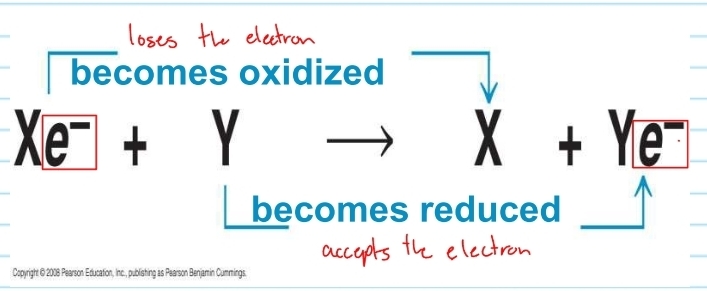
principles of redox
oxidation - when a substance loses electrons (oxidized)
reduction - when a substance gains electrons (reduced →becomes negatively charged)
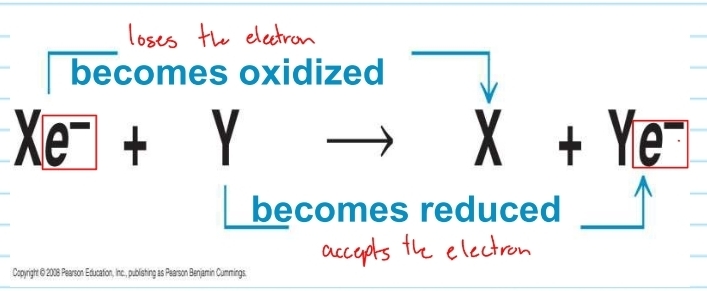
electron donor
the substance that loses electrons (oxidized)
called the reducing agent
electron acceptor
the substance that gains electrons (reduced)
called the oxidizing agent
In cellular respiration…
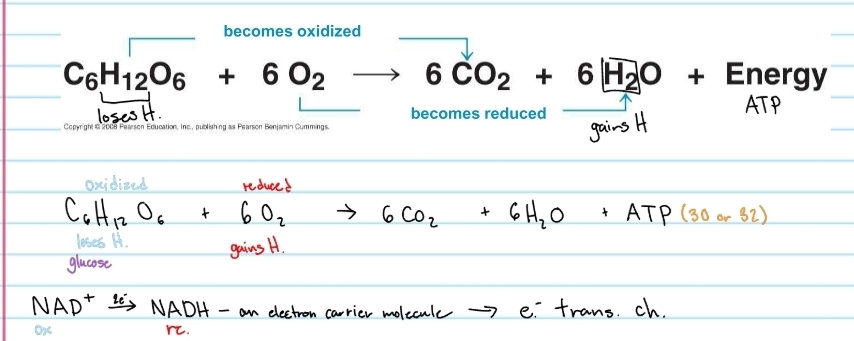
C6H12O6 + 6 O2 → 6 CO2 + 6 H2O + ATP (energy)
which is reduced
which is oxidized
Oxygen becomes reduced (gains H)
Glucose becomes oxidized (loses H)
energy harvest via NAD+
electrons (H) that are stripped from glucose (during glycolysis) travel with protons
they are first transferred to NAD+ (coenzyme)
NAD+ becomes reduced after accepting the electron (H)
this forms NADH, which stores energy that will used to synthesize ATP
NADH passes the electrons to the electron transport chain
stages of cellular respiration
Glycolysis
Pre-citric acid cycle
Krebs cycle
Oxidative phosphorylation
glycolysis
“splitting of sugar”
the breakdown of glucose into two molecules of pyruvate (C6H12O6 → C3H6O3 × 2)
occurs in the cytoplasm and does not require oxygen (anaerobic)
has two major phases: energy investment phase & energy payoff phase
glycolysis - step 1
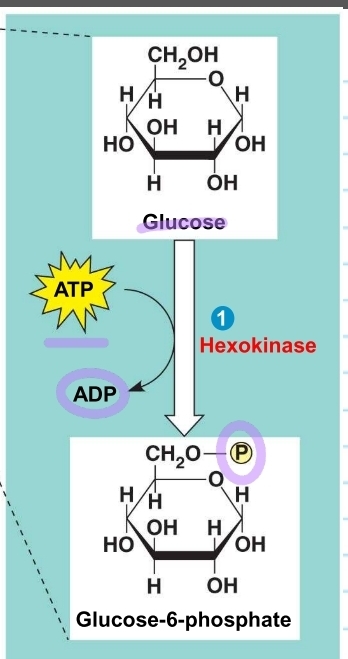
first investment of ATP
ATP gets hydrolyzed becoming ADP, where the third phosphate gets transferred onto glucose
this turns glucose (the substrate) into glucose-6-phosphate
all this is done with the Hexokinase enzyme
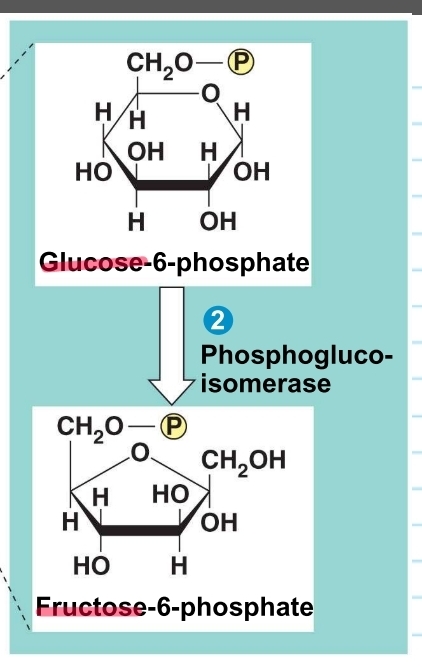
glycolysis - step 2
the enzyme, phosphoglucoisomerase, turns glucose-6-phosphate into fructose-6-phosphate
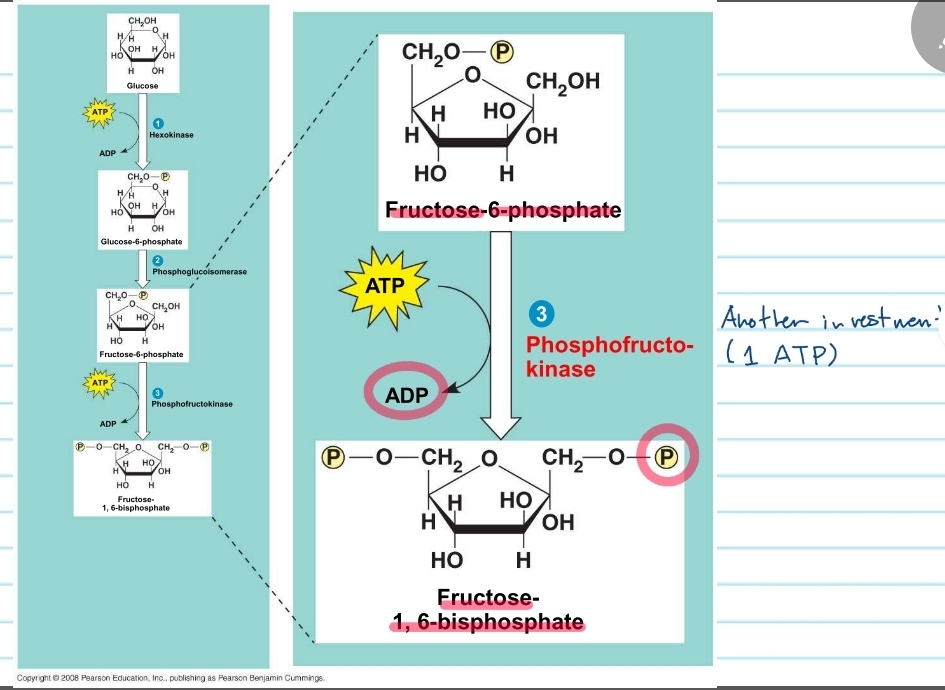
glycolysis - step 3
second investment of ATP
takes a phosphate from another ATP (hydrolyzed) and transfers it onto fructose-6-phosphate
turns it into fructose-1,6-biphosphate
done by phosphofructokinase (enzyme)
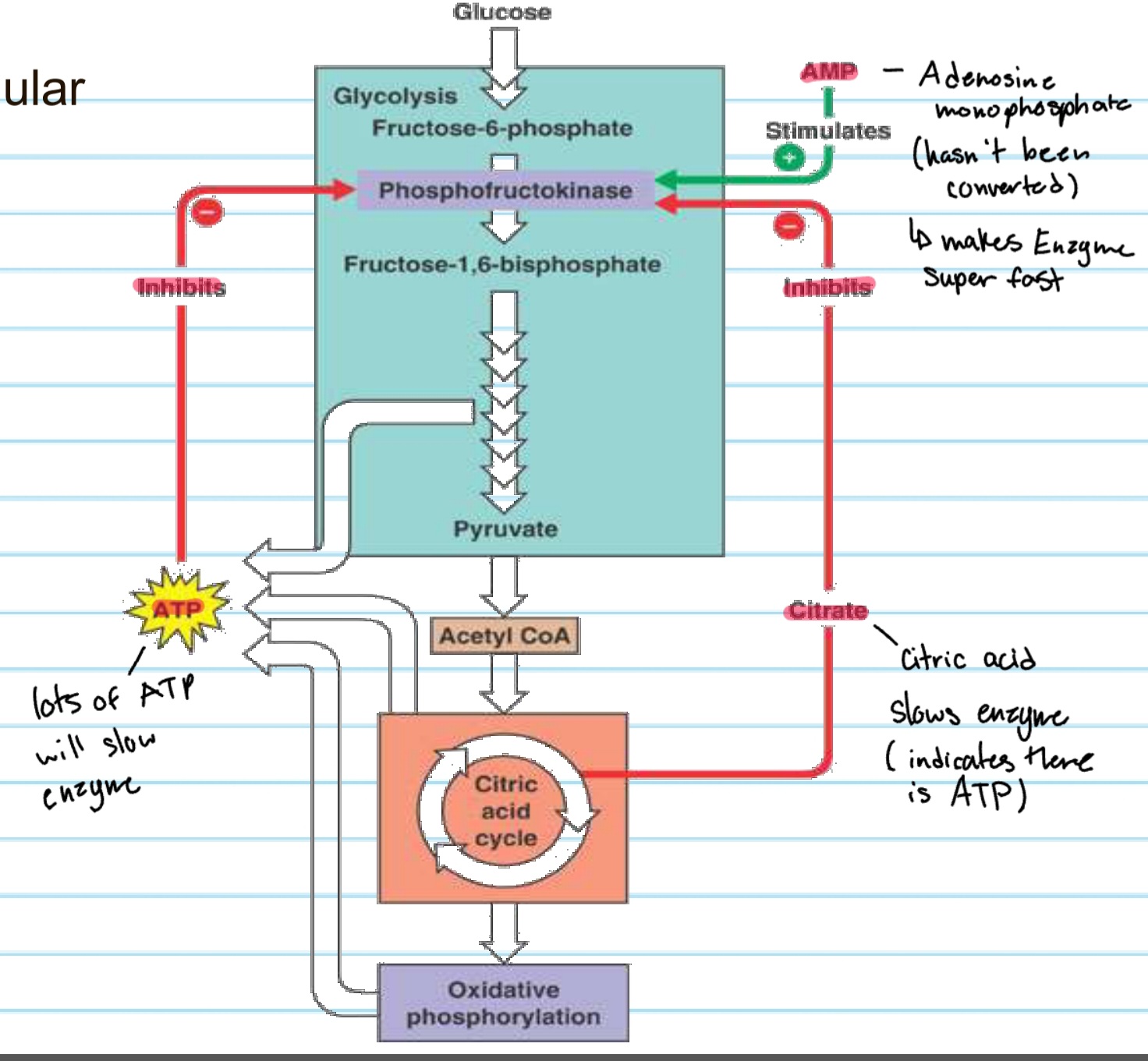
how is phosphofructokinase regulated and stimulated?
regulators:
ATP
Citrate
these inhibit the enzyme from creating more products
basically saying there is enough ATP or components to make ATP
stimulator
AMP - Adenosinemonophosphate
this molecule stimulates the enzyme to go faster and make more product
basically saying there is not a lot of ATP and the body needs more
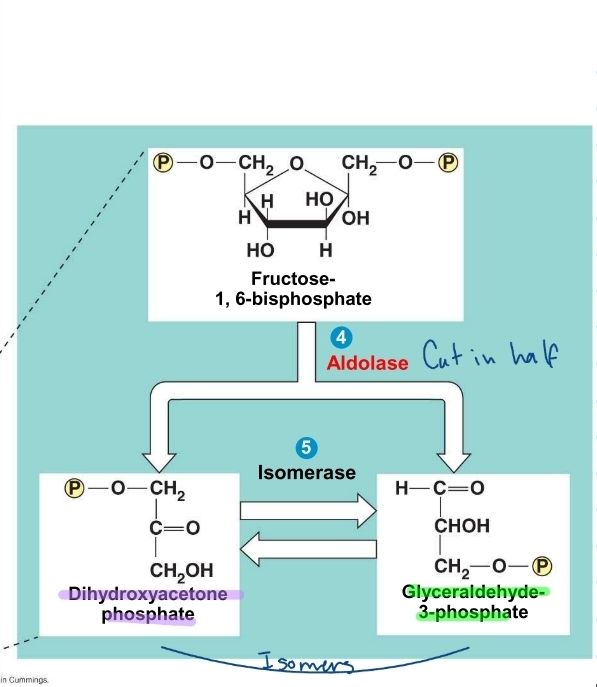
glycolysis - step 4
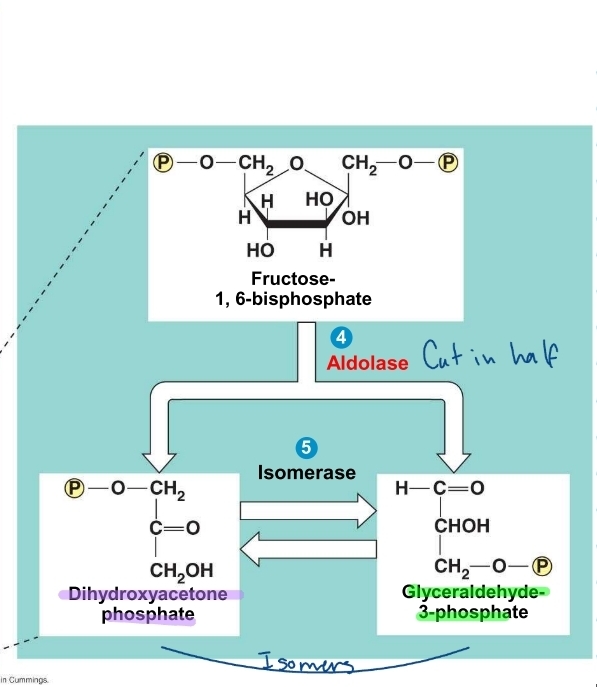
splits fructose-1,6-biphosphate into dihydroxyacetone phosphate and glyceraldehyde-3-phosphate
done by the enzyme aldolase
glycolysis - step 5
isomerase turns dihydroxyacetone phosphate into glyceraldehyde-3-phosphaste
glyceraldehyde-3-phosphate and dihydroxyacetone phosphate are isomers.
isomerase just turns it into it's isomer
glycolysis - step 6
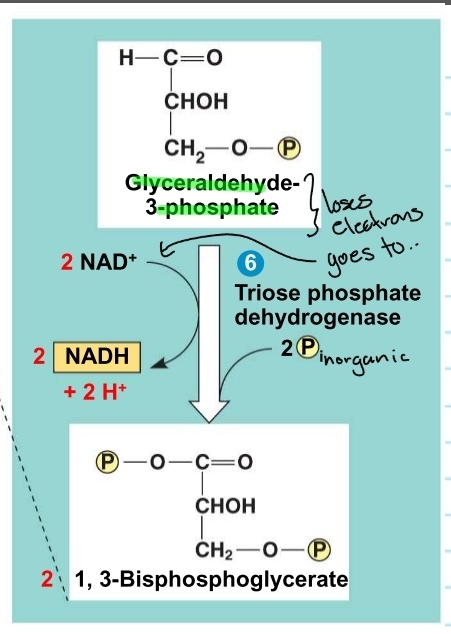
both glyceraldehyde-3-phosphates loses their electrons
both electrons get transferred onto 2 NAD+
turns it into 2 NADH and an additional 2 H
while both glyceraldhyde-3-phosphate turns into 1,3-biphosphoglycerate (after losing their electrons)
they gained inorganice phosphates (phosphates found in the system)
glycolysis - step 7
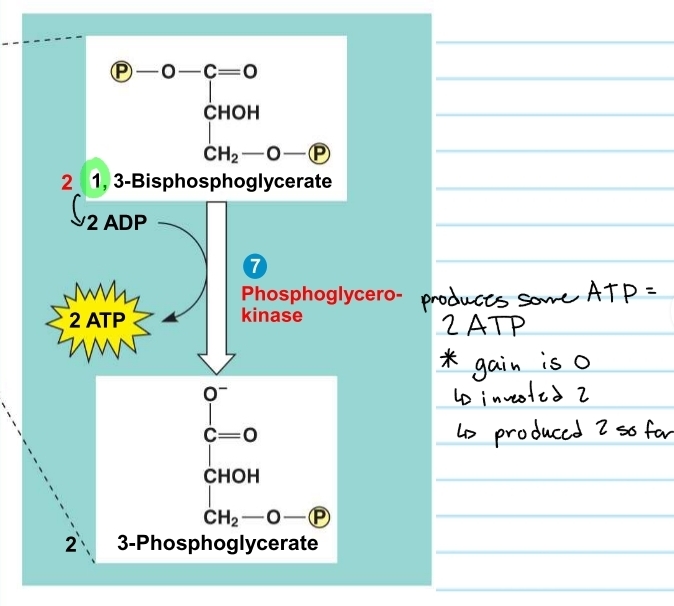
the payoff step (overall gain is 0 → invested 2 → got 2)
2 1,3-biophosphoglycerate loses one of their phosphates
those 2 phosphate lost gets transferred onto ADP creating 2 ATP
this turns them into 3-phosphoglycerate
done by phosphoglycerokinase
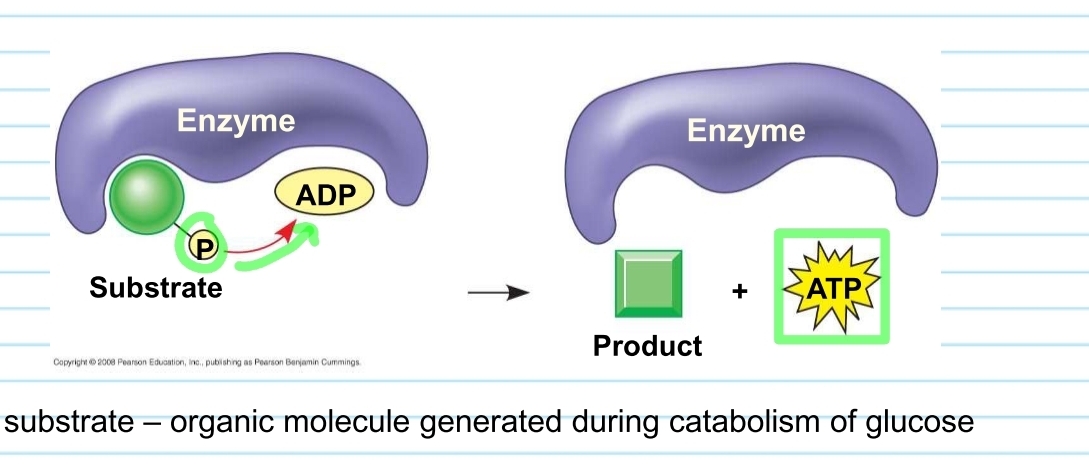
this reaction is substrate level phosphorylation
substrate level phosphorylation
where a phoshpate group is directly transferred from a substrate to an ADP to form ATP
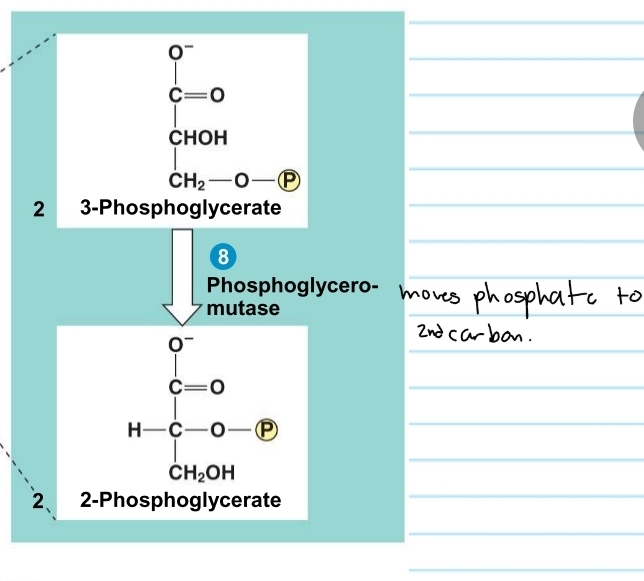
glycolysis - step 8
phosphoglyceromutase moves the phosphate on both 3-phosphoglycerate to the 2nd carbon
turns it into 2 2-phosphoeglycerate
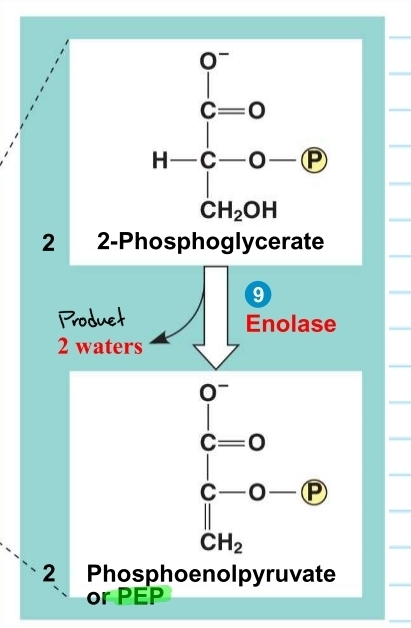
glycolysis - step 9
produces 2 water
enolase converts 2 2-phosphoglycerate into 2 phosphoenolpyruvate
by product is water
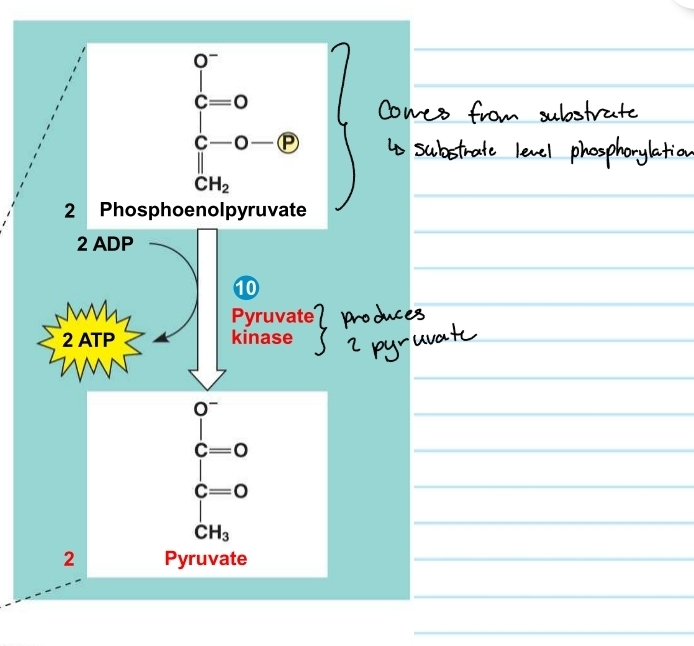
glycolysis - step 10
2 phosphoenolpyruvate loses it's phosphates, which gets directly transferred to ADP
creates 2 ATP (substrate level phosphorylation)
pyruvate kinase performs this reaction
the 2 phosphoenolpyruvate then becomes 2 pyruvate
glycolysis net yield
2 pyruvate → goes to mitochondria
2 ATP (substrate level)
2 H2O
2 NADH (goes straight to Oxidative phosphorylation)
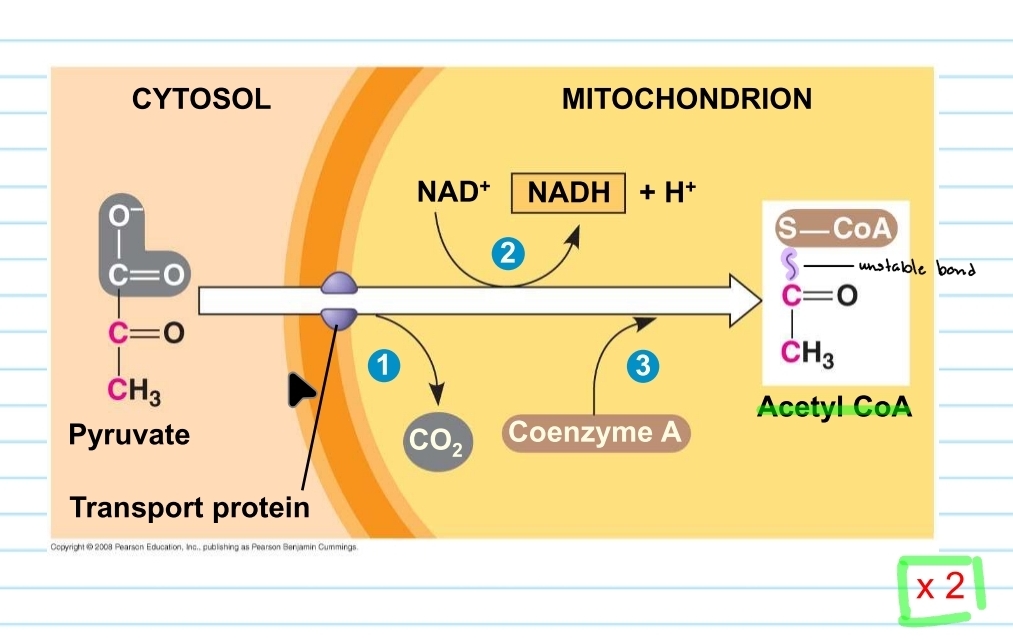
pyruvate oxidation (pre-citric acid cycle)
In the presence of O2 (aerobic), pyruvate enters the mitohondria's matrix
before the acid cycle begins, pyruvate must be converted into Acetyl CoA
this links the citric cycle to glycolysis
Acetyl CoA…
It is an highly reactive molecule and contains a unstable bond
this is used in the first step of Krebs Cycle
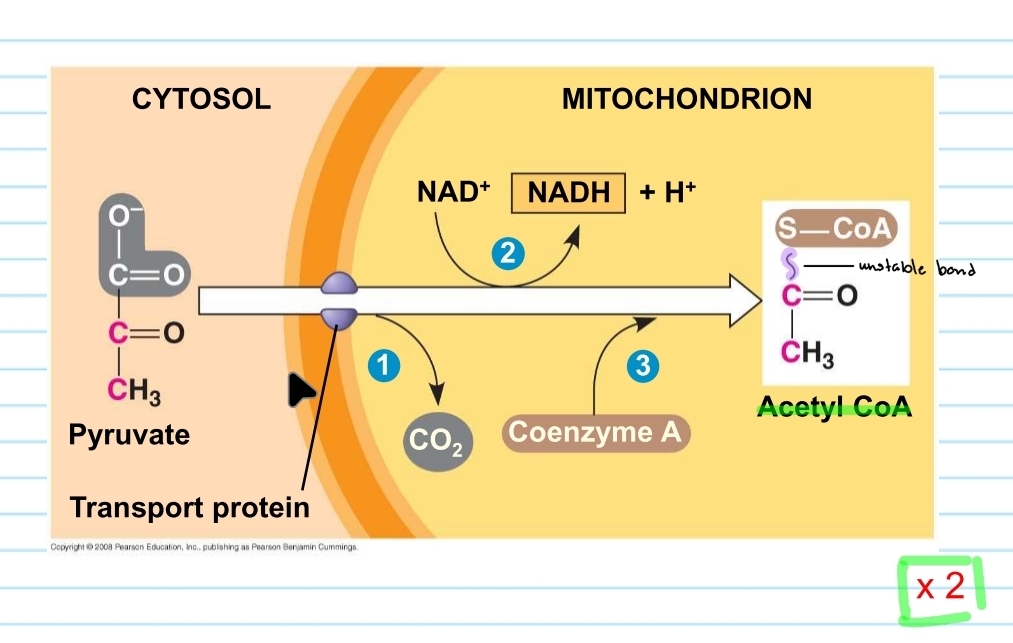
Conversion fo pyruvate into Acetyl CoA
2 Pyruvate enters the mitochondria with a transport protein
Coenzyme A then gets added to each Pyruvate
as this Co-A gets added..
each pyruvate (which has 3 carbons), loses one carbon that becomes CO2
NAD+ comes and pulls hydrogen ions off of each pyruvate to form 2 NADH’s and 2H+
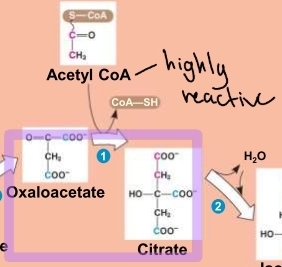
Krebs Cycle - step 1(CITRATE)
When Acetyl CoA enters the cycle it fuses with Oxaloacetate
They can fuse together by enzyme, Citrate Synthase, to create CITRATE
Citrate is a 6 cabron molecule used as a substrate with the next step.

Krebs Cycle - step 2 (IS)
Citrate from step 1 gets converted into Isocitrate
This is an isomerization reaction
shuffles the hydrogens and carbons around
Isocitrate can also turn back into Citrate when there is too much of it
All this is done by the enzyme Aconitase
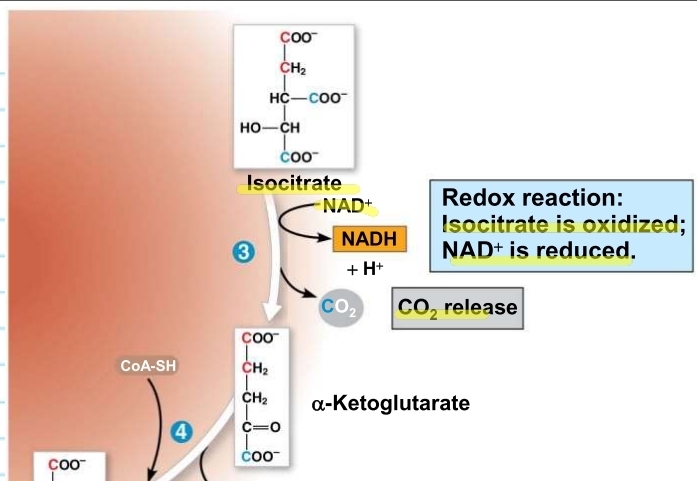
Krebs Cycle - Step 3 (KREBS)
Isocitrate gets converted into a-Ketoglutrate
The molecule loses one carbon which means it is released as CO2
a-Ketoglutrate is a 5 carbon molecule
This is done by an enzyme by Isocitrate Dehydrogenase
Dehydrogenase indicates that NAD+ is being reduced (making NADH) → Redox Reaction
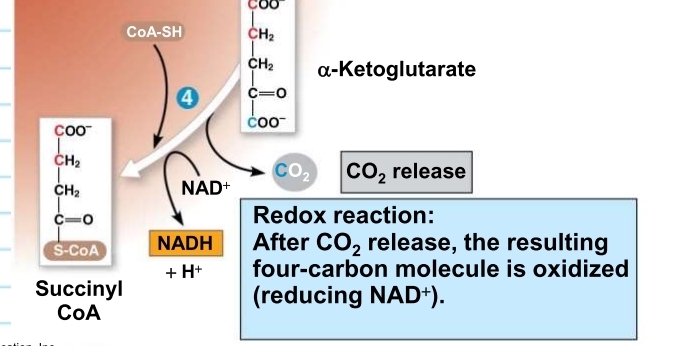
Krebs Cycle - Step 4 (STARTING)
a-Ketogluterate gets converted into Succinyl CoA which is a 4 carbon molecule with a CoA on it
means it releases CO2 and a CoA enzyme added to it
Done by a-Ketogluterate Dehydrogenase enzyme
which then means NAD+ gets reduced into NADH (Redox Reaction)

Krebs Cycle - Step 5 (SUBSTRATE)
Succinyl CoA loses it's CoA and turned into Succinate
When CoA is released it generates some energy
GDP and an inorganic phosphate fuses to form GTP
ADP comes by and takes a phosphate from GTP to form ATP
GTP then returns to GDP
This is Substrate Level Phosphorylation
This is all done by Succinyl CoA Synthetase
It stimulates the substrate level phosphorylation
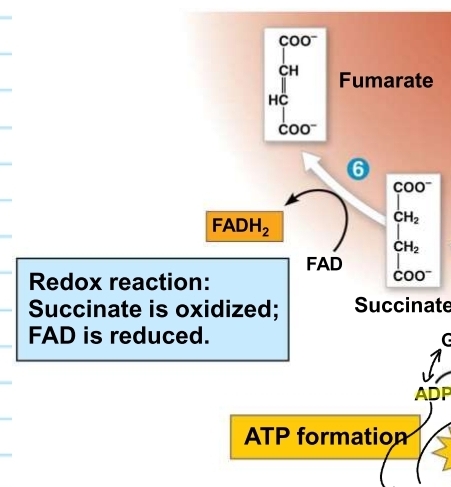
Krebs Cycle - step 6 (FOR)
Succinate gets converted into Fumarate
FAD gets reduced into FADH2
This is done by Succinate Dehydrogenase
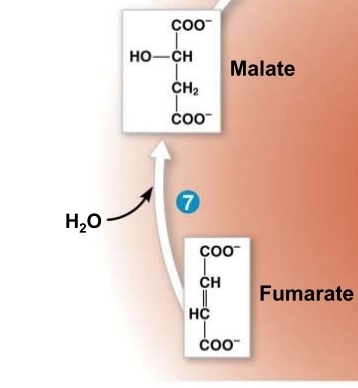
Krebs Cycle - step 7 (MAKING)
Fumerate gets converted into Malate
Fumerase adds water into the reaction to convert fumerate
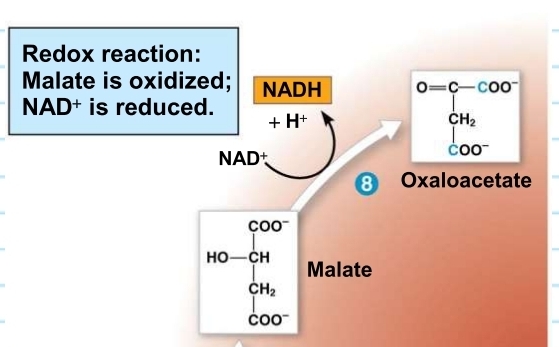
Krebs Cycle - step 8 (OXALOACETATE)
Malate gets converted into Oxaloacetate
Done by Malate Dehydrogenase
which means NAD+ gets reduced into NADH
How many times does Krebs Cycle happen?
2 times
this is because we put in two Acetyl CoA to go through the cycle, meaning it happens twice
Which means all the products are multiplied by 2
Krebs Cycle Net Yield
4 CO2
6 NADH + 6H ions
2 FADH
2 ATP (Substrate Level Phosphorylation)
Krebs Cycle Pneumonic for each substrate
Citrate - Citrate
Isocitrate - Is
a-Ketogluterate - Krebs
Succinyl-CoA - Starting
Succinate - Substrate
Fumerate - For
Malate - Making
Oxaloacetate - Oxaloacetate
2 process in Oxidative Phosphorylation
Electron transport Chain
Chemiosmosis
where is the electron transport chain and what is it?
in the cristae of the mitochondria
it is a multiprotein complex
does the electron transport chain generate atp?
no
what carries electrns to the electron transport chain?
NADH & FADH2
electron transport chain consists of how many proteins?
4 protein complexes with smaller proteins inside each one.
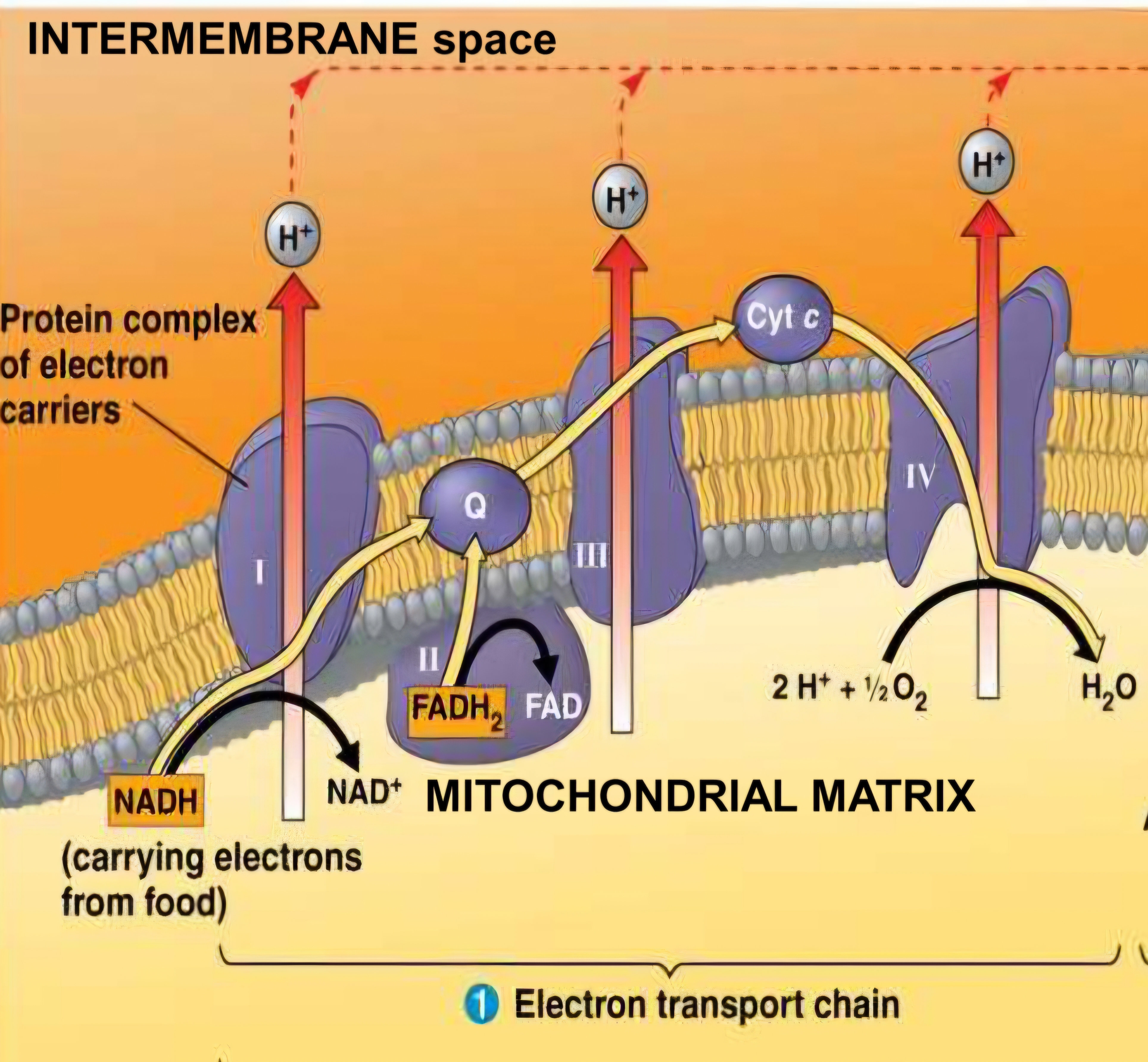
how does the electron transport chain work?
NADH enters the first protein complex and becomes oxidized (NAD+) leaving behind electrons
The second protein complex is where FADH2 enters becomes FAD leaving behind electrons
comes from Krebs Cycle and past steps
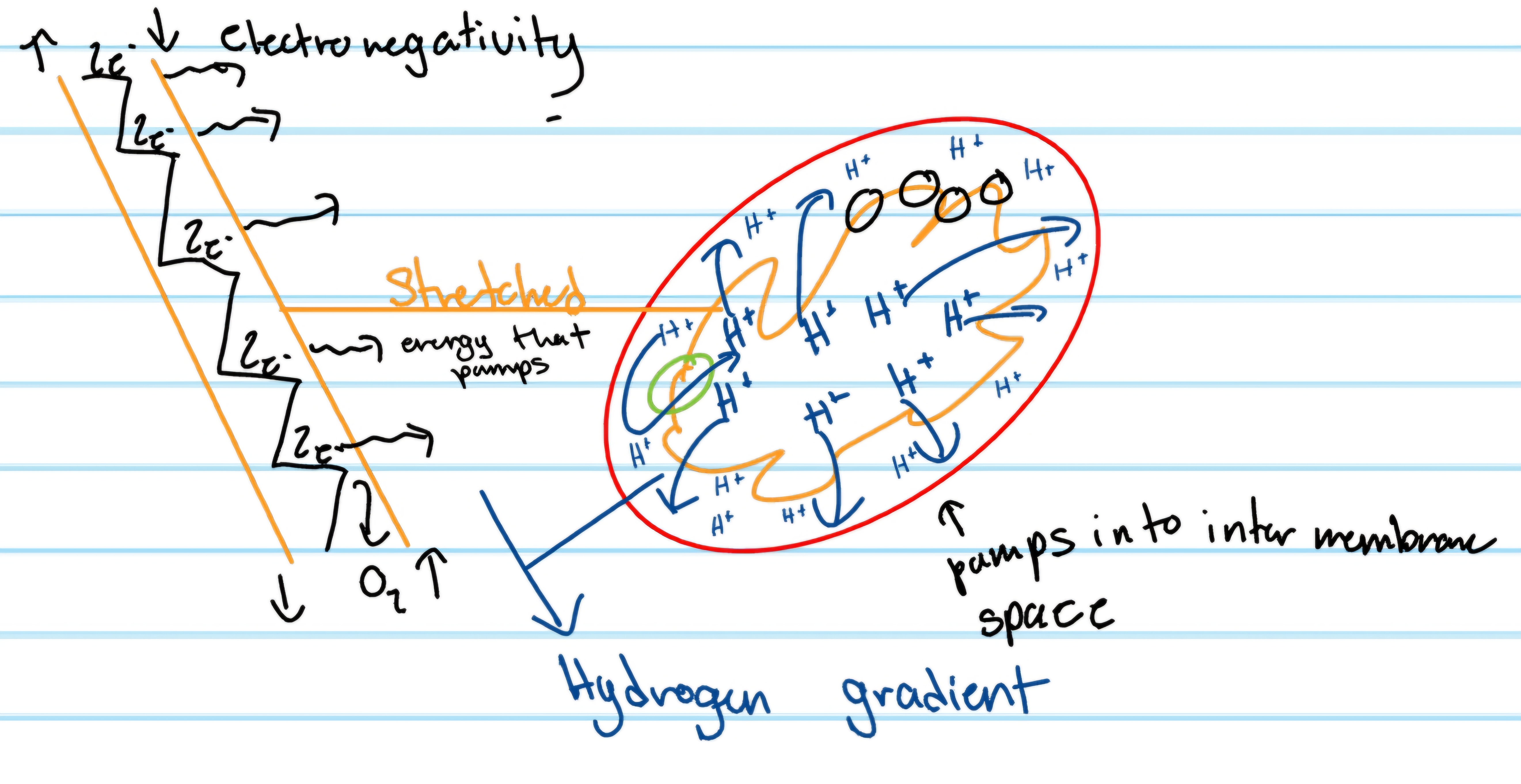
This area in the electron transport chain has the lowest electronegativity
Electrons then are transported by a molecule to enter complex 3 and then exit through complex 4
when it exits the electrons get picked up by O2 and O2 combines with Hydrogen ions (from NADH) to create 4 H2O
This area is the most electronegative
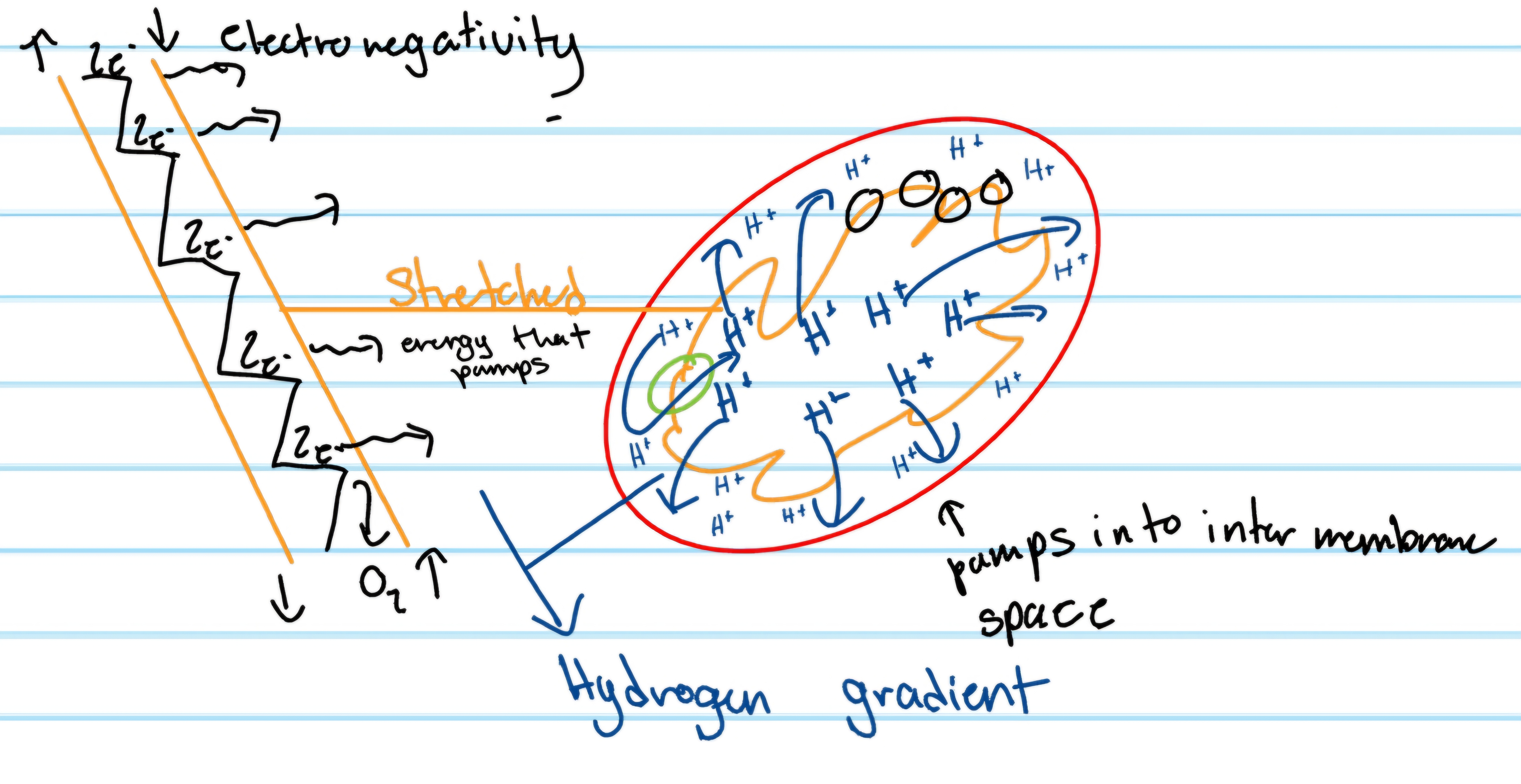
what type of energy is released by electron transport chain
it releases potential energy as electrons move through the transport chain
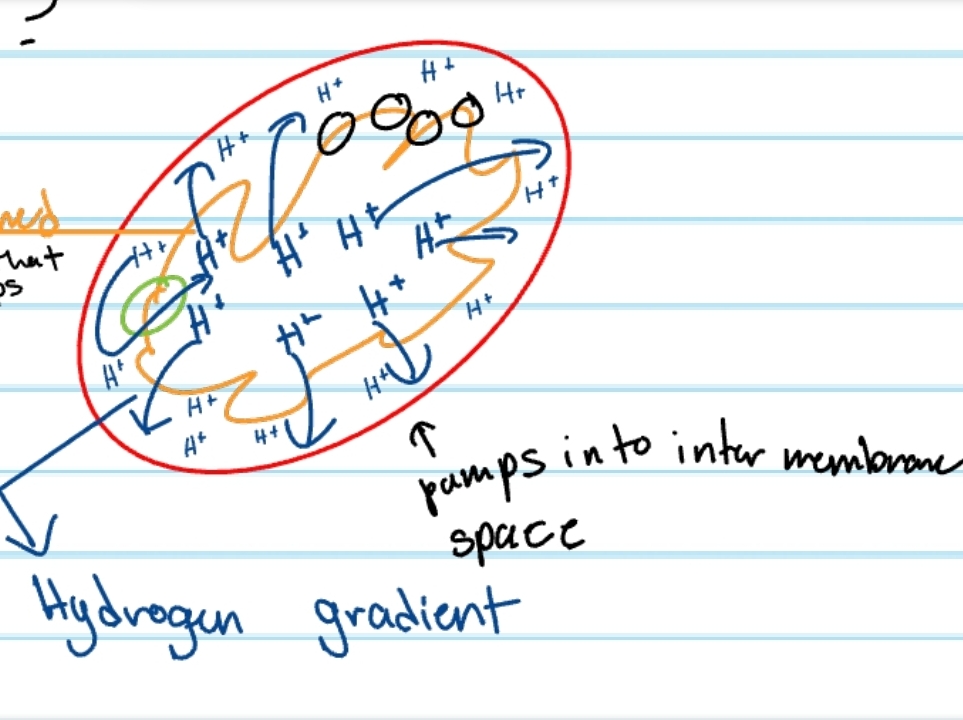
what is potential energy from the electron transport chain used for?
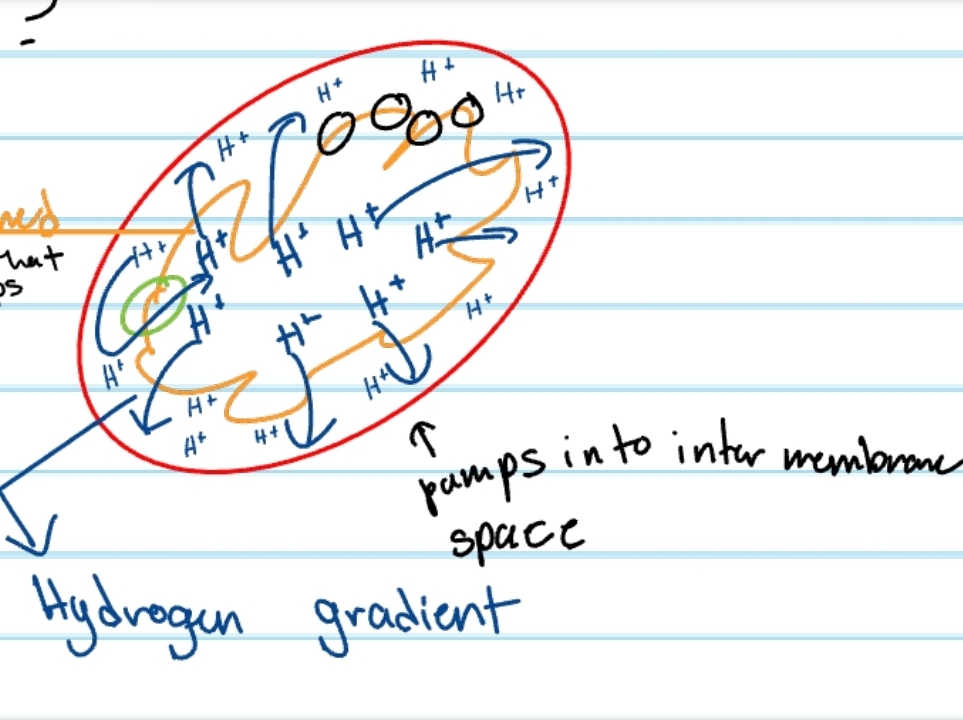
It is used to create a hydrogen gradient
it pumps the hydrogen ions from the matrix (of the mitochondria) into the intermembrane space
high concentration of hydrogens gets moved into the intermembrane space
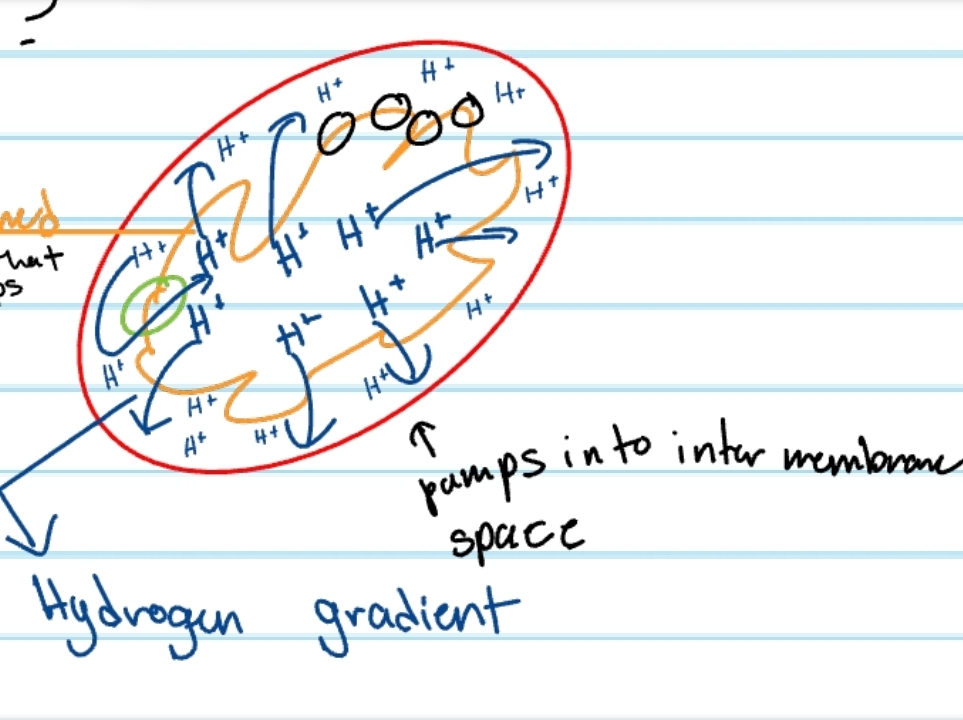
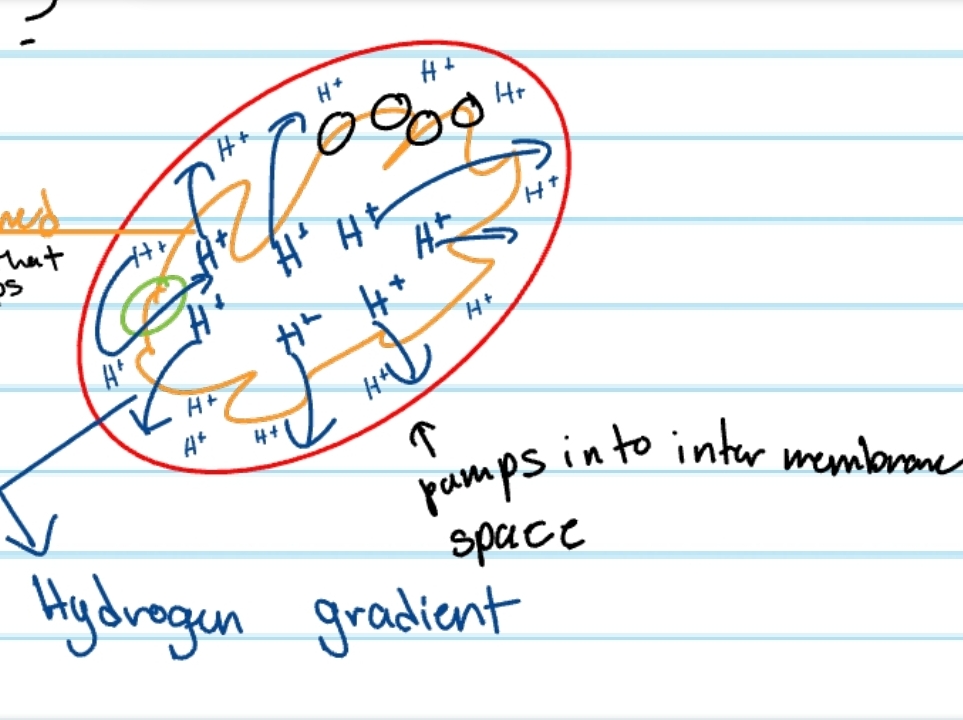
what is the overall purpose of the electron transport chain? is the reaction a burst or controlled?
to create a hydrogen gradient
it is a controlled reaction meaning in a step wise action
what is the hydrogen gradient?
a difference in hydrogen concentration in the mitochondria
crucial for cellular respiration/making ATP
it is also referred to as a proton-motive force → the capacity for it to do work (in chemiosmosis)
what is the net yield for electron transport chain?
0 ATP
4 H2O
what enzyme is used for chemiosmosis
ATP Synthase
what does ATP synthase do?
Synthesis of ATP
how does chemiosmosis work?
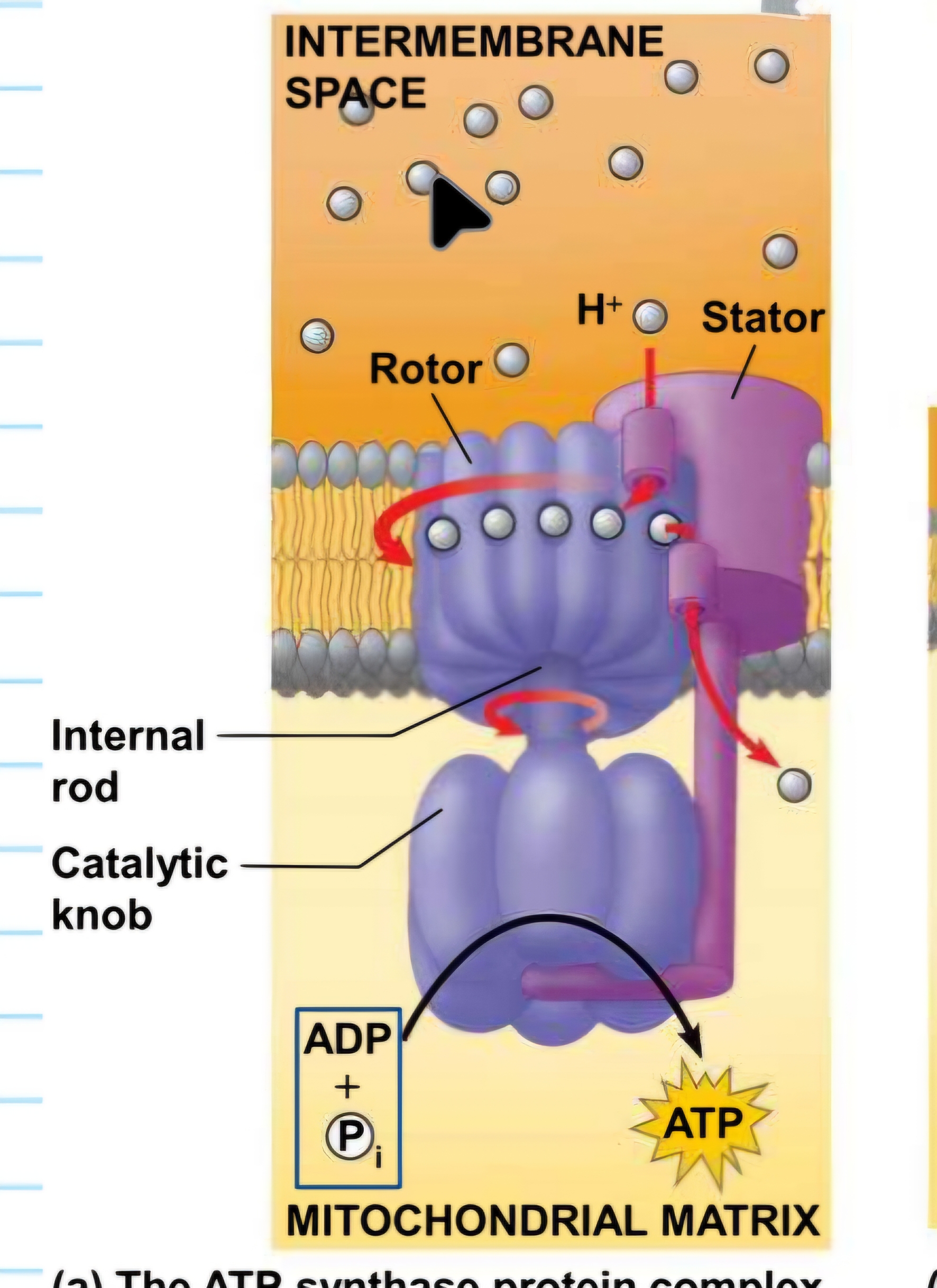
Hydrogens that are present in the intermembrane space flows through the ATP synthase enzyme back into the matrix
the hydrogens is what pumps the enzyme to create ATP (like a water wheel for electricity)
While this happens ATP is synthesized
ADP and an inorganic phosphate get fused into ATP
This is oxidative phosphorylation
what is oxidative phosphorylation?
when an inorganic phosphate is added to ADP
the phosphate is inorganic because it is just present someowhere in the mitochondria
how much ATP does chemiosmosis make?
either 26 ATP or 28 ATP
why can chemiosmosis create different amounts of ATP?
this is because it depends on the shuttle that carries the electrons
Either 2 NADH or 2 FADH2
how much ATP do you get if the shuttle is NADH?
if the shuttle is NADH..
1 NADH = 2.5 ATP
because it enters the first complex it creates more ATP
So the 2 NADH shuttle would equal to; 2NADH x 2.5 = 5 ATP
this gets added to the ATP created from NADH's and FADH2's from Krebs Cycle, which is 23 ATP
So; 5 + 23 = 28 ATP (IF THE SHUTTLE IS NADH)
how much ATP would you get if FADH2 was the shuttle?
if FADH2 was the shuttle…
1 FADH2 = 1.5 ATP
it enters the second complex meaning it goes through less complexes, so less ATP
So the if FADH2 was the shuttle; 2FADH2 × 1.5 = 3 ATP
Which then gets added to 23 ATP we get from krebs cycle
3 + 23 = 26 ATP
where do the electron shuttles come from?
they come from the 2 NADH that is formed in glycolysis
the NADH cannot enter the mitochondria by itself, so it needs a shuttle to help it.
the shuttle can either be NADH or FADH2
overall how much ATP does cellular respiration make?
2 from glycolysis (Anaerobic)
2 from Krebs Cycle (Aerobic)
26 or 28 from Chemiosmosis
OVERALL: 30 or 32 ATP
what is fermentation?
the process of making ATP without O2 (Anaerobic)
done through repeated glycolysis
what processes does fermentation consist of?
glycolysis
reactions that regenerate NAD+, which can be reused by glycolysis
two common types of fermentation
alcohol fermentation
lactic acid fermentation
what happens in alcohol fermentation and what is it used for?
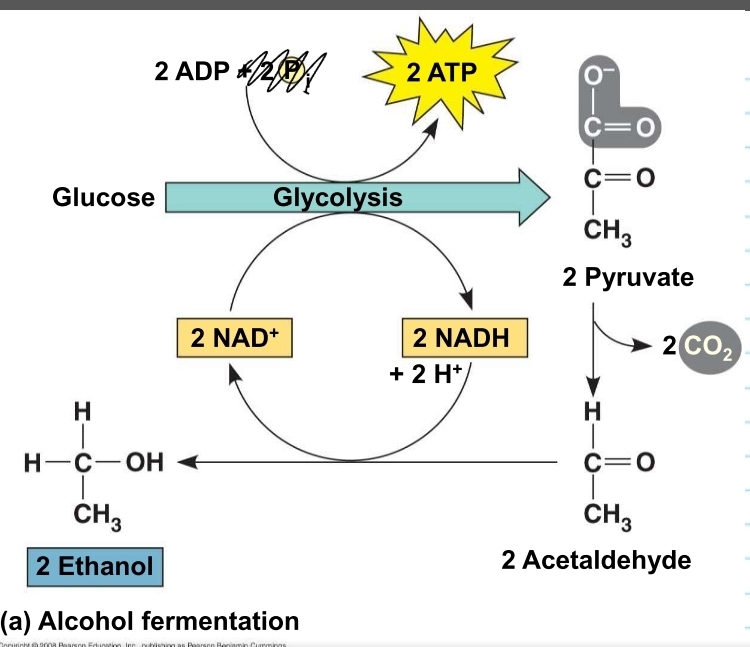
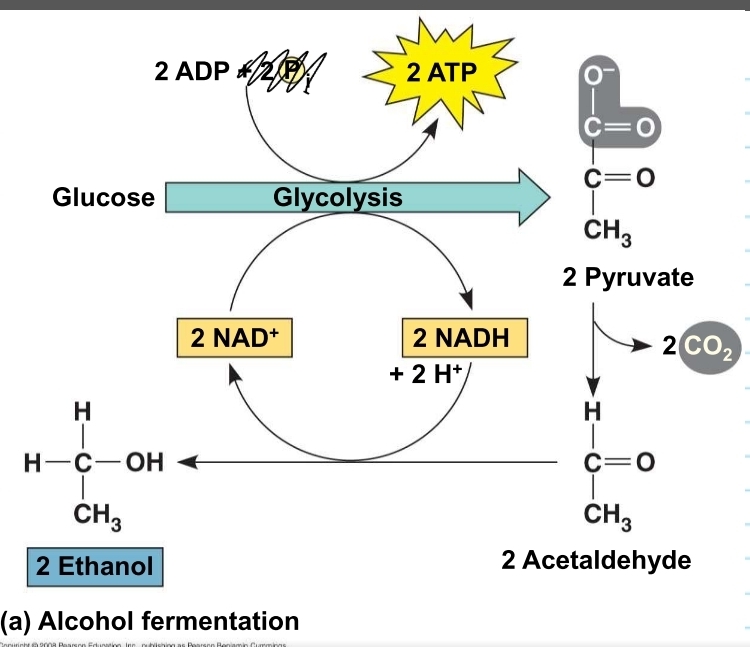
2 pyruvate from glycolysis is converted into 2 Acetaldehyde into 2 ethanol
CO2 is released when pyruvate gets converted
this type of fermentation (by yeast) is used in brewing, winemaking, and baking
what is the acetaldehyde and what does it do?
it is a derivitave that comes from the pyruvate, which can accept electrons from NADH, formed in glycolysis, and oxidize it back to NAD+
this allows for glycolysis to happen again
what happens in lactic acid fermentation and what is it used for?
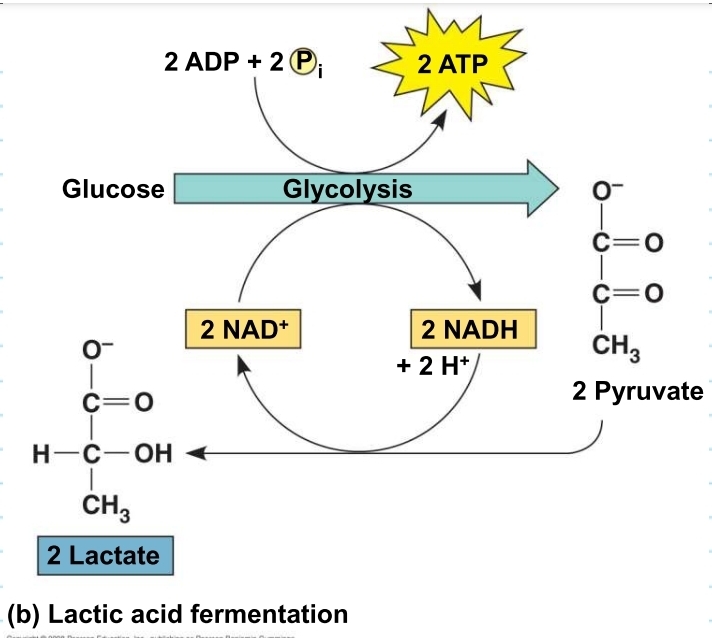
2 pyruvate, from glycolysis, gets converted into lactate
this realese no CO2
this fermentation is done by some fungi and bacteria which is used to make cheese and yogurt
do humans use lactic acid fermentation?
yes they do!
the human cells use this to generate ATP when O2 is scarce (low oxygen)
this is when muscles shift from cellular respiration during intense workouts when the body is using a lot of oxygen to create more ATP
how does lactic acid fermentation regenerate NAD+?
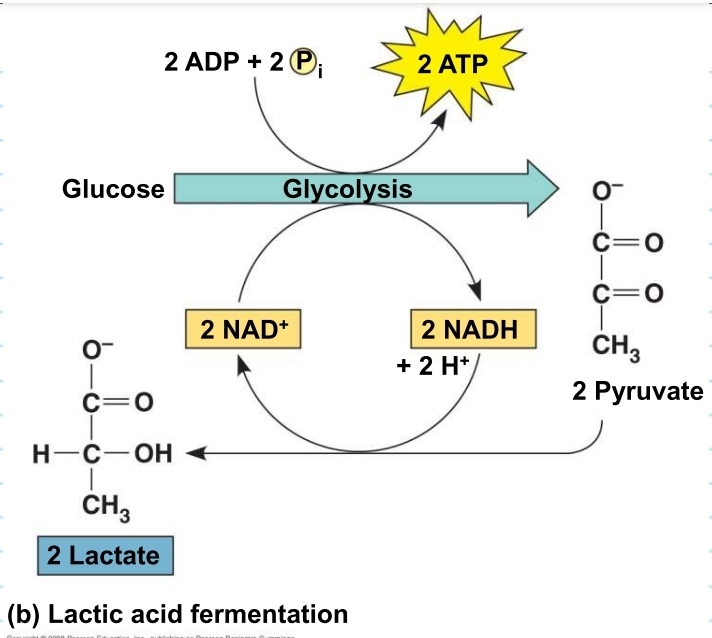
it regenerates NAD+ by using pyruvate itself as an electron acceptor
which allows NADH to oxidize by to NAD+
this then turns pyruvate into lactate
how much ATP does fermentation produce?
2 per glucose molecule
glycolysis creates 2 ATP each time
 Note
Note  Flashcards (36)