Exercise Physiology (Final)
 Studied by 0 people
 Call Kai
 Learn
Learn Practice Test
 Spaced Repetition
 Match
Match Flashcards
 Knowt Play
1/20

There's no tags or description
Looks like no tags are added yet.
Name | Mastery | Learn | Test | Matching | Spaced | Call with Kai |
|---|
No analytics yet
Send a link to your students to track their progress
21 Terms
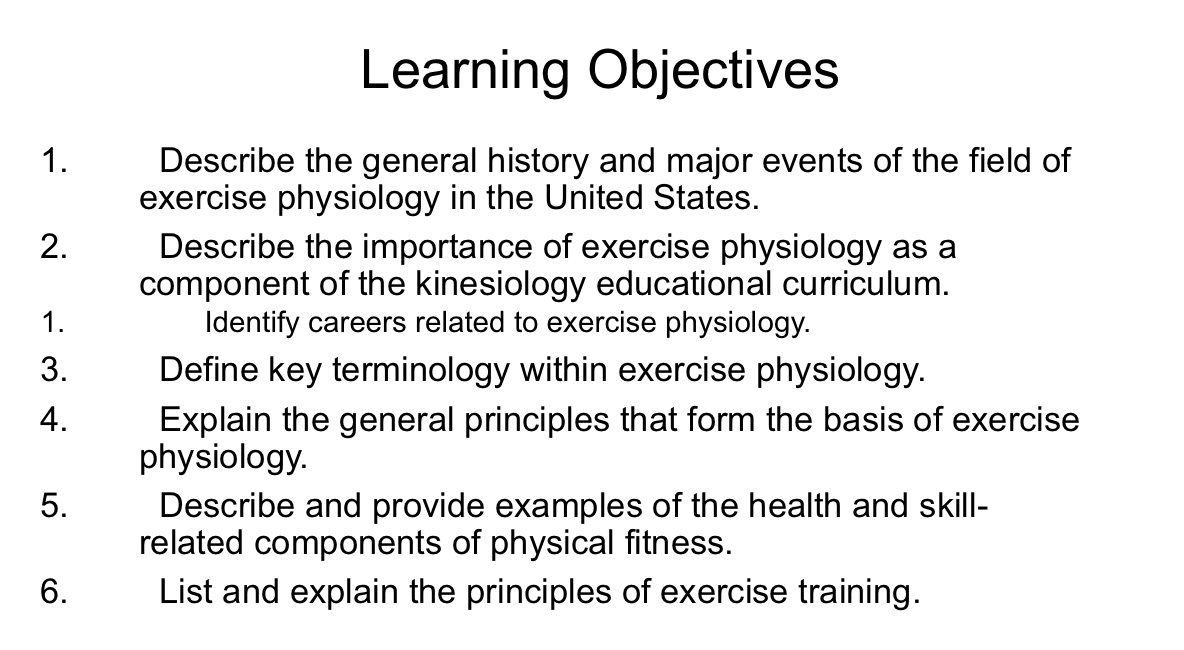
Learning Objectives
Harvard Fatigue Laboratory
1927
Basic physiology focus
1950-1980
Applied exercise physiology focus
1980-current
Why study exercise physiology? (4)
Understand how the body responds to to exercise
Improve health and performance
Prevent and manage disease
Ensure safe and effective training
The study of how the body responds and adapts to physical stress
Exercise physiology
Sudden and short-lived responses to exercise
Acute exercise effects
Gradual and long term responses to exercise
Chronic exercise effects
Any bodily movement that requires the use of energy by the individual
Physical activity
The basic self care tasks that a person needs to perform every day in order to live independently
Activities of daily living (ADLs)
A specific type of PA that is planned and structures with the explicit purpose of improving physical fitness
Exercise
Physiological attributes that reflect the ability of the systems of the body to support physical activity, ADLs, sport, occupational tasks
Physical fitness
The ability to perform prolonged, large-muscle, dynamic exercise at moderate to high levels of intensity
Aerobic capacity
The proportion of total body weight made up of fat mass and fat-free mass
Body composition
What are the acute physiological responses to stress? (4)
^ O2 intake into lungs
^ O2 delivery to muscles
^ O2 supply
^ ATP supply
What is the gold standard for assessment of aerobic capacity?
The cardiopulmonary exercise test
What does the cardiopulmonary exercise test measure?
Measures maximal volume of oxygen uptake during stress
Regular and specific exercise can lead to…
Long term changes within the systems of the body in response to the stress of exercise
The body must be stressed to a level beyond that to which it is normally accustomed to stimulate physiological training adaptations
Principle of overload
As the body adapts to exercise, the exercise intensity must be increased to continue to stimulate physiological training adaptations
Principle of progression
When an exercise stress is removed, the physiological training adaptations to that stress are lost
Principle of reversibility
 Note
Note  Flashcards (27)