07 - Win Win Ecology: Mutualism and Facil
 Studied by 0 people
 Call Kai
 Learn
Learn Practice Test
 Spaced Repetition
 Match
Match Flashcards
 Knowt Play
1/52

There's no tags or description
Looks like no tags are added yet.
Name | Mastery | Learn | Test | Matching | Spaced | Call with Kai |
|---|
No analytics yet
Send a link to your students to track their progress
53 Terms
competition is ( __ , __ )
( - , - )
amensalism is ( __ , __ )
( - , 0 ) or ( 0 , - )
parasitism-predation is ( __ , __ )
( - , + )
( + , - )
commensalism is ( __ , __ )
( 0 , + )
( + , 0 )
mutualism is ( __ , __ )
( + , + )
Facilitation
any positive interaction between species in which at least one organism benefits and neither is harmed.
These interactions often help organisms survive or reproduce in challenging environments by improving conditions such as nutrient availability, shelter, or protection
Mutualism
a type of facilitation where both species benefit from the interaction. Each partner provides something the other needs — such as food, shelter, or protection — leading to a reciprocal positive relationship.
Example: Bees and flowering plants — bees get nectar, while plants get pollinated.
Obligate Mutualism:
both species depend entirely on each other for survival or reproduction. They cannot live or reproduce successfully without their partner.
Example: The relationship between fig trees and fig wasps, where each species is essential for the other’s life cycle
Obligate–Obligate:
Both partners are obligate mutualists, meaning neither can survive independently.
Example: Termites and gut protozoa — termites rely on protozoa to digest cellulose, and protozoa rely on termites for habitat and food.
Obligate–Facultative:
One species is obligate (it cannot live without the other), while the other is facultative (it benefits but can survive without the relationship).
Example: Certain species of ants and aphids — some ants depend on aphids for food, while aphids can survive without the ants.
Facultative Mutualism
The interaction is beneficial but not essential. Both species can survive independently, but they gain advantages when interacting.
Example: Birds that eat ticks off large mammals — both benefit, but neither depends entirely on the other
Facultative–Facultative:
Both species are facultative mutualists, meaning each can live without the other but benefits when together.
Example: Oxpecker birds and rhinoceroses — birds get food by eating ticks, while rhinos get pest control
Commensalism
Commensalism is a type of facilitation in which one species benefits while the other is neither helped nor harmed.
Example: Barnacles on whales — barnacles gain mobility and access to nutrients, while whales are unaffected.
Leafcutter ants - obligate-obligate mutualism
Leafcutter ants in Ecuador sometimes appear in large aggregations, with each ant carrying a piece of cut leaf. The relationship between leafcutter ants and their fungi gardens is an obligate-obligate mutualism
Black bears and manzanita shrubs - Facultative- Facultative
Black bears and manzanita shrubs are facultative partners in a loose mutualism. When bears eat manzanita berries, they receive a caloric benefit, and depositing the seeds far from the parent plant offers a transportation or dispersal benefit to the manzanita plant.
Benefits of Mutualism
1. Transportation: Reproduction and Dispersal
2. Acquisition of Energy and Nutrients
3. Protection and Defense
how is Transportation a Benefit of Mutualism
Mutualisms are created by two self-interested individuals from two different species, with each individual trying to gain a fitness advantage over other individuals in its own species.
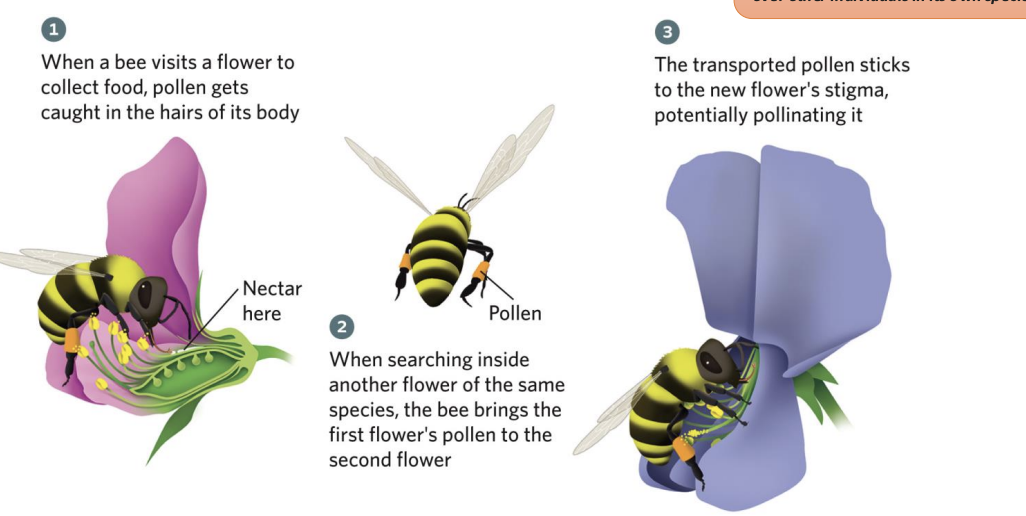
Scarification
A process that breaks or softens a seed’s hard coat to allow water and gases to enter, triggering germination. It can occur naturally (through fire, animals, or weathering) or artificially (by scratching, heating, or chemical treatment).
how is Acquisition of Energy and Nutrients a Benefit of Mutualism
The diversity of microorganisms found in a newborn child’s intestine from birth through 850 days of age, as measured through stool samples, steadily increases, approaching that of the mother. The measure of diversity used here is called phylogenetic diversity (Koenig et al. 2011).
Mycorrhizae are soil fungi that can form symbiotic associations with plant roots to exchange resources. In general, the plants offer carbohydrates to the mycorrhizae, and the mycorrhizal fungi offer critical resources such as phosphorus to the plant.
how is Protection and Defense a Benefit of Mutualism
Ants in the genus Pseudomyrmex and Neotropical acacia trees in the genus Vachellia sometimes form mutualisms, with ants protecting the trees from herbivory in exchange for protection (homes within thorns) or food such as nectar from extrafloral nectaries (the gree
Clownfish in the family Pomacentridae form mutualistic interactions of the defenceprotection type with sea anemones
symbiotic relationship
A symbiotic relationship, or symbiosis, refers to a close and long-term biological interaction between two different species, where at least one species benefits.
These relationships can be beneficial, neutral, or harmful, depending on how each species is affected.
Many symbiotic interactions are
detrimental or pathogenic, like the interaction between the bacterial symbiont Vibrio shiloi and the colony-forming coral Oculina patagonica.
On the left, the zooxanthellae impart colour to the coral; on the right, coral with symbiotic V. shiloi is bleached and without colour due to loss of zooxanthellae.
The bleaching can lead to coral death.
The Lotka-Volterra Model approach for Mutualism
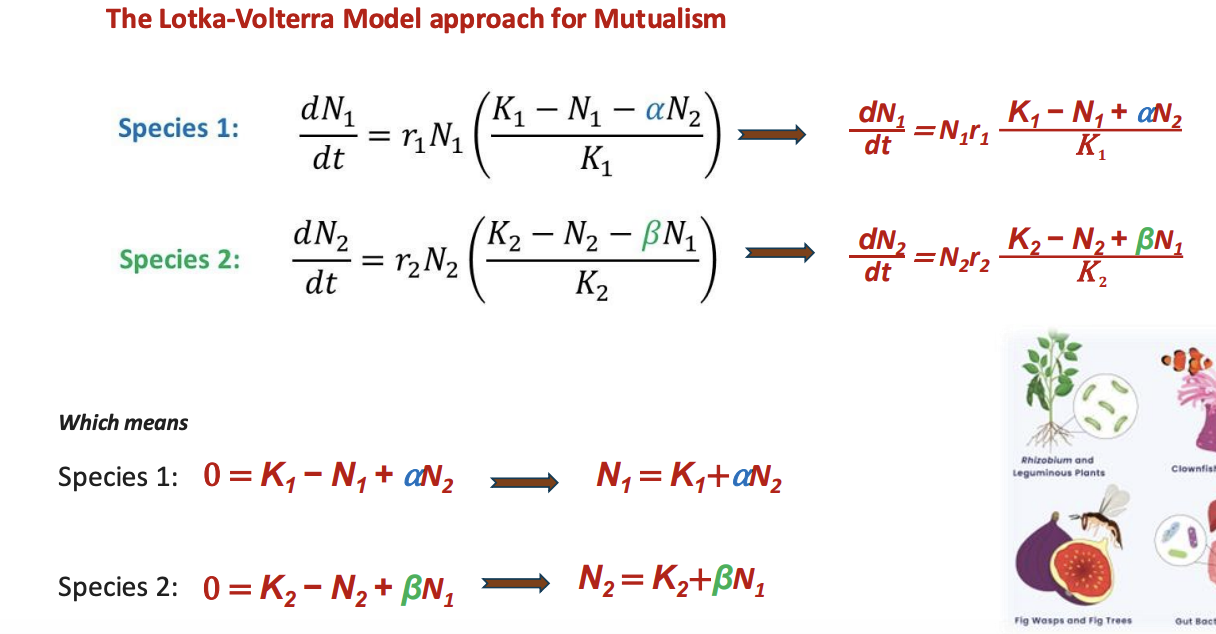
A mutualism model based on the Lotka-Volterra competition model leads to _____ outcomes for facultative mutualisms
two outcomes
depending on the strength of the interaction (i.e., the α and β from Equations).
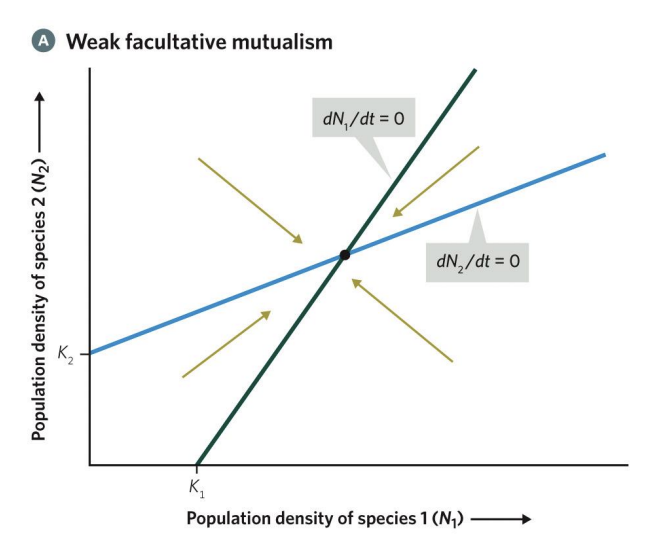
weak facultative mutualism model
If the interaction is weak, then we observe a small increase in the population density of the focal species with a large or moderate increase in the population density of the mutualistic partner. The arrows lead to a stable equilibrium point with each population above its carrying capacity
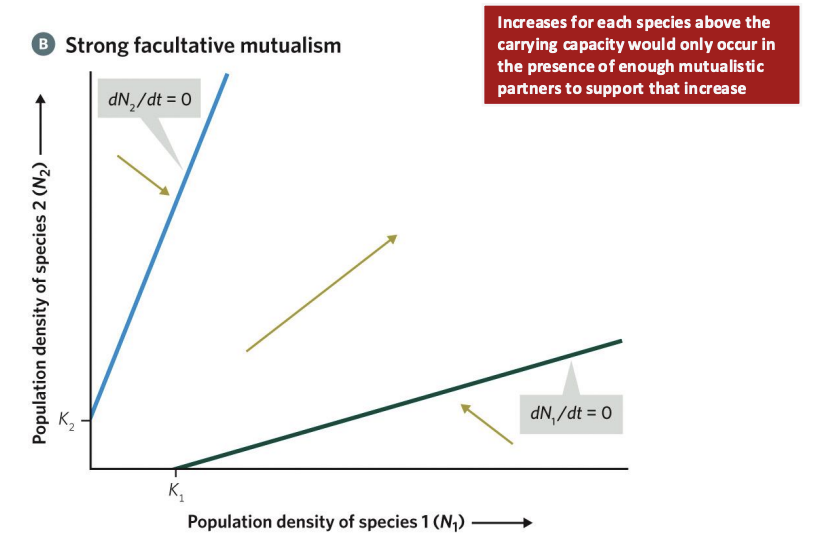
strong facultative mutualism model
B. When the interaction is stronger, each mutualistic partner increases so much in the presence of the other species that the two isoclines do not intersect, and there is no stable equilibrium; instead the populations of the two species increase exponentially without limit.
prisoners dilemma
a paradox in decision analysis in which two individuals acting in their own self interest do not produce the optimal outcome
Here we see the prisoner’s dilemma payoffs for two thieves who stole and then stashed $10 million, which they are going to retrieve at a later date. Yellow represents decisions and payoffs for thief 1; blue represents decisions and payoffs for thief 2. Defecting (turning the other person in to the police) leads to a higher average payoff for each thief
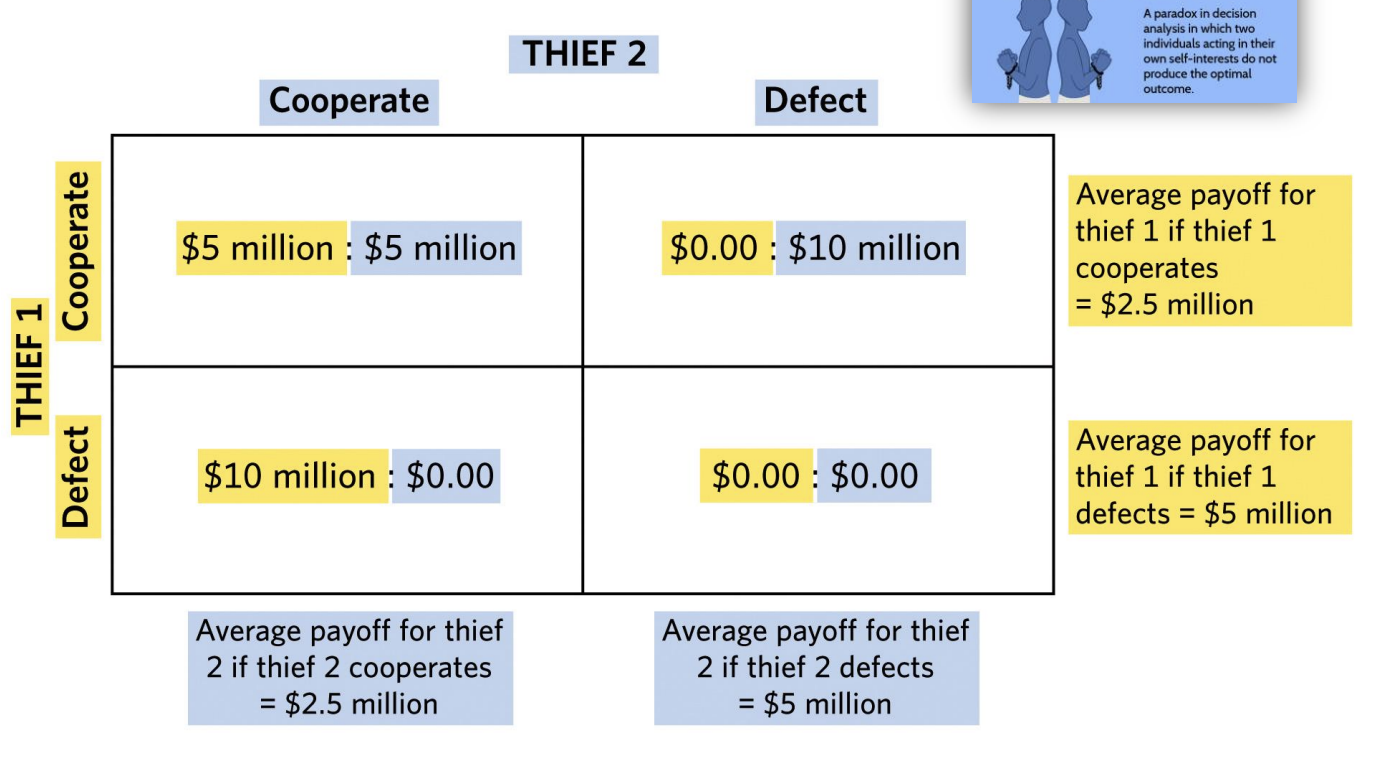
Iterative Prisoners’ Dilemma (IPD):
Robert Trivers suggested that cooperation was more likely to evolve if the two individuals in the prisoner's dilemma game had multiple opportunities to interact over time, much like species do in their environment.
Also called reciprocal altruism.
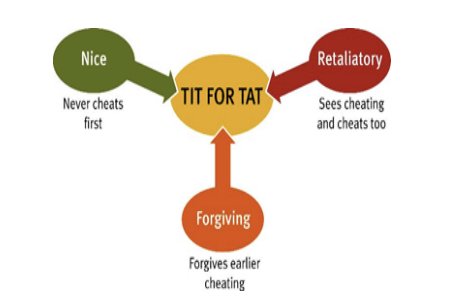
Tit for Tat:
Robert Axelrod and William Hamilton (1981)
Tit for Tat’s success depends on niceness and forgiveness
Game Theory Models Example - A honeybee and a hummingbird rob nectar from flowers
A. Notice the dark patches in the flowers, indicating slits or holes where nectar has already been removed. Although honeybees are one of the most successful generalist pollinators, nectar robbery rarely results in pollination.
B. A hummingbird steals nectar from a flower by piercing the corolla to get nectar and bypassing the pollen-laden anthers.
Game Theory Models Example - bluestreak cleaner wrasse
A bluestreak cleaner wrasse cleans the mouth of a tiger grouper in Sodwana Bay, South Africa.
Cleaning inside the mouth this way exposes the cleaner fish to the risk of predation
An Economic Model
A standard economic model of trade assumes that two independent groups differ in their abilities to access resources
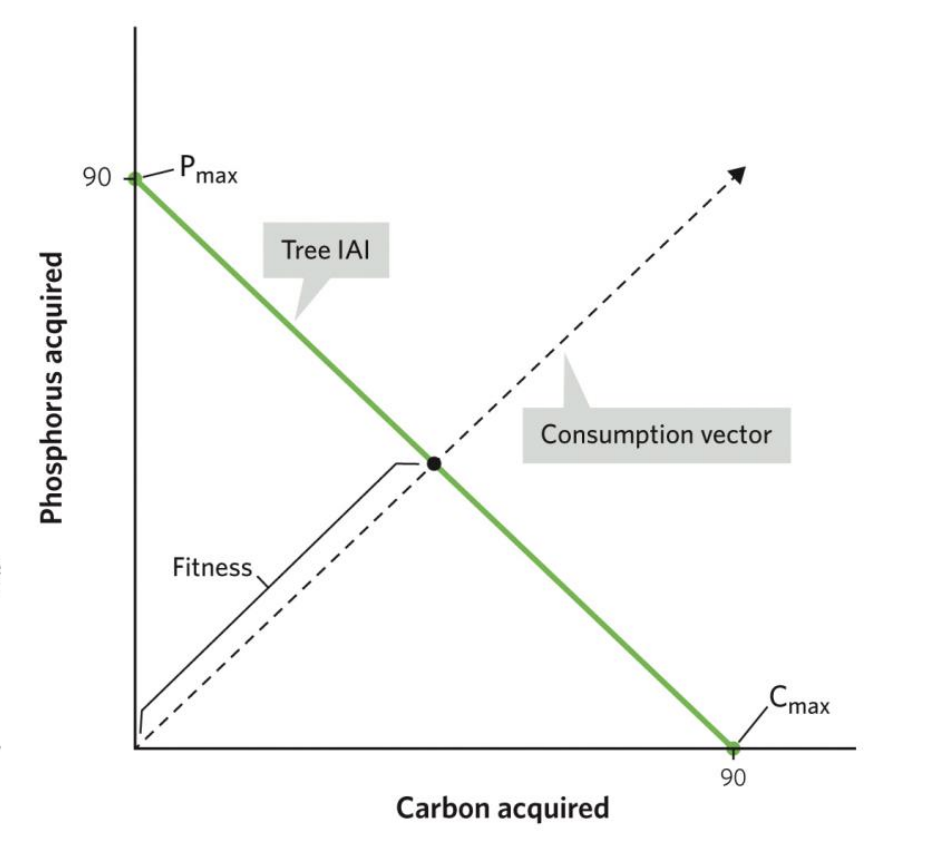
isolation acquisition isocline (IAI) for a tree
represents all the combinations of ways that the tree can use its resources to acquire carbon (C), phosphorus (P), or both if the two resources do not interact (meaning if acquiring one does not block or facilitate acquiring the other).
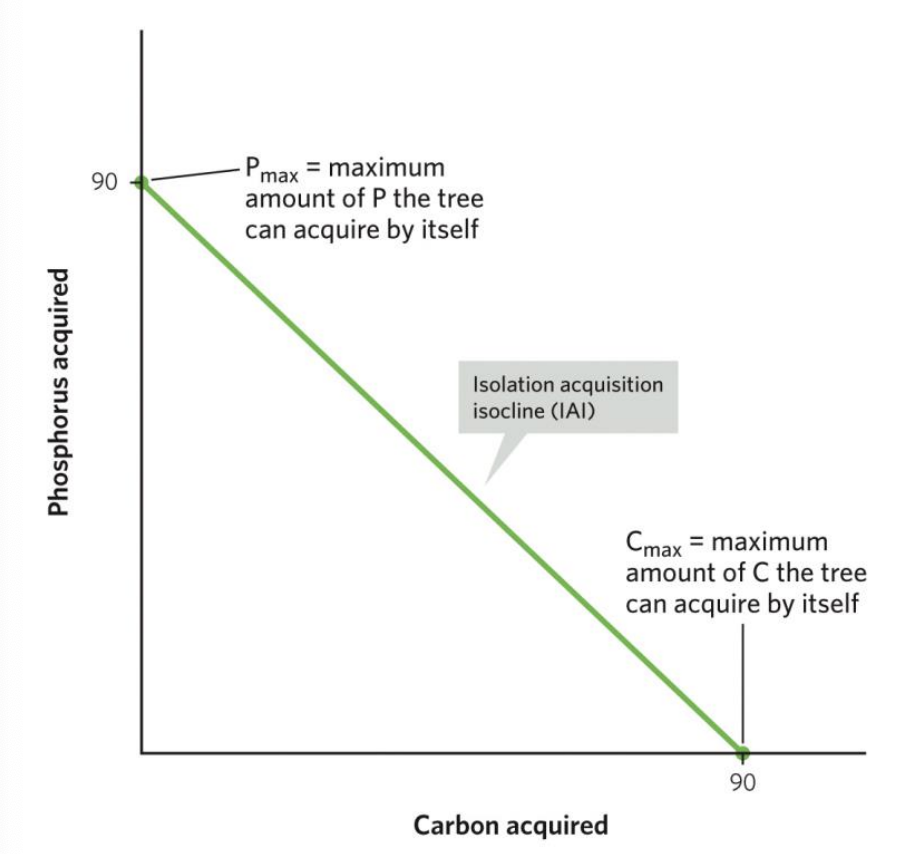
consumption vector in tree
shows the equilibrium amounts of phosphorus and carbon that the tree acquires.
The point at which the consumption vector and IAI intersect is a
measure of evolutionary fitness because if one individual tree has an equilibrium point further from the graph’s origin point than other trees in the same population, the tree acquiring more resources will grow, survive, and reproduce better than the others.
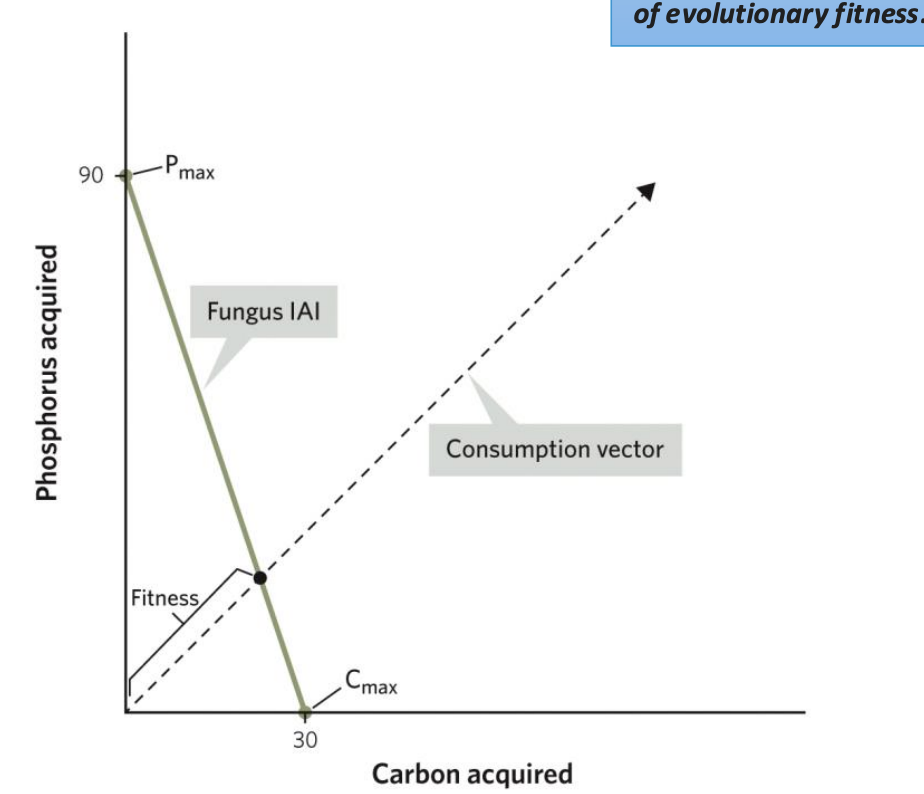
Resource acquisition and the IAI for mycorrhizal fungus
he fungus acquires phosphorus more easily than carbon. As with the tree, an intersection point that lies further from the graph’s origin indicates higher resource access and thus higher fitness.
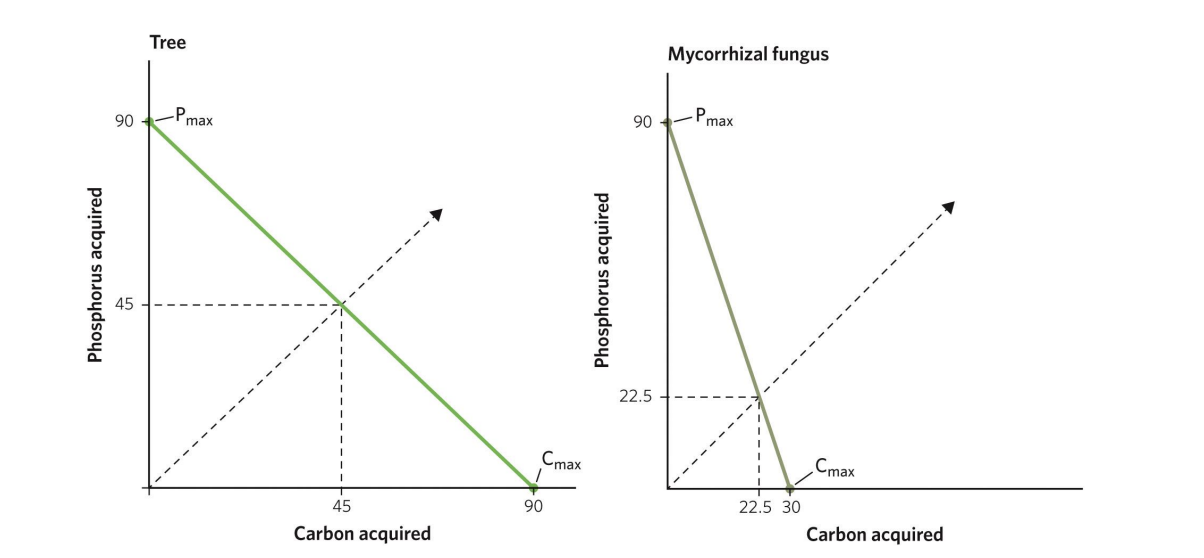
Resource acquisition and IAIs for a tree and a mycorrhizal fungus in isolation from one another. Note the differential abilities of the tree and fungus to acquire both carbon and phosphorus, as well as the relative amounts of each nutrient the organisms acquire in isolation.
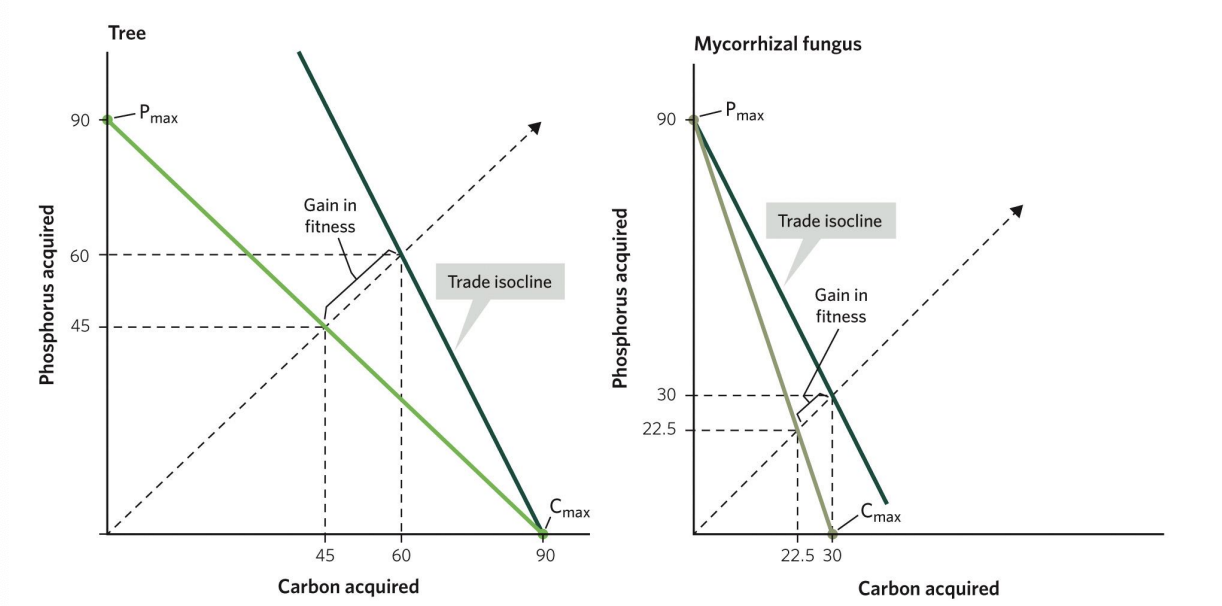
Conditions for trade between a tree and a mycorrhizal fungus, along with the resultant benefits for both organisms.
association between two remoras and a green sea turtle
there is little benefit or cost to the sea turtle
Yet the sea turtle facilitates the remora by swimming, accessing food, and avoiding predators.
this is a ___ interaction
commensalism
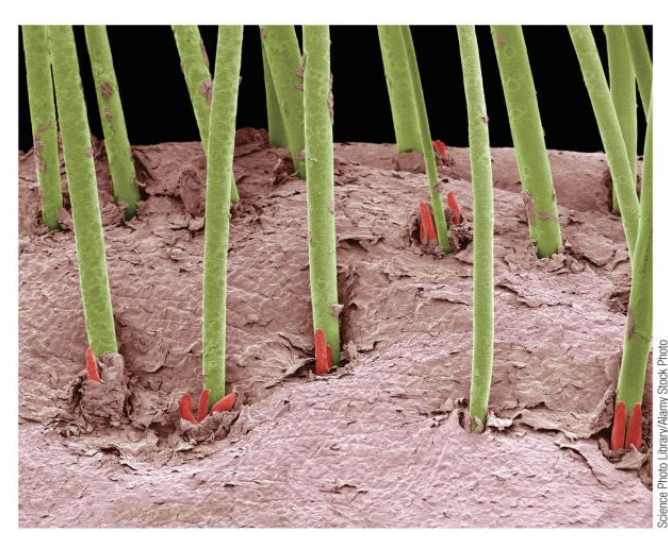
Most humans engage in a _____ relationship with tiny mites that live on the hair follicles on our faces.
This colored scanning electron micrograph shows human hair follicles with the mites (colored red) associated with individual hairs (colored green) in a human eyelash.
commensal
Nurse Plants in Deserts
Larger shrubs or cacti provide shade and moisture that help seedlings of other plants establish and survive in harsh, dry conditions.
Hedgerows provide habitat for a wide range of species and may protect adjacent agricultural crops by increasing the densities of predaceous insects that eat herbivore agricultural pest insects, thus ___
facilitating higher crop yields.
Foundation Species:
A foundation species is an organism that creates, modifies, or stabilizes a habitat, making it more suitable for other species and thereby facilitating their survival and growth.
These species often have a large physical presence or strong ecological influence that shapes community structure.
example of Foundation Species:
• Coral reefs – Corals build reef structures that support diverse fish and invertebrate species.
• Kelp forests – Kelp provides shelter and food for many marine organisms.
• Mangrove trees – Their roots stabilize coastlines and create nurseries for fish and crabs.
Restoration Ecology
is the scientific study and practice of repairing or restoring degraded ecosystems to bring back their natural structure, function, and biodiversity.
Restoration Ecology aim and what plays a key role in ti
It aims to help ecosystems recover from human disturbances such as deforestation, pollution, or habitat loss.
Facilitation plays a key role in restoration because some species — called foundation species or facilitators — can improve environmental conditions for other organisms, helping the ecosystem recover more quickly.
Foundation Species in Restoration
example: Coral species: Rebuilding coral reefs restores shelter and feeding grounds for marine biodiversity.
Pollinators in Restoration
Bees, butterflies, and hummingbirds Act as mutualistic facilitators by pollinating flowering plants, increasing seed production and plant diversity.
Invasional Meltdown
An invasional meltdown occurs when multiple non-native (invasive) species interact in ways that reinforce each other’s spread and impact, leading to accelerated ecosystem degradation and native species decline.
Yellow Crazy Ant (Anoplolepis gracilipes) - invasive species
• Accidentally introduced to Christmas Island.
• Formed supercolonies with very high population densities.
• These ants are aggressive and invasive, capable of killing large native animals like the red land crab
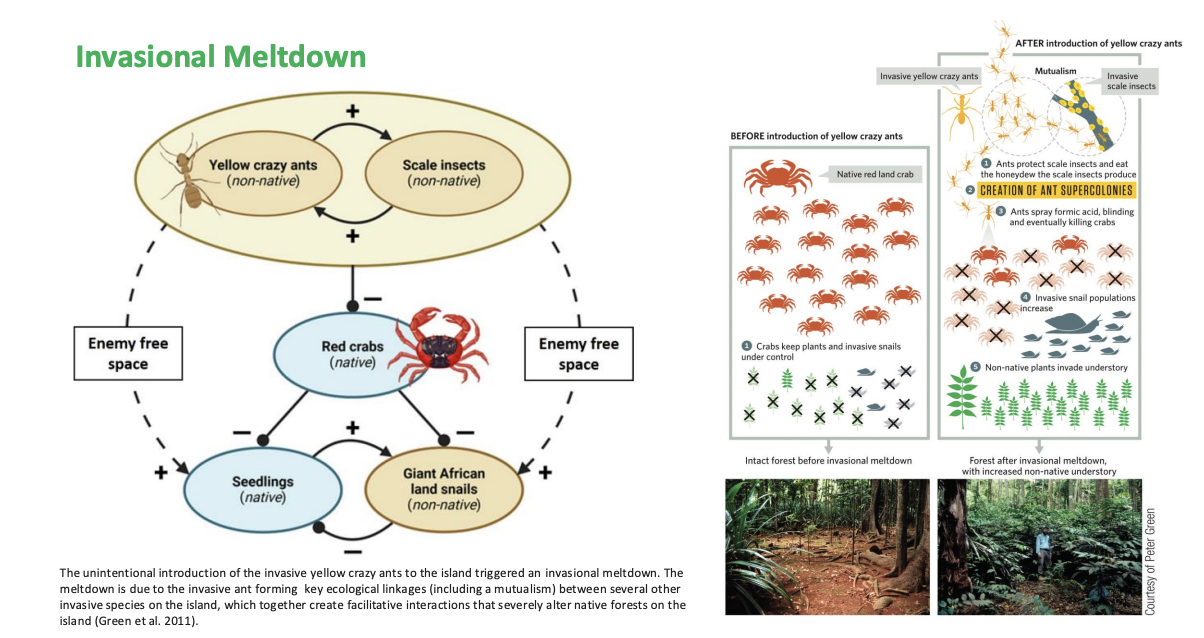
Scale Insects (e.g., Tachardina aurantiaca) - invasive species
• Also non-native; produce honeydew, a sugary substance.
• The yellow crazy ants feed on this honeydew, gaining energy and nutrients.
• In return, ants protect the scale insects from predators and parasites.
• This is an example of mutualistic facilitation between two invasive species
Red Land Crab (Gecarcoidea natalis) - invasive species
• A native and keystone species — previously controlled the forest floor by eating seedlings and leaf litter.
• Killed in massive numbers (tens of millions) by the yellow crazy ants.
• Their loss caused major ecological changesto forest composition and nutrient cycling
Giant African Snail (Achatina fulica) - invasive species
• Another invasive species was introduced earlier. • Provides a food source for the scale insects and ants, indirectly sustaining the invasional network. • The ants also feed on honeydew from the scale insects living on plants infested due to snail activity
 Note
Note  Flashcards (49)