The Skeletal System and Joints of Domestic Animals Part II
 Studied by 0 people
 Call with Kai
 Learn
Learn Practice Test
 Spaced Repetition
 Match
Match Flashcards
 Knowt Play
1/77

There's no tags or description
Looks like no tags are added yet.
Name | Mastery | Learn | Test | Matching | Spaced | Call with Kai |
|---|
No analytics yet
Send a link to your students to track their progress
78 Terms
What are the 5 functions of the skeleton system?
Protection, support, movement, mineral storage, blood cell formation
Hard layer
Compact bone
Porous network
Spongy bone
Space (long bones)
Medullary cavity
Either end (long bones)
Epiphysis
Between epiphyses
Diaphysis
Widest part (long bone)
Metaphysis
Bone grow area
Epiphyseal cartilage
Thin layer (articular)
Articular cartilage
Fibrous membrane (exterior)
Periosteum
Fibrous membrane (interior)
Endosteum
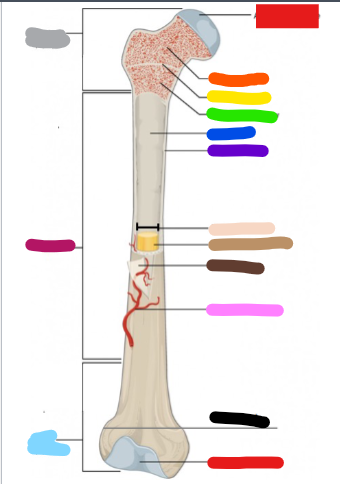
What is the red?
Articular cartilage
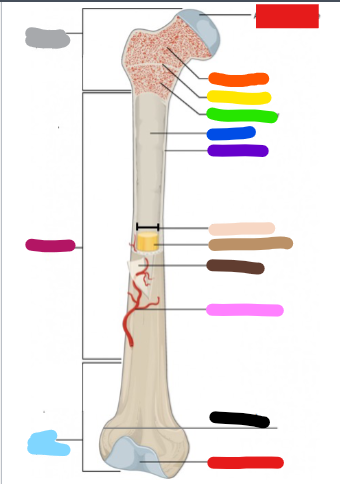
What is the orange?
Spongy bone
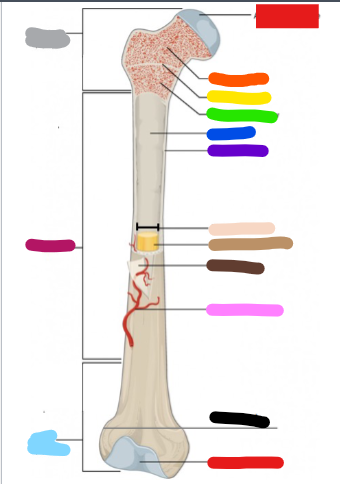
What is the yellow?
Epiphyseal line
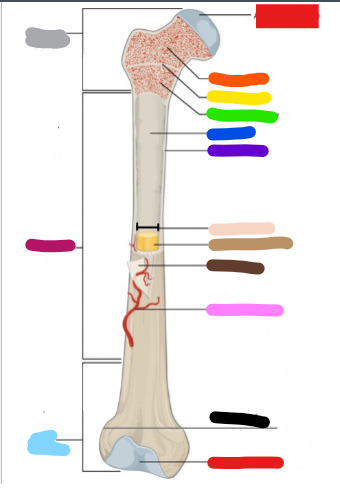
What is the green?
Red bone marrow
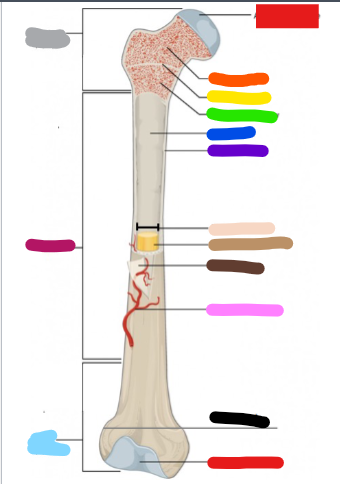
What is the blue?
Endosteum
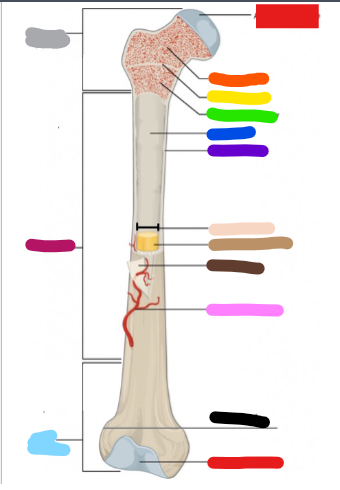
What is the purple?
Compact bone
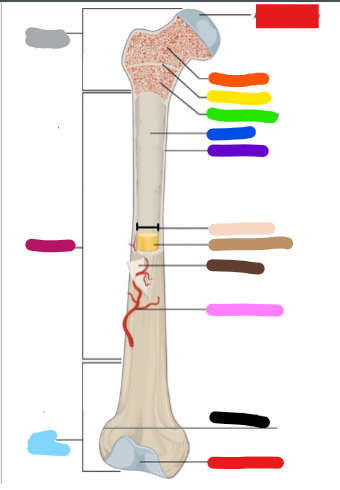
What is the tan?
Medullary cavity
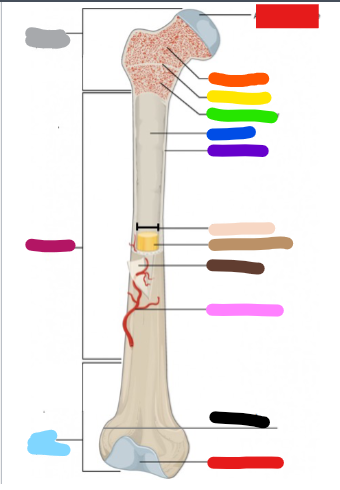
What is the light brown?
Yellow bone marrow
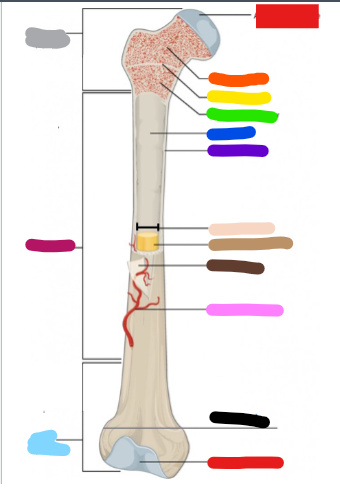
What is the brown?
Periosteum
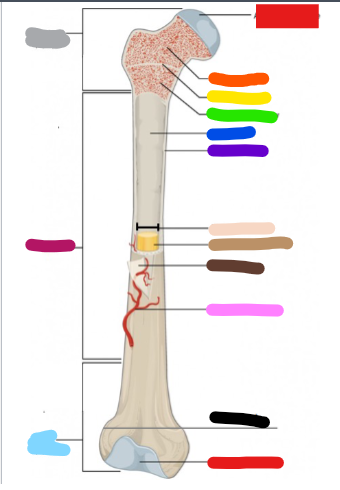
What is the pink?
Nutrient artery
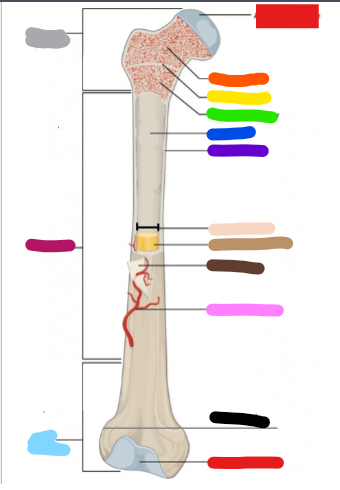
What is the black?
Metaphysis
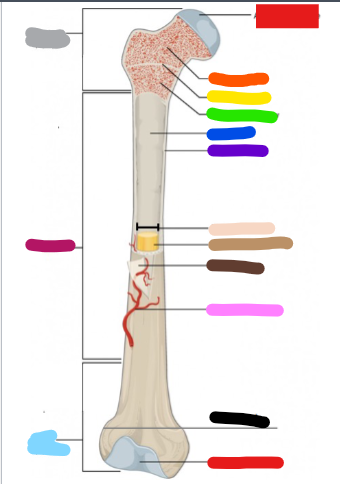
What is the grey?
Proximal epiphysis
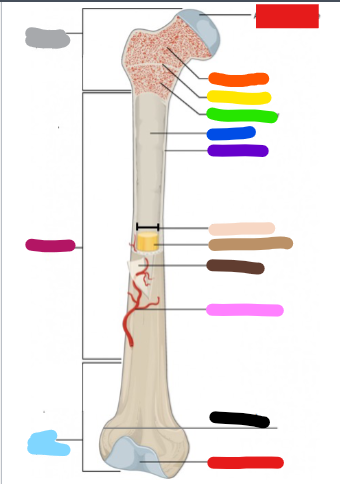
What is the plum?
Diaphysis
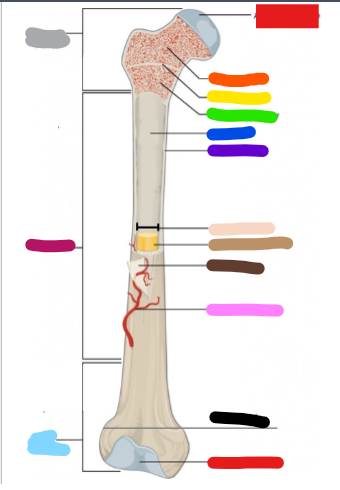
What is the light blue?
Distal epiphysis
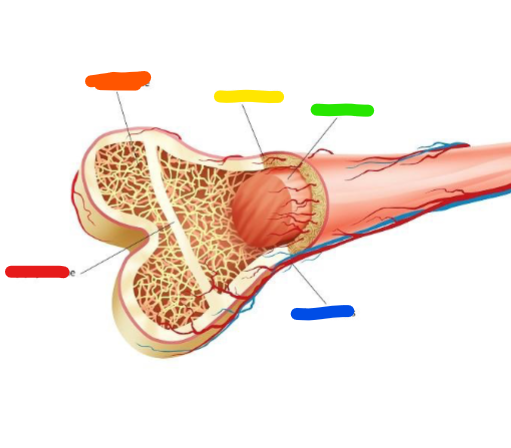
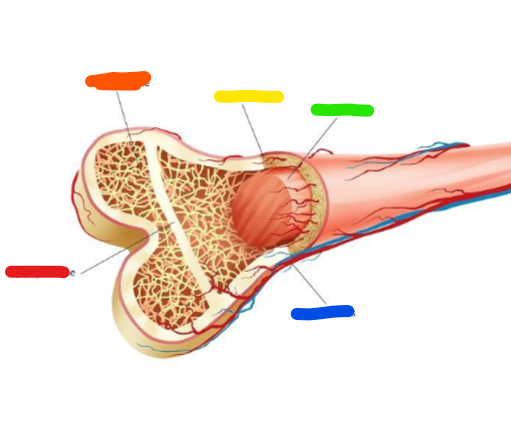
What is the red?
Epiphyseal line
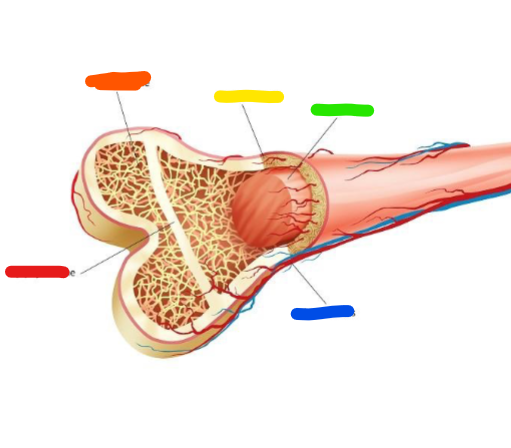
What is the orange?
Spongy bone
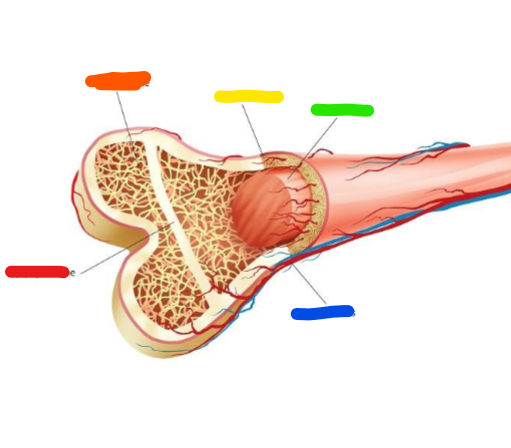
What is the yellow?
Compact bone
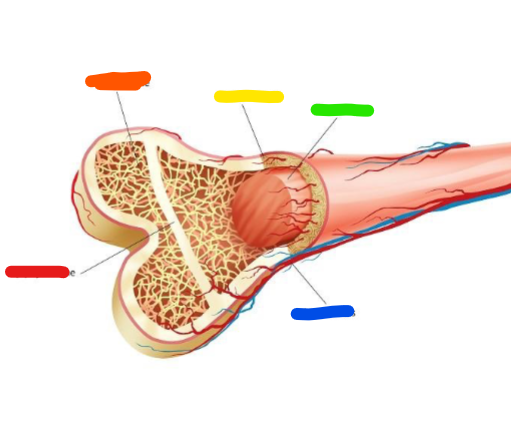
What is the green?
Bone marrow
What is the blue?
Blood vessels
Support/locomotion/grasp
Long bone
Ex. Femur
Long bone
Shock absorption
Short bone
Ex. carpus
Short bone
Protection
Flat
Ex. scapulae
Flat
Friction reduction
Sesamoid
Ex. Patella
Sesamoid
Communication with exterior
Pneumatic
Ex. Frontal bone- skull
Pneumatic
Protection/support/muscular attachment
Irregular
Ex. Vertebrae
Irregular
Bones on or attached to the axis (middle) of the body
Axial skeleton
Pectoral and pelvic limbs
Appendicular skeleton
Study of joints, also known as articulations
Syndesmology/atrhrology
What are the four classifications of joints?
Fibrous joints, cartilaginous joints, synovial joints, synovial structures
No joint cavity
Fibrous joints
Bones are united by fibrous tissue (dense collagenous connective tissue)
Fibrous joints
Limited to no movement
Fibrous joints
Examples of fibrous joints
Connection between skull, anchors teeth, forearm, leg bone
Bones are united by cartilage, with no intervening joint cavity (‘without joint cavity’)
Cartilaginous joints
The most common type of joint in the body
Synovial joints
Presence of joint cavity; contain fluid filled space
Synovial joint
Lubrication
Synovial fluid
Provides joint mobility
Synovial joints
Layers of compact bone
Articular surface
Layer of hyaline covering the ends of articulating bones
Articular cartilage
Space between two bones
Articular cavity
Two layers
Joint capsule
Muscle to bone
Tendon
Bone to bone
Ligament
Fluid filled sac between tendon and bone (acts as a cushion in the elbow, knee, rob, shoulder)
Bursa
Acts as a cushion (knee, stifle, and temporomandibular joint)
Meniscus fibrocartilage
Decrease the angle between segments
Flexion
Increase the angle between segments
Extension
> 180 degrees or straight line
Hyperextension T
Towards the median plane
Adduction
Away from the median plane
Abduction
Around its own axis
Rotation
Combination of all movements (except rotation)
Circumduction
“Soft spot” or molera (young mammal’s skull)
Fontanel
Between mandible and temporal bone (contains meniscus)
Temporomandibular
Skull and C1 (1st atlas or 1st cervical vertebrae)
Atlanto-occipital joint
C1 and C2 vertebrae
Atlanto-axial joint
Fibrocartilage; allows bending in any direction
Intervertebral disk (IVD)
Carpal bones-radius
Carpus (radiocarpal) joint
Proximal-distal carpal bones
Midcarpal joint
Carpal-metacarpal bones
Carpometacarpal
 Note
Note  Flashcards (126)