Chordates
 Studied by 0 people
 Call with Kai
 Learn
Learn Practice Test
 Spaced Repetition
 Match
Match Flashcards
 Knowt Play
1/37

There's no tags or description
Looks like no tags are added yet.
Name | Mastery | Learn | Test | Matching | Spaced | Call with Kai |
|---|
No study sessions yet.
38 Terms
body plan
Fundamental similarities exist between amphioxus and all other chordates
Sometimes modified or lost in adults
These features = chordate body plan
Features are family resemblance showing we all descended from a common ancestor species
5 key features
Shared by all chordates at some point in their life
tells us all chordates are related
Notochord
Dorsal, hollow nerve chord
Overlapping muscle segments
Pharyngeal slits
Post-anal tail
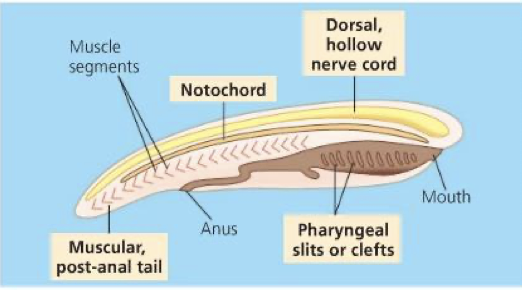
notochord
Stiffened rod of tissue between nerve cord and gut
Supports back – gives muscles something to pull against during movement
Lost in some adult vertebrates, tunicates; present in all chordate embryos
nerve chord
Chordate nervous system has a hollow, dorsal nerve chord
Forms when ectoderm rolls up into a tube (neurulation)
The space inside your spinal chord used to be your back
In vertebrates, nerve chord developed to form the spinal chord
muscle bands
Muscles form overlapping segments (myomeres) in Amphioxus
Retained in vertebrates
Vertebrae and ribs correspond to muscle segments: one vertebrae and rib per segment
Superficially similar to segments of worms and arthropods (convergent evolution)
Primitive relatives of chordates, worms and arthropods lack segments
Chordate bands are homologous (common evolutionary origin)
Worm and insect segments are analogous and convergent (independent evolutionary origin)
Segments in humans
Segmental muscles (serratus) in back correspond to segments of Amphioxus and fish, as do ribs and vertebrae
Humans retain segmental structure of ancestral chordate
pharyngeal slits
slits make an opening in throat to let water through
post-anal tail
In most animals (worms, arthropods, echinoderms, hemichordates) anus lies at the end of the body
In chordates, the body projects past the anus, to make a tail to swim with
Retained in vertebrates
Even in humans and apes
Coccyx (tailbone)
Fused vertebrae at the base of the pelvis
diversity deuterostomes
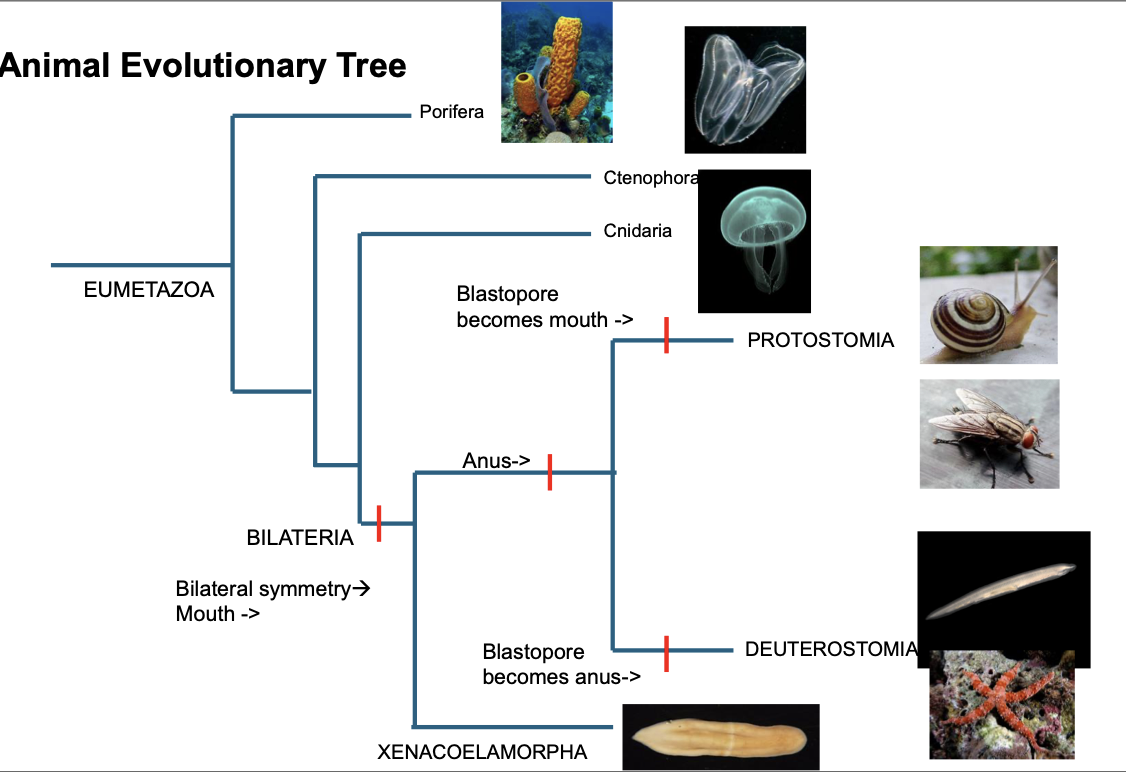
Bilaterally symmetrical animals (bilateria) fit in 2 groups
Protostomia (mouth first)
Mollusca
Antropoda
Bachiopodia
Tardigradia
etc
Deuterostomia (anus first)
3 phyla
Echinodermata
Chordata
hemichordata
In both, embryo starts as hollow ball of cells (blastula), then one end is pushed in (gastrulation)
Deuterostomes include chordates, echinoderms and hemichordates
hemichordates (acorn worms)
Deuterostomes united by embryonic development
Help bridge gap between chordates and more primitve animals
Have pharyngeal slits and a dorsal nerve tube like chordates
Lack a tail, muscle bands and a notochord
deuterostomes

3 major chordate groups
Cephalochordata (lancelets)
Urchordata (tunicates)
Vertebrata (hagfish, lamprey, sharks, fish, tetrapod, humans)
tunicates (sea squirts)
Filter feeders
Mouth sucks water through the pharynx (incurrent siphon), which is slotted due to pharyngeal slits
Food is filtered and water is expelled through the excurrent siphon
Larvae have notochords, muscle bands and tails
Become sessile as they attach to rock and metamorphosise
Has thick, leathery skin, reinforced with cellulose
Salps
Pelagic tunicates that do not become sessile
Form gelatinous, transparent colonies that float through the sea
Propel themselves with siphons
Larvaceans
Free-swimming tunicates
Thought to represent tunicates that lost metamorphosis
lancelets
Amphixious swims like fish
Filter feeders
Bury tail in sand and stick snout out to feed
did tunicates evolve from a lancet-like ancestor?
We think of tunicates as primitive.
But ancestor of protostomes and deuterostomes- ancestral Bilateria- had head and tail end, could move
Immobile and headless isn’t primitive. It is advanced relative to ancestral forms.
Lacking head is a specialised condition, having head is ancestral condition
Ancestral condition can be more complex than descendant condition.
Humans evolved by losing many chordate features
the fossil record
Lack bones, but there are still a few fossils
Chordates appear in cambrian

hagfish
Blind, eel-like fish
Dorsal and ventral fin like advanced fish, but lack jaws and eyes
Cartilage skull (cranium)
No vertebrae
Classified as craniates
Suggested to be highly modified, rather than primitive
Losing vertebrae is useful for animals that burrow inside carcasses and tie themselves in knots
Eyes are of little use for animals that burrow in the dark depths of the sea
lampreys (petromyzontiformes)
Have long, slender bodies with dorsal and ventral tail fins, cartilage skull (like hagfish)
More sophisticated than hagfish
Have vertebrae
Have eyes
Classified as vertebrates
Have sucker-like oral disk with spines to hook onto fish
Once attached, use toothlike barbs on the tongue to scrape away skin and suck blood
Share more DNA with hagfish than sharks and bony fish
Form a group to the exclusion of other fish = cyclostomes
features of vertebrata
cranium
brain
eyes
nostrils
tongue
gills
fin rays
vertebrae
teeth
cranium
brain is surrounded by a box of cartilage or bone
brain
Enlarged anterior nerve clusters evolve independently in arthropods and mollusks but are absent in bilaterian
Useful for processing sensory information from eyes, nose, body (especially tracking prey) and coordinating a response
eyes
Grow from the brain
Useless for filter-feeding (food is too small to see)
Simple eyes are useful for detecting movement to avoid predation
Complex eyes are good for resolving images and tracking movement (being a predator)
nostrils
nasal passages let water pass over olfactory tissues to detect chemicals
tongue
for pushing food down the throat
gills
Slits on the side of head let water pass in through the mouth, out of the slits
Supported by cartilage arches (gill arches), each bearing a series of filaments (gills)
Blood circulates through gills, absorbing oxygen from seawater
Improved oxygenation of blood lets vertebrates become larger, faster and more active
fin rays
Cartilage or bone struts support fins
Permits larger, more elaborate fins; associated muscles let vertebrates control shape and move fin
vertebrae
Vertebrae form around the notochord
Notochord is kept in some, and lost in others
In bony fish, vertebrae ossify (first form as cartilage and then turn to bone)
Make a strong support for the body, allowing for more powerful swimming muscles
teeth
For tearing apart other animals
In jawed vertebrates = hardened with calcium phosphate
In lampreys and hagfish, made of keratin
vertebrae evolution - ecological shift
Filter feeding probably appeared in worm-like chordate ancestors (seen in some hemichordates)
Chordates evolve swimming- to escape, to move, exploit new habitats (e.g., shifting sand) where attached filter feeders can’t live
In vertebrates, adaptations for tracking prey (eyes, nose, brain), feeding (teeth, tongue), pursuing prey (gills, vertebrae, fin rays) reflect shift to predation
Primitive vertebrates aren’t very good predators: maybe why they have disgusting feeding habits like burrowing into carcasses, sucking blood
jawed vertebrates (gnathostomes)
Chondrichthyes (cartilagenous fish)
Selachimorpha - Sharks (470 species)
Batoidea – rays, skates and sawfish (560 species)
Holocephali – chimaeras (50 species)
Osteichthyes (bony fish)
Actinopterygii – ray-finned fish (30,000 species)
Sarcopterygia – lobe-finned fish (30,000 species)
features of gnathostomes
have features not seen in cyclostomes
pectoral and pelvic fins
jaws
mineralised teeth
mineralised scales
pectoral and pelvic fins
Effective for stabilising/steering
3-axis control
Pitch (up and down)
Roll (around long axis)
Yaw (left and right)
Create hydrodynamic lift to do banked turns
Improved manoeuvrability works for pursuing prey and to avoid becoming prey
Used for propulsion
jaws
Modified from first gill arch
In sharks, made of cartilage
In bony fish, cartilage (Meckel’s cartilage) forms a scaffold on which bones of the lower jaw grow
Unlike cyclostomes, which literally lick prey to death, jaws let you seize, cut, tear prey- and expand mouth to eat much larger prey items
adaptation for predation
mineralised teeth
In hagfish and lamprey, teeth (if they really are teeth) made of tough keratin
In sharks and bony fish, teeth hardened with mineralised tissues: mineralised dentine covered by a very hard enamel
Probably homologous with scales
They cut and pierce, even through armour like scales and bones, can crush armour shells
Combined with jaws, teeth make for deadly predators
mineralised scales
Bodies of gnathostomes typically covered with scales
May be covered with enamel (sharks, primitive bony fish)
May contain bone (many fish, stegosaur plates, etc.)
May be composed of tough keratin proteins (snakes and lizards, bird feathers… mammal fur?)
mineralisation
In cartilagenous fish (sharks and rays) scales and teeth are mineralised
In bony fish, the skeleton is also mineralised
In invertebrates, the mineral is calcium carbonate/limestone CaCO3
Vertebrate tissues are hardened with calcium phosphate/apatite CaPO4
conodonts
Conodonts are earliest example of mineralisation in vertebrates
Presence of mineralised toothplates led to proposal that mineralisation began with teeth, then extended to other parts of the body
replacement
Teeth are subject to heavy wear, especially when used on tougher objects
Vertebrates evolved the ability to shed worn-out teeth and replace them with newer, sharper and larger ones
bone history
Our ancestors evolved bony scales and armour plates to defend from predators
Later, adapt mineralised tissues for feeding, evolving jaws, then teeth
Finally, in bony fish, mineralisation of cranium, fin rays and vertebrae made possible a sturdier skeleton
Hard bone made precisely formed joints and hinges possible
 Note
Note  Flashcards (32)