genetics exam uno prep :/
 Call Kai
 Learn
Learn Practice Test
 Spaced Repetition
 Match
Match Flashcards
 Knowt Play
1/190

There's no tags or description
Looks like no tags are added yet.
Name | Mastery | Learn | Test | Matching | Spaced | Call with Kai |
|---|
No analytics yet
Send a link to your students to track their progress
191 Terms
haploid, diploid
haploid: 1 copy of each chromosome
diploid: 2 copies of each chromosome
homologous vs. non-homologous chromosomes
Homologous: same genes arranged in same order
- Ex. The pair within a set
Non-homologous: different genes
How are diploid organisms formed?
sperm (haploid) and egg (haploid) combine via fertilization to form a zygote (diploid)
Chromosomes come in different types and classes
What are the different types?
How can we recognize the different classes?
Types:
Sex chromosomes differ in males and females
Non-sex chromosomes are called autosomes.
Classes: band pattern, size, where the centromere is
DNA probes
are used to locate specific nucleotide sequences in DNA or RNA
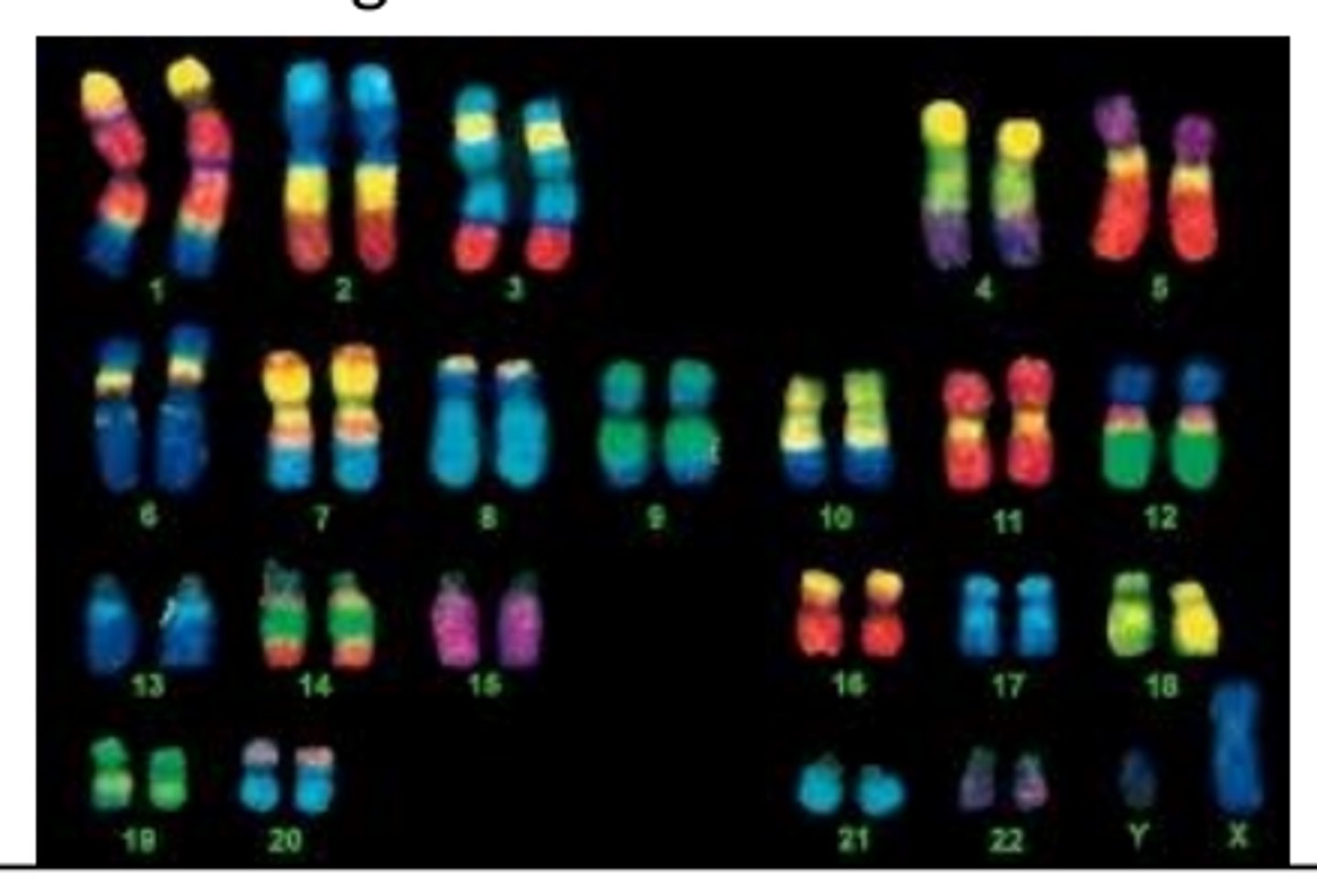
What is chromosome painting?
a process fluorescently labels DNA probes that stick to specific regions of the chromosome.
A computer picks up the emissions and creates a colored image.
Why does DNA replicate?
To maintain the same amount of DNA in each daughter cell after the cell divides during mitosis.
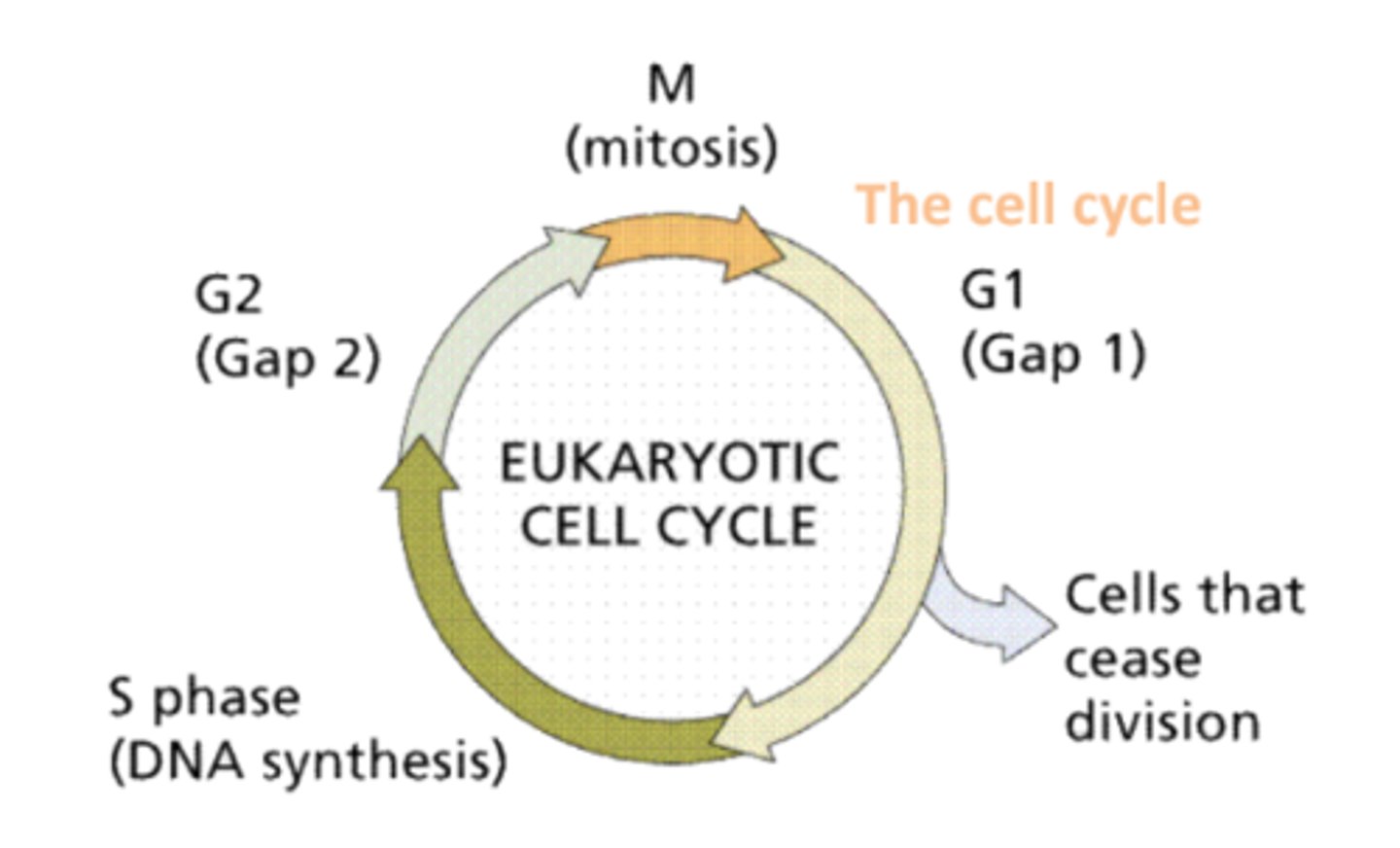
Describe the Cell Cycle.
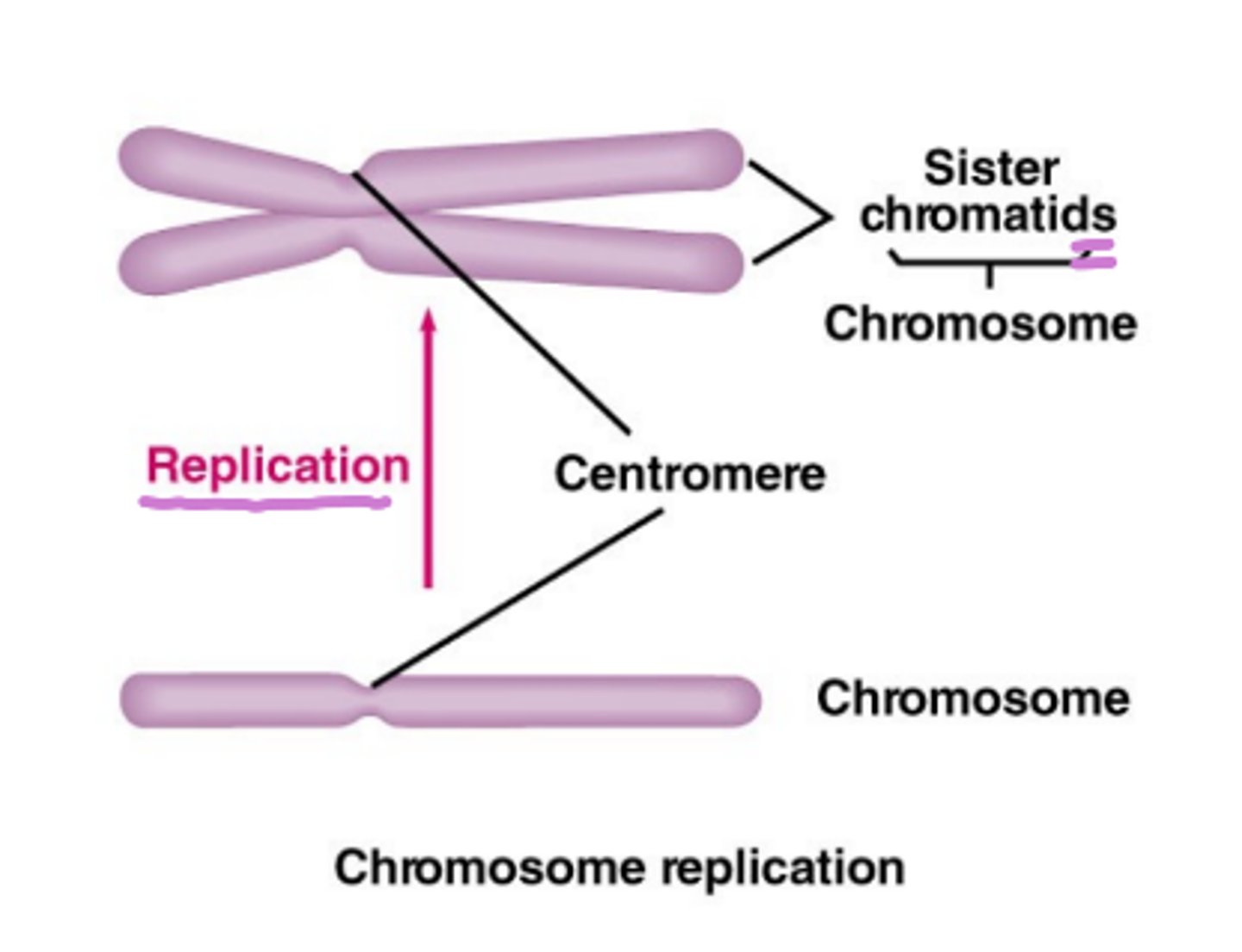
Each chromosome replicates in the form of ____________
Once split __________ are called _____________________
sister chromatids
chromatids, daughter chromosomes
Centrioles
are PAIRED barrel shaped organelles in the cytoplasm of animal cells near the nuclear envelope.
The area of cytoplasm where the centrioles are located is called the centrosome*.
play a role in organizing microtubules that serve as the cells skeletal system. (cytoskeleton?)
helps determine the locations of the nucleus and other organelles within the cell.
*tip: -some? that's where their home is!
Cell division for growth
mitosis
describe mitosis and all its steps✨
Go to page 352 in the textbook :D
tip: PMAT
prophase
prometaphase
metaphase
telophase
Why does the DNA start as chromatin in prophase?
it was chromatin because it was being replicated.
Why is DNA polar?
DNA is polar because its sugar-phosphate backbone has distinct 5' and 3' ends, creating directionality that results in antiparallel strands.
What is the mitotic spindle/spindle apparatus made of?
it is made from microtubule fibers (protein=tubulin)
What are the two parts of the mitotic spindle?
chromosomal fibers: kinetochore fibers
pull chromosomes apart
polar fibers: extending from center of pole to metaphase plate
cause cell to elongate
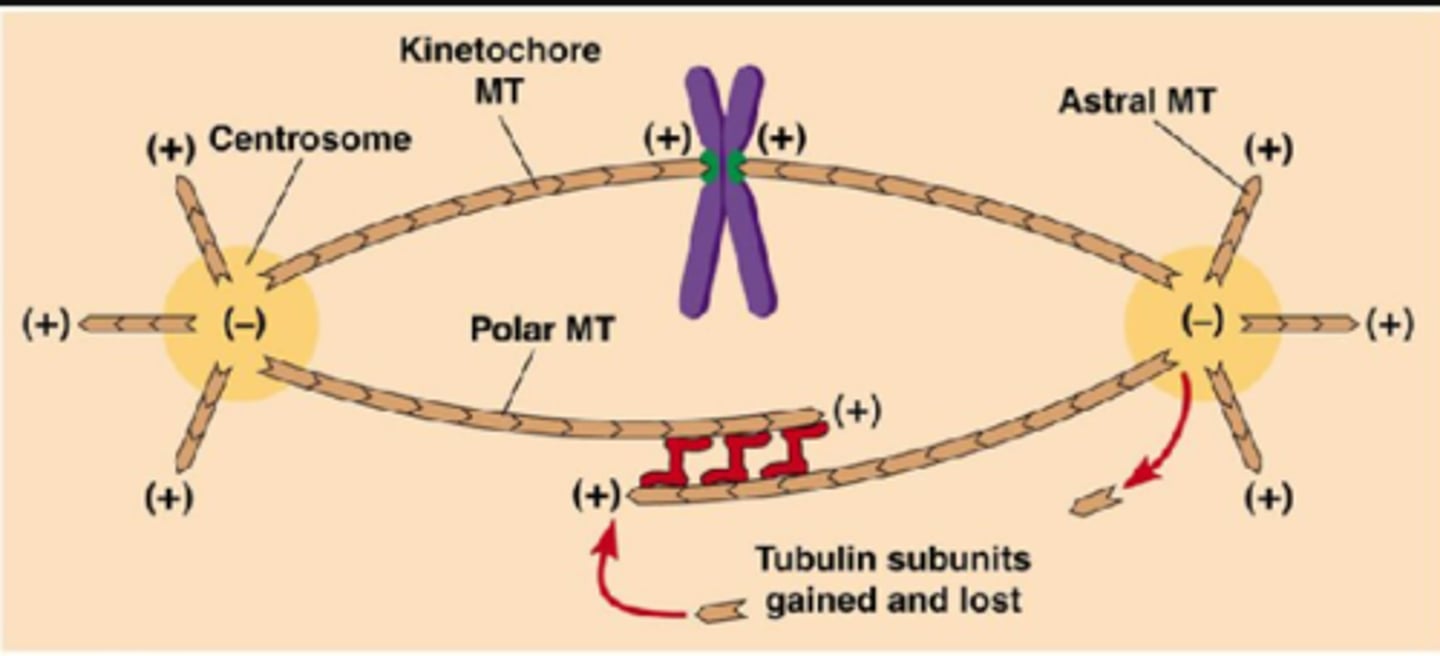
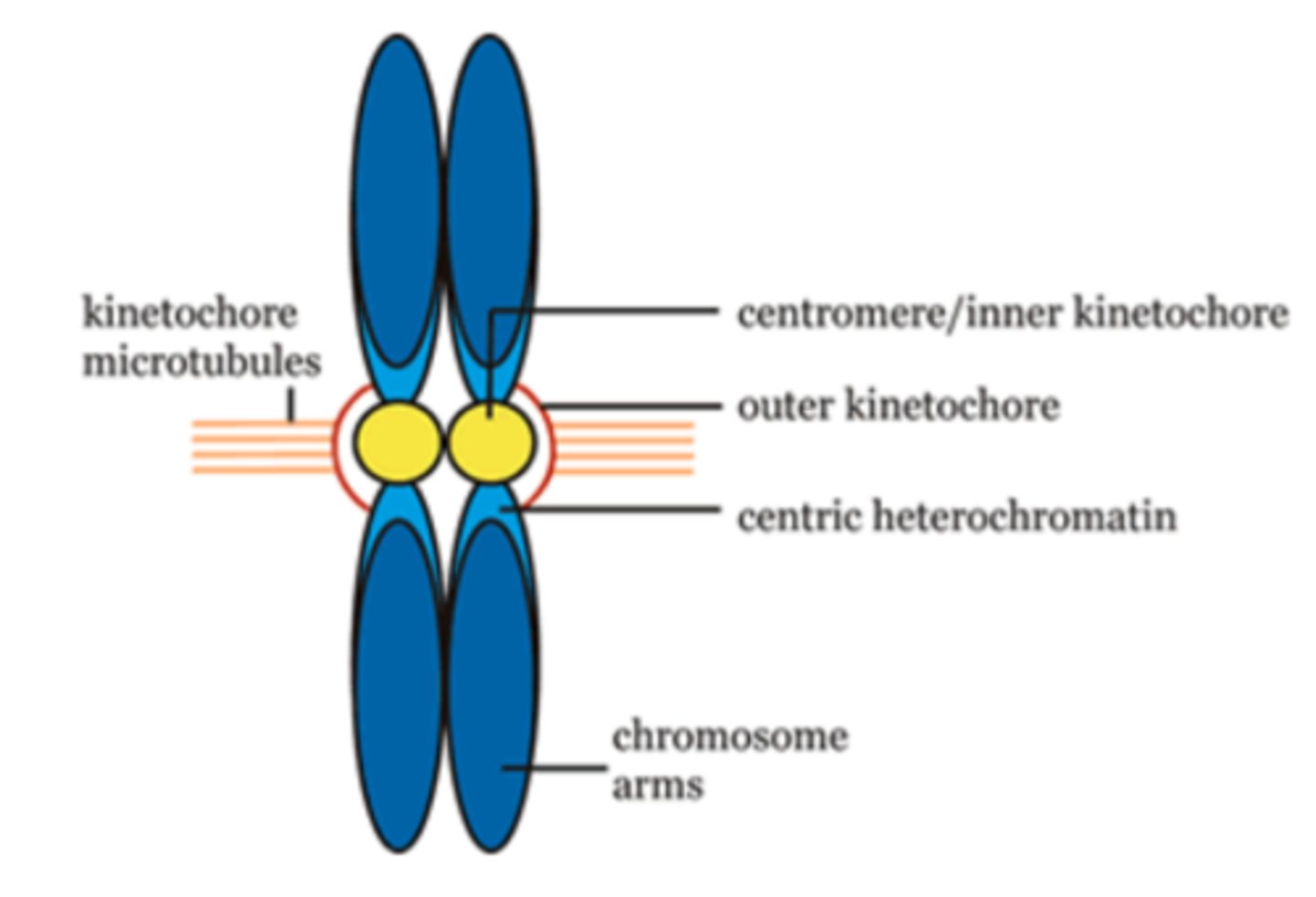
What is a kinetochore?
a multiprotein complex that uses kinetochore microtubules to bind the centromere of each sister chromatid to opposite poles of the cell.
What are the PARTS of the kinetochore?
inner kinetochore
outer kinetochore
kinetochore microtubules
cell division for gametes
meiosis
describe meiosis and all its steps✨
Go to page 356 in the textbook :D
What's the difference between meiosis 1 and meiosis 2?
Meiosis I: Reduces chromosome number (diploid to haploid), separates homologous chromosomes, and includes crossing over.
Meiosis II: Similar to mitosis, separates sister chromatids, and maintains haploid chromosome number.
The number of eggs a woman has is _________
finite
The stages of prophase I and what occurs in each
Leptotene Stage: chromosomes look like long, thin threads as they start to condense
Pachytene Stage: Homologous chromosomes align and undergo synapsis where each base pair aligns between homologues.
Diplotene Stage: 4 sister chromatids = tetrad. Crossing over occurs.
Diakinesis: 4 arms of tetrad are available
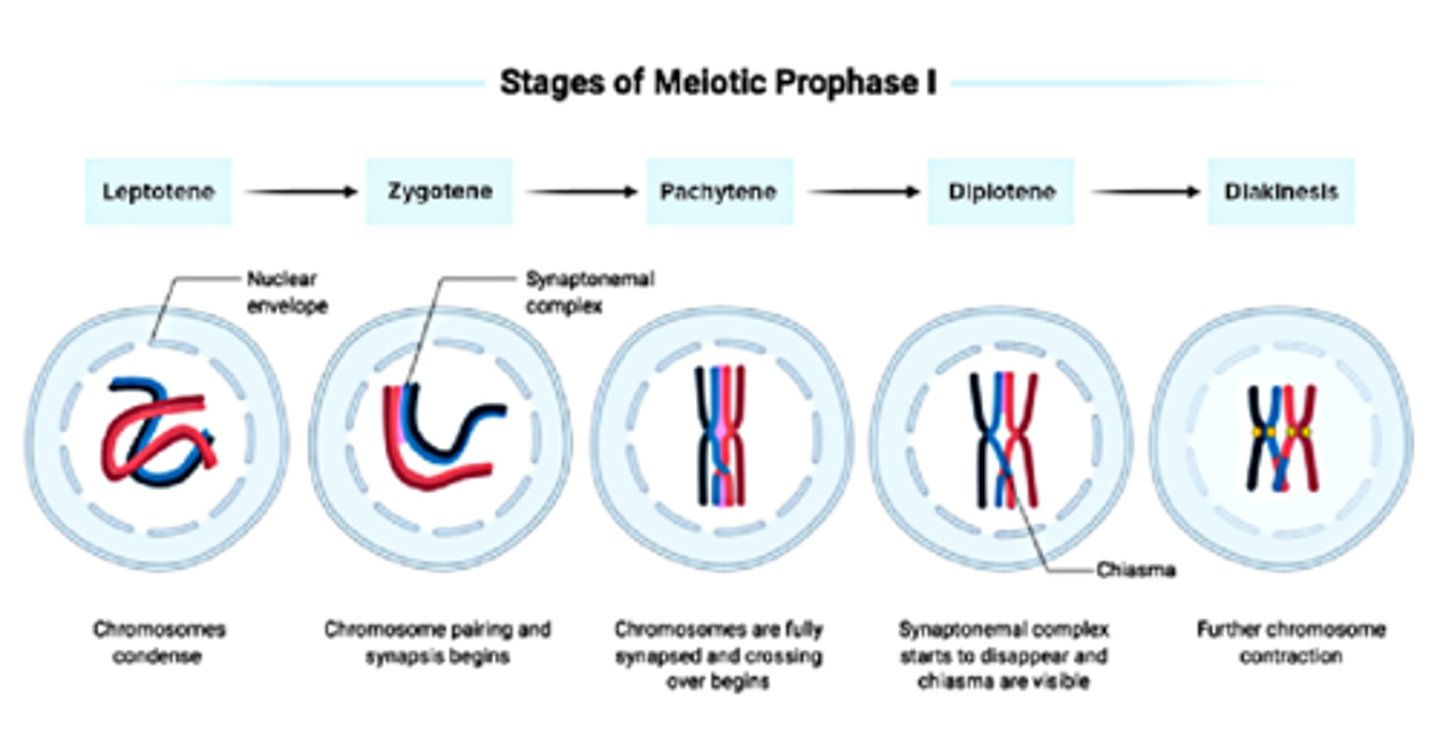
Human eggs remain in __________ stage until ______ when each month one egg completes ________ and is ________.
Diplotene, puberty, meiosis I, ovulated
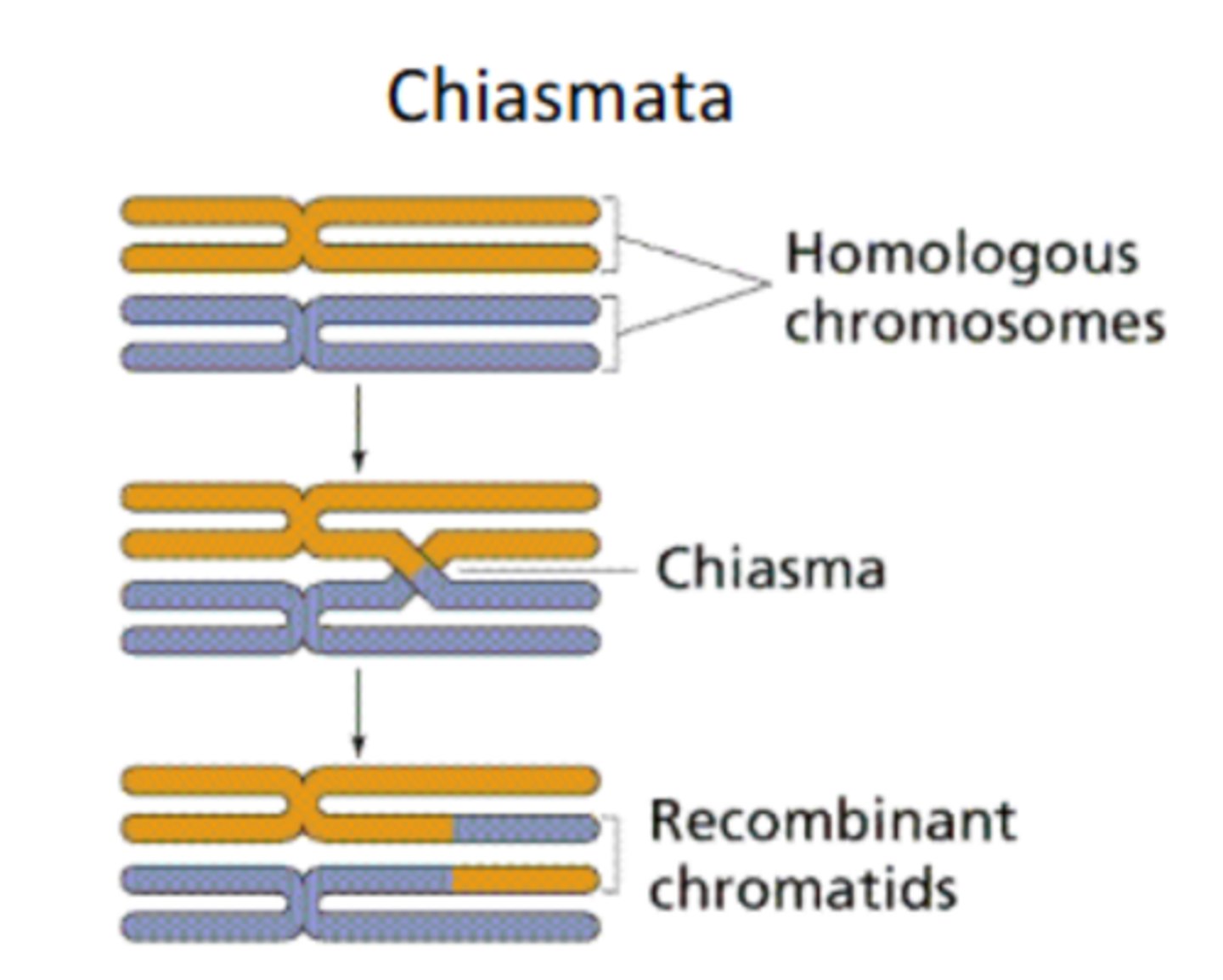
What is crossing over?
Crossing over is the reciprocal exchange of chromosome segments at corresponding segments of the homologous chromosomes
Crossing over is a mechanism of ___________ ; it yields a ________________
recombination, recombinant chromosome
What/where is the chiasma? (chiasmata)
places where the crossing over of chromosomes took place
What are the "4 products" of crossing over?
2 nonrecombinant chromosomes and 2 recombinant chromosomes
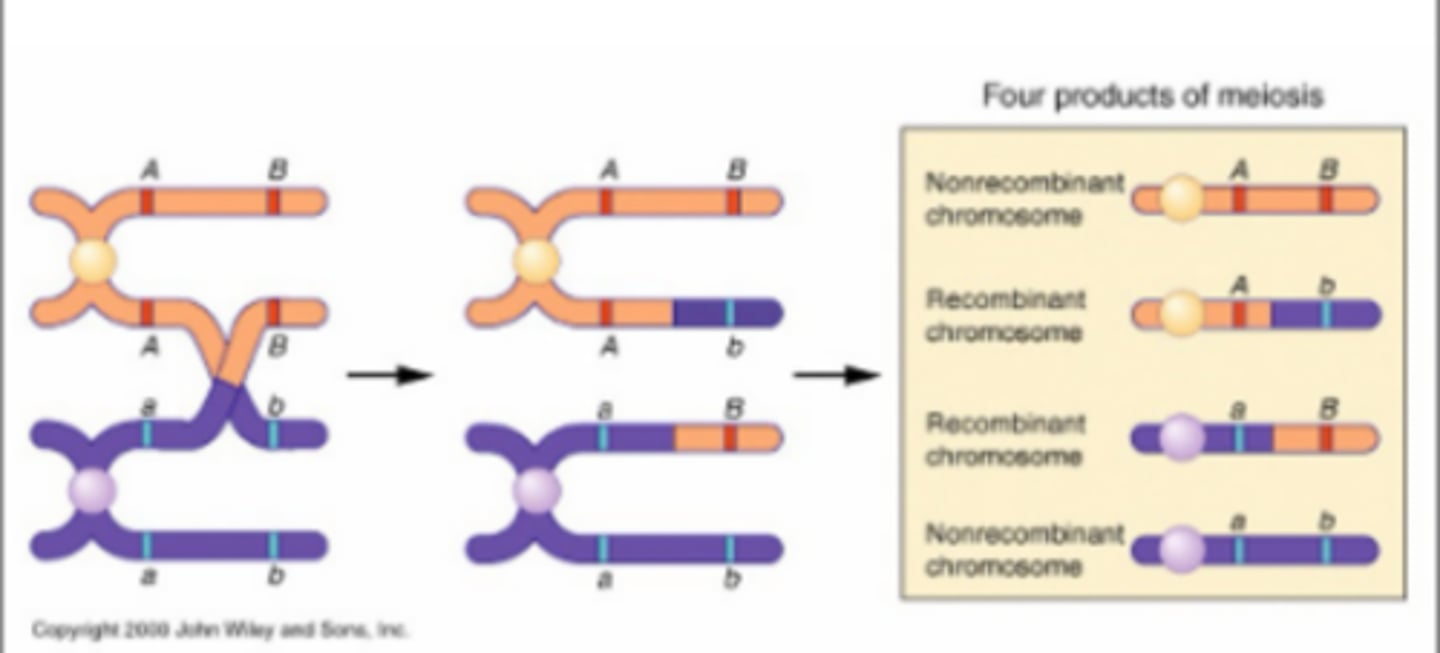
What's another word for non-recombinant chromosome?
parental chromosome
Syntenic
Genes that are located on the same chromosome.
Linkage Disequilibrium
When genes are located close to each other on a chromosome and do not assort independently (i.e., they tend to be inherited together).
Linkage Map/Genetic Map
A diagram that shows the relative positions (loci) of genes on a chromosome, based on how often they recombine during meiosis.
Genetic Marker/Physical Marker
Genetic marker: A variant or mutation in DNA that can be detected and used to track inheritance.
Physical marker: Visible changes on a chromosome, often used for chromosome mapping.
Parentals (Non-Recombinant Chromosomes)
refer to non-recombinant chromosomes, meaning that the offspring inherit chromosomes that are identical to the parental chromosomes—no crossing over occurred between the genes in question.
These chromosomes maintain the original combinations of alleles (for example, AB or ab if we're tracking two genes).
Recombinants (Recombinant Chromosomes)
Recombinants refer to recombinant chromosomes, meaning that crossing over has occurred, and the offspring inherit chromosomes with new combinations of alleles (for example, Ab or aB).
How can crossing over FAIL to lead to recombination?
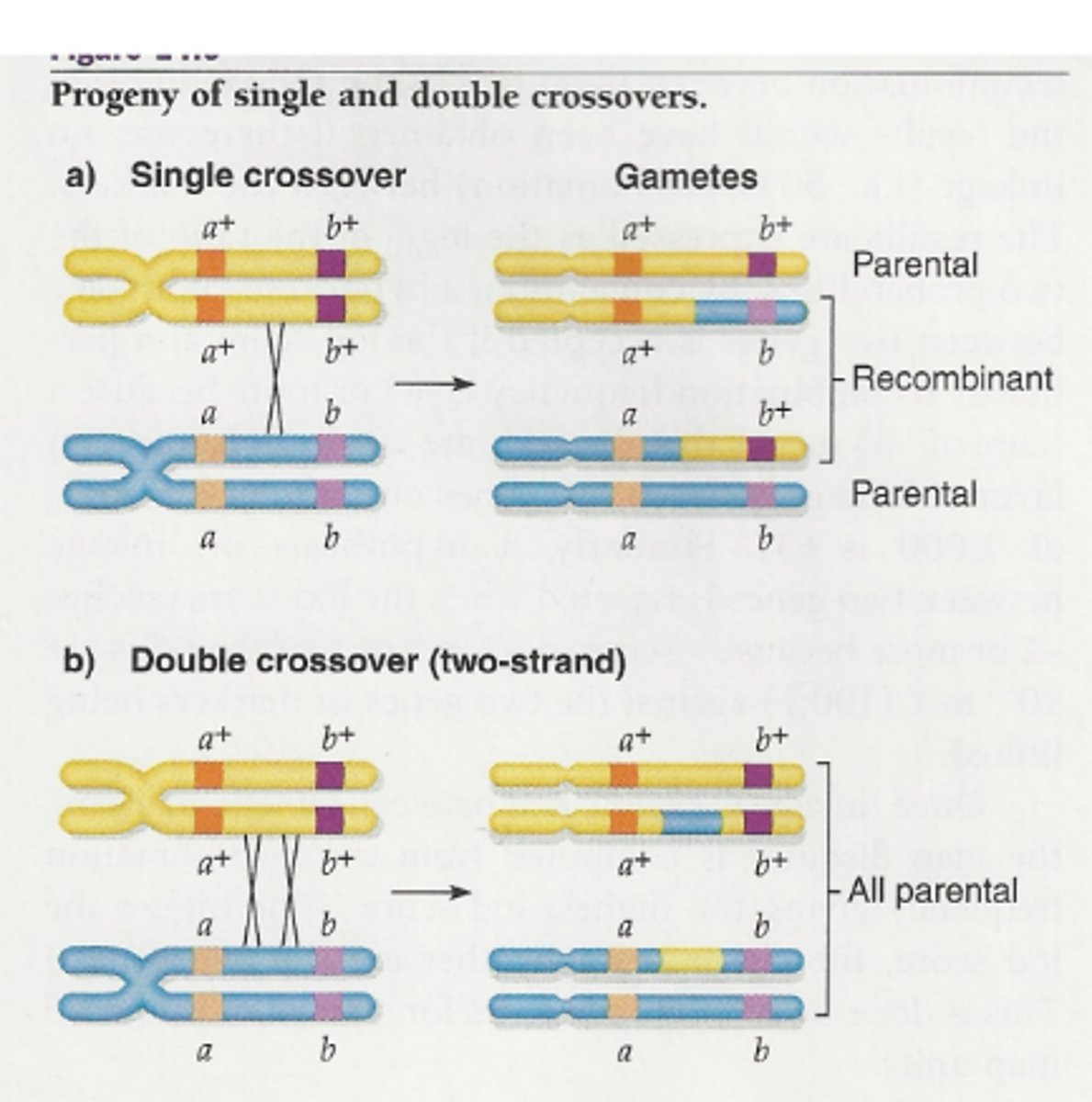
Map distances are based on _________ not __________
recombinant frequency NOT crossover frequency
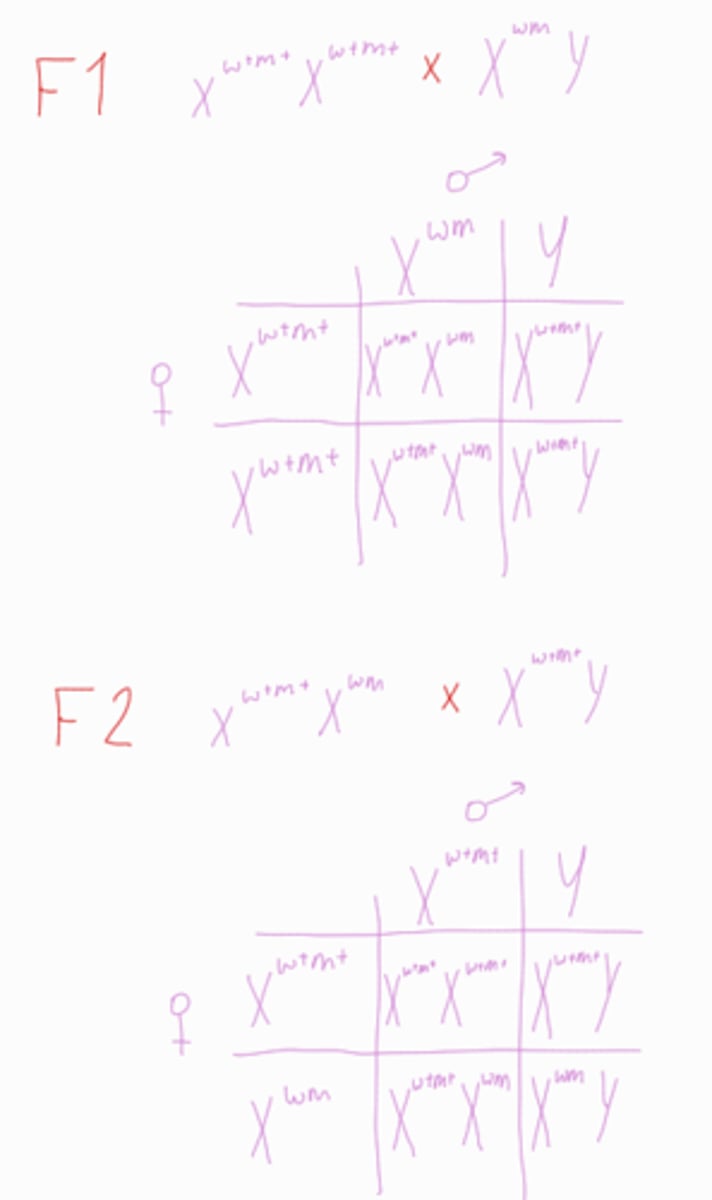
Draw Mendel Cross for F1 and F2
Bred white-eyed, mini-winged females (X-linked recessive traits) with wild-type males and then bred the F1.
Alleles of genes close together on the same chromosome are _____________________ and are more likely to show ____________
less likely to assort independently, linkage
How do we figure out gene order?
The two most abundant phenotypes inform the parental genotypes (no recombination)
Then look at the frequencies of the recombinant phenotypes:
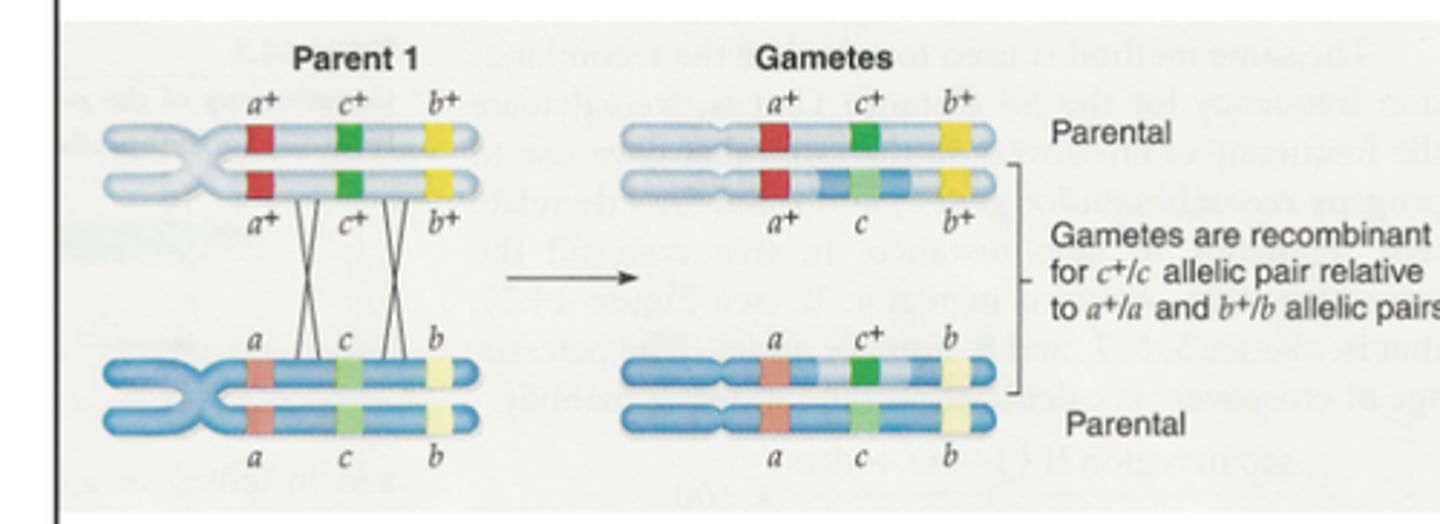
The lowest number represents a double crossover. This changes the middle gene keeping the two ends like the parental chromosomes.
Draw what a double crossover would look like
What are the units for recombination frequency? and what does it measure?
map units (mu) or centimorgan (cM).
distance between genes
The distance at which 1% of crossing over occurs = _____mu.
1
Why are genetic maps based on recombination frequency limited in accuracy?
Crossing over is not equally likely in different regions of the genome, even if the distance between genes is equivalent, making genetic maps based on recombination frequency limited.
How are physical maps of chromosomes created?
using molecular genetics techniques
Topoisomerases
Manage topological state of the DNA in the cell, relax supercoils, introduce supercoils into DNA
Karyotype
The complete set of chromosomes in eukaryotes - can be haploid or diploid
C value
Gives the number of base pairs in a haploid genome/nucleus (measured by weight in picograms); C= constant/ characteristic.
C value paradox
NO correlation between amount of DNA and complexity of organism
Chromatin
Loosely spread out complexes of DNA and protein found in a cell's nucleus that form chromosomes
Chromosomes
Tightly coiled self-replicating DNA/protein complexes in the nucleus that contain genes
Nucleosomes
Balls of histone protein with DNA wrapped around
Euchromatin
Show NORMAL cycle of condensation + decondensation (replication) and are transcribed
Heterochromatin
Remains condensed throughout the cell cycle. Replication later occurs in the S phase. NOT transcribed
Homologues
Matching pairs in diploid organisms
Constitutive Heterochromatin
Present in all cells at the same location on both homologues, repetitive DNA = telomeres + centromeres
Facultative Heterochromatin
Varies in different cells + stages in development (inactivated)
Telomeres
Specific DNA sequence at the ends of the chromosome required for replication + stabilizes the chromosome
Centromere
Region of chromosome containing DNA sequences where spindle fibers attach + accurately segregates the daughter chromosomes
What is needed for DNA replication?
DNTPs, DNA Polymerase, Template DNA, DNA/RNA Primer, Mg2+
What stitches together the Okazaki fragments?
DNA Polymerase I and Ligase
What are the main differences between chromatin and chromosomes?
topological state and density of DNA
What is chromatin made of?
equal parts DNA and histone proteins
What is one example of tandem repeats?
centromere
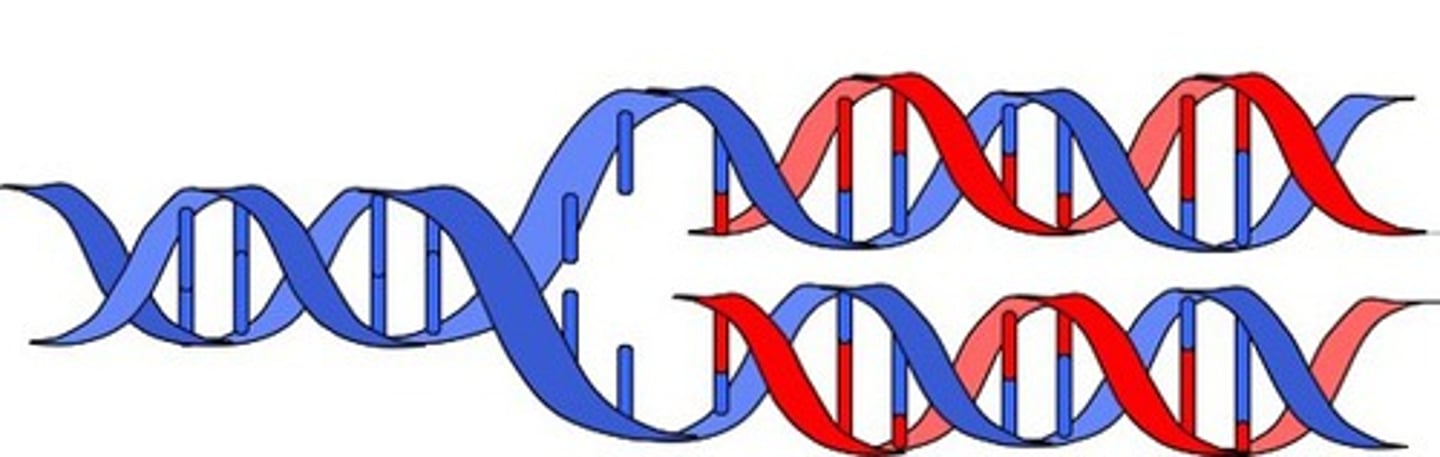
Semiconservative model of replication
Genotype
the sequence/code/genetic composition
DNA Poly I
_____ uses the preceding Okazaki (5' end) fragment to add dNTPs and link it to the next fragment
Phenotype
observable traits expressed through genes
What almost always has an affect on phenotype?
genes + environment
Mendel's Principle of Dominance
dominant alleles show in the phenotype, whereas recessive alleles do NOT show in phenotype when dominant alleles are expressed
Mendel's Principle of Segregation
each gamete only carries one allele
Why should DNA replicate?
1. necessary for cell division
2. allows for growth, repair, and reproduction
Mendel's Principle of Independent Assortment
alleles of different genes assort into gametes independently of one another; alleles can combine in ANY way
How does DNA replication happen in eukaryotes?
1. takes place during S phase of the cell cycle BEFORE mitosis
2. during S phase, the entire genome is duplicated
3. have multiple origins of replication EACH having TWO replication forks
Ligase (DNA Replication)
seals the last sugar phosphate backbone bond (=the nick).
Where is the replication fork found?
inside the replication bubble
Origin of Replication
Site where the replication of DNA begins
Replicator
NOT enzyme; sequence of DNA that directs the start of replication,
Replication bubble
denatured area where DNA replication is happening
Prokaryotes
In ________, most DNA is unique.
Eukaryotes
In _______, DNA is both repetitive and unique.
Unique sequence
Protein coding genes
Repetitive sequence
can be found distributed in the genome as dispersed repeated (LINEs or SINEs) or tandem repeated
Barr Bodies
an inactive X chromosome observable at interphase as a darkly stained heterochromatin mass
Males
______ do not have Barr bodies
Females
_______ have Barr bodies (one X remains inactive)
LINEs
long interspersed elements; resemble mRNAs in mammals; 4-7 kb long
SINEs
short interspersed elements; structures resemble mRNAs; 100-150 bp long
UTR
untranslated region; the sequence of DNA is not translated to a protein
semiconservative replication
a mechanism of DNA replication in which each single strand of the parent double helix serves as a template for synthesis of its complement. the result is two daughter double helixes that each contain one of the original DNA strands intact (conserved) and one completely new strand
What direction is new DNA made in?
5' to 3'
Steps of DNA Replication
initiation, elongation, termination
step 1: initiation
RNA primer made by DNA primase starts replication of lagging strand (synthesis of 1st Okazaki fragment)
step 2: untwisting + elongation of new DNA strands
2nd Okazaki fragment elongated; Polymerase III dissociates
step 3: more elongation
2nd Okazaki fragment finished, 3rd being synthesized; DNA primase beginning 4th fragment
step 4: primer removed
removed by DNA Polymerase I; when completed, single-strand nick remains
step 5: termination
joining of adjacent DNA fragments by DNA ligase
initiation of replication in E. coli
the DnaA initiator protein binds to oriC (the replicator) and stimulates DNA denaturation. DnaB (helicase) is recruited and loaded onto the DNA. it begins to untwist the DNA to form two head-to-head replication forks Each DNA helicase recruits DNA primase to form the primosome complex (helicase + primase). DNA primase synthesizes a short RNA primer
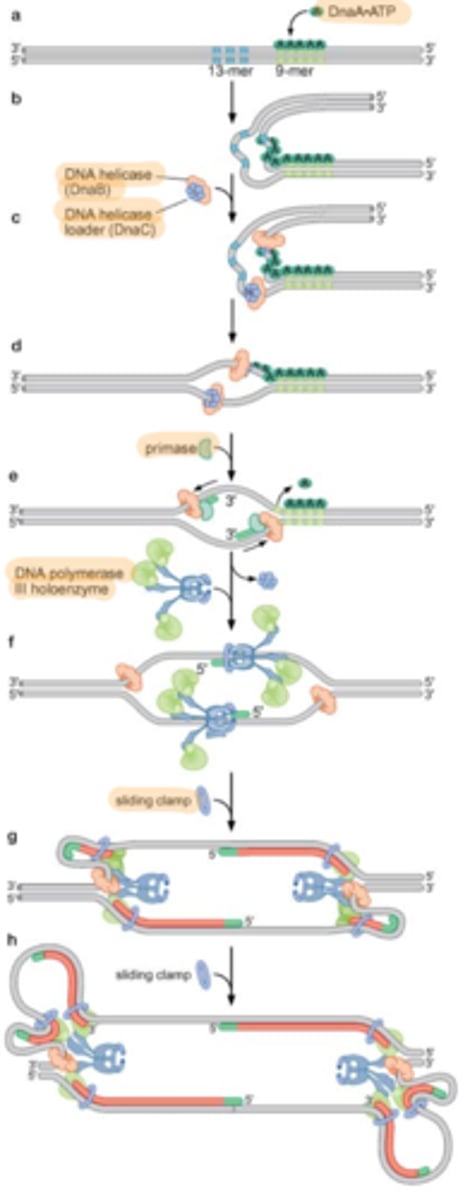
DNA primases
enzymes that make an RNA primer used in replication in a cell found in prokaryotes and eukaryotes
helicases
enzymes that untwists the DNA helix by breaking the hydrogen bonds that connect complementary bases found in prokaryotes and eukaryotes

