Life Science
0.0(0)
Studied by 5 people Call Kai
 Learn
Learn Practice Test
 Spaced Repetition
 Match
Match Flashcards
 Knowt Play
Card Sorting
1/18

Earn XP
Description and Tags
Last updated 5:44 PM on 2/27/23
Name | Mastery | Learn | Test | Matching | Spaced | Call with Kai |
|---|
No analytics yet
Send a link to your students to track their progress
19 Terms
1
New cards
Capillaries -
thin blood vessels; transport blood, nutrients, and oxygen to cells and organs. They one-cell thick for exchange of gases.
2
New cards
Artery
1. Carry blood from heart to different organs.
2. Carry oxygenated blood
3. The wall is thick
4. Blood flows under high pressure.
3
New cards
Vein
1. Carry blood from different organs to the heart
2. Carry deoxygenated blood.
1. The wall is thin
2. Blood flows under low pressure
4
New cards
Atherosclerosis
Hardening of artery walls by buildup of cholestoral and other lipids.
5
New cards
Hypertension
Abnormally high blood pressure
6
New cards
Blood pressure –
Pressure exerted by blood on the arterial walls.
Systolic pressure - during ventricular contraction.
Diastolic pressure - in arteries when heart relaxes, in between beats.
Systolic pressure - during ventricular contraction.
Diastolic pressure - in arteries when heart relaxes, in between beats.
7
New cards
Platelets –
Clots during an injury.
8
New cards
Lymphatic system –
1. Lymph vessels, thymus, lymph nodes spleen, tonsils, bone marrow form the lymphatic system.
2. Open system as lymph can move in and out of the vessels.
3. Circulating fluid is lymph
4. Fights athogens and forms basis of the body’s defense mechanism.
Some lymph vessels in abdomen move fats from intestine into blood.
9
New cards
Cardiovascular system -
1. Heart, blood and blood vessels form the cardiovascular system
2. Closed system as vessels forms a closed loop
3. Circulating fluid is blood.
4. Transports gases, nutrients, chemical messengers and hormones throughout the body
10
New cards
Process of Respiratory System
Nose
Pharynx
Larynx
Trachea (in Lungs)
Trachea > bronchi
Bronchi > Bronchioles
Bronchioles > Aveoli
Pharynx
Larynx
Trachea (in Lungs)
Trachea > bronchi
Bronchi > Bronchioles
Bronchioles > Aveoli
11
New cards
Bone marrow –
Soft tissue inside of bones where blood cells are produced.
12
New cards
Blood -
Fluid connective tissue carries gases, nutrients, and wastes through the body
maintains transporting homeostasis by hormones, nutrients, carrying oxygen to cells, removing waste.
When the body temp increase the blood vessels expand and release heat to surrounding and vice versa.
maintains transporting homeostasis by hormones, nutrients, carrying oxygen to cells, removing waste.
When the body temp increase the blood vessels expand and release heat to surrounding and vice versa.
13
New cards
Components of blood and their functions?
1\.Plasma- The fluid part of blood. It is a mixture of water, minerals , nutrients, sugars and proteins (wmns). The gang and waste materials are present in plasma.
2\.RBC- Transports oxygen to all cells in the body.
3\. WBC- Keeps the body healthy by destroying pathogens , dead and damaged cells.
4\. Platelet- Clots blood and prevents bleeding during an injury.
2\.RBC- Transports oxygen to all cells in the body.
3\. WBC- Keeps the body healthy by destroying pathogens , dead and damaged cells.
4\. Platelet- Clots blood and prevents bleeding during an injury.
14
New cards
What are the organs of the lymphatic system and their importance in the circulation of blood cells?
Lymph nodes - Bean shaped organs that remove pathogen & dead cells from lymph, armpits, neck, groin.
Lymph vessels – Thin walled vessels that carry lymph back to circulatory system
Bone marrow- Soft tissue inside bones where blood cells are produced.
Tonsils: Traps pathogens/defends against infection
Spleen: Largest. Stores WBC and allows them to mature. Releases WBC in blood during an infection. As blood passes, marks pathogens. Thymus: Some WBC finish developing after they are produced in the bone marrow. Thymus > Lymphatic System > areas of body.
Lymph vessels – Thin walled vessels that carry lymph back to circulatory system
Bone marrow- Soft tissue inside bones where blood cells are produced.
Tonsils: Traps pathogens/defends against infection
Spleen: Largest. Stores WBC and allows them to mature. Releases WBC in blood during an infection. As blood passes, marks pathogens. Thymus: Some WBC finish developing after they are produced in the bone marrow. Thymus > Lymphatic System > areas of body.
15
New cards
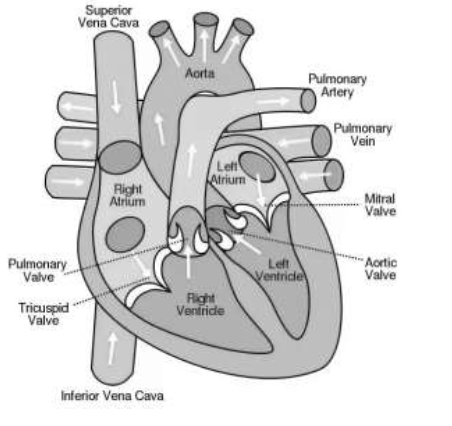
Explain the flow of blood through the circulatory system in the form of a flowchart.
1. Deoxygenated blood from the upper parts and lower parts of the body enter the right atrium via the superior and inferior vena cava.
2. Blood from right atrium flows to the right ventricle, via tricuspid valve. Deoxygenated blood from right ventricle is pumped to the lungs via the pulmonary artery.
3. In the lungs, exchange of gases takes place. Carbon dioxide is given out. Oxygen is absorbed by the blood. Oxygenated blood returns to the heart via pulmonary vein and enters the left atrium.
4. Blood flows from the left atrium to the left ventricle, via bicuspid valve/mitral valve. Oxygenated blood from the left ventricle is sent to all body parts via the aorta.
16
New cards
Explain how the respiratory, circulatory and lymphatic systems work towards maintaining equilibrium (homeostasis)in our body.
1. **Respiratory system**: Increase of carbon dioxide in blood leads to (acidosis). Lungs ensures this carbon dioxide is removed.
C and R work closely to move fluids around your body to protect it from disease
2. Cardiovascular System: When the body temperature increases the blood vessels near the skin expand and release heat to surrounding and vice versa
3. Lymphatic Systen: Returns leaked fluid from blood back to the cardiovascular systems thus maintaining fluid balance.
17
New cards
Asthma
Airways narrowed due to inflammation of bronchi
18
New cards
Pneumonia
Inflammation of lungs caused by bacteria/viruses.
19
New cards
Emphysema
Occurs when alveoli are damaged

