Prokaryotic Bio Lecture 0(Chapter 1)
 Studied by 0 people
 Call with Kai
 Learn
Learn Practice Test
 Spaced Repetition
 Match
Match Flashcards
 Knowt Play
1/22

There's no tags or description
Looks like no tags are added yet.
Name | Mastery | Learn | Test | Matching | Spaced | Call with Kai |
|---|
No study sessions yet.
23 Terms
Mortality gone down
life expectancy increased
infant mortality down drammatically decreased
Infectious diseases results, 1800’s compared to now
Microbes
organisms that are too small to be seen with the unaided eye
10–6 m
1 μm = ______
10–9 m
1 nm = ______
1 μm
1000 nm = _____
1 nm
0.001 μm = _____
Bacteria and Archaea
Which two major groups that microbiologist study are prokaryotes?
Prokaryotic
cells that lack a true membrane-delimited nucleus
Eukaryotic
– cells that have a membrane-enclosed nucleus
– are more complex morphologically
– are usually larger than prokaryotic cells
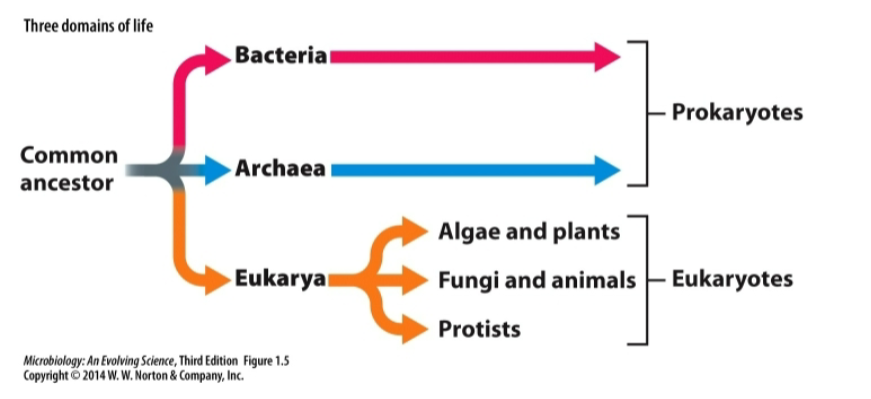
Memorize this chart!!
• Usually single-celled
• Majority have cell wall with peptidoglycan
• Most lack a membrane- bound nucleus
• Ubiquitous and some live in extreme environments
Domain Bacteria
Cyanobacteria
____________ produce significant amounts of oxygen
• Distinguished from Bacteria by unique rRNA (16S) gene
sequences
• Lack peptidoglycan in cell walls
• Have unique membrane lipids
• Some have unusual metabolic characteristics
• Archaeal ribosomes are similar to eukaryotic ribosomes
• Many live in extreme environments (eg. high temperature)
Domain Archaea
• Protists – generally larger than Bacteria and Archaea
• Algae – photosynthetic
• Fungi
– Yeast - unicellular
– Mold - multicellular
Domain Eukarya
• Eukaryotes
• Absorb or ingest organic chemicals
• May be motile via pseudopods, cilia, or flagella
Protists /Protozoa
• Eukaryotes
• Cellulose cell walls
• Use photosynthesis for energy
• Produce molecular oxygen and organic compounds
Algae
• Eukaryotes
• Chitin cell walls
• Use organic chemicals for energy.
• Yeasts are unicellular.
• Molds and mushrooms are multicellular
Fungi
• Acellular.
• DNA or RNA genome.
• Genome is surrounded by a protein coat called capsid.
• Coat may be enclosed in a lipid envelope.
• Viruses are replicated only when they are in a living host cell
(obligate intracellular parasites).
Viruses
viruses
Microbes are living creatures (except for ________?).
Jeff Taubenberger and Johan Hultin
Reconstruction of the 1918 influenza virus By ______________ and _________________
0.000001(10-6 m)
1 micrometer (μm) is ______ meter (m) ?
b) Bacteria, archaea, fungi, viruses
-plants and animals are quite large and are considered macroscopic
Microbes include members of which of
the following groups?
a) Bacteria, animals, protozoa, fungi
b) Bacteria, archaea, fungi, viruses
c) Archaea, viruses, plants, fungi
d) Bacteria, archaea, protozoa, plants
 Note
Note  Flashcards (36)