Foundations of Biology Unit 3
0.0(0)
 Studied by 2 people
 Call Kai
 Learn
Learn Practice Test
 Spaced Repetition
 Match
Match Flashcards
 Knowt Play
Card Sorting
1/136

Earn XP
Description and Tags
Last updated 3:11 AM on 12/11/22
Name | Mastery | Learn | Test | Matching | Spaced | Call with Kai |
|---|
No analytics yet
Send a link to your students to track their progress
137 Terms
1
New cards
Forward genetics
An approach that begins with an interesting phenotype, finds the gene(s) underlying it, and then determines as much as possible about those genes
2
New cards
Reverse genetics definition
An approach that begins with a gene and attempts to determine its function, often by examining what happens when the gene is knocked out
3
New cards
What does reverse genetics do?
Uses the genetic code to predict the amino acid sequence of the protein, computational methods to predict protein structure and function, and experimental methods to mutate the gene and see the effect on the organism.
4
New cards
Sanger method
Uses chemically modified nucleosides (ddNTPS) in combination with normal nucleosides (dNTPS). Synthesis stops when a ddNTP is added by DNA polymerase to a polynucleotide chain because ddNTP has no hydroxyl group at the 3' end. The sequence is determined by detecting the terminal (3') base (A, C, G, or T) at each position in the DNA.
5
New cards
Components of sequencing methods:
DNA polymerase, short (18-22 bases) primer complementary to template strand, all 2' deoxynucleoside triphosphates (dNTPs), all 2' and 3' dideoxynucleoside triphosphates (ddNTPs); labeled uniquely so that each can be detected, template DNA
6
New cards
T or F: the ratio between dNTPs and ddNTPS in DNA sequences is important
True
7
New cards
Human Genone Project
A publicly and privately funded research effort, successfully completed in 2003, to produce a complete DNA sequence for the entire human genome
8
New cards
High-throughput sequencing
Rapid DNA sequencing on a microscale in which many fragments of DNA are sequenced in parallel; involves physical binding of DNA to a solid surface or to microbeads and amplification of DNA templates by PCR; Thousands or millions of sequencing reactions are run at once
9
New cards
Transcriptome
The subset of the genome that is expressed as RNA in a particular cell or tissue at a particular time
10
New cards
RNA sequencing (RNA-seq)
The sequencing of all of the complementary DNA in a sample, obtained from the RNA by reverse transcription
11
New cards
Functional genomics
The assignment of functional roles to the proteins encoded by the genes identified by sequencing entire genomes
12
New cards
Genome annotation
Identifying the various functional regions of the genome
13
New cards
Open reading frames
Sequences of DNA within genes that begin with a start codon and end with a stop codon; can help biologists find a protein-coding gene
14
New cards
Comparative genomics
Computer-aided comparison of DNA sequences between different organisms to reveal genes with related functions
15
New cards
Proteomics
The study of the proteome
16
New cards
Proteome
The set of proteins that can be made by an organism. Because of alternative splicing of pre-mRNA, the number of proteins that can be made is usually much larger than the number of protein-coding genes present in the organism's genome
17
New cards
Ways a proteome can be measured
1. Gel electrophoresis
2. Mass spectrometry
3. Antibodies
2. Mass spectrometry
3. Antibodies
18
New cards
Metabolomics
The study of the metabolome as it relates to the physiological state of a cell, tissue, or organism
19
New cards
Metabolome
The quantitative description of all the small molecules in a cell, tissue, or organism
20
New cards
Primary metabolites
Involved in normal cellular processes, such as intermediates in pathways such as glycolysis. Also includes hormones and other signal molecules
21
New cards
Secondary metabolites
Are often unique to particular organisms or groups of organisms. They are often involved in special responses to the environment. Examples are alkaloids (morphine, cocaine, caffeine), Terpenoids (Taxol), Phenols (salicylic acid), and antibotics (penicillin)
22
New cards
Key features of prokaryotic genomes
Relatively small, usually one circular chromosome
Compact--mostly protein-coding regions and RNA genes
Most genes do not have introns
Often carry plasmids--small circular DNA molecules
Compact--mostly protein-coding regions and RNA genes
Most genes do not have introns
Often carry plasmids--small circular DNA molecules
23
New cards
Core genome
Genes common to all strains of a species; only in prokaryotes
24
New cards
Pan genome
All genes found in a species across all strains
25
New cards
What is CRISPR-Cas9?
A new way of knocking out genes that is more specific
26
New cards
Pseudogene
A nonfunctional copy of a gene
27
New cards
Paralogs
Genes that arise via duplication
28
New cards
Gene family
Two or more paralogs in a genome
29
New cards
Two common types of common genetic variation
SNPS and STRs
30
New cards
Single Nucleotide Polymorphisms (SNPs)
Inherited variations involving a single base-- originating by point mutations
31
New cards
Short Tandem Repeats (STRs)
Short repetitive sequences occurring side by side on chromosomes, usually in noncoding regions
32
New cards
Restriction Fragment Length Polymorphisms (RFLPs)
Mutations at restriction sites that change the ability of the enzyme to cut; observed as bands on an electrophoresis gel following digestion of PCR-amplified target or hybridization of digested DNA with probe
33
New cards
Natural selection
Slight variations among individuals that affect the chances of surviving and producing offspring
34
New cards
Artifical selection
Selective breeding of animals and plants by humans similarly produced changes in characteristics of those breeds
35
New cards
Coyne's 6 elements of evolutionary theory
Evolution, Common Ancestry, Gradualism, Natural Selection, Speciation, and Nonselective Mechanisms
36
New cards
Fitness
Reproductive contribution of a phenotype to subsequent generations relative to other phenotypes; determined by the rate (or amount) of survival and reproduction of individuals with that phenotype relative to other phenotypes
37
New cards
Sexual selection
Acts on characters that determine reproductive success; favors traits that increase the chances of reproduction
38
New cards
Intrasexual selection
Traits such as bright colors, long horns, and elaborate courtship displays that may improve ability to compete for mates
39
New cards
Intersexual selection
Traits that make an organism more attractive to the opposite sex that improves chances of mating
40
New cards
Three kinds of natural selection
Stabilizing, directional, and disruptive
41
New cards
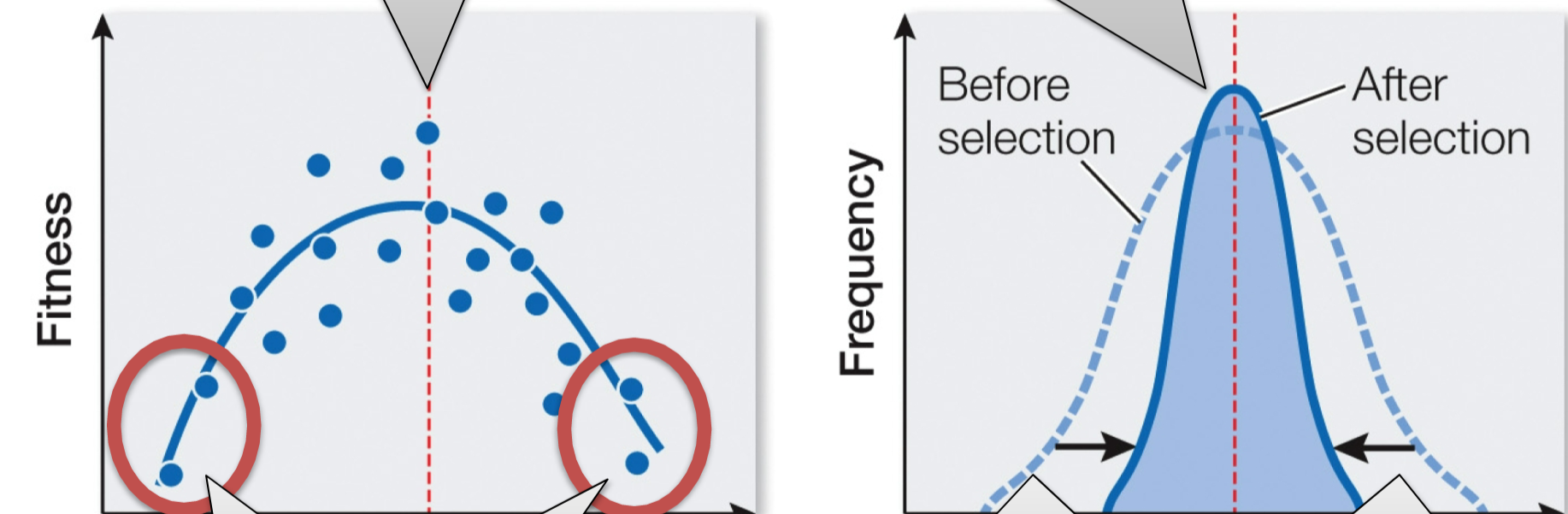
Stabilizing selection
Preserves average phenotype; often called purifying selection
42
New cards
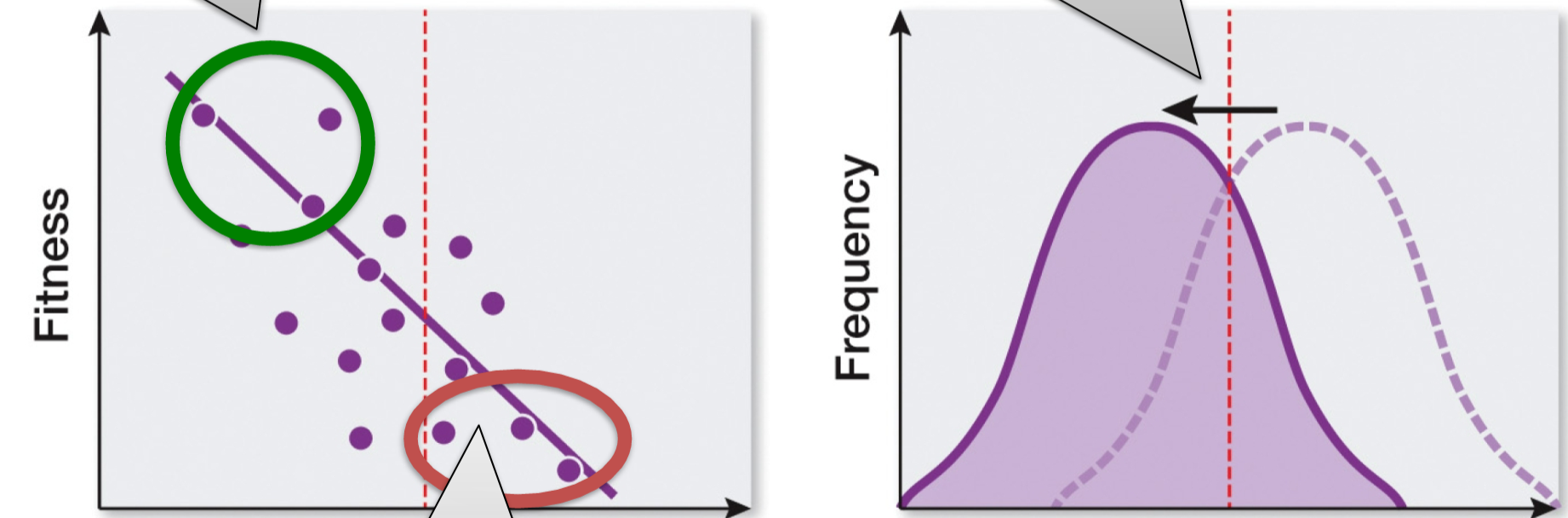
Directional selection
Favors individuals that vary in one direction; also called positive selection
43
New cards
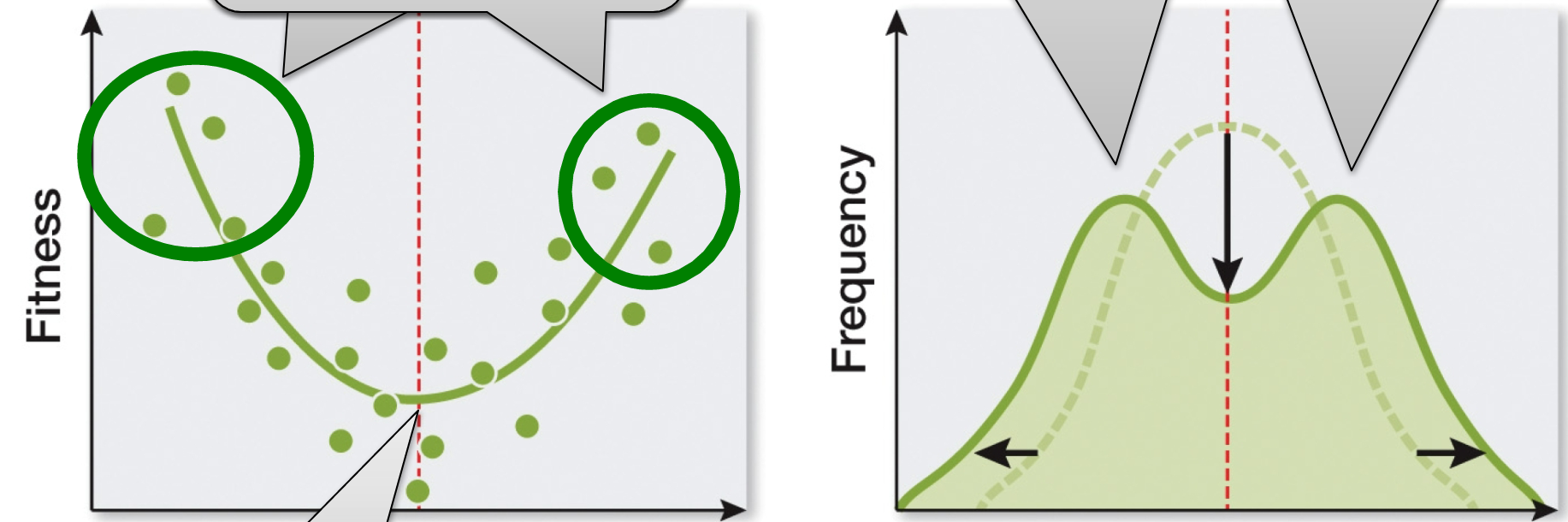
Disruptive selection
Favors individuals that vary in opposite directions from the mean
44
New cards
Frequency of an allele (A for example but also works for a)
[(2 x # of AA individuals) + # of Aa individuals] / 2 x total
45
New cards
Hardy-Weinberg Equilibrium
A model population in which allele and genotype frequencies do not change
46
New cards
Requirements for a Hardy-Weinberg population
No mutations, No gene flow, Infinite population size, random mating, and no natural selection
47
New cards
Short-term deviations from the Hardy-Weinberg equilibrium
Nonrandom mating and gene flow
48
New cards
Long-term deviations from the Hardy-Weinberg equilibrium
Mutation, genetic drift, natural selection
49
New cards
Selfing (self-fertilization)
A way that certain plants reproduce by themselves; reduces the frequency of heterozygotes and increases the frequency of homozygotes, but does not change allele frequencies in the population
50
New cards
Genetic drift
Changes in allele frequencies that results from chance (is random)
51
New cards
T or F: Size of population and strength of genetic drift are positively correlated
False; there is a larger # of changes in smaller populations and a smaller # of changes in larger populations
52
New cards
Bottleneck effect
A temporary reduction in population size in which much of the genetic variation of the population is lost
53
New cards
Founders effect
Equivalent to a population bottleneck, but applies to small populations that colonize a new region; the small colonizing population is likely to contain only a subset of genetic variation, and descendant generations will exhibit elevated frequencies of the alleles present in founder individuals
54
New cards
T or F: Random genetic drift decreases genetic variation
True
55
New cards
Neutral allele
An allele that does not affect fitness; they increase in frequency by genetic drift
56
New cards
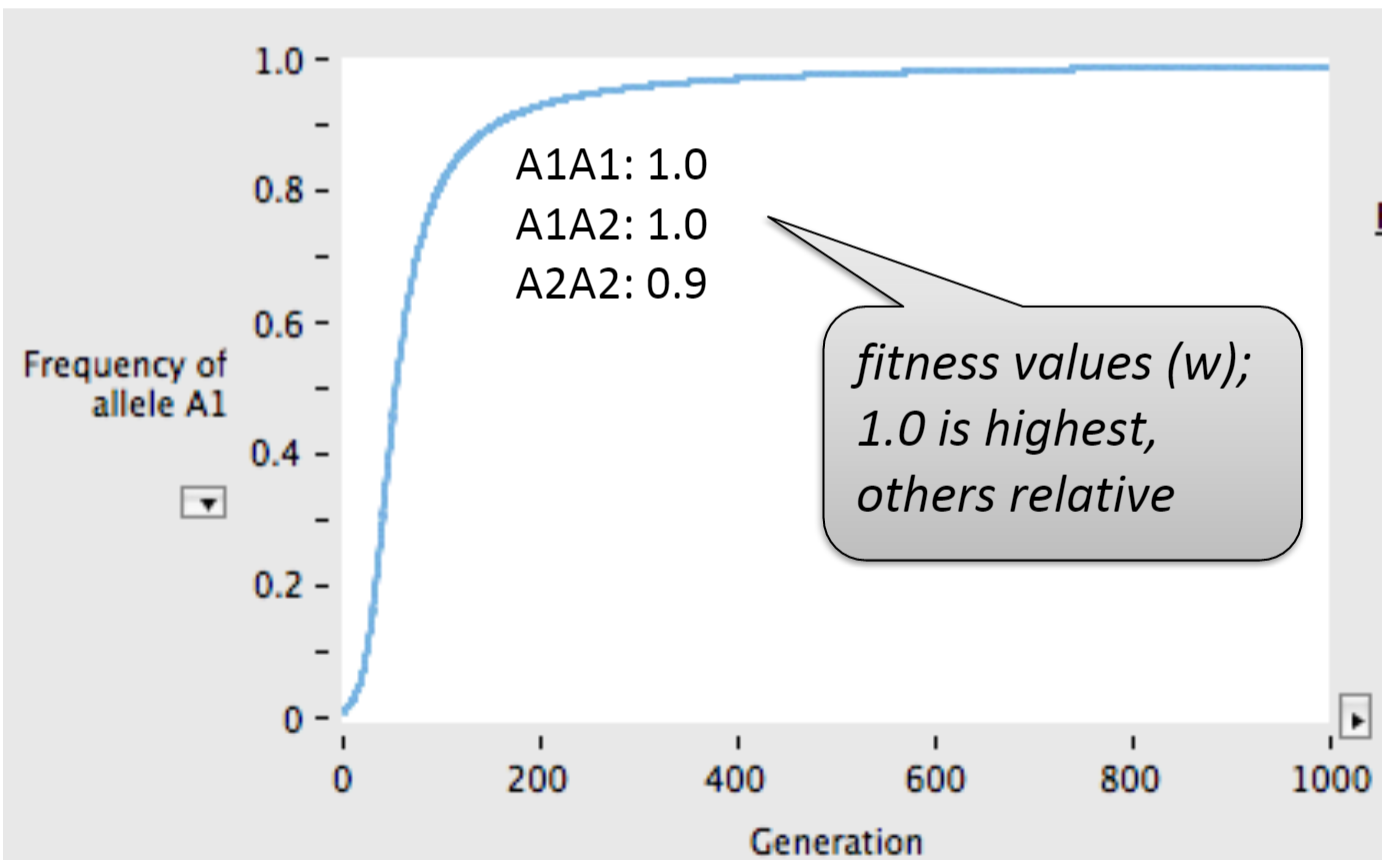
Positive selection
Natural selection acts to increase the frequency of an allele that increases individual fitness; the rate of increase depends on fitness of the heterozygote; ex. Lactase persistence
57
New cards
Balancing selection
Natural selection acts to maintain intermediate frequencies of alleles at the locus, because heterozygotes are favored; ex. Sickle-Cell anemia
58
New cards
Phylogeny
The evolutionary history of relationships among organisms or their genes
59
New cards
Convergent evolution
Independently evolved traits subjected to similar selection pressures may become superficially similar
60
New cards
Homoplasies
Similar traits generated by convergent evolution and evolutionary reversals; no common ancestor!
61
New cards
Homologous
Features shared by two or more species that were inherited from a common ancestor
62
New cards
Ancestral traits
A characteristic of a homologous trait that was present in the common ancestor of the group
63
New cards
Derived traits
A characteristic of a homologous trait found in a descendant that differs from the ancestral trait; specific to the group
64
New cards
Synapomorphies
Derived characteristics of homologous traits shared among a group that are viewed as evidence of the common ancestry of the group
65
New cards
Parsimony principle
The simplest explanation of observed data is the preffered explanation
66
New cards
Occam's razor
The best explanation fits the data with the fewest assumptions
67
New cards
Taxon order
Species, genus, family, order, class, phylum, kingdom, and domain
68
New cards
Monophyletic
One taxon contains an ancestor, and all descendants are of that ancestor, and no other organisms
69
New cards
Paraphyletic
A group that does not include all descendants of a common ancestor
70
New cards
Polyphyletic
A group that does not include its common ancestor
71
New cards
Molecular clock hypothesis
Rates of molecular change are constant enough to predict timing of evolutionary divergence
72
New cards
Molecular clock
Uses the average rate at which a given gene or protein accumulates changes to gauge the timing of divergences; must be calibrated using independent data, such as the fossil record, known divergences, or biogeographic dates
73
New cards
Neutral theory of molecular evolution
The majority of mutations are neutral, and may fix in populations through genetic drift
74
New cards
T or F: the rate of fixation is equal to the neutral mutation rate
True
75
New cards
Substitution
Loss of the ancestral allele
76
New cards
Probability of fixation=
1/2N (N= population size)
77
New cards
Rate of fixation=
2Nu(1/2N)=u (N= population size) (u=neutral mutation rate per gamete per generation)
78
New cards
Molecular evolution
Study of the mechanisms and consequences of the evolution of macromolecules, the relationships between the structure of genes and proteins and organism function, and using molecular variation to reconstruct evolutionary history
79
New cards
Synonymous/silent substitutions
A substitution that does not change the amino acid that is specified and therefore has no effect on the protein coded
80
New cards
Nonsynonymous/missense substitutions
A substitution that changes the amino acid that is specified and effects the protein; often deleterious
81
New cards
If an amino acid position is under positive selection for change, the rate of nonsynonymous substitutions can be ________ than synonymous
Much higher
82
New cards
If an amino acid is position is under purifying selection, the rate of synonymous substitutions is ______ than nonsynonymous
Much higher
83
New cards
What happens with the two genes after one is duplicated?
One copy becomes nonfunctional from accumulation of deleterious substitutions and becomes a pseudogene, both genes retain original function but expression diverges in different tissues or at different times, and one copy accumulates substitutions that allow it to perform a new function
84
New cards
Maternal effect genes
Regulates expression of segmentation genes in Drosophilia
85
New cards
Segmentation genes
Define segment number and orientation of each segment in Drosophilia
86
New cards
Types of segmentation genes
Gap genes, pair rule genes, segment polarity genes
87
New cards
Gap genes
1st segmentation gene to act; organzies broad areas
88
New cards
Pair rule genes
2nd segmentation gene to act; divides embryo into units of two segments each
89
New cards
Segment polarity genes
3rd segmentation gene to act; determines boundaries and anterior-posterior organization in individual segments
90
New cards
Hox genes
Expressed in different combinations along the length of the embryo. Their expression determines the morphology of each segment; in two segments, ordered the same as their spatial expression in the embryo
91
New cards
Homeotic mutants
Mutants with mis-regulation of gene expression
92
New cards
Genetic toolkit
The regulatory genes that govern developmental processes that have been highly conserved throughout evolution
93
New cards
What does the Ubx Hox gene do?
It is involved in producing morphological differences in thoracic and abdominal appendages
94
New cards
Heterometry
Altered quantity of gene expression of a developmental gene
95
New cards
Heterochrony
Altered timing of gene expression of a developmental gene
96
New cards
Heterotopy
Altered spatial pattern of gene expression of a developmental gene
97
New cards
Species
Groups of organisms that mate with one another and can produce fertile offspring
98
New cards
Types of species concepts
Biological, lineage, and morphological
99
New cards
Biological species concept
Groups of actually or potentially interbreeding populations which are reproductively isolated from other such groups are defined as a species; does not apply to organisms that reproduce asexually
100
New cards
Lineage species concept
Species are terminal monophyletic branches on the tree of life; each species has a history that starts at a speciation event and ends at extinction or another speciation event
 Note
Note  Flashcards (27)