Unit Two
 Call Kai
 Learn
Learn Practice Test
 Spaced Repetition
 Match
Match Flashcards
 Knowt Play
1/46

Earn XP
Description and Tags
This quizlet is covering unit 2 of Plant Biology with Professor Simon the Austalian.
Name | Mastery | Learn | Test | Matching | Spaced | Call with Kai |
|---|
No analytics yet
Send a link to your students to track their progress
47 Terms
Transpiration
The movement of water up the xylem and into the atmosphere, driven by the evaporation of water from the stomata.
Cohesion-Tension
The molecular mechanism that makes transpiration happen; explained by water molecules linking together by cohesion and being pulled up by the xylem by tension caused by a negative water potential
Cohesion
The strong, attractive hydrogen bonding interactions between water molecules
Adhesion
The formation of hydrogne bonding interactions between water and non-water molecules, usually of a solid like cellulose
Guard Cells
Paired cells on either side of a stomatal pore that monitor environmental conditions and accordingly open or close the stoma by varying their turgor pressure.
Abscisic acid
A plant hormone produced in response to drought and other stress that causes stomatal closure.
Hormone
In plants, an organic compound with signaling or regulatory roles that interacts with cells to activate or deactivate cellular processes.
Apoplastic route:
A pathway water and dissolved solutes can take into the root system by moving through the interconnected cell walls, as opposed to through the cytoplasm (see symplastic route).
Endothermis
A ring of cells in the root between the cortex and the vascular bundle (stele) that acts as a barrier for molecules entering the xylem from the cortex.
Casparian Strip
A ring of waterproof waxy material that encircles the cell walls of a root’s endodermis, thus blocking the apoplastic route (see suberin).
Suberin:
A waxy, waterproof material produced by plants, notably in the endodermis to form the Casparian strip.
Symplastic route:
A pathway water and dissolved solutes can take into the root system by moving through the shared cytoplasm of adjacent cells via plasmodesmata. (see apoplastic route).
Plasmodesmata
Pores in plant cell walls in that allow the cytoplasm and cell membranes of neighboring cells to be continuous and joined together so that molecules can easily pass between cells.
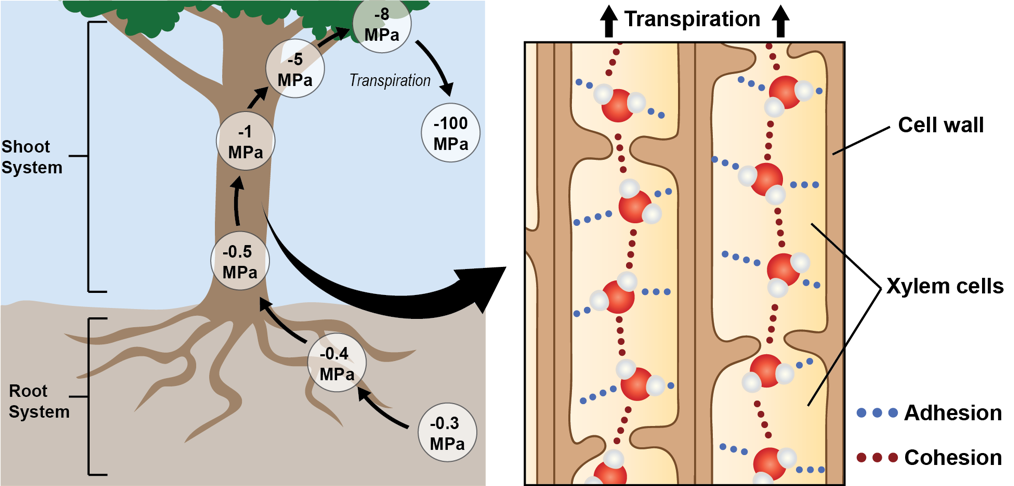
What is the physical reason behind transpiration>
The force driving transpiration can be explained by a strong water potential gradient that exists across the plant from the soil to the atmosphere. Note how the water potential (ψ) gets increasingly negative along the path of water flow through the xylem.
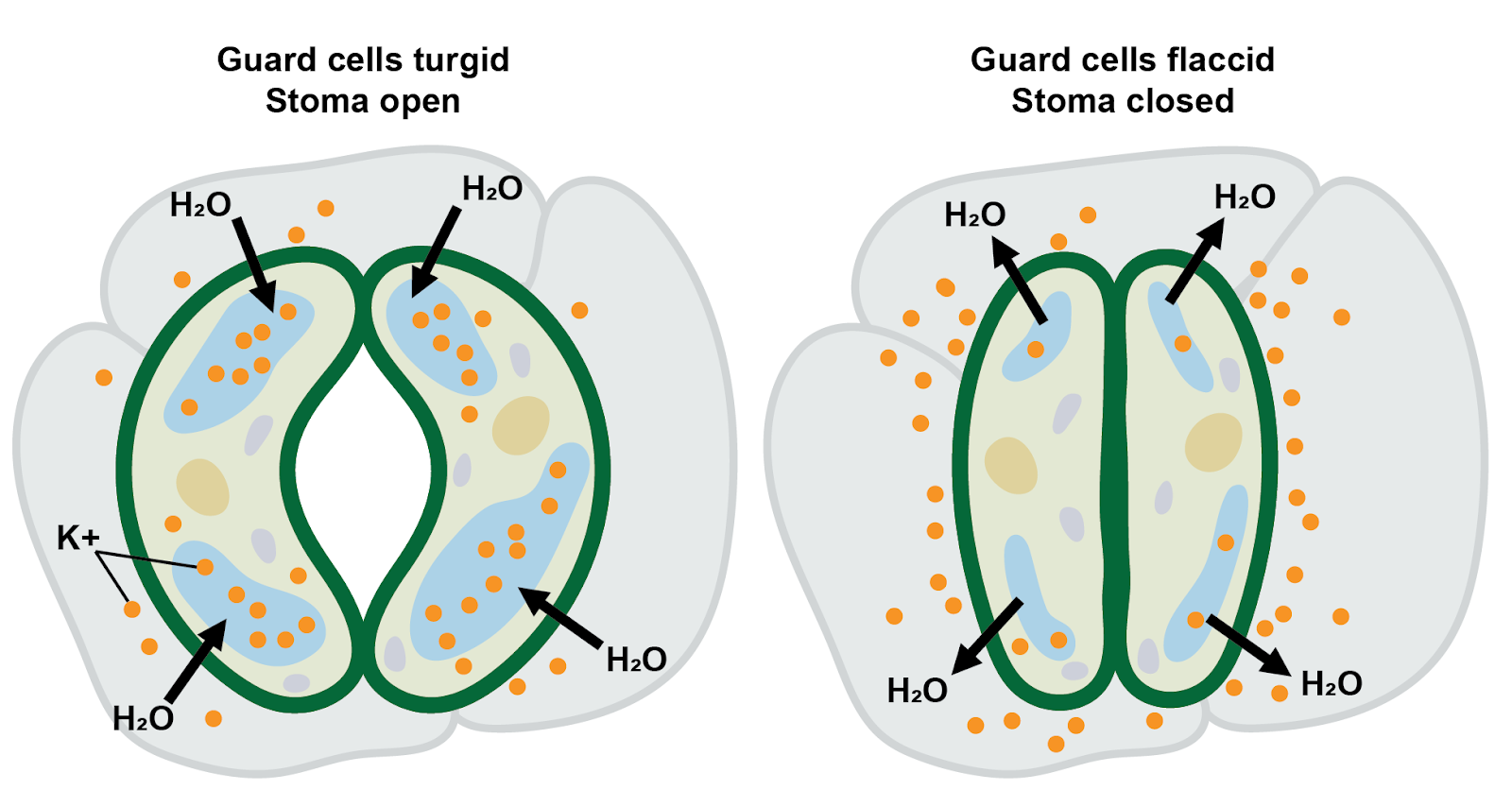
How does the stomatal pore open? Left side.
The guard cell is being made to take up water by moving potassium ions (K+) into its cytoplasm. This increase in solute concentration makes the solute potential ψs much more negative and water diffuses across the cell membrane into the cytoplasm by osmosis.
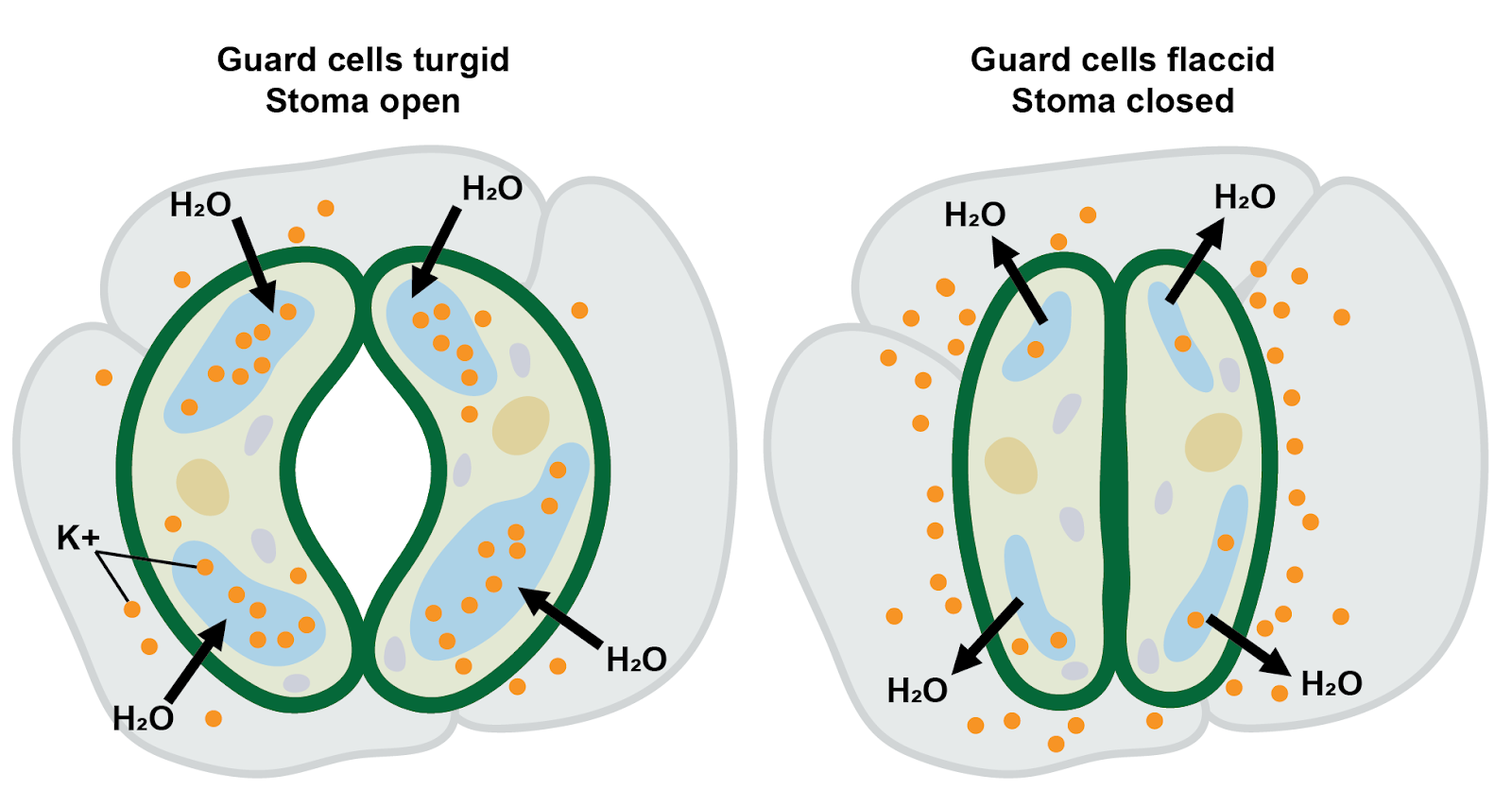
How does the stomata pore close? Right side.
Potassium ions are moved out of the gaurd cells, moving water out of the cell, making the gaurd cells lose water and become flaccid
How does a plant open its stomatal pore?
The guard cells experience an increase in solute concentration, making the solute potential much more negative. This causes water to enter the cells via osmosis and the turgid guard cells bow outwards and open the pore between them.
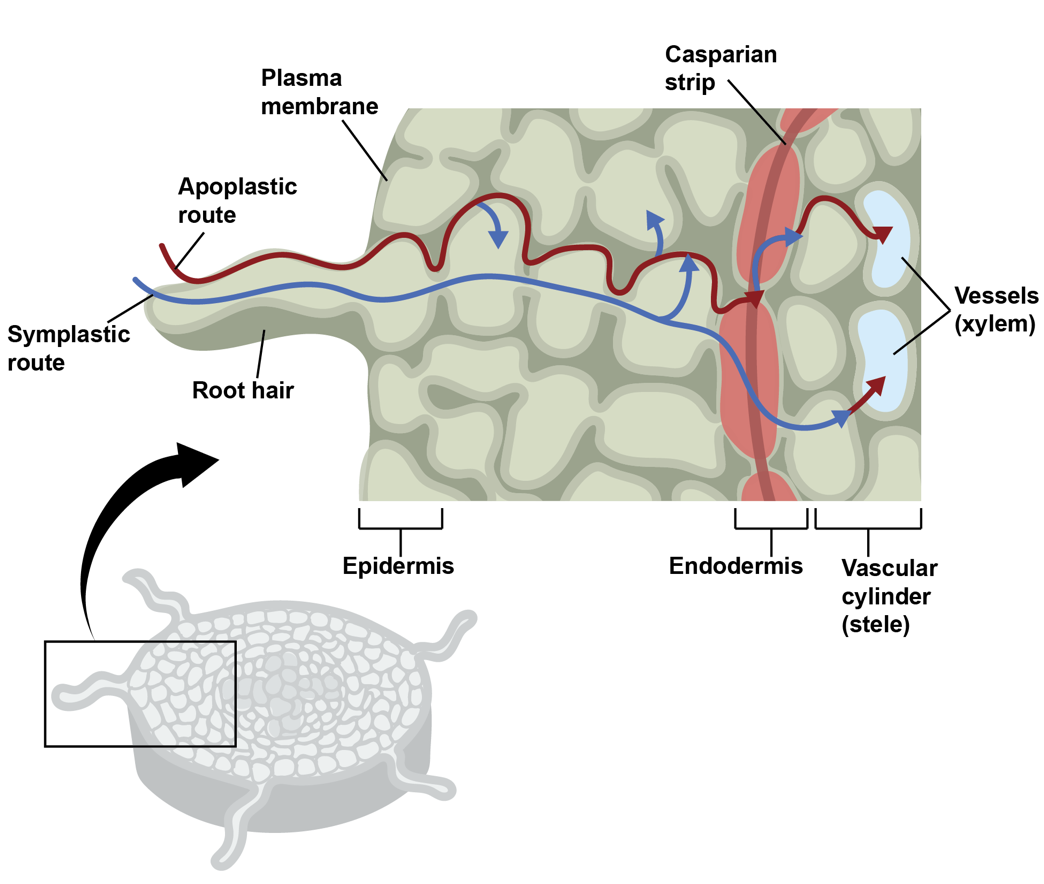
Why is the xylem part of the apoplast?
Because these cells are dead and lack cytoplasm or membranes and so inside the xylem is in contact with the apoplastic cell wall space.
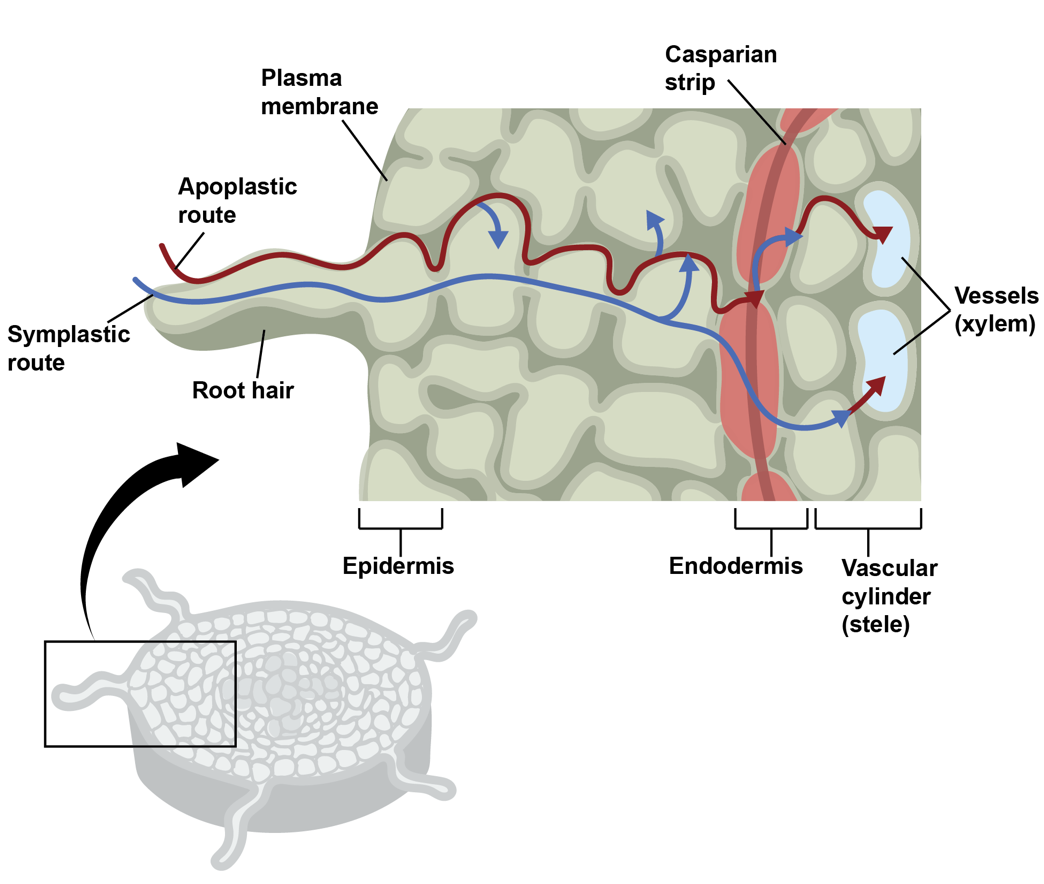
What is the pathway of the apoplastic route?
Water molecules travel through the cell walls of the root cells. The uptake of water and dissolved solutes is controlled by the endothermis. The casparian strip controls and filters what is absorbed from the soil and exports these from the endothermal cells back into the apoplastic space inside the xylem.
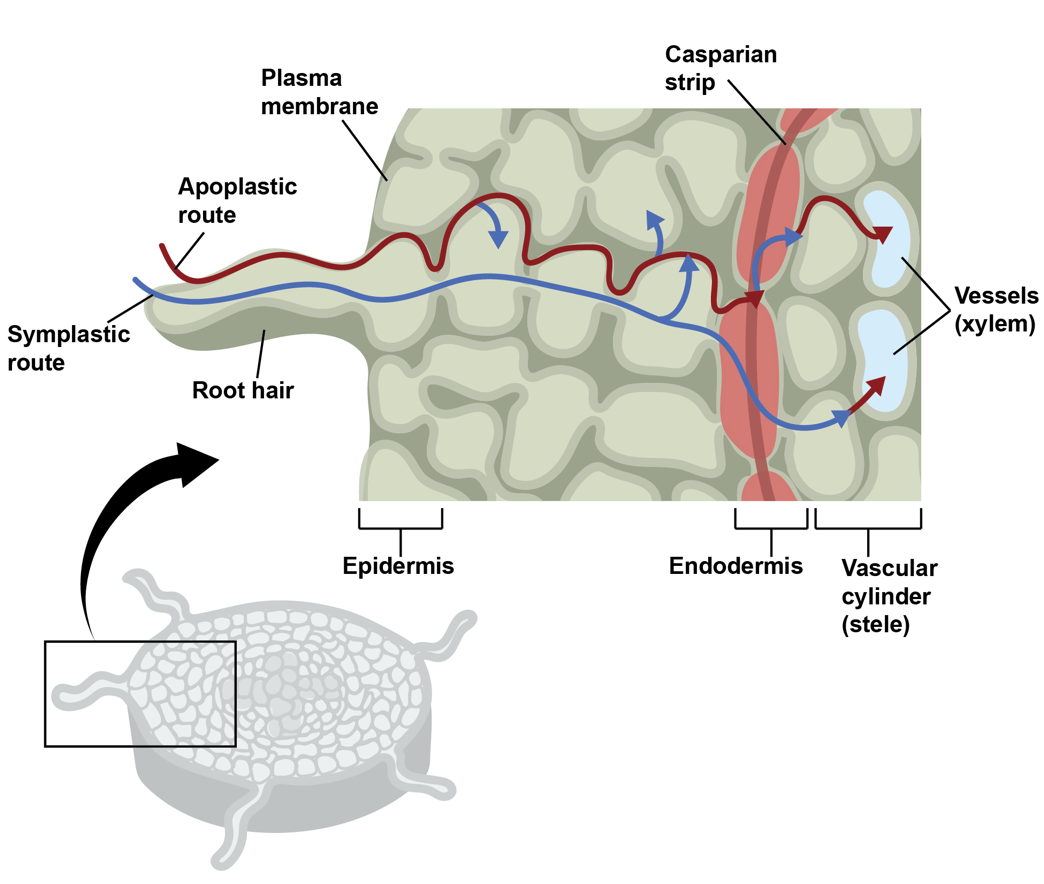
What is the symplastic route>
Water can travel between through the space interior of the cell membranes, or the cytoplasm. This is due to plasmodesmata, which are pores in plant cell walls in which the cytoplasm and cell membranes of neighboring cells are continuous and joined together. They are filtered not by the casparian strip, but by already crossing cell membranes that have transporter proteins allowing certain nutrients to pass and excluding other for the endothermal cells and the apoplastic route. Once in the symplast, these molecules can travel through the cytoplasm of the endothermis and into the xylem.
Which of the following correctly summarizes the difference between the apoplastic and the symplastic route?
Materials in the apoplastic route cross a cell membrane at the endodermis layer while materials in the symplastic route cross a cell membrane at the epidermis layer.
What is the function of the Casparian strip?
It allows plants to selectively “filter” what they absorb from the soil.
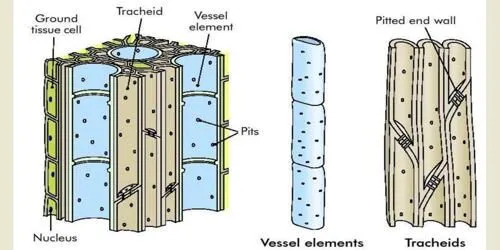
What are the two types/components of xylem?
Tracheids and vessels.
An isolated plant cell can be cultured in a Petri dish and made to divide and produce a completely new plant. This is possible because some plant cells are in a permanently embryo-like state (i.e., can divide into any cell type in the plant), while others are capable of changing the patterns of gene expression in their nucleus from those of their current cell type (such as root cell, or leaf cell) back to this embryo-like state. Cells with an embryonic-like nature can divide to produce any of the structures of the plant and so are capable of dividing to make a complete new plant. All of the following cells would be able to regenerate an entire new plant EXCEPT for a/an:
A. apical meristem cell
B. parenchyma cell
C. collenchyma cell
D. sieve tube cell
E. axillary meristem cell
D. Sieve Tube Cells
For Xylem. What moves through this tissue type?
Water and dissolved minerals
What is the direction of the flow of water and dissolved minerals in xylem?
Upwards
Is xylem alive or dead at functional maturity>
Dead
List two types/ components of xylem
Tracheids and vessels
Phloem is one of the main types of vascular tissue. What moves through this tissue type?
Sugars and photosynthates
Phloem is one of the main types of vascular tissue. What is the direction of the flow?
Upwards
Is phloem alive or dead at functional maturity?
Alive
Phloem is one of the main types of vascular tissue. List three types/components
Sieve tube elements, sieve plates, companion cells
True or False; Ferns do not produce flowers, whereas angiosperms do.
True
True or False; Ferns have visible structures on the underside of the leaf that produce spores, while angiosperms only produce pollen and do not produce spores.
False. Both plant groups use alternation of generations that produces a spore from the sporophyte by meiosis.
Ferns have a life cycle where the gametophyte represents the major part*, while in angiosperms it is the sporophyte. (“major” here to mean the phase of the life cycle with the largest and most obvious individual plants)
False. In both ferns and angiosperms, the sporophyte(2n) is the large, dominant and photosynthetic plant
Angiosperms produce seeds, while ferns do not produce seeds
True
FIX ME: Only the angiosperms and gymnosperms produce true leaves and roots, while ferns produce leaf-like structures called sporangia and root-like structures called rhizoids.
False. Rhizoids are only located in non-vascular plants or bryophytes.
Which statement best describes a source in a plant?
A part of the plant that exports sugars it produces or has store
Which statement best describes a sink in a plant?
A tissue that imports sugars because it cannot meet its own energy needs
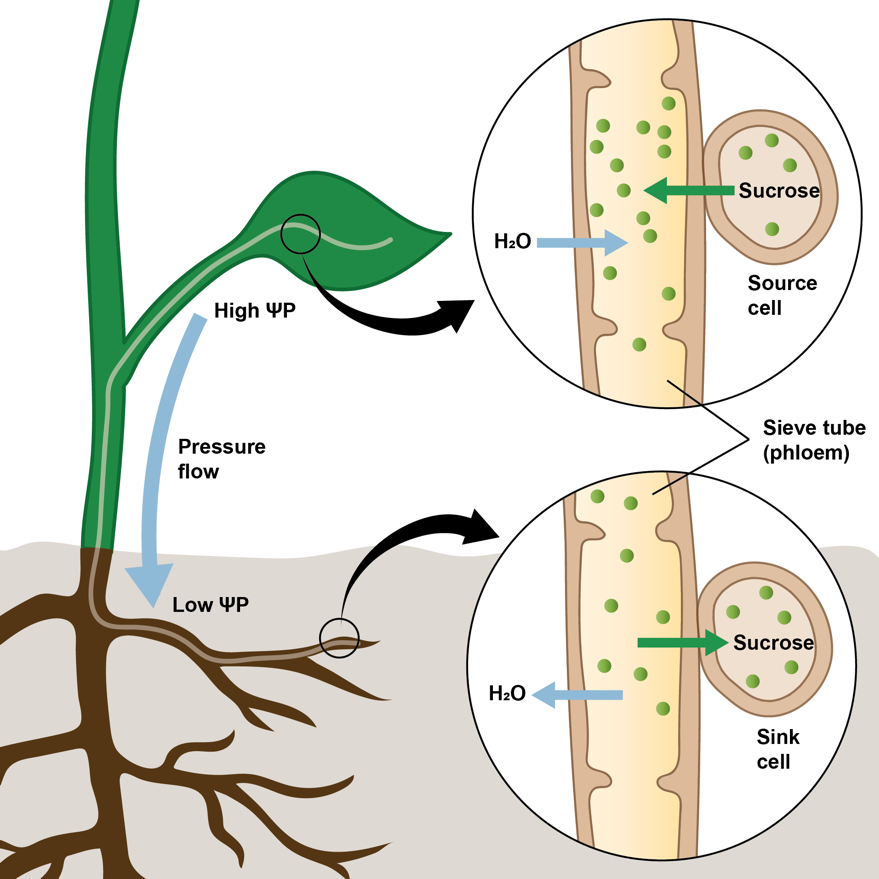
Why does water enter the phloem at the source end?
Because the high sucrose concentration in the source end lowers solute potential, drawing water in by osmosis
Why must phloem sieve-tube elements be alive?
They need functional membranes and transport proteins to actively load sucrose
Chemiosmosis
The diffusion of protons down their concentration gradient, which is often used to power reactions in biological systems
Sucrose-Proton Symporter
An active transport protein in a sieve-tube cell membrane that co-transports sucrose into the cell against its concentration gradient and protons down their concentration gradient
Translocation
The directed movement of water and dissolved sugar through the ploem
Pressure Flow
The physical mechanism that makes translocation happen in the phloem; explained by water moving form areas of high to low pressure caused by a difference in solute (sugar) concentrations

