Lab 8 - Urinary System (Renal)
 Call Kai
 Learn
Learn Practice Test
 Spaced Repetition
 Match
Match Flashcards
 Knowt Play
1/52

There's no tags or description
Looks like no tags are added yet.
Name | Mastery | Learn | Test | Matching | Spaced | Call with Kai |
|---|
No analytics yet
Send a link to your students to track their progress
53 Terms
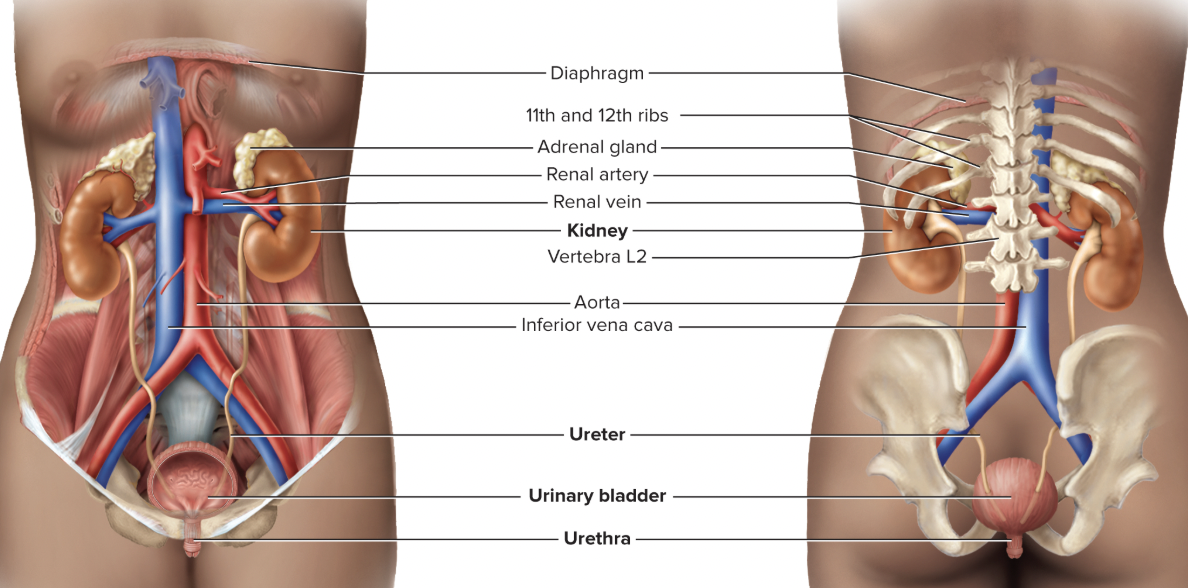
What organs does the urinary system consist of?
Two ureters
Single urinary bladder
Single urethra
What are some functions of the urinary system?
Cleansing blood / ridding of waste
Regulation of BP
Regulation of pH
Erythropoietin release
What might a person with kidney failure experience?
Weakness/lethargy
Shortness of breath
Acidosis
Rising potassium
and much more
Where is the left kidney located? Why is the right kidney slightly lower?
Left kidney located at the level of T12-L3
The right kidney is slightly lower due to displacement by the liver
What structure anchors the kidneys to the posterior abdominal wall
The renal fascia
Renal hilum
Medial entry/exit site of the kidneys
Extends into the renal sinus
What are the semi-triangular portions of the renal medulla (inner portion) called?
Renal pyramids (pyramid of renal medulla)
What separates the renal pyramids?
Renal columns
(Also have lots of framework for blood vessels entering/exiting the cortex)
Renal papillae
found at the ends of each renal pyramid; where calyces begin
Collecting ducts that transport urine to the calyces for excretion
Where is urine made?
Nephrons
Minor calyx
First stop for urine; enclose the renal papillae
Funnel urine into the major calyx
Major calyx
Conduct urine into the renal pelvis
T/F: The kidneys have a portal system
True! Helps filter blood
What is the first vessel to enter the kidney?
Renal artery from the abdominal aorta
What are the different branches of the renal artery as you continue further into the kidneys?
Renal artery
Segmental arteries in the renal sinus
Interlobar arteries in the renal columns
Arcuate arteries between the medulla and the cortex
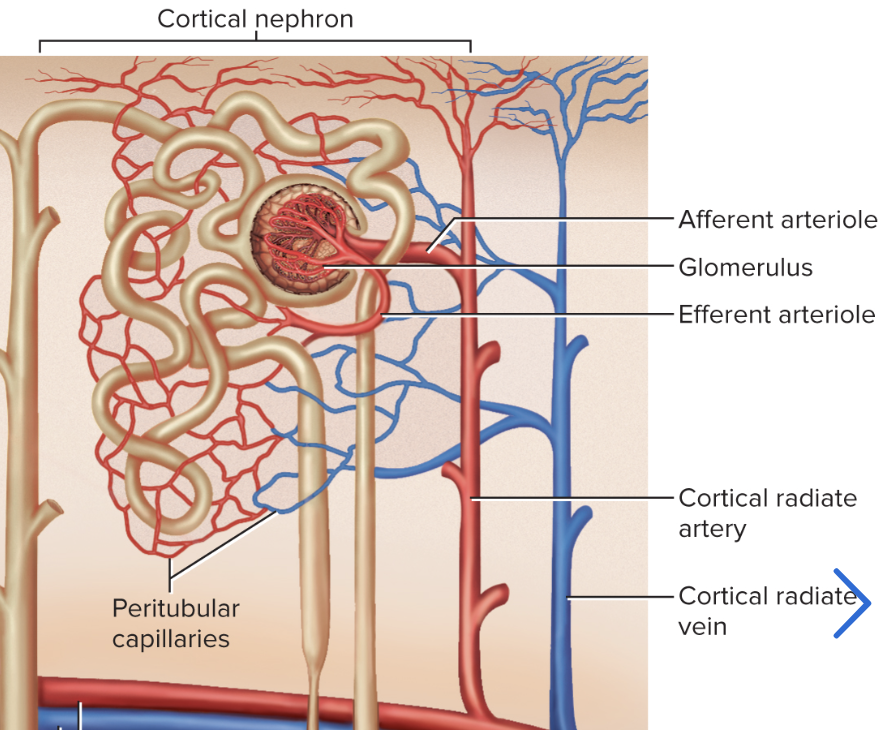
Cortical radiate arteries are in the cortex
What do the cortical radiate arteries branch into?
branch to become afferent arterioles
Where do afferent arterioles take blood?
To the glomerulus: a cluster of capillaries where filtration occurs
Directly from the glomerulus, where does blood travel?
Through efferent arterioles to the peritubular capillaries OR to the vasa recta
What happens in the peritubular capillaries?
Reabsorption and secretion
What happens in the vasa recta?
Production of concentrated urine; exchanges water and solutes
What are the three capillary beds of the kidney?
Vasa recta, peritubular capillaries, glomeruli
Blood from the peritubular capillaries and vasa recta go to the…
Cortical radiate veins
List the veins coming from the peritubular capillaries to the inferior vena cava
Cortical radiate v.
Arcuate v.
Interlobar v.
SKIPS the segmental region
Renal v.
Inferior vena cava
Nephrons
“Functional units of the kidney”; filter blood and create urine
In the kidneys, what is filtration based on?
Size; large elements cannot pass through the filtration membrane (blood, platelets, antibodies, etc)
What are the functional regions of a nephron?
Renal corpuscule
Proximal convoluted tubule
Nephron loop
Distal convoluted tubule
What are the components of the renal corpuscle? What takes place here?
Glomerulus + capsule
(glomerulus is inside the nephron)
Site of filtration
Filtered fluid from the glomerulus is funneled into the…
Proximal convoluted tubule (PCT)
What is the function of the proximal convoluted tubule (PCT)?
Reabsorption of solutes (Na+, Cl-, glucose, etc.) from the blood (microvilli to increase SA)
Simple cuboidal
Leaving other products in the filtrate to be disposed
*Most essential function of the nephron
Once filtrate leaves the PCT, where does it go?
Loop of Henle
The descending loop begins ___ (thick/thin), whereas the ascending loop begins (thick/thin)
Thick; thin
After the loop of Henle, where is the filtrate directed?
The distal convoluted tubule (DCT)
What processes occur in the DCT?
Reabsorption and secretion, but to a lesser extent than the PCT
Where is filtrate directed after the DCT?
Collecting ducts
What are collecting ducts?
Tubes that receive the filtrate (now mostly waste) before final modification
Where do collecting ducts empty?
Renal papilla
T/F: As urine passes through the ureters, it passively drains into the bladder
False! Urine is propelled by waves of peristalsis
Why is the bladder a highly distensible organ?
Irregular crisscrossing bands of smooth muscle (aka detrusor muscle)
Interior is made up of transitional epithelium
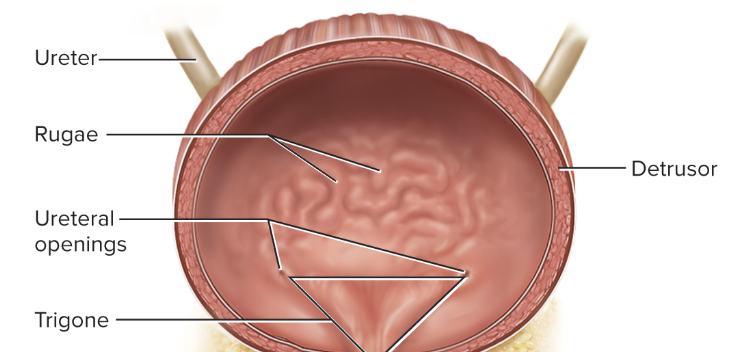
What forms the trigone in the bladder?
The triangle that forms from the two ureteral openings in the bladder and the urethra
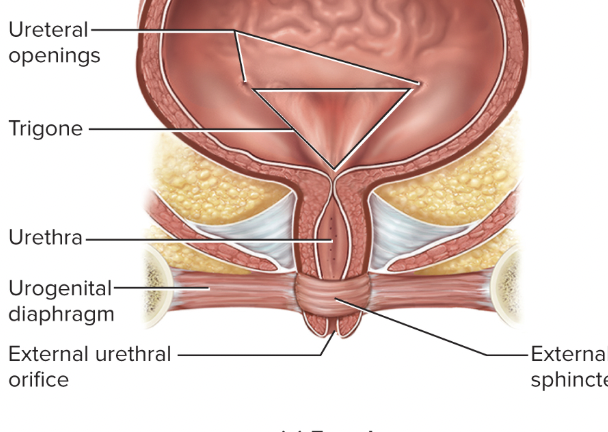
The proximal urethra is made up of _____; while the terminal portion of the urethra is made up of _____
Transitional epithelium; nonkeratinized stratified squamous epithelium
In males, there are two urinary sphincters. Describe them, and which one is present in females?
Internal urinary sphincters; smooth muscle + involuntary
External urinary sphincters; skeletal muscle + voluntary
About how long is the female urethra?
3-4 cm long from the urinary bladder to the external urethral orifice
About how long is the male urethra?
~20 cm in length from the urinary bladder to the external urethral orifice
Where does urine pass through after leaving the urinary bladder in males?
Prostate gland
Prostatic urethra
Membranous urethra
Spongy (penile) urethra
Prostatic urethra
During sexual intercourse, receives sperm from the ejaculatory ducts + secretions from seminal vesicles
also where mucus is secreted to buffer urethral pH during sex; also for lubrication for ejaculation
Why are mucus glands important in the urethra?
To protect against the extreme pH of urine
How does urine get its color?
Breakdown of RBC - irons from blood transports to urine as urochrome
What causes odor in urine?
The breakdown of urea → ammonia by bacteria
foods (asparagus → asparagustic acid → sulfur)
How much urine do we excrete a day, roughly? What is the term for less than average urination and higher than average urination?
1-2 L /day
Oliguria
Urine output below 1-2 L/day
Anuria
No urine output
Polyuria
Urine output greater than 1-2 L / day
Glycosuria
High amounts of glucose found in urine

