McKay Microbiology Chapter 6 quiz and study guide
 Call Kai
 Learn
Learn Practice Test
 Spaced Repetition
 Match
Match Flashcards
 Knowt Play
1/44

There's no tags or description
Looks like no tags are added yet.
Name | Mastery | Learn | Test | Matching | Spaced | Call with Kai |
|---|
No analytics yet
Send a link to your students to track their progress
45 Terms
Viruses are considered to be non-living pathogens for which reason?
they are acellular
Retroviruses use the enzyme reverse transcriptase to
direct the production of double-stranded DNA from a single-stranded RNA genome.
A newly-discovered double-stranded RNA virus which infects animal cells is found to contain a unique enzyme which synthesizes double-stranded RNA using an RNA template. Which of the following statements is likely to be true?
The virus must bring this enzyme into the host cell as synthesizing RNA from an RNA template does not happen in animal cells.
Which of the following are contributors to viral genome evolution?
quick replication time and the large number of virions released within a host
Which description of antigenic drift and antigenic shift in the influenza virus is incorrectly matched?
Antigenic drift: Often involves reassortment of viral strains in an animal host followed by a "species jump" to humans.
Which property is not currently used to classify viruses?
host range of the virus
Which viral family and representative disease contains single-stranded+ RNA and reverse transcriptase?
Retroviridae (AIDS)
All the following are DNA viruses except
Picornaviridae.
Viruses which infect many different tissue types are said to have a(n)
broad tropism.
Which suffix denotes the "family" level of classification for viruses?
viridae
The key event that occurs during lysogenic replication of bacteriophage that does not occur during lytic replication is
integration of the phage DNA into the host cell DNA.
Compared to both prokaryotic and eukaryotic cells, viruses
are generally smaller.
During lytic replication of bacteriophage, which process uses factors from the host cell, rather than (those or factors) coded by the viral genome?
enzymes which transcribe and translate viral genes
Phage conversion occurs when
prophage confer new pathogenic properties on bacterial cells.
Which stage of animal virus replication may be blocked by a drug that binds with the viral spike?
attachment
HIV, the virus which causes AIDS, interacts with two receptors on the host cell membrane: CD4 and CCR5. A small percentage of individuals have a genetic mutation which causes their cells to lack CCR5. These individuals will never develop AIDS nor are they able to pass HIV on to others. Which part of viral replication is being blocked by the lack of a receptor?
HIV cannot attach to the host cell without the proper membrane receptor.
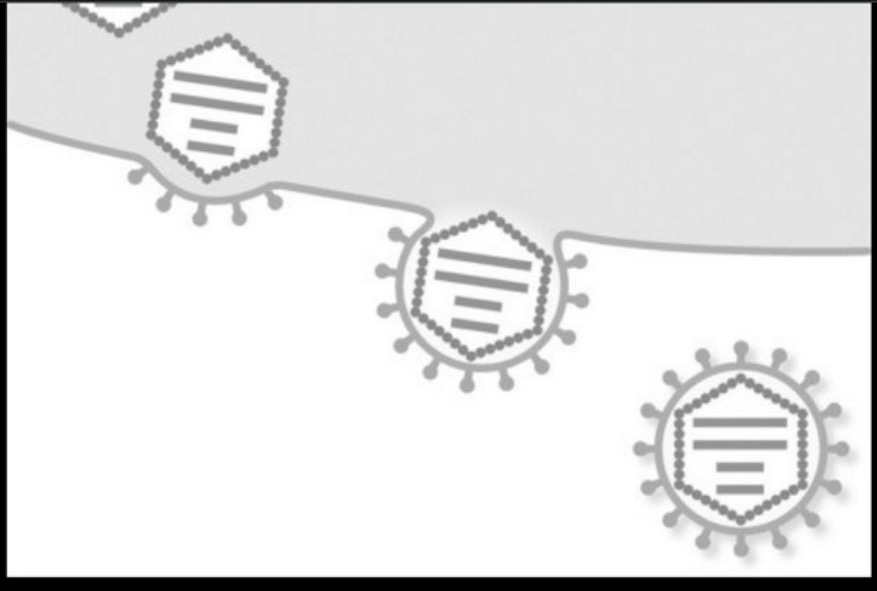
Which stage of viral replication is shown?
release by budding
Which stage of animal virus replication will not be different between naked viruses and enveloped viruses?
replication
Which statement is not true about chronic persistent viral infections?
May involve periods of flare-up where the virus is actively replicating alternating with periods of dormancy.
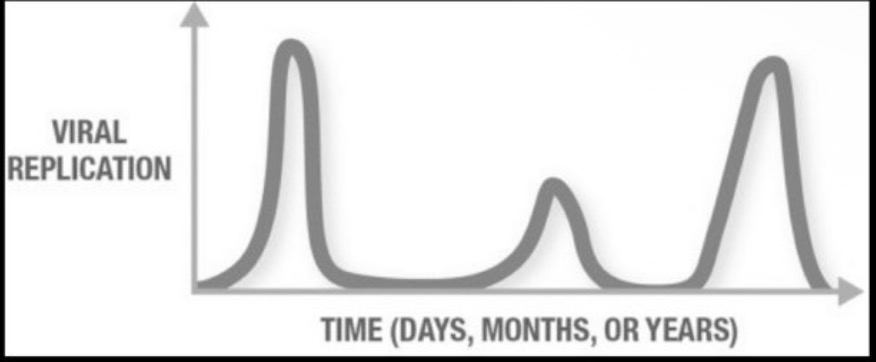
Which type of viral infection is demonstrated by the graph?
latent persistent
Oncogenic viruses
stimulate uncontrolled host cell division.
Which is not a cancer linked to a specific virus?
skin cancer
A previously undescribed infection has been detected among inhabitants in an isolated village in a remote tropical rainforest. When serum from an infected individual is passed through a filter, the infection can be transmitted to laboratory animals. Nothing is observed when the serum is examined with a light microscope at the highest magnification. Biochemical tests show the presence of RNA and protein but no carbohydrates or lipids. This data is consistent with what type of infectious agent?
virus
Animal viruses can be grown in all of the following except
E. coli cells.
When mixed with their host bacterium and plated on solid agar, lytic phage will form clear areas in the bacterial growth. What are these clear areas called?
plaques
One ml of a liquid suspension of bacteriophage is mixed with its host bacteria and plated. After incubation, the plate is completely clear. What is the probable explanation?
The phage concentration was so high that all the host bacterial cells were killed.
What does the plaque assay determine?
number of bacteriophage in a sample
Which of the following tests works by detecting viral nucleic acid?
PCR
An individual uses an in-home test kit one week after engaging in high-risk behavior for HIV infection. The test kit uses a saliva sample that is mailed to a lab where an agglutination test to detected HIV antibodies is run. The results come back negative for HIV. What should the patient consider regarding these test results?
One week may not be enough time for HIV antibodies to be detected.
Challenges in developing effective antiviral drugs with minimal side effects to the patient include
Viruses use the cell's own machinery and metabolism for replication.
Which of the following antiviral drug categories is incorrectly matched with its description?
Interferons: Used for postexposure prophylaxis
Prions are
misfolded proteins which can cause normal versions to also misfold.
Which of the following prion diseases may be acquired by eating beef contaminated with a cattle prion?
variant CJD
Which statement is not true about the virus capsid?
Because the capsid is not essential to the virus, it is not a useful target for antiviral drugs.
How would the structure of the SARS-CoV2 virion (causative agent of COVID-19) be best described?
enveloped helical
When a virus has an envelope,
it likely escapes its host cell by budding.
Which of the following statements is not correct regarding viral spikes?
Viral spikes always extend from the envelope, so non-enveloped viruses will not include spikes.
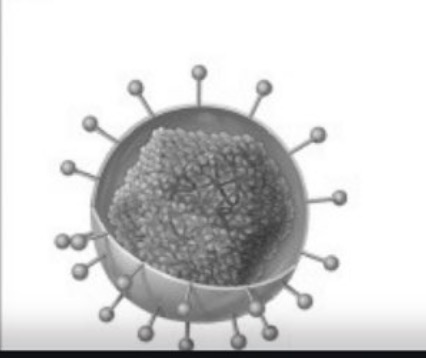
Which picture shows an icosahedral enveloped virus with spikes?
Which genomic arrangement has not been found in viruses?
double-stranded circular RNA
All viruses must use their genome to produce ________, which is then used by the host cell to produce ________.
mRNA; proteins
Both viruses and prokaryotes reproduce by binary fission.
False
The shape of a virus may be determined by either its capsid or its envelope.
False
Naked viruses usually exit the animal host cell by budding while enveloped viruses exit by lysis.
False
All persistent viral infections occur when the virus integrates into the host cell DNA to form a provirus.
False
In both lytic and lysogenic bacteriophage replication, the first two steps (Attachment and Penetration) are the same.
True

