Week 1 - Introduction to Key Course Concepts; Fundamentals of Evidence-Informed Practice
 Studied by 0 people
 Call with Kai
 Learn
Learn Practice Test
 Spaced Repetition
 Match
Match Flashcards
 Knowt Play
1/100

There's no tags or description
Looks like no tags are added yet.
Name | Mastery | Learn | Test | Matching | Spaced | Call with Kai |
|---|
No study sessions yet.
101 Terms
Evidence based practice definition according to Dr. David Sackett
“The integration of best research evidence with clinical expertise and patient values.”
decision making in nursing is defined by:
Research evidence and individual values
Client choice
Clinical judgement
Ethics
Legislation
Regulation
Health care resources
Practice environments
Core components of EBP
Best research evidence
Patient values
Clinical expertise
What isn’t EBP
All core components must be present (even if one is missing → not EBP)
Sources of evidence for nursing practice
Tradition
Authority
Personal experience
Assembled information
Disciplined research
Traditions in EBP
Untested traditions, customs, and "unit culture"
Sometimes easier to use traditions especially in fast-paced environment
Existing source of knowledge for making quick clinical decisions
Why is traditions not considered best evidence?
Because they are sometimes biased (or they have been used for long time, but they haven’t been involved in scientific research)
Authority in EBP
A person with specialized expertise, supervisors, nursing faculty, textbook authors
Risky, because only based on personal experience
May be outdated
Sources of EBP in personal experience
Clinical experience and trial & error
Sources of EBP in assembled information
Local, national, international benchmarking data (e.g., the rates of using various procedures, risk factors for certain disease or rates of clinical problems)
Ex) benchmark data showing prevalence, indicators of quality care, etc
Disciplined research in EBP***
Best method of acquiring reliable knowledge
EBP requires nurses to base their clinical practice on best available evidence from rigorous research.
Why is evidence from rigorous scientific research considered the strongest source of evidence in EBP?
Lack of bias
Research validity
What is research?
Research is systematic inquiry that use structured methods.
Structured methods used in research ex:
Answer questions (e.g., describe, explore, explain, predict, control a phenomenon of interest)
Systematic meaning in research
“predetermined route” and structured method
Generate knowledge/evidence used to →
Solve problems
What is nursing research?
Nursing research is a systematic inquiry designed to develop trustworthy evidence about issues of importance to the nursing profession.
Why is nursing research used
To strengthen nursing practice and improve patient outcomes
Nursing as Both a Profession and Science
Nursing is a rigorously educated, regulated and autonomous profession, and it is first a discipline based in science — not a random gathering of personal opinions and ideologies
Grounded in systematic inquiry
What connect nursing as profession to nursing as a science
Research
Role of Nursing Research in EBP
Provides scientific evidence to inform clinical decision-making
Reduces reliance on tradition, authority, or personal experience alone
Supports the development of clinical guidelines, policies, and standards of care (holistic perspective)
Continuum of research participation
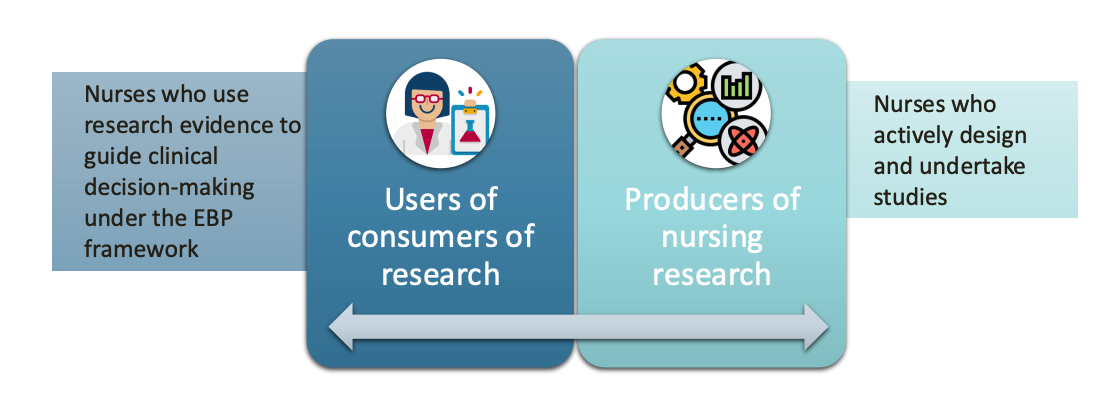
Research nurse vs. Nurse researcher - Are they the same?
Research nurses work in clinical settings, and help with research activities, implement clinical protocols
Nurse researchers develop the research protocol and actively design nursing research
Research-related Activities Nurses are Commonly Involved In
Use clinical practice guidelines or protocols
Read and critically appraise a research article and a research article (e.g., participate in a journal club)
Develop a clinical question
Interpret statistical information to educate patients or families (e.g., risk, benefits, percentiles)
Collect or review data (e.g., audits, surveys, chart reviews)
Help implement or evaluate a practice change
Assist with a research study (e.g., recruitment, data collection)
What else?
Future Directions for Nursing Research
Continued focus on EBP and translational research (aka implementation science research)
Focus on how we can better translate research evidence into clinical practice
Clinical significance and patient-oriented research
Clinical significance vs statistical significance
Increased focus on diversity issues and health disparities
Eg) Intersectionality research
Interprofessional collaboration in health research
Expanded local research (for local issues)
Increased replication of studies in different clinical settings
We don’t want research with very narrow focus
Continued emphasis on systematic reviews
Expanded dissemination of research findings
Disseminated to a broader audience (to be known and learned)
Paradigm definition
A worldview or general perspective on the complexities of the real world with certain assumptions about reality.
What does paradigm shape
Paradigms shape how research is designed, conducted, and interpreted
Oncology + Epistemology →
Paradigm
Positivist paradigm (Positivism)
Begins with predefined hypothesis
Deducting process
Purely objective existence (information they can collect can be quantified)
Constructivist (naturalistic) paradigm (Constructivism)
There is no 1 objective reality
May not start research with predefined hypothesis
May not even define phenomena
Inductive process - generate hypothesis from what they find from their research
How does the positivist paradigm view the nature of reality?
Reality exists; there is a real world driven by real, natural causes.
How does the constructivist paradigm view the nature of reality?
Reality is multiple and subjective, mentally constructed by individuals.
In the positivist paradigm, what is the relationship between the researcher and those being researched?
The researcher is independent from those being researched
In the constructivist paradigm, what is the relationship between the researcher and those being researched?
The researcher interacts with those being researched; findings are the creation of the interactive process.
What is the role of values in inquiry within the positivist paradigm?
Values and biases are to be held in check; objectivity is sought.
What is the role of values in inquiry within the constructivist paradigm?
Subjectivity and values are inevitable and desirable.
What type of reasoning process is emphasized in the positivist paradigm?
Deductive processes leading to hypothesis testing.
What is emphasized regarding concepts in the positivist paradigm?
Emphasis on discrete, specific concepts.
What type of data does the positivist paradigm focus on?
Objective and quantifiable data.
How does the positivist paradigm treat researchers’ predictions?
It seeks corroboration of researchers’ predictions.
What type of research design is used in the positivist paradigm?
Fixed, pre-specified design.
How does the positivist paradigm handle context?
It applies controls over context.
What type of information is collected in the positivist paradigm?
Measured, quantitative information.
What type of analysis is used in the positivist paradigm?
Statistical analysis.
What is the overall goal of positivist research findings?
To seek generalizations.
What type of reasoning process is emphasized in the constructivist paradigm?
Inductive processes leading to hypothesis generation.
What is emphasized regarding scope in the constructivist paradigm?
Emphasis on the whole.
What type of data does the constructivist paradigm focus on?
Subjective and non-quantifiable data.
Where do insights emerge from in the constructivist paradigm?
Emerging insight grounded in participants’ experiences.
What type of research design is used in the constructivist paradigm?
Flexible, emergent design.
How does the constructivist paradigm treat context?
It is context-bound and contextualized.
What type of information is collected in the constructivist paradigm?
Narrative information.
What type of analysis is used in the constructivist paradigm?
Qualitative analysis.
What is the overall goal of constructivist research findings?
To seek in-depth understanding.
Which paradigm seeks objectivity and controls bias?
Positivist paradigm
Which paradigm views subjectivity as inevitable and valuable?
Constructivist paradigm.
Which paradigm uses deductive reasoning and hypothesis testing?
Positivist paradigm.
Which paradigm uses inductive reasoning and hypothesis generation?
Constructivist paradigm.
Which paradigm aims for generalizable findings?
Positivist paradigm.
Which paradigm aims for deep, contextual understanding?
Constructivist paradigm.
How does positivism & quantitative research view burnout?
Burnout is a measurable, quantifiable concept that exists independently of individuals and can be captured using standardized tools.
How does constructivism & qualitative research view burnout?
Burnout is a subjective, socially constructed experience that varies across individuals and contexts.
What is the starting point in positivism & quantitative research when studying burnout?
Predefined concepts and hypotheses, such as burnout existing at a certain level and being associated with workload or staffing.
What is the starting point in constructivism & qualitative research when studying burnout?
Open-ended, broad questions, often without a fixed definition of burnout, focusing on nurses’ lived experiences of work stress.
What type of research question is asked in constructivism & qualitative research on burnout?
How do nurses experience and make sense of burnout or work-related stress?
What type of research question is asked in positivism & quantitative research on burnout?
What is the level of burnout among the study population, and what factors are associated with it?
What is the role of the researcher in positivism & quantitative research?
The researcher aims to be objective and detached, minimizing bias through study design and analysis.
What is the role of the researcher in constructivism & qualitative research?
The researcher is actively engaged with participants, and interactions and interpretation are part of knowledge generation.
How is data collected in constructivism & qualitative research on burnout?
Through interviews, focus groups, or field observations that collect rich, narrative, non-numeric data.
How is data collected in positivism & quantitative research on burnout?
Through surveys using standardized instruments, such as the Maslach Burnout Inventory, and structured questions.
How is data analyzed in positivism & quantitative research on burnout?
Statistical analyses are used to describe burnout levels and test relationships between burnout and other variables.
How is data analyzed in constructivism & qualitative research on burnout?
Qualitative analysis, such as thematic or content analysis, is used to construct meanings and patterns related to burnout.
What type of knowledge is produced by positivism & quantitative research on burnout?
Generalizable findings about the prevalence and predictors of burnout.
What type of knowledge is produced by constructivism & qualitative research on burnout?
In-depth understanding of how burnout is experienced and understood in a specific context.
Which research approach views burnout as measurable and quantifiable?
Positivism & quantitative research.
Which research approach views burnout as socially constructed and subjective?
Constructivism & qualitative research.
Which approach relies on interviews and focus groups?
Constructivism & qualitative research.
Which approach uses standardized tools like the Maslach Burnout Inventory?
Positivism & quantitative research.
Which approach aims to produce generalizable findings?
Positivism & quantitative research.
Which approach aims for contextual, in-depth understanding?
Constructivism & qualitative research.
What are scientific methods in quantitative research?
A set of orderly procedures used to gather and analyze information.
How does quantitative research move through the research process?
It moves in a systematic fashion from defining the research problem to the solution.
What does “systematic” mean in quantitative research?
Progressing through a series of steps according to a pre-determined plan.
What is a key aim of quantitative research regarding bias and validity?
To minimize bias and maximize validity.
What tools are used to collect data in quantitative research?
Formal instruments are used to collect quantitative data.
How is data analyzed in quantitative research?
Using statistical methods.
Why can measuring complex social or psychological phenomena be problematic in quantitative research?
Because phenomena such as stress are difficult to measure and analyze precisely.
What is the primary goal of quantitative research?
To generalize findings.
How are quantitative research results applied?
Results from a sample are applicable and useful for the population.
What is a common criticism of quantitative research?
It is considered narrow and reductionistic, not capturing the full breadth of human experience.
What do constructivist methods and qualitative research emphasize?
The dynamic, holistic, and individual aspects of human life within the context of those experiencing them.
How are procedures structured in qualitative research?
Procedures are flexible and evolving, allowing findings to emerge during the study.
Where does qualitative research often take place?
In naturalistic settings.
How are data collection and analysis handled in qualitative research?
Collection of qualitative information and analysis occur concurrently.
What are qualitative research findings typically like?
They are often rich and in-depth.
What type of reasoning process is used in qualitative research?
An inductive process
How does inductive reasoning function in qualitative research?
Researchers integrate information to develop a theory or description explaining the phenomenon under observation.
What serves as the primary instrument for data gathering in qualitative research?
Humans are directly used as the instrument for gathering information.
Why are qualitative methods criticized for subjectivity?
Because different researchers may interpret the same phenomenon differently.
What are common criticisms of qualitative research?
Subjectivity of findings and challenges with replication.
Purpose of Nursing Research
Why do nurses do research?
Several different classification systems to classify different purposes of doing research
Purposes on the descriptive-explanatory continuum
Purposes linked to EBP
 Note
Note  Flashcards (75)