fourier, convolution and sampling
 Call Kai
 Learn
Learn Practice Test
 Spaced Repetition
 Match
Match Flashcards
 Knowt Play
1/15

There's no tags or description
Looks like no tags are added yet.
Name | Mastery | Learn | Test | Matching | Spaced | Call with Kai |
|---|
No analytics yet
Send a link to your students to track their progress
16 Terms
when can you use a fourier series
used when a function is periodic aka: repeats and has a constant interval of \Delta x
what are harmonic waves?
waves that have a whole number frequency multiple of each other
this also results in the wavelength being divided by that positive whole number
fourier series equation
F(x)=\frac{a_o}{2} \Sigma a_n cos(n\Omega x)+b_n sin(n\Omega x) where \Omega=\frac{2\pi}{\Delta x}
a_0=\frac{1}{\pi}\int_{-\pi}^{\pi}\!f(x)\,dx
a_{n}=\frac{1}{\pi}\int_{-\pi}^{\pi}\!f(x)\cos(n\Omega x)\,dx
b_{n}=\frac{1}{\pi}\int_{-\pi}^{\pi}\!f(x)\sin(n\Omega x)\,dx
what are the properties of a sine graph
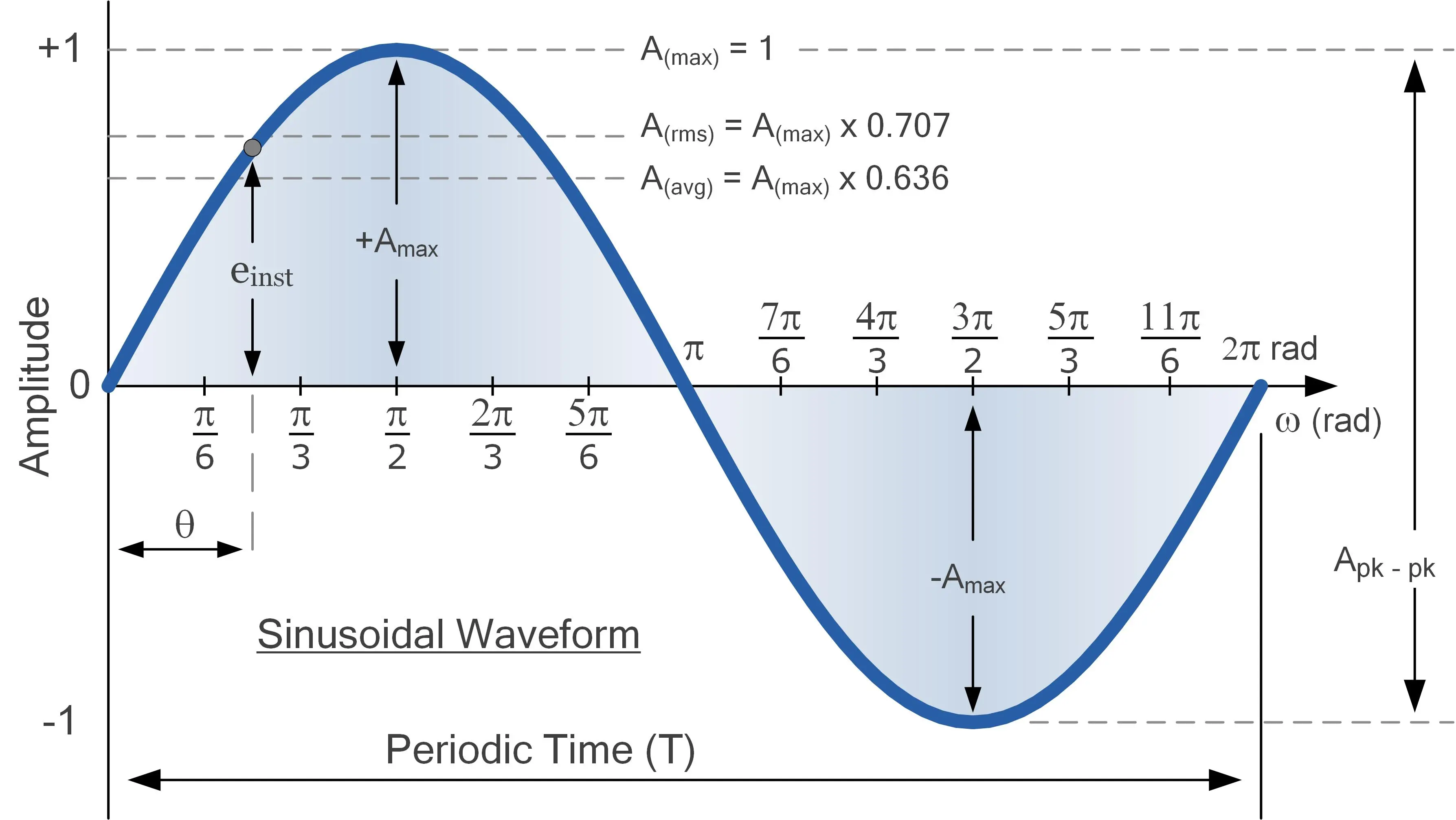
at 0 sine = 0
when n is an interger of PI the value of sine = 0
the graph is NOT SYMMETRIC → IT IS ODD → imaginary
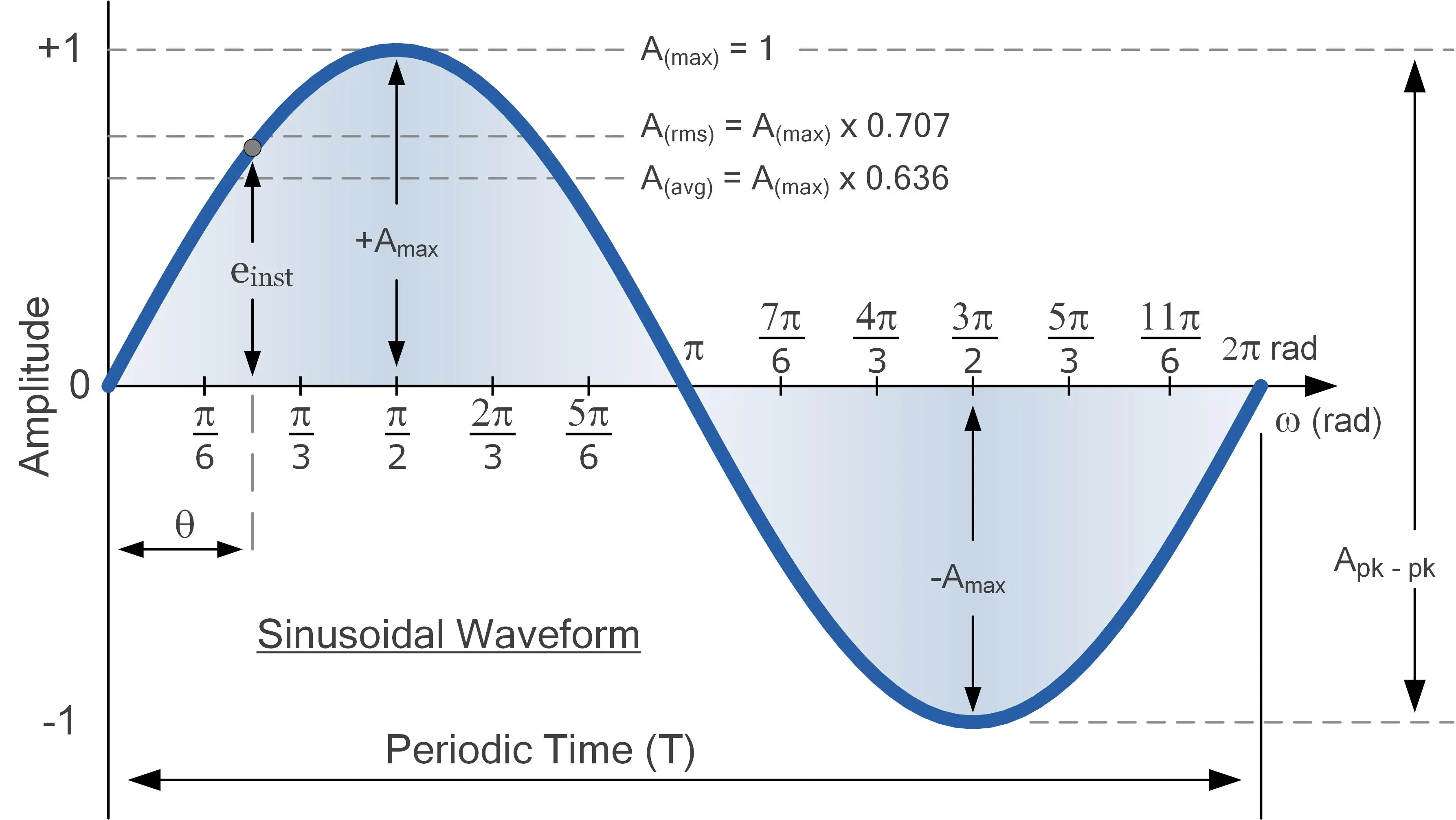
what are the properties of a cos graph
at x = 0 cos = 1
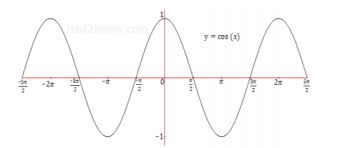
the graph is symmetric and therefor and even function → real function
when x is an even number the value of cos is either 1 or -1
how does increasing the number of terms effect the image in a fourier series
increasing the number of turns makes the image “shaper” making it resemble the actual function more closely
what is sin(nx) in exponential
\frac{(e^{inx}-e^{-inx})}{2i}
what is cos(nx) in exponential
\frac{e^{inx} + e^{-inx}}{2}
general fourier series equation:
→ when do you use it,
→ how is it produced
→ used when the period of the function is anything except of 2\pi
→ produced by substituting the exponential versions of sine and cos then grouping the like exponentials to each other
c_{n}=\frac{1}{P}\int_{-\frac{P}{2}}^{\frac{P}{2}}\!f\left(x\right)e^{\left(-inw_0x\right)}\,dx where w_0 = \frac{2\pi}{period}
f(T)=\Sigma c_{n}e_{}^{inw_0t}
fourier tranform
→ when is it used
F\left(u\right)=\int_0^{\infty}\!f\left(x\right)e^{-2\pi iux}\,dx
→ used for non-periodic functions
inverse fourier tranform
f(x)=\int_0^{\infty}\!F\left(u\right)e^{2\pi iux}\,dx
how is the width of the real funciton related to that of the fourier
→ what happens when you make the real pulse wider or larger
widthofreal=\frac{constant}{widthoffourier}
→ wider pulse = narrower fourier and less frequencies
→ narrower pulse = wider fourier and more frequencies
integral of a dirac delta function
\int_0^{\infty}\!\delta\left(x\right)\,dx=1
this is because the area under the dirac delta is always 1
integral of a function with a dirac delta function
\int_0^{\infty}\!f\left(X\right)\cdot\delta\left(x-a\right)\,dx=f\left(a\right)
picks out the value of the function when x = a
\int_0^{\infty}\!f\left(X\right)\cdot\delta\left(b\left(x-a\right)\right)\,dx=?
\int_0^{\infty}\!f\left(X\right)\cdot\delta\left(b\left(x-a\right)\right)\,dx\to\int_0^{\infty}\!f\left(X\right)\cdot\frac{1}{b}\delta\left(x-a\right)\,dx=\frac{1}{b}\int_0^{\infty}\!f\left(X\right)\cdot\delta\left(x-a\right)\,dx=\frac{1}{b}f\left(a\right)
what is the fourier of a dirac function
\int_0^{\infty}\!\delta\left(x-a\right)e^{-2\pi iux}\,dx=e^{-2\pi iua}

