Physics - Unit 12
 Call Kai
 Learn
Learn Practice Test
 Spaced Repetition
 Match
Match Flashcards
 Knowt Play
1/23

There's no tags or description
Looks like no tags are added yet.
Name | Mastery | Learn | Test | Matching | Spaced | Call with Kai |
|---|
No analytics yet
Send a link to your students to track their progress
24 Terms
Light Source
A light source is an object that emits its own light.
The Law of Reflection
The law of reflection tells us about the direction in which the ray of light is reflected.
Incident Ray
The ray of light coming in.
Light travels in ————.
straight lines
The Angle of Reflection
The angle between the normal line and the reflected ray.
Reflection
The bouncing back of a ray of light when it strikes the surface of a non-transparent/reflective material.
Luminous
An object which is a source of light is described as luminous.
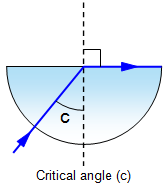
Critical Angle
Critical angle means the angle of incidence which gives 90° for the angle of refraction.
Non-luminous
An object which is not a source of light is described as non-luminous.
When a ray of light enters a transparent material, it……
Why do we see a clear image in a mirror?
A mirror has a very flat, smooth surface. Rays of light bounce off the mirror without being scattered.
Why don’t we see a clear image in a sheet of paper?
A sheet of paper has a rough surface. When rays of light strike the paper, they are scattered in all directions.
Normal
The normal is a straight line drawn at the right angle of 90° to the mirror at the point where the ray is reflected.
Explain Dispersion
Dispersion happens because of refraction. When white light enters a glass block, some colours bend more than others. Violet bends the most, red bends the least. This means that different colours travel off in different directions, and so we can see them separately.
Law of reflection equation
angle of incidence = angle of reflection
When a ray of light leaves a transparent material, it……
Dispersion
The splitting up of white light into a spectrum of separate colours is called dispersion. The colours of the spectrum always appear int eh same order : Red, Orange, Yellow, Green, Blue, Indigo, Violet.
Angle of Incidence
The angel between the normal line and the incident ray.
Reflected Ray
The ray of light going out.
Refraction
The change of direction of a light ray when it enters of leaves a transparent material is called refraction.
If you can see a clear reflected of yourself in an object, what does this tell you about the surface of the object?
The surface of the object must be very smooth.
A prism is a ———.
triangular glass block
How does refraction work?
The ray bends at the point where it enters a transparent material and at the point where it leaves the material. It follows a straight path in the material.
Total Interval Refraction is when…..
the angle of incidence is greater than the critical angle, leading the refracted angle into the transparent material.

