Unit 4: DNA & Heridity Study Guide
 Call Kai
 Learn
Learn Practice Test
 Spaced Repetition
 Match
Match Flashcards
 Knowt Play
1/141

There's no tags or description
Looks like no tags are added yet.
Name | Mastery | Learn | Test | Matching | Spaced | Call with Kai |
|---|
No analytics yet
Send a link to your students to track their progress
142 Terms
Frederick Griffith 1928
Discovered the transforming principle and showed genetic information could transfer between bacteria
Transforming principle
A substance that can transfer genetic information between bacteria
Oswald Avery Colin MacLeod Maclyn McCarty 1944
Identified DNA as the transforming principle responsible for bacterial transformation
Alfred Hershey Martha Chase 1952
Confirmed that DNA not protein is the genetic material using bacteriophages
Rosalind Franklin
Used X ray crystallography to produce Photo 51
Photo 51
X ray diffraction image providing evidence of DNA helical structure
James Watson Francis Crick 1953
Proposed the double helix model and complementary base pairing
DNA
A molecule that contains the genetic code unique to every individual
Genetic code
Information encoded in the sequence of nucleotide bases
Genetic information
Encoded in the sequence of bases and determines traits
Inheritance
Passing genetic information from parents to offspring
Double helix
Two long strands forming a twisted ladder shape
DNA backbone
Alternating sugar deoxyribose and phosphate groups
Nucleotide
Building block of DNA
Three parts of a nucleotide
Sugar deoxyribose phosphate group nitrogenous base
Deoxyribose
Five carbon sugar in DNA
Phosphate group
Links the sugar of one nucleotide to the next
Nitrogenous base
Base component that carries genetic information
Adenine DNA
Base that pairs with thymine
Thymine DNA
Base that pairs with adenine
Cytosine DNA
Base that pairs with guanine
Guanine DNA
Base that pairs with cytosine
DNA base pairing
A pairs with T and C pairs with G
A pairs with T DNA
Forms 2 hydrogen bonds
C pairs with G DNA
Forms 3 hydrogen bonds
Hydrogen bonds
Bonds that hold complementary bases together
Complementary strands
DNA strands run complementary to each other
RNA base pairing
A pairs with U and C pairs with G
A pairs with U RNA
Adenine pairs with uracil in RNA
C pairs with G RNA
Cytosine pairs with guanine in RNA
Uracil
Base found in RNA that replaces thymine
DNA replication
Process by which the genome DNA is copied
Purpose of replication
Ensures each daughter cell receives a complete genome
Replication fork
Y shaped structure where DNA is separated and copied
Leading strand
Synthesized continuously in the 5 prime to 3 prime direction
Lagging strand
Synthesized discontinuously
Okazaki fragments
Short fragments formed on the lagging strand
Termination replication
Process by which DNA replication is completed
Importance of replication
Essential for growth repair and cell division
Heredity
Passing of traits from parents to offspring
Genetics
Study of how genes and traits are passed down
Molecular genetics
Structure and function of genes at a molecular level
Transmission genetics
Patterns of inheritance and gene transfer
Population genetics
Genetic variation within and between populations
Josef Kolreuter
Conducted hybridization experiments observed blending inheritance and noted hybrids reverted in later generations
TA Knight
Crossbred pea plants observed consistent inheritance patterns and laid groundwork for Mendel
Gregor Mendel
Austrian monk who conducted pea plant experiments and founded Mendelian genetics
True breeding
Always passes its characteristics to the next generation
Pea plant advantages
Self pollination easy cross pollination clear contrasting traits
Trait
Characteristic that distinguishes one individual from another
Polygenic trait
Characteristic determined by many genes
Seven pea plant traits
Flower position axial or terminal plant height tall or short pod color green or yellow pod appearance round or wrinkled seed color yellow or white seed appearance round or wrinkled flower color purple or white
P generation
True breeding parent generation
F1 generation
First generation offspring from parent cross
F2 generation
Offspring produced when F1 plants are crossed
Hybrid
Offspring of two different true breeding parents
F2 recessive ratio
Approximately one fourth show recessive trait
3 to 1 ratio
Typical phenotype ratio in F2 monohybrid cross
Law of Dominance
Some traits mask the expression of others
Law of Segregation
Each organism inherits two alleles one from each parent which separate during gamete formation
Law of Independent Assortment
Different traits are inherited independently except in linked genes
Gene
Segment of DNA that codes for a protein and determines a trait
Allele
Different form of a gene
Dominant allele
Always expressed if present represented by capital letter
Recessive allele
Expressed only when two copies are present represented by lowercase letter
Genotype
Genetic makeup of an organism such as AA Aa or aa
Phenotype
Physical expression of a trait
Homozygous
Two identical alleles such as AA or aa
Heterozygous
Two different alleles such as Aa
Punnett square
Tool used to predict genotype and phenotype ratios
Genotype ratio
Ratio of allele combinations in offspring
Phenotype ratio
Ratio of observable traits in offspring
Mendels impact
Foundation of modern genetics influenced chromosomal theory DNA discoveries agriculture GMOs medicine genetic screening and gene therapy
DNA Replication Step 1
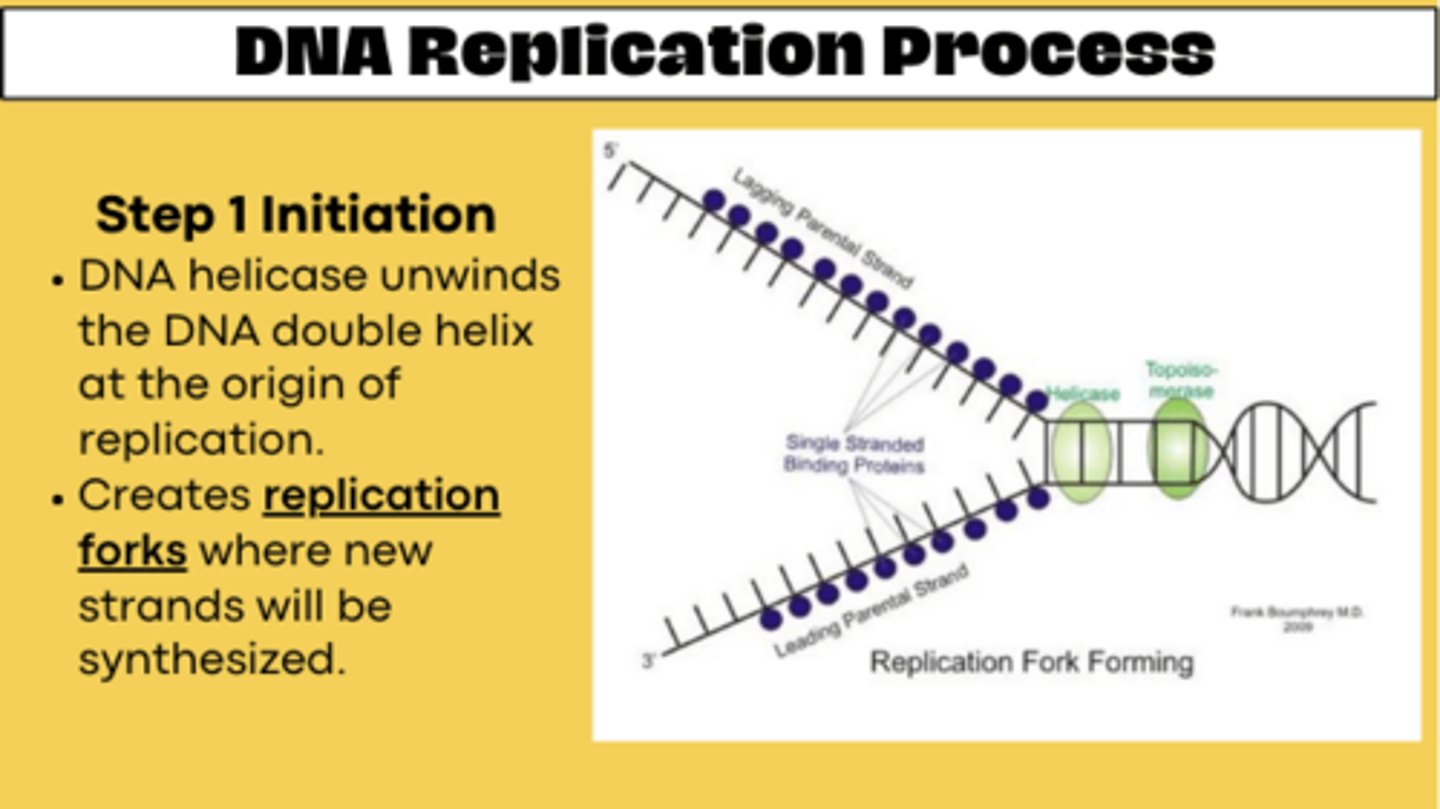
Initiation: DNA Helicase unwinds the DNA double helix at the origin of replication.
Creates replication forks where new strands will be synthesized.
DNA Replication: Step 2
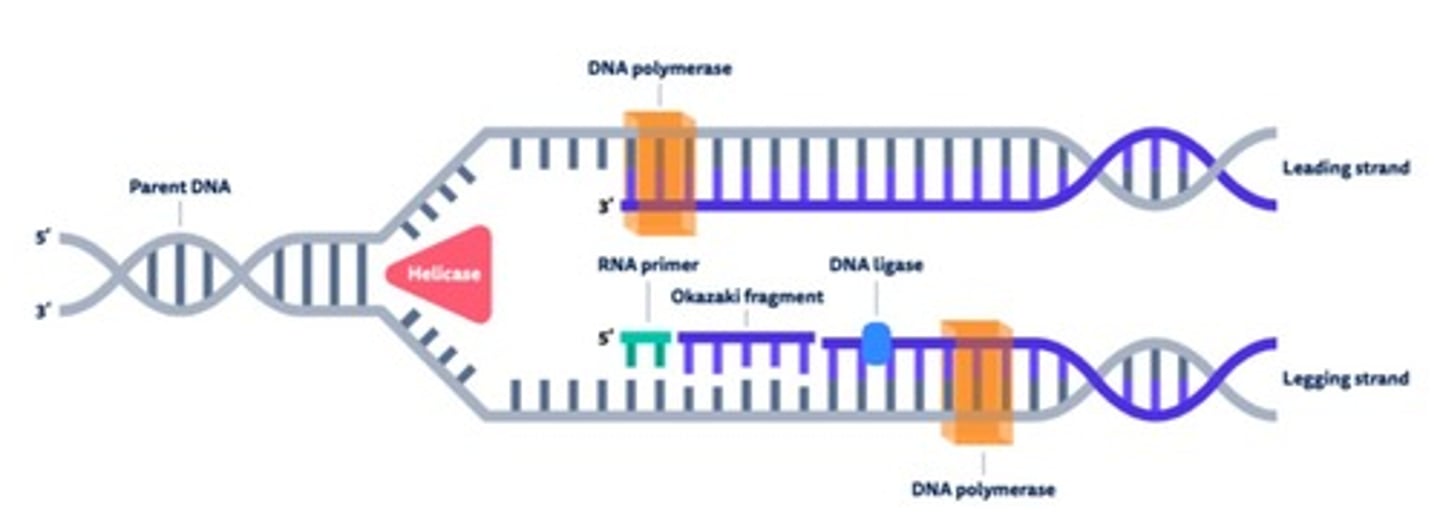
Primer Synthesis: RNA primase synthesizes short RNA primers complementary to the DNA template.
Provides a starting point for DNA polymerase.
DNA Replication: Step 3
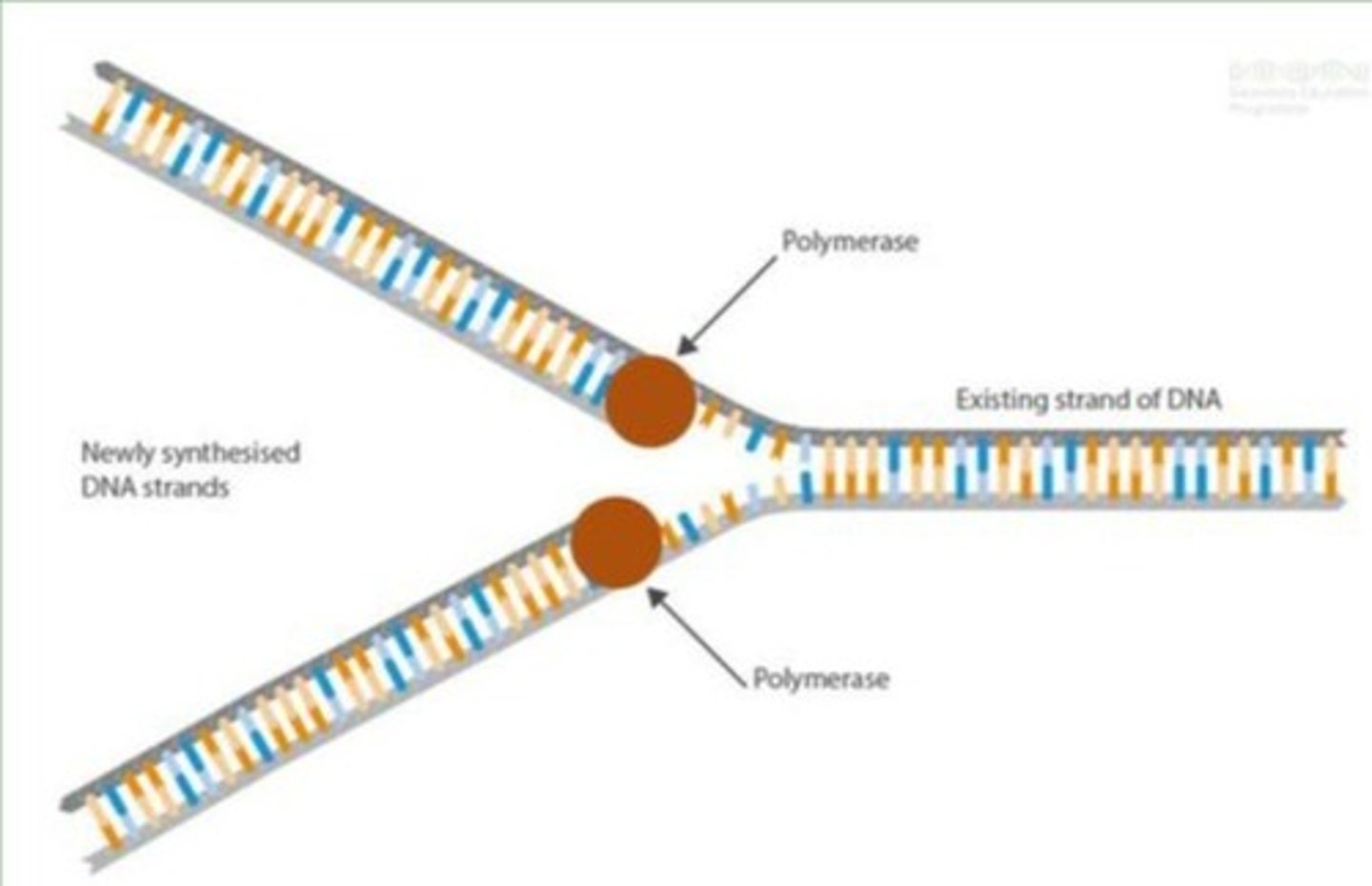
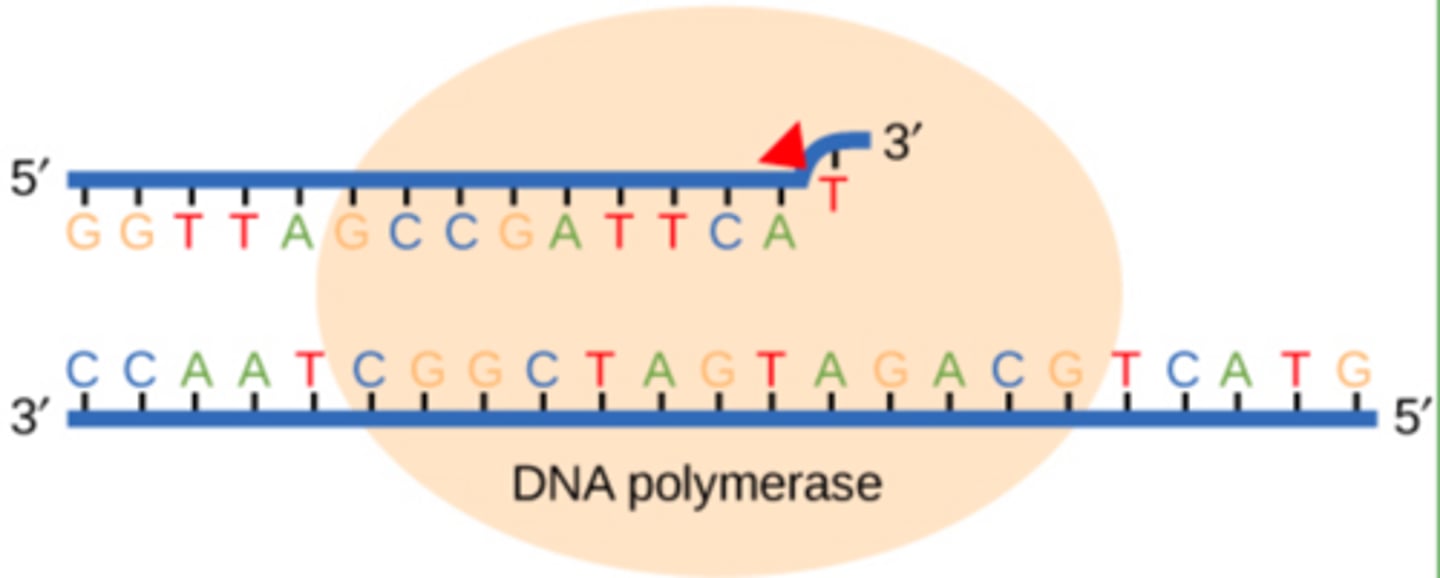
Elongation: DNA polymerase adds complementary nucleotides to the template strands.
DNA Replication: Leading Strand
Synthesized continuously in the 5' to 3' direction.
DNA Replication: Lagging Strand
Synthesized discontinuously in Okazaki fragments in the 3' to 5' direction. (Always write in the 5' to 3' direction)
DNA Replication: Step 4
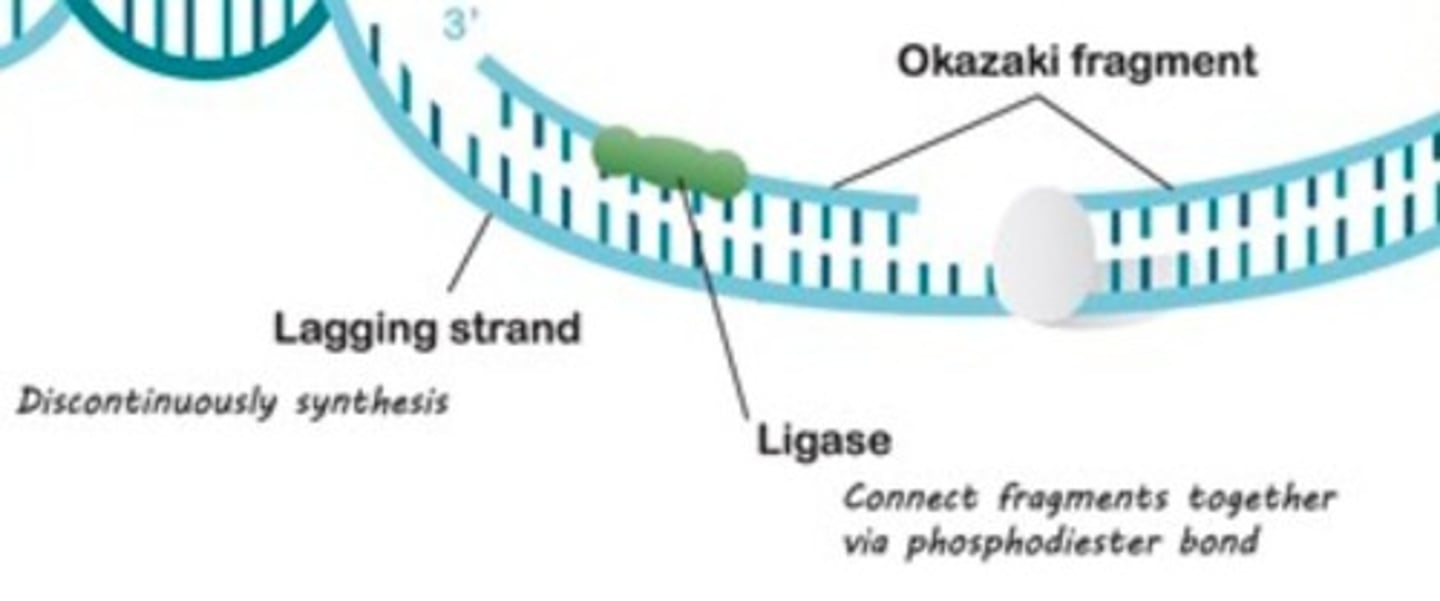
Okazaki Fragment Processing: RNA primers are removed by DNA polymerase and replaced with DNA nucleotides.
Gaps between fragments are sealed by DNA ligase
DNA Replication: Step 5
Termination: Replication proceeds in two opposite directions until entire DNA molecule is replicated.
Process completes when replication forks meet or termination regions are reached
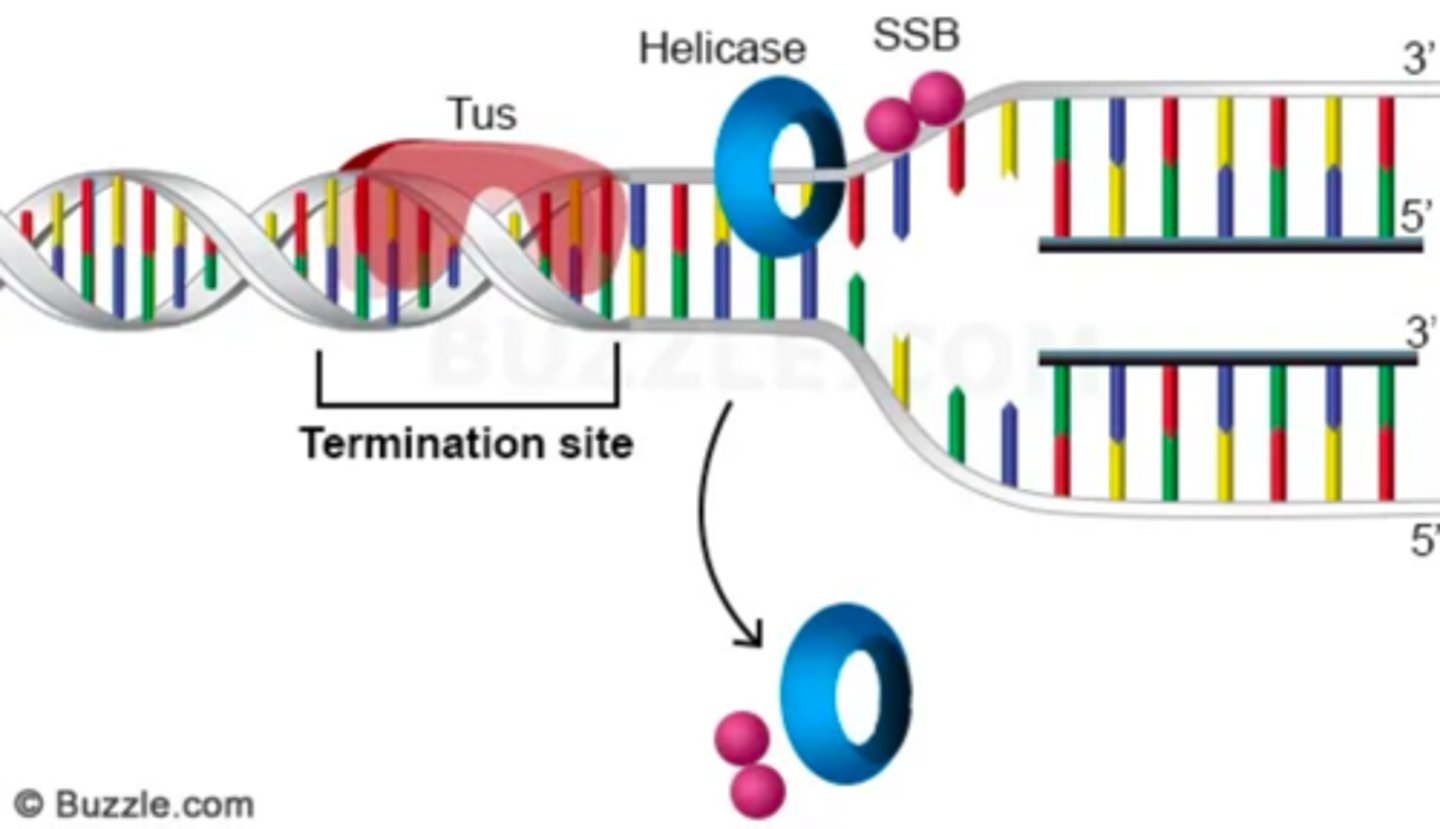
DNA Replication: Step 6
Accuracy and Proofreading: DNA polymerase proofreads and corrects errors during replication.
Ensures high levels of accuracy in copying genetic information.
Termination
Process by which replication of a DNA molecule is completed
DNA Helicase
Unwinds the double helix at the replication fork.
DNA Polymerase
Catalyzes the addition of nucleotides to the growing DNA strand.
RNA Primase
Synthesizes short RNA primers necessary for DNA
synthesis.
DNA Ligase
Joins Okazaki fragments on the lagging strand.
RNA primer
Short segment of RNA synthesized by RNA primase,
which provides a starting point for DNA synthesis.
Mutation
A change in the DNA sequence due to errors or
environmental factors, affecting genetic information.
Spontaneous Mutations
Natural errors during DNA replication or repair processes.
External Factors in Mutations
Exposure to mutagens like UV radiation, chemicals, or viruses that increase mutation rates
Types of Mutations: Point Mutations
Single base changes (substitution of
one nucleotide for another)
Types of Mutations: Insertions and Deletions:
Addition or removal of
nucleotide(s), altering gene sequence.
Types of Mutations: Frameshift Mutations:
Insertions or deletions that shift
the reading frame, changing subsequent amino acids.
Genetic Diversity
Mutations contribute to genetic variability within populations.
Disease
Harmful mutations can disrupt gene function, leading to genetic disorders, cancer, or developmental abnormalities.
Cystic Fibrosis
Chronic coughing, wheezing, and lung infections
Difficulty breathing
Autosomal Recessive
Huntington's Disease
Uncontrolled movement, difficulty with memory and learning
Autosomal Dominant
BRCA 1 & 2 Mutations
Linked to increased risk of breast and
ovarian cancers.
Epigenetics
Study of changes in gene expression caused by mechanisms other than changes in the DNA sequence itself. Changing how the genes are used not the genes themselfs.
Epigenetics: Cancer
Epigenetic changes can activate oncogenes or silence tumorsuppressor genes

