topic 5 - photosynthesis & respiration
 Call Kai
 Learn
Learn Practice Test
 Spaced Repetition
 Match
Match Flashcards
 Knowt Play
1/112

There's no tags or description
Looks like no tags are added yet.
Name | Mastery | Learn | Test | Matching | Spaced | Call with Kai |
|---|
No analytics yet
Send a link to your students to track their progress
113 Terms
What is the overall photosynthesis reaction?

Where does photosynthesis occur within the chloroplasts?
In the thylakoid membrane and the area it encloses - mainly in the grana.
What is the structure of the grana?
Thylakoid membrane surrounding the outside - contains photosystems
Thylakoid lumen in the inside - contains other molecules and ions
Stroma surrounding it - contains other molecules & ions and is where the LIR occurs
What stages is photosynthesis composed of?
2 stages (which both occur in the chloroplasts)-
Light dependent reaction - LDR
Light independent reaction - LIR
What are the photosystems and their role in photosynthesis?
The photosystems (PS1 & PS2) are funnel like structures in the thylakoid membrane and contains pigments like chlorophyll a & b that absorb light energy etc.
The photosystems are where many of the reactions in the LDR occur.
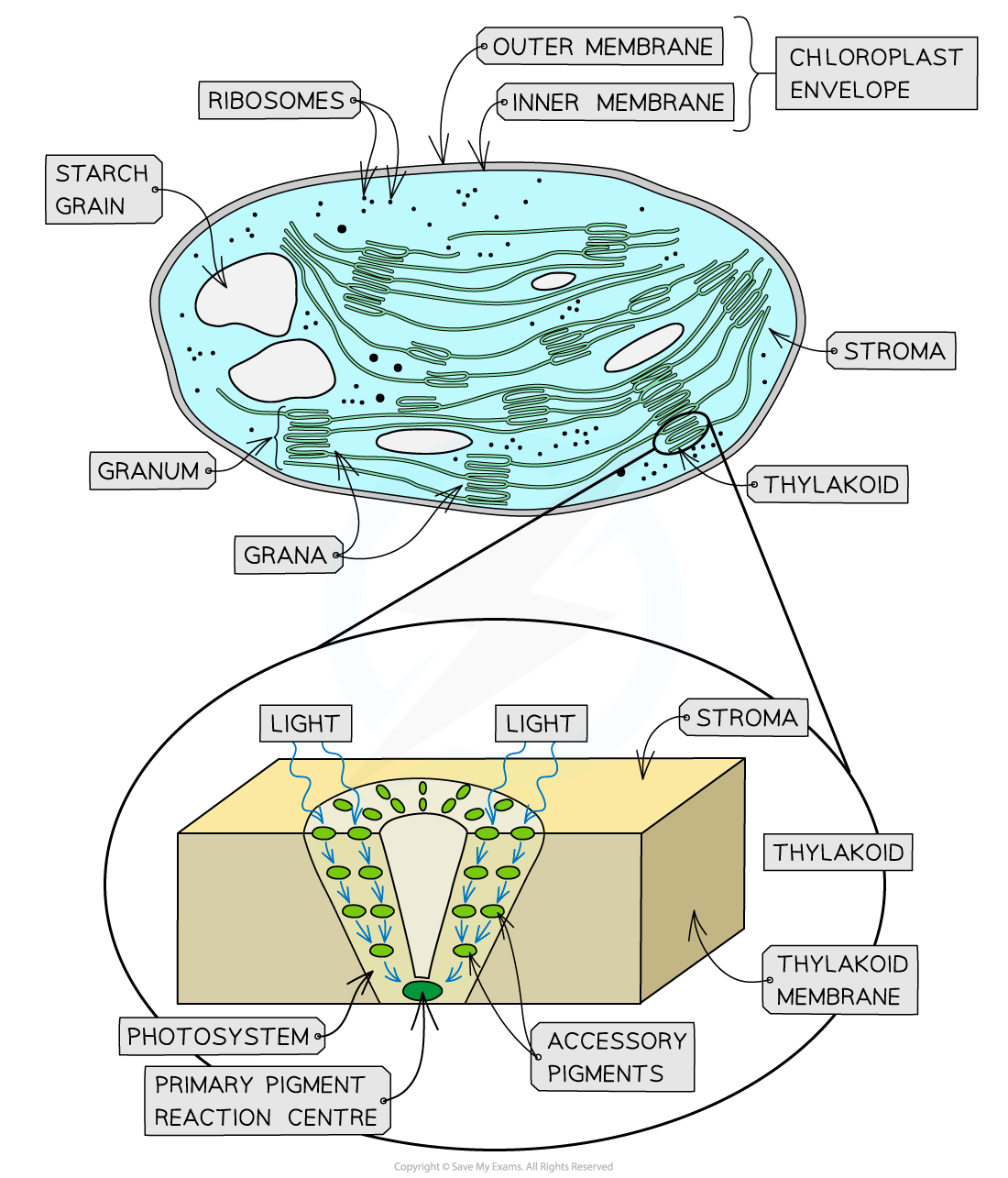
How do the thylakoid membrane and the photosynthetic pigments in it result in a higher rate of photosynthesis?
The membranes create a large surface area so many LDRs can happen.
There are many pigments including chlorophyll a & b which absorb different wavelengths of light so that as much energy can be gained as possible.
What are the biology definitions of reduction and oxidation?
Reduction - gain of hydrogen
Oxidation - loss of hydrogen
What metal does chlorophyll contain in its structure and how is this useful in photosynthesis?
Chlorophyll contains a Mg atom in its structure which can lose 2 electrons if the right wavelengths of light hit chlorophyll.
These 2 electrons can be used to generate energy, protons & in reactions in the LDR (duh).
What happens in the light dependent reaction overall?
Phosphorylation of ADP to form ATP
Production of NADPH/reduced NADP
Both of these products are moved between the LDR to the LIR - all others are considered waste products
What is NADP and its forms?
NADP is a molecule formed by and used in photosynthesis that can be oxidised NADP+ or reduced NADPH2
These forms are often written as NADP & NADPH.
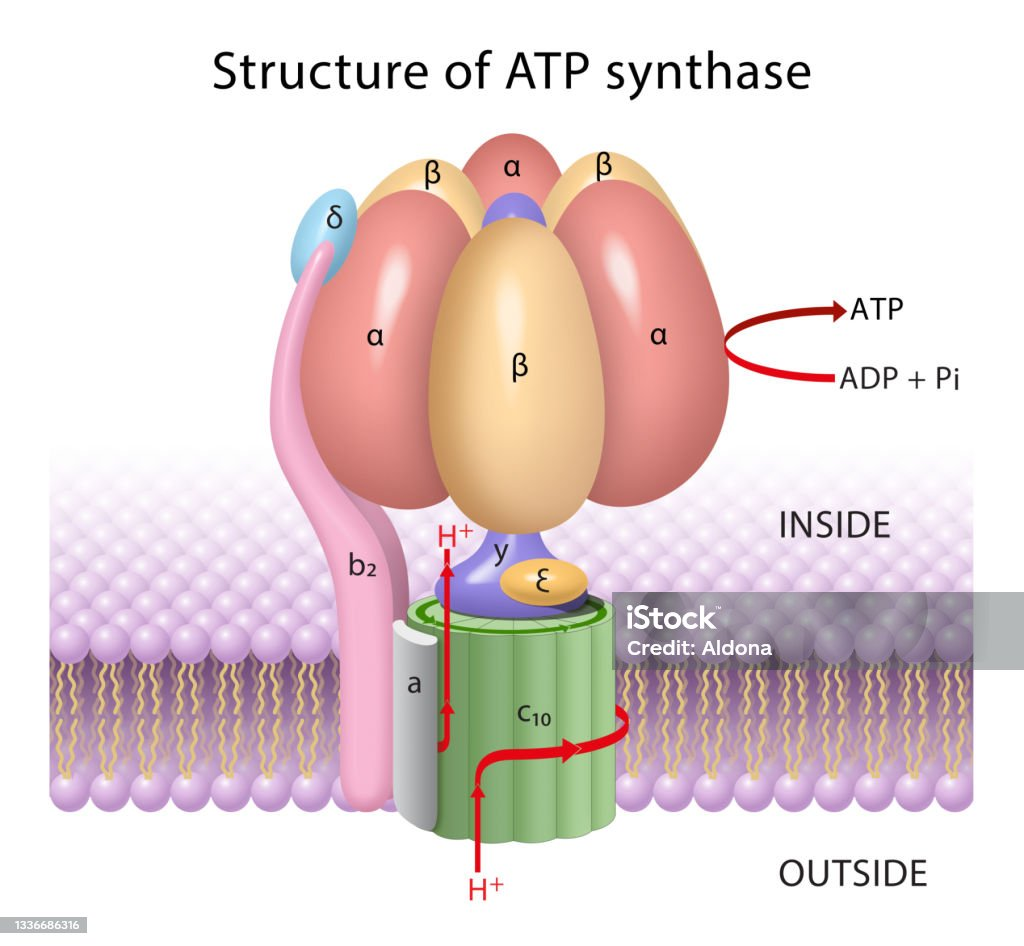
What is the structure and function of ATP synthase?
ATP synthase is both an enzyme and an ion channel for protons found in the thylakoid membrane.
It is a large multiunit protein/ quaternary protein which has a rotating top - the tree looking thing.
On the rotating top molecules of ADP & Pi can bind on, on opposite sections which can move closer together.
What are the two types of phosphorylation that occurs in the LDR and why are they different?
Non-cyclic phosphorylation
NADPH & ATP is produced
both PS2 & PS1 are involved
occurs in a linear way with movement of electrons from PS2 to PS1
Cyclic phosphorylation
only ATP is produced
only PS1 is involved
occurs in cycle with movement of electrons contained in PS1
Why there two different types of phosphorylation?
The LIR/Calvin Cycle needs more ATP than NADPH which is why both types produce ATP but only non-cyclic produces NADPH.
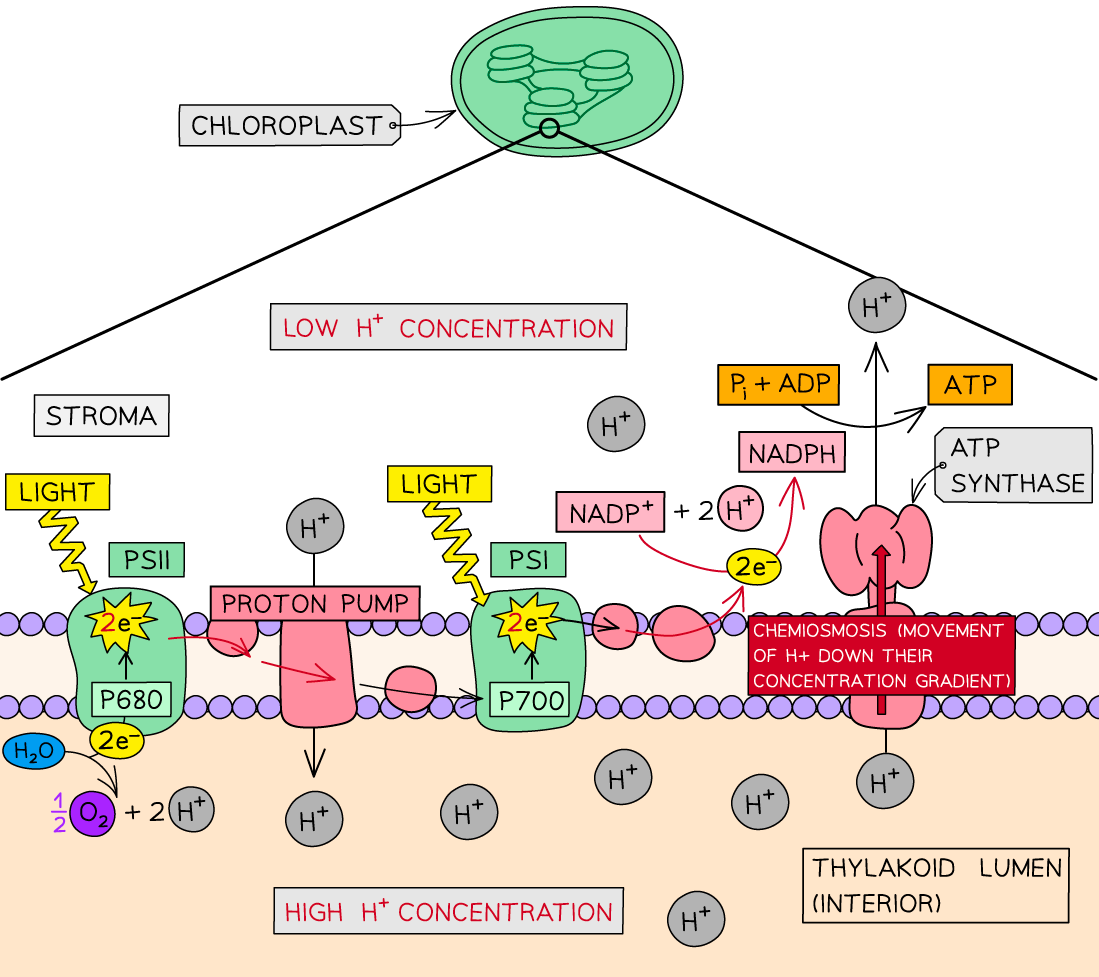
What are the general steps of the LDR - non-cyclic phosphorylation?
Photoionisation
Movement down the Electron Transport Chain (ETC)
Photolysis
Synthesis of NADPH
Synthesis of ATP
What are the general steps of the LDR - cyclic phosphorylation?
Photoionisation
Movement down the Electron Transport Chain (ETC)
this is contained in PS1
Synthesis of ATP
as no NADPH is produced photolysis doesn’t occur
Where does photoionisation occur?
Can occur in both photosystems but if its noncyclic then it’ll be in PS2, if its cyclic it’ll be in PS1.
What happens in photoionisation - noncyclic phosphorylation?
Light photons of the right wavelength hit the chlorophyll causing 2 Mg electrons to become excited/highly energised
Mg —> Mg2+ + 2e-
The electrons leave chlorophyll and then PS2
They travel down a set of proteins called the ETC - idea of a pinball machine
What happens in photoionisation & movement down the ETC - cyclic phosphorylation?
Light photons of the right wavelength hit the chlorophyll causing 2 Mg electrons to become excited/highly energised
Mg —> Mg2+ + 2e-
The electrons leave chlorophyll but remain in PS1
They travel down the ETC contained in PS1 and end up back at chlorophyll - same image of pinball machine
This pumps protons from the stroma across the thylakoid membrane into the thylakoid lumen
This causes a build up of protons
What happens in the synthesis of ATP - cyclic phosphorylation?
A concentration gradient of protons has formed between the thylakoid lumen and the stroma
theres a higher conc in the lumen because of the pumping of protons
The protons (by facilitated diffusion)/chemiosmosis move out of the thylakoid lumen through ATP synthase
An ADP & Pi bound to the rotating top of ATP synthase will move closer together as protons move through the ion channel
Eventually with enough protons ADP & Pi are close enough to react together.
What happens in the Movement down the Electron Transport Chain (ETC) - noncyclic phosphorylation?
The electrons move down the ETC to PS1 and lose energy while doing so
This energy is used to pump protons from the stroma across the thylakoid membrane into the thylakoid lumen
Protons build up in the thylakoid lumen
What happens in photolysis - noncyclic phosphorylation?
Energy from photons is used to split water
H2O —→ 2H+ + 2e- + ½ O2
the oxygen produced is a waste product that diffuses out of the cells into air spaces etc
This occurs in the thylakoid lumen
At the same time the 2 electrons produced are used to reduce Mg2+ to form Mg in the PS2 chlorophyll
What happens the synthesis of NADPH?
At PS1 the electrons arrive but have lost the majority of their energy through movement in the ETC
They are then re-energised by light energy
The electrons move through a series of proteins so chemiosmosis happens as the electrons lose energy
In the stroma - outside the thylakoid - the 2 electrons pass to NADP reducing it to become NADPH
the gaining of 2 electrons means it can pick up 2 hydrogens
2H+ + 2e- + NADP -→ NADPH2
What happens in the synthesis of ATP - noncyclic phosphorylation?
A concentration gradient of protons has formed between the thylakoid lumen and the stroma
theres a higher conc in the lumen because of the pumping of protons
The protons (by facilitated diffusion) move out of the thylakoid lumen through ATP synthase
An ADP & Pi bound to the rotating top of ATP synthase will move closer together as protons move through the ion channel
Eventually with enough protons ADP & Pi are close enough to react together.
What does the light dependent reaction look like overall?
Overall what happens in the LIR/Calvin Cycle?
Carbon dioxide and the products of the LDR - ATP & NADPH are used to produce two molecules of triose phosphate which can be used to make glucose and other organic substances.
Where does the LIR/Calvin Cycle take place?
The stroma of the chloroplast.
What can the Calvin Cycle be split up into?
Three steps- the Calvin Cycle is a cycle so it isn’t actually a series of steps as we can start the cycle at any point.
Carboxylation
Redox reaction
Regeneration
What happens in carboxylation of the Calvin Cycle?
Ribulose Triphosphate/RuBP - a compound made up of 5 carbons - has CO2 added onto it by Rubisco - an enzyme.
This forms an unstable 6 carbon intermediate that immediately splits into 2 three-carbon molecules each with a phosphate bonded to one of its ends - two glycerate phosphate/GP.
Overall - 1RuBP + 1CO2 —> 2GP
What happens in the redox reaction step of the Calvin Cycle?
The two GP molecules formed each go on to react with NADPH in a redox reaction where each GP is reduced gaining 2 electrons and one proton. This forms 2 triose phosphate molecules.
NADPH is oxidised to NADP+ that can then return to the LDR.
ATP is also required to provide more energy to convert GP to triose phosphate so it’s converted into ADP + Pi which are also returned to the LDR.
Overall 2GP —> 2Triose Phosphate which requires 2NADPH + 2ATP.
What happens in regeneration in the Calvin Cycle?
At the “end” of the Calvin Cycle RuBP needs to be regenerated so the cycle continues.
RuBP is a 5 carbon molecule which needs to be regenerated from 3 carbin triose phosphate molecules. This means 5 triose molecules are needed to form 3 RuBP molecules - 15 carbon atoms.
The Calvin Cycle happens all though out the stroma producing other triose phosphate molecules or we can “wait” for multiple turns of one Calvin Cycle.
This regeneration requires more ATP - from the LDR - and the triose phosphate molecules not used in regeneration form organic molecules e.g. glucose.
Overall : 5Triose Phosphate —> 3RuBP
In summary, what happens in the Calvin Cycle?
CO2 combines with RuBP - this is catalysed by the Rubisco enzyme
Two molecules of GP are produced
2 GP molecules are reduced to 2 Triose Phosphates using 2ATP and 2NADPH
Triose Phosphate is converted into glucose and other useful organic compounds
RuBP is regenerated when 5 Triose Phosphates have been produced - this uses ATP
What are the products of the Calvin Cyle/LIR?
In one turn of the cycle :
2NADPH
2x ADP + Pi
these pass back into the LDR
2Triose Phosphate
In multiple turns of the cycle :
3RuBP from 5Triose Phosphate so at least 3 turns
Glucose from 2 Triose Phosphate molecules but due to the need to regenerate RuBP 3 turns only produces 1Triose Phosphate glucose so overall 6 turns are needed for 1Glucose
This also means that for every 3 turns of the cycle only 1Triose Phosphate is produced
What are the limiting factors of photosynthesis?
Light intensity
Temperature
CO2 concentration
How does light intensity affect photosynthesis?
Low light intensity
Less photoionsiation can occur in the LDR leading to less ATP & NADPH made and used in the LIR. Less triose phosphate is produced so less glucose & RuBP are produced also due to the effect of less ATP so there’s less RuBP for the LIR.
High light intensity
Rate of photosynthesis increases to a point due to higher light intensity where the rate will then plateau as something else becomes limiting. This could be the rate of enzyme activity in photolysis if the electrons from photoionisation etc cannot be re-energised fast enough.
How does temperature affect photosynthesis?
Changes in temperature will effect the rate of enzyme activity such as Rubisco & ATP Synthase and the rate of diffusion will be affected - in the LDR in chemiosmosis and in the LIR in diffusion of CO2 from the atmosphere into the stroma of the plant cells in the leaf.
Increasing temp will increase the rate of both of these to an extent as once temp gets too high membranes start to melt and enzymes start to denature. Decreasing temp however means that enzyme activity is reduced and membranes become more rigid up to a point.
How does CO2 concentration affect photosynthesis?
Increasing CO2 concentration means more RuBP can be converted to GP so the quantity or conc of RuBP is low while GP is high - the opposite occurs when CO2 concentration is low.
As CO2 conc affects the production of GP then the amount of NADPH that is oxidised to NADP+ in the conversion of GP to triose phosphate is affected. If the CO2 conc is too low not enough NADP+ is formed and returned to the LDR so the LDR & LIR are both slowed down.
What are the different stages of respiration?
Glycolysis
Link Reaction
Krebs Cycle
Electron Transport Chain
Where does respiration occur within the cell?
Glycolysis - cytoplasm
Link Reaction - in the mitochondrial matrix
Krebs Cycle - in the mitochondrial matrix
Electron Transport Chain - found in the membrane of the cristae/inner membrane
What happens in each stage of respiration (very basic summary)?
Glycolysis - glucose is converted to 2 pyruvate molecules
Link Reaction - pyruvate is converted into acetylCo-Enzyme A
Krebs Cycle - acetylCoA is used to produce NADH & FADH
Electron Transport Chain - NADH & FADH transfer electrons & protons to the ETC, pumping protons etc to produce ATP
What happens in substrate level phosphorylation vs oxidative phosphorylation?
Substrate level - the Pi is added to the ADP is from a molecule, the substrate of an enzyme is passing the Pi
Oxidative - the Pi is not from a molecule - its bonded to ATP synthase and the energy etc is from chemiosmosis
What are the steps of glycolysis?
Phosphorylation - glucose is phosphorylated to triose phosphate
Oxidation - triose phosphate is oxidised to pyruvate
What happens in glycolysis - phosphorylation?
Glucose is phosphorylated twice using ATP
This produces hexose biphosphate making it more reactive and able to split
The hexose biphosphate splits symmetrically & vertically producing 2 triose phosphate molecules
This means that 6C glucose is converted into 3C triose phosphate
Another phosphate - not from ATP - is added to each triose phosphate
This means that each triose phosphate has 2 phosphate ions bonded to it
What happens in glycolysis - oxidation?
Each of the 2 triose “biphosphates” are oxidised
2 phosphates are passed to ADP making 2ATP per 1Triose phosphate
Each triose phosphate also loses one H+ which is gained by NAD
Overall 2Triose Phosphate → 2Pyruvate meanwhile 4ADP + 4Pi → 4ATP & 2NAD + H+ → 2NADH
Overall what happens in glycolysis?
One glucose is phosphorylated by 2ATP to produce 1Hexose biphosphate
Hexose biphosphate splits into 2Triose phosphate molecules
Each of the 2Triose phosphate molecules have one phosphate added to it forming 2Triose “biphosphate”
The 2Triose “biphosphate” are oxidised to form 2Pyruvate
This reaction reduces 2NAD and phosphorylates 4ADP producing 2NADH and 2ATP
Overall: 2Pyruvate + 2ATP + 2NADH
Why are only 2 ATP molecules produced at the end of glycolysis?
2ATP molecules are used at the start to phosphorylate Glucose and 4ATP molecules are produced from 2Triose phosphate → 2Pyruvate so the net gain of ATP is 2 molecules.
What happens to each of the products formed in glycolysis?
2Pyruvate - diffused or actively transported into the mitochondria for the Link Reaction
2NADH - goes to the ETC in aerobic respiration
2ATP - used in the cells activities
What happens in the Link Reaction?
2Pyruvate is diffused into the mitochondrial matrix via facilitated diffusion (it can’t diffuse simply as there is a slight charge on it)
In the mitochondrial matrix each Pyruvate is converted into acetylcoenzymeA in a reaction between Pyruvate and Co-Enzyme A
This requires the loss of CO2 as Pyruvate is a 3C molecule and acetylCoA is a 2C molecule
This reaction also reduces NAD to NADH as on Pyruvate a COOH is lost to lose CO2 so a H+ is also lost
Why does pyruvate have to react with Coenzyme A in the Link Reaction?
So that it is more reactive and can be used in the Krebs Cycle - the Coenzyme basically carries pyruvate to the Krebs Cycle.
Overall what are the products of the Link Reaction?
From one glucose molecule fed into glycolysis meaning that the Link Reaction happens twice :
2CO2 - one per pyruvate
2NADH - one per pyruvate
2AcetylCoA - one per pyruvate
What happens to the products of the Link Reaction?
2CO2 - released as waste
2NADH - goes to the ETC
2AcetylCoA - goes to the Krebs Cycle
What are the 3 molecules featured in the Krebs/Citric Acid Cycle?
Oxaloaceate, Citrate, 5C intermediate
The cycle “starts” with Oxaloacetate so this is what needs to be reformed at the “end” and the cycle overall is the interconversion between these molecules.
What happens in the Krebs Cycle?
“Starts” with 2C AcetylCoA reacting with 4C Oxaloacetate to form 6C citrate
Coenzyme A returns to the Link Reaction
Citrate is decarboxylated and oxidised to form a 5C intermediate
This releases 1CO2 and reduces 1NAD to 1NADH
The 5C goes through this process again to produce a 4C molecule + 1CO2 & 1NADH
The 4C molecule is oxidised again which reduces FAD+ to FADH
ATP is also formed via substrate level phosphorylation
More oxidation occurs to turn this 4C molecule into Oxaloacetate so another NAD+ is reduced to NADH
What are the products of the Krebs Cycle(not including the reformed Oxaloacetate)?
Per 1Glucose = 2 turns of the Krebs Cycle as 1AcetylCoA is needed for the cycle to “start” and 2 are produced from 1Glucose:
4CO2 - 2 per AcetylCoA
6NADH - 3 per AcetylCoA
2FADH - 1 per AcetylCoA
2ATP - 1 per AcetylCoA
What happens to each of the products of the Krebs Cycle(not including the reformed Oxaloacetate)?
4CO2 - waste product diffused out of the cell etc
6NADH - goes to the ETC
2FADH - goes to the ETC
2ATP - used by the cell
Where does the Electron Transport Chain occur?

Proteins in the ETC & ATP synthase are embedded in the cristae/inner mitochondrial membrane. It also involves the intermembrane space between the outer membrane and inner membrane.
What happens in The Electron Transport Chain?
Oxidation of NADH & FADH occurs at the ETC releasing protons and electrons
The electrons pass along the ETC from protein to protein through a series of redox reactions releasing energy
At the end the electrons are passed onto the final electron acceptor - Oxygen producing water
This energy is used to pump the protons into the intermembrane space across the inner membrane
Over time the concentration of protons builds up causing facilitated diffusion to occur via ATP synthase producing ATP molecules
What are the products of the Electron Transport Chain?
NAD+
FAD+
Many molecules of ATP
H2O
What happens to the products of the Electron Transport Chain?
NAD+ - returns to Gycolysis mainly but also Link Reaction, Krebs Cycle
FAD+ - returns to the Krebs Cycle
ATP - used by the cell
H2O - waste product
What is the total number of ATP molecules produced at the end of areobic respiration?
32 - most of these are from oxidative phosphorylation in the ETC
Why is the theoretical ATP yield of 32 molecules rarely achieved in practice?
Some ATP is used moving hydrogen from NADH made in glycolysis into the mitochondria
Some ATP is used moving pyruvate into the mitochondria via active transport
Some is used to generate heat to maintain a suitable body temperature for enzyme-controlled reactions.
What is the role of Oxygen in respiration?
It is the final electron acceptor of electrons in the ETC.
What does a lack of Oxygen in areobic respiration lead to?
There is less Oxygen able to recieve electrons at the end of the ETC
Electrons cannot be passed along the ETC because there's nowhere for them to go at the end.
Electron carriers remain reduced (full of electrons) — NADH and FADH₂ cannot unload their electrons.
This means less protons can be pumped etc leading less ATP being produced as the ETC can’t function
FADH & NADH also can’t be oxidised to FAD+ & NAD+
This effects the Link Reaction (NAD+) and the Krebs Cycle (both) causing both stages to stop as there isn’t anywhere to put the electrons & protons produced in them
This means pyruvate builds up as it less can be converted to AcetylCoA in the Link Reaction
As there is a lack of NAD+ glycolysis can’t continue so are all of areobic respiration is at least slowed
What is the role of anaerobic respiration?
To maintain glycolysis and so continue some ATP production.
What are the two different anaerobic respiration pathways?
Ethanol fermentation - e.g. in yeast cells
Lactate fermentation - e.g. in animal cells
What happens in ethanol fermentation?
Glycolysis occurs as normal to produce pyruvate & ATP
3C Pyruvate is converted to 2C Ethanal by decarboxylation
Ethanal is reduced to Ethanol in a redox reaction with NADH
This produces the NAD+ required for Glycolysis allowing anerobic respiration to continue
What is the issue with ethanol fermentation?
Ethanol is toxic at high concentrations and can kill the yeast/other cells with are carrying out anaerobic respiration.
Some bacteria can breakdown ethanol into acetic acid - vinegar - which kills any surrounding cells instead of it.
What happens in lactate fermentation?
Glycolysis occurs as normal producing pyruvate & ATP
3C Pyruvate is reduced to 3C lactic acid
This requires the oxidation of NADH → NAD+ and so produced the NAD+ needed for Glycolysis
What is the issue with lactate fermentation?
Lactic acid is toxic as it lowers the pH resulting in the denaturing of the proteins
In animals lactic acid will also enter the blood lowering the blood pH and then be transported to the liver
There the lactic acid is detoxified by converting it back to glucose
However this requires ATP & Oxygen, creating an oxygen debt after anaerobic respiration
What are the differences between the two types of anaerobic respiration?
Ethanol Fermenation
Doesn’t happen in animal cells - instead in yeast cells
Requires both decarboxylation & reduction of pyruvate
Produces ethanol as the final product
Doesn’t create an oxygen debt
Lactate Fermentation
Happens in animal cells
Requires only reduction of pyruvate
Produces lactic acid as the final product
Creates an oxygen debt
What is an autotroph?
Organisms that produce their own food using sunlight, water, and carbon dioxide (photosynthesis) or inorganic chemical reactions (chemosynthesis).
What is the role of plants in any ecosystem?
As plants are autotrophs they will always act as primary producers as they’re able to produce their own carbohydrates.
They will always be the first/bottom trophic level.
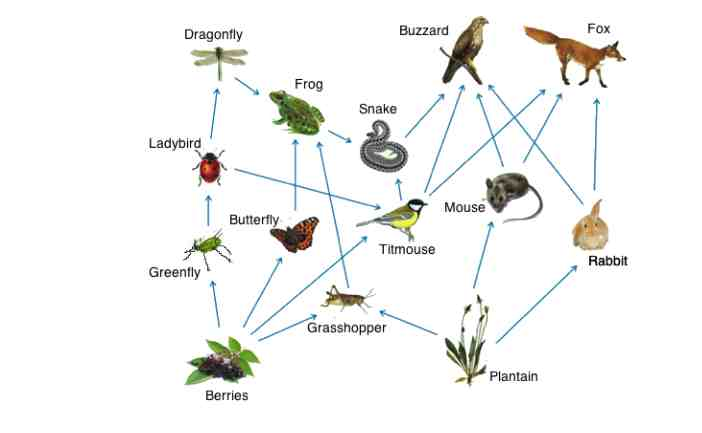
What is a food web?
Shows the connections between organisms in an ecosystem.
Split into trophic levels which are the different stages in a food web or chain. Biomass is transferred up each trophic level.
What happens to the organic materials synthesised by plants in photosynthesis?
Most of the sugars synthesised by plants are used as respiratory substrates. The rest are used to make other groups of biological molecules which form the biomass of the plants.
What is biomass?
The mass of living material present in an organism or tissue sample
This is the amount of biological molecules that make up living tissue
Why is biomass energy transfer between trophic levels inefficient?
Only around 10% of chemical food energy is passed between organisms in the food chain. The majority of biomass is lost due to uneaten parts of the organism (e.g. bones), decay of dead material, excretion, and exothermic reactions in the body (like heat lost in respiration).
How can biomass be measured?
Mass of carbon (carbon atoms in organic molecules)
Dry mass of tissue after all water has been removed
Per given area for both.
How can the chemical energy in dry biomass be measured?
Using calorimetry:
Sample of biomass burned in calorimeter in pure oxygen
Heat released is measured (measure change in temperature of the water)
From the heat released, the chemical energy stored is calculated
Why is water excluded in dry mass?
Water does not store any chemical energy.
How can you measure how productive an ecosystem is?
How productive an ecosystem is depends on biotic and abiotic factors, if these maximise the rate of photosynthesis (high light intensity etc) then more carbohydrates can be produced and transferred between trophic level. This can be quantified using GPP & NPP.
What is Gross Primary Production (GPP)?
The total amount of chemical energy converted from light energy by photosynthesis in a given area and time.
What is Net Primary Production (NPP)?
The chemical energy store in plant biomass after respiratory losses to the environment have been taken into account.
NPP = GPP - R
What can NPP be used for?
As its the chemical energy avaliable to be used outside of respiration its used by plants for growth and reproduction. It is also available to other trophic levels in the ecosystem which is first the primary consumers - herbivores and decomposers (which consume plant material).
What is the net production of consumers (N)?
The energy stored in a consumer’s biomass after losses from ingestion, excretion and respiration are taken into account.
How can you calculate the net production of consumers?
N = I - (F+R)
Where I is the chemical energy store in ingested food
F is the chemical energy lost due to the environment in faeces/urine
R is the respiratory losses to the environment
What is primary productivity?
The rate at which plants (producers) convert solar energy into chemical energy (biomass) in a given area per unit time = the rate of primary production
Measured as biomass produced per area per time, e.g., kJ ha⁻¹ year⁻¹
Can be split into gross primary productivity and net primary productivity
What is secondary production?
The production of biomass by primary consumers/heteroraphs.
The process by which heterotrophs, such as animals, consume organic matter produced by autotrophs or other heterotrophs and convert it into their own biomass.
Secondary productivity is the rate of secondary production
Still measured in kJ ha⁻¹ year⁻¹/similar units e.g. m-2 not ha⁻¹
Why do we measure rates of productivity in kJ ha⁻¹ year⁻¹?
kJ for energy
ha⁻¹ to standardise the results allowing different environments to be compared - its takes into account that different environments will be different sizes and that conditions can differ slightly in the same environment
year⁻¹ to taken into account the impact of different seasons will have on abiotic conditions - it provides an annual average to allow for fair comparisons between environments
How is the efficiency of energy transfer increased in farming?
Humans are fed directly from primary producers (plants), or fed from one type of animal. this reduces energy lost from non-human food chains
Livestock are kept in pens/cages/restricted areas. this reduces respiratory losses, so more energy is converted into biomass
What is the nitrogen cycle?
The process by which nitrogen and its compounds are converted between different forms in the environment and living organisms.
It allows nitrogen from the air to be converted into compounds that can be absorbed & used by plants.
What are the steps in the nitrogen cycle?
Nitrogen fixation – nitrogen gas → ammonia/nitrates
Nitrification – ammonia → nitrites → nitrates
Assimilation – plants absorb nitrates to make proteins
Ammonification – saprobionts release ammonia from dead matter and waste
Denitrification – bacteria convert unused nitrates in the soil to nitrogen gas
What are saprobionts?
Decomposer organisms that obtain their energy from the external digestion of dead decaying matter.
They do this by secreting digestive enzymes such as carbohydrases, proteases etc producing glycerol, fatty acids etc and the nitrogen containing amino acids. The amino acids can then be broken down to release ammonium in ammonification.
What happens in nitrogen fixation?
Conversion of atmospheric nitrogen (N₂) into ammonia (NH₃) or ammonium ions (NH₄⁺)/ ammonium compounds
Done by: nitrogen-fixing bacteria in root nodules (e.g. Rhizobium) & free-living nitrogen-fixing bacteria in soil.
What types of plant have root nodules and why is this useful?
Legumes/ leguminous plants have root nodules.
The nitrogen fixating bacteria in the root nodules & plant have a mutualistic relationship - the bacteria fixate nitrogen into ammonium containing compounds for the plant, in exchange for carbohydrates made by the plant
This means the plants are more likely to survive in soil with a low nitrate ion concentration
What happens in nitrification?
For plants which don’t have nitrogen fixating bacteria/ root nodules the ammonium in the soil has to be converted into nitrate.
Ammonium ions in the soil are converted into nitrites by nitriting bacteria
The nitrites are converted into nitrates by different nitrating bacteria
Both of these are oxidation reactions so can only happen in aerobic conditions.
What happens in assimilation?
The nitrogen can now be taken up by plants as it’s in an absorbable form - nitrates.
Why is the nitrogen cycle important to plants (and all organisms)?
There are many important nitrogen containing compounds : ATP, nucleotides (of all nucleic acids), amino acids → proteins, co-enzymes e.g. NADH & NADPH etc.
What happens in ammonification?
Dead organic material (plant or animal) is decomposed by saprobionts in the soil which break down nitrogen containing compounds e.g. urea into ammonium ions.
What happens in denitrification?
Nitrate ions are converted back into nitrogen gas.
This is done by denitrifying bacteria which work in anaerobic conditions e.g. waterlogged soils where the concentration of oxygen is low.
As denitrification removes nitrates from soil it reduces the amount of nitrogen avaliable for plant growth.
What does the nitrogen cycle look like?

What is the phosphorous cycle?
The process by which phosphorous is absorbed from the evironment and then returned to the environment in multiple different forms.