Physics Concepts ALL
5.0(1)
 Studied by 67 people
5.0(1)
 Call Kai
 Learn
Learn Practice Test
 Spaced Repetition
 Match
Match Flashcards
 Knowt Play
Card Sorting
1/176

There's no tags or description
Looks like no tags are added yet.
Study Analytics
Name | Mastery | Learn | Test | Matching | Spaced |
|---|
No study sessions yet.
177 Terms
1
New cards
For the voltmeter in the image below, what is the reading given by needle A expressed to the best precision of the instrument?
107mV
2
New cards
The number of significant figures in 0.01500 is
four
3
New cards
he most appropriate metric unit for measuring the length of an automobile is the
meter.
4
New cards
Which of the following is equal to 58.3cm?
5.83x10-^4 km
5
New cards
How does the independent variable in a graph differ from the dependent variable?
The independent variable is directly manipulated or controlled by the person doing the experiment, while dependent variable is the one that changes as a result.
6
New cards
Which formula is equivalent to 𝐷=𝑚/𝑉
𝑉=𝑚/𝐷
7
New cards
Moustapha Jones has a problem to do involving time, distance and velocity, but he has forgotten the formula. The question asks him for a measurement in seconds, and the numbers that are given have units of m/s and km. What could Moustapha do to get the answer in seconds?
divide the km by the m/s then multiply by 1000
8
New cards
At x = 3, a function f(x) has a positive value with a positive slope that decreases in magnitude with decreasing x. Which option could correspond to f(x)?
y=x^2
9
New cards
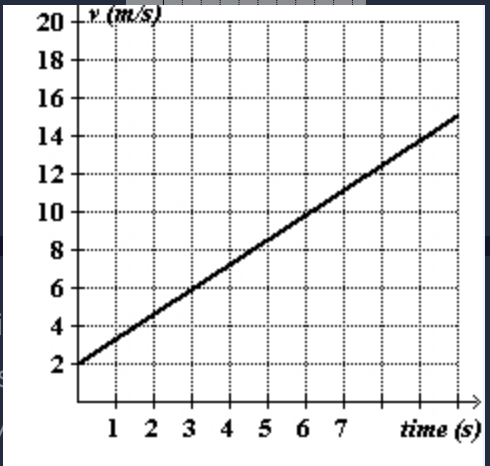
What is the magnitude of the slope of the line in Graph 1.1?
1.3 (slope formula)
10
New cards
Describe all of the characteristics that can be determined about a straight line with a slope of {-3} and a y-intercept of 50 on a graph.
Based on the information, the line has a negative slope. Because its y-intercept is 50 and its slope is negative, this line gradually moves downward on the graph as the x-value increases.
11
New cards
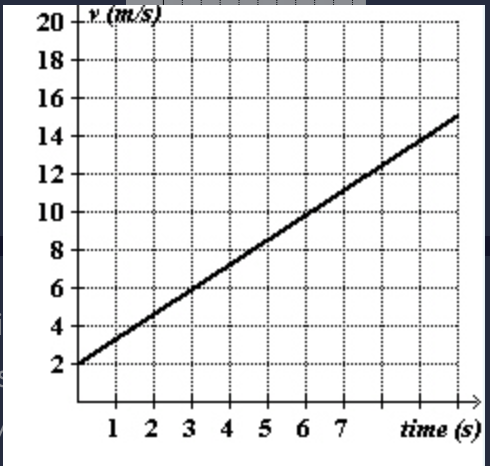
What are the units for the slope of the line shown in Graph 1.1?
m/s^2
12
New cards
The SI base unit for time is
1 second.
13
New cards
Which of the following would describe a length that is 2.0 x 10^-3 of a meter?
2.0 millimeters
14
New cards
What is the slope of the graph?
0.25m/s2 (y2-y1/x2-x1)
15
New cards
Describe the main difference between the metric system and the U.S. Customary System.
In the metric system, unit changes are based on powers of 10, while in the U.S. customary system, each unit conversion has unrelated conversion factors.
16
New cards
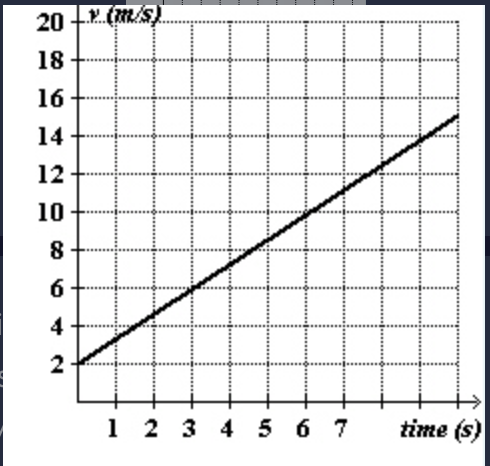
What term best describes the relationship shown in Graph 1.1?
positive linear
17
New cards
The symbol mm represents a
millimeter
18
New cards
The SI base unit used to measure mass is the
kilogram
19
New cards
Velocity, or speed, is measured using the following formula: v = d/t , where v is velocity, d is the distance travelled, and t is the time the object took to travel the distance. If the velocity-time data are plotted on a graph, which variable will be on which axis? Why?
Time would be on the x-axis and velocity on the y-axis, because time is an independent variable and velocity is a dependent variable.
20
New cards
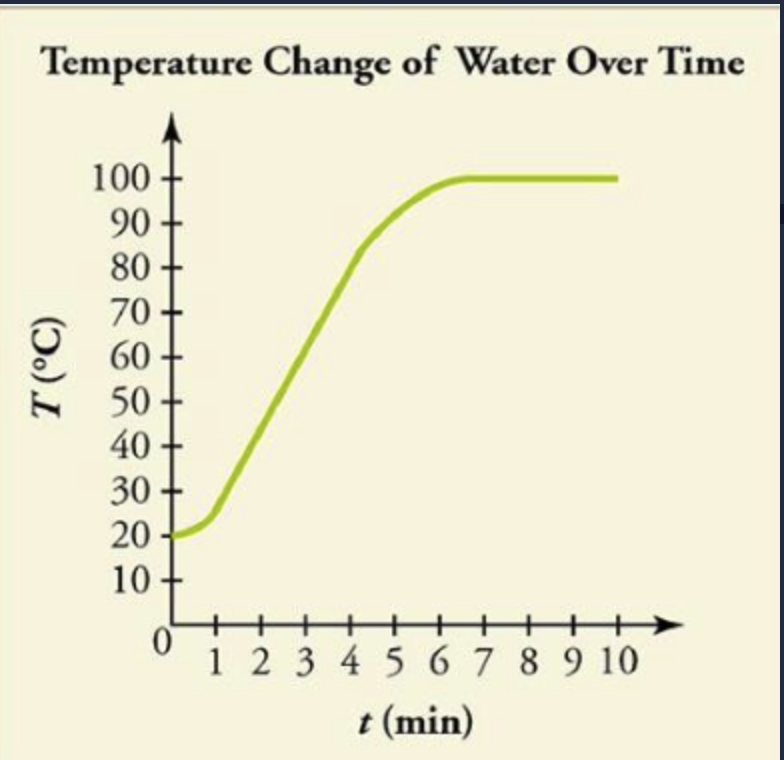
The graph shows the temperature change over time of a heated cup of water. See the graph below. What is the slope of the graph between the time period 2 min and 5 min?
15 ºC/min
21
New cards
The measurement 64.010cm has how many significant digits?
5
22
New cards
The speed limit on some interstate highways is roughly 80 km/h. What is this in meters per second? How many miles per hour is this?
22.2 m/s, 49.7 mph
23
New cards
The number of significant figures in 0.040 is
two
24
New cards
Which of the following has three significant figures?
0.0500 mm
25
New cards
Suppose that a bathroom scale reads a person's mass as 65 kg with a 3 percent uncertainty. What is the uncertainty in their mass in kilograms?
2 kg
26
New cards
What would be the slope for a line passing through the two points below? Point 1: (1, 0.1) Point 2: (7, 26.8)
4.5
27
New cards
The speed of sound is measured at 342 m/s on a certain day. What is this in km/h? Report your answer in scientific notation.
1.23 x 10^3 km/h
28
New cards
A commemorative coin that sells for $40 is advertised to be plated with 15 mg of gold. Suppose gold is worth about $50 per gram. Which of the following best represents the value of the gold in the coin?
$0.75
29
New cards
A bee flies straight at someone and then back to its hive along the same path. Assuming it takes no time for the bee to speed up or slow down, except at the moment it changes direction, how would the graph of position vs time look? Consider the initial direction to be positive.
The graph will look like a downward opening V shape.
30
New cards
A car is moving on a straight road at a constant speed in a single direction. Which of the following statements is true?
The magnitude of average velocity is equal to the average speed.
31
New cards
A car travels with an average velocity of 23 m/s for 82 s. Which of the following could have been the car's displacement?
1,900 m west
32
New cards
A fly buzzes four and a half times around Kit Yan's head. The fly ends up on the opposite side from where it started. If the diameter of his head is 14 cm, what is the total distance the fly travels and its total displacement?
The distance is 63π cm with a displacement of 14 cm..
33
New cards
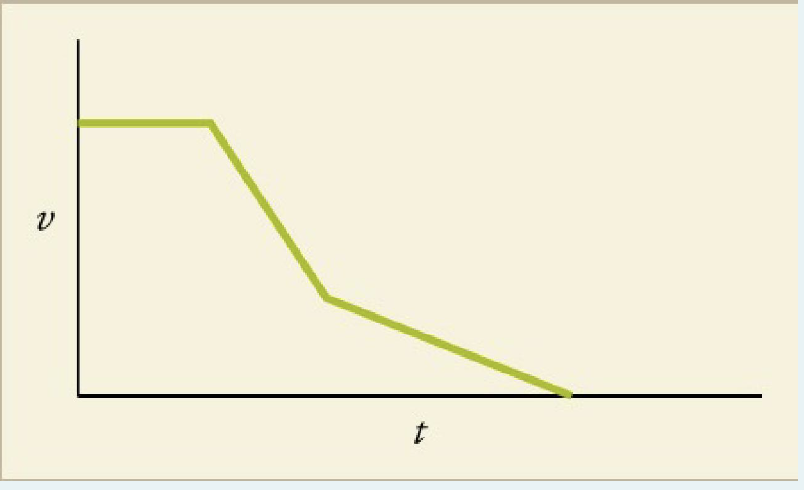
A graph of velocity vs. time of a ship coming into a harbor is shown below. Describe the acceleration of the ship based on the graph. (question 5 with a graph)
The ship is moving in the forward direction at a steady rate. Then it decelerates in the forward direction, and then continues to slow down in the forward direction, but with less deceleration.
34
New cards
A position vs. time graph of a frog swimming across a pond has two distinct straight-line sections. The slope of the first section is 1 m/s. The slope of the second section is 0 m/s. If each section lasts 1 s, then what is the frog's total average velocity?
0.5 m/s
35
New cards
An object has an average speed of 7.4 km/h. Which of the following describes two ways you could increase the average speed of the object to 14.8 km/h?
Double the distance that the object travels, keeping the time constant, or keep the distance constant and reduce the time by half.
36
New cards
An object is moving along a straight path with constant acceleration. A velocity vs. time graph starts at 0 and ends at 10 m/s, stretching over a time-span of 15 s. What is the magnitude of the object's net displacement?
75 m
37
New cards
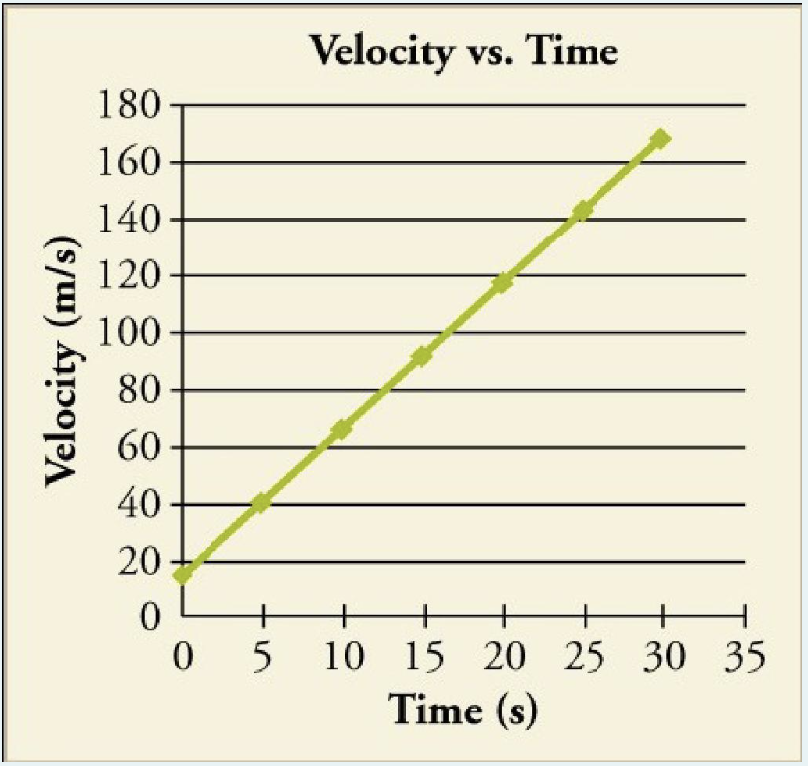
Calculate that object's net displacement over the time shown in the graph below. (Question 9 with a graph)
2,790 m
38
New cards
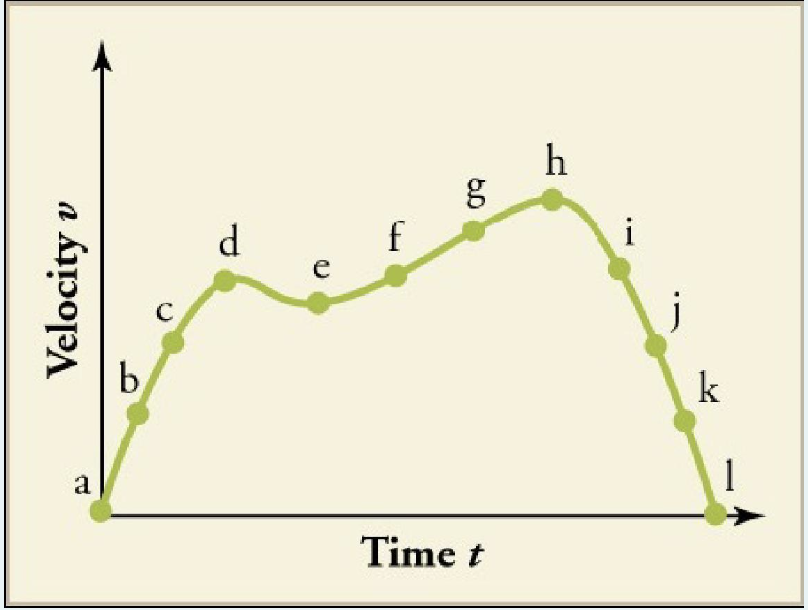
Consider the motion of the object whose velocity is charted in the graph below. During which points is the object slowing down and speeding up? (Question 10 with a graph)
It is slowing down between d and e and then after h. It is speeding up between a and d and e and h.
39
New cards
Four bicyclists travel different distances and times along a straight path. Which cyclist traveled with the greatest average speed?
Cyclist 4 travels 108 m in 24 s.
40
New cards
If a biker rides west for 50 miles from his starting position, then turns and bikes back east 80 miles. What is his net displacement?
30 miles east
41
New cards
If a space shuttle orbits Earth once, what is the shuttle's distance traveled and displacement?
Distance is circumference of the circular orbit while displacement is zero.
42
New cards
In a coordinate system in which the direction to the right is positive, what are the distance and displacement of a person who walks 35 m to the left, 18 m to the right, and then 26 m to the left?
Distance is 79 m and displacement is -43 m.
43
New cards
In the definition of velocity, what physical quantity is changing over time?
displacement
44
New cards
Is it possible to determine a car's instantaneous velocity from just the speedometer reading?
No, it reflects speed but not the direction.
45
New cards
Maud sends her bowling ball straight down the center of the lane, getting a strike. The ball is brought back to the holder mechanically. What are the ball's net displacement and distance traveled?
Displacement of the ball is zero, while the distance is twice the length of the lane.
46
New cards
Rob drove to the nearest hospital with an average speed of v m/s in t seconds. In terms of t, if he drives home on the same path, but with an average speed of 3v m/s, how long is the return trip home?
t/3
47
New cards
Swimming one lap in a pool is defined as going across a pool and back again. If a swimmer swims 3 laps in 9 minutes, how can his average velocity be zero?
His average velocity is zero because his total displacement is zero.
48
New cards
Terri, Aaron, and Jamal all walked along straight paths. Terri walked 3.95 km north in 48 min. Aaron walked 2.65 km west in 31 min. Jamal walked 6.50 km south in 81 min. Which of the following correctly ranks the three boys in order from lowest to highest average speed?
Jamal, Terri, Aaron
49
New cards
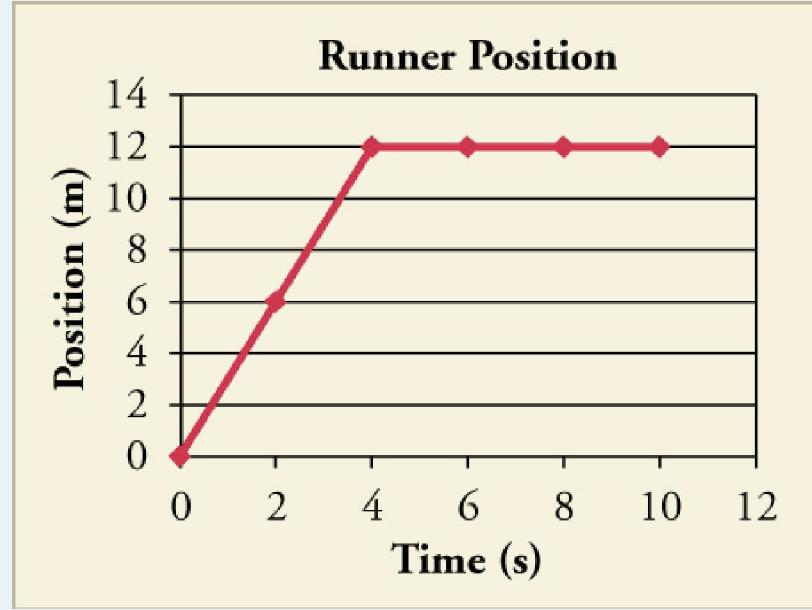
Use the graph below to describe a runners motion. What is the runner's displacement and how do his average and instantaneous velocities compare at time=10s? ( question 21 graph question)
The net displacement is 12 m and the average velocity is greater than his instantaneous velocity.
50
New cards
Using the graph below, what is the average velocity for the whole 10 seconds? (question 22 graph)
The total average velocity is 1.2 m/s.
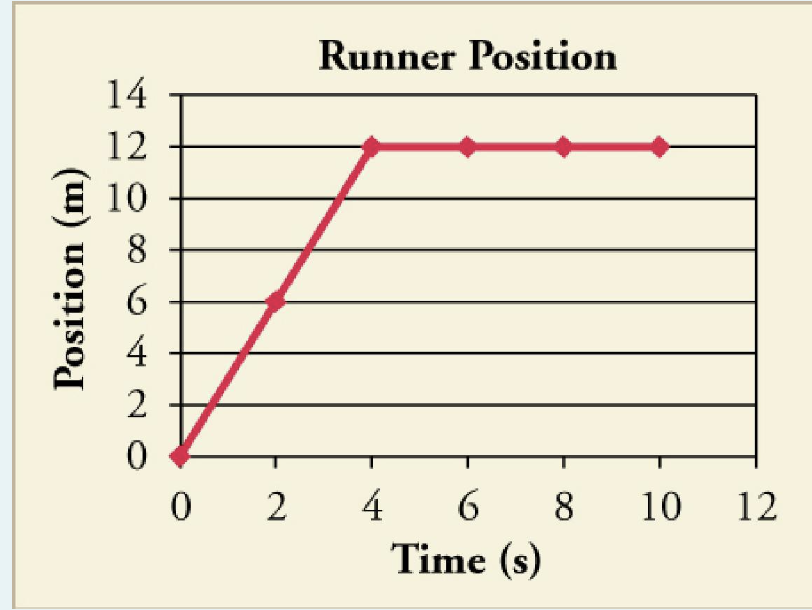
51
New cards
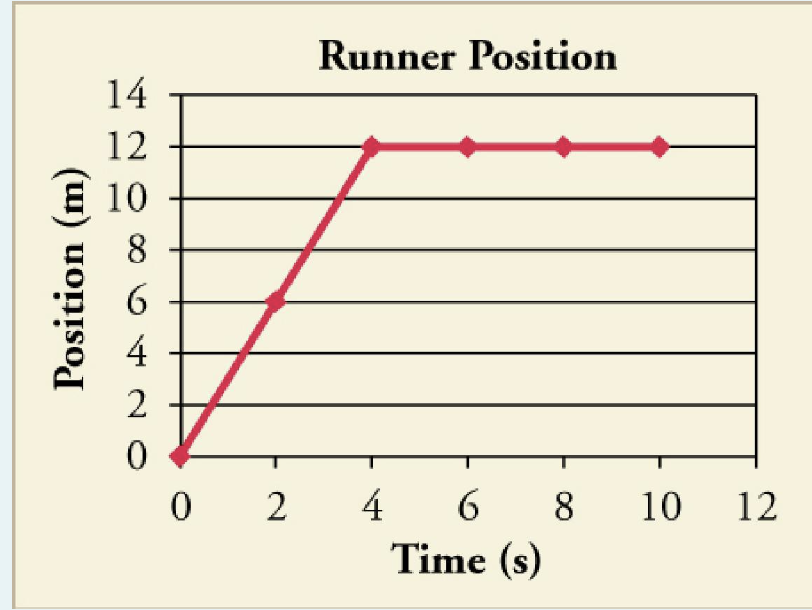
Using the graph below, what is the runner's velocity from 4 to 10 s? ( graph question 23)
0 m/s
52
New cards
What can you infer from the statement, Velocity of an object is zero?
Object is either at rest or it returns to the initial point
53
New cards
What does the area under a velocity vs. time graph line represent?
displacement
54
New cards
What does your car's odometer record?
distance
55
New cards
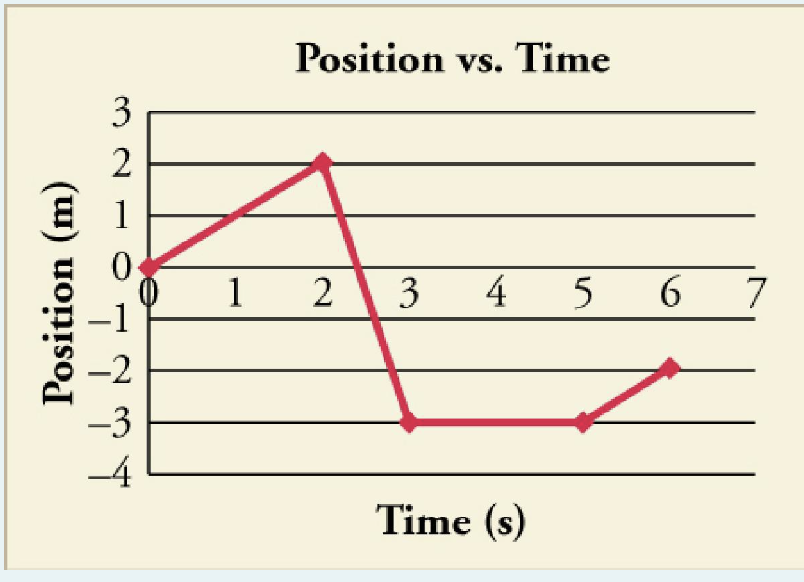
What is the average velocity for the whole time period shown in the graph below? ( 27 graph question)
-1/3 m/s
56
New cards
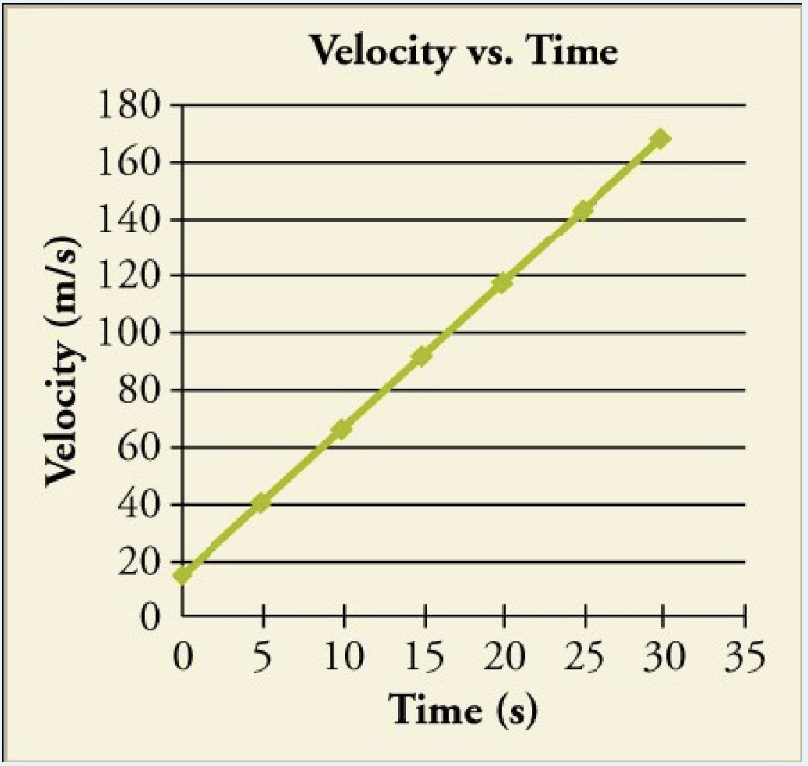
What is the object's average velocity? (graph question 28)
93 m/s
57
New cards
What is the slope of a straight line graph of position vs. time?
Velocity
58
New cards
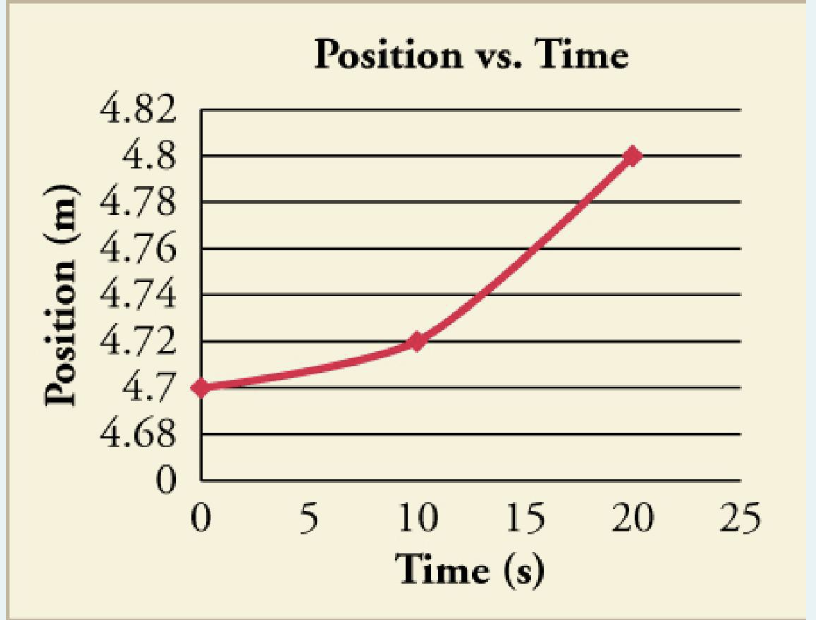
What kind of motion would create a position graph like the one shown? See the graph below (graph question 30)
any motion that accelerates
59
New cards
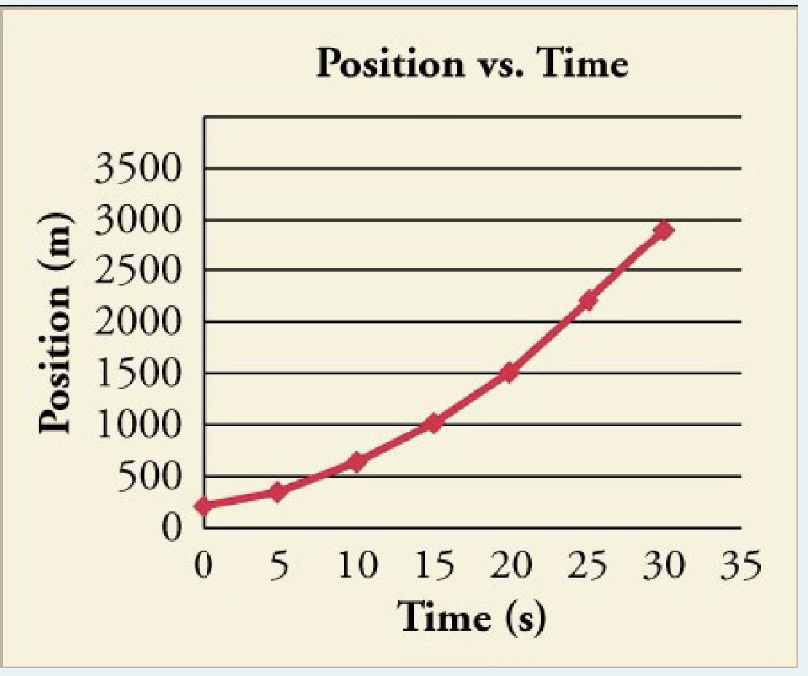
What would the velocity vs. time graph of the object whose position is shown in the graph below look like? ( graph question 31)
It is a straight line with positive slope
60
New cards
Which of the following is true for the displacement of an object?
It is both the straight line distance the object moved as well as the direction of its motion.
61
New cards
Which statement correctly describes the object's speed, as well as what a graph of acceleration vs. time would look like? See graph below.
The object is speeding up, and the acceleration vs. time graph is a horizontal line at some positive value.

62
New cards
You sit in a car that is moving at an average speed of 86.4 km/h. During the 3.3 s that you glance out the window, how far has the car traveled?
79 m
63
New cards
A swan on a lake gets airborne by flapping its wings and running on top of the water. If the swan must reach a velocity of 6.00 m/s to take off and it accelerates from rest at an average rate of 0.350 m/s2, how far will it travel before becoming airborne?
51.4 m
64
New cards
A test car carrying a crash test dummy accelerates from 0 to 30 m/s and then crashes into a brick wall. Describe the direction of the initial acceleration vector and compare the initial acceleration vector's magnitude with respect to the acceleration magnitude at the moment of the crash.
The direction of the initial acceleration vector will point towards the wall, and its magnitude will be less than the acceleration vector of the crash.
65
New cards
A ball is thrown straight up, reaches a maximum height, then falls to its initial height. Make a statement about the direction of the velocity and acceleration as the ball is coming down.
Both its velocity and its acceleration point downward.
66
New cards
Suppose a ball is thrown straight up, reaches a maximum height, then falls to its initial height. Make a statement about the direction of the velocity and acceleration as the ball is going up.
Its velocity points upward and its acceleration points downward.
67
New cards
If a car decelerates from 20 m/s to 15 m/s in 5 s, what is the change in velocity, Δv?
-5 m/s
68
New cards
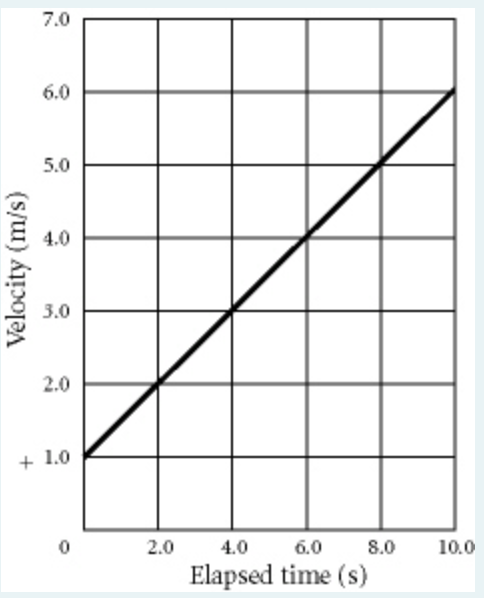
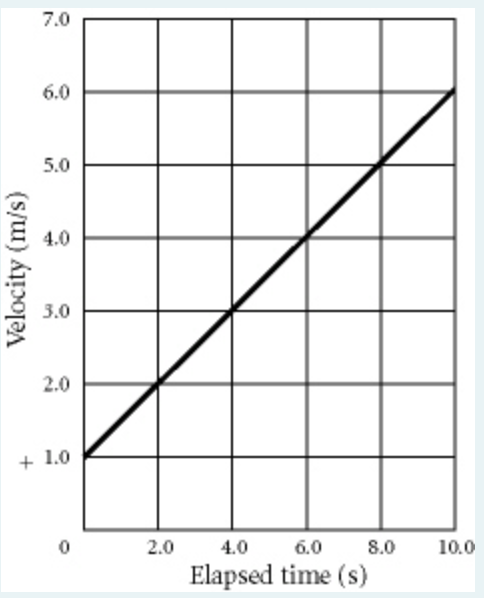
The graph above describes the motion of a cyclist.From this graph we can determine that the acceleration of the cyclist . . . (Question 6)
is constant
69
New cards
When a car's velocity is positive and its acceleration is negative, what is happening to the car's motion?
The car slows down.
70
New cards
How can you use the definition of acceleration to explain the units in which acceleration is measured?
Acceleration is the rate of change of velocity. Therefore, its unit is m/s2.
71
New cards
A girl rolls a basketball across a basketball court. The ball slowly decelerates at a rate of −0.20 m/s2. If the initial velocity was 2.0 m/s and the ball rolled to a stop at 5.0 sec after 12:00 p.m., at what time did she start the ball rolling?
5 seconds before noon
72
New cards
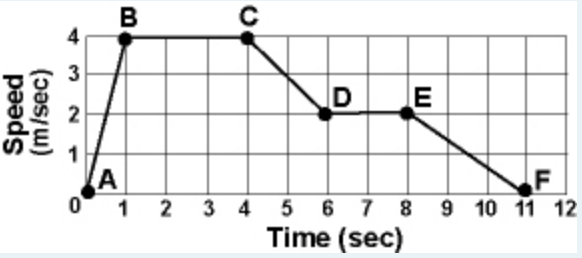
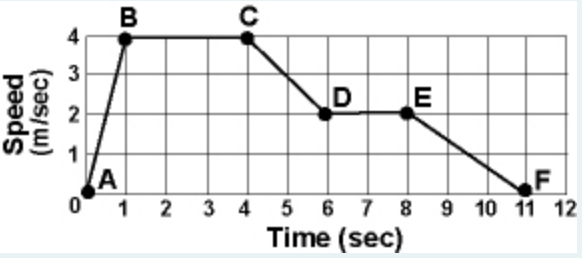
The graph below represents the speed-time relationship for a 2.0-kilogram mass moving along a horizontal frictionless surface:According to Figure 2-1A, during which time interval is the acceleration of the object zero? (Question 10 Graph)
D to E
73
New cards
A student calculated the final velocity of a train that decelerated from 30.5 m/s and got an answer of −43.34 m/s. Which of the following might indicate that he made a mistake in his calculation?
The sign of the final velocity is wrong.
74
New cards
What do we call the rate at which velocity changes?
acceleration.
75
New cards
Which of the following statements explains why a racecar going around a curve is accelerating, even if the speed is constant?
The car is accelerating because the direction of velocity is changing.
76
New cards
The graph above describes the motion of a cyclist. During the interval shown, the cyclist is
speeding up
77
New cards
When an object is released from rest and falls in the absence of friction, which of the following is true concerning its motion?
Its acceleration is constant.
78
New cards
Which variable represents displacement?
d
79
New cards
The graph below represents the speed-time relationship for a 2.0-kilogram mass moving along a horizontal frictionless surface:Figure 2-1AAccording to Figure 2-1A, what is the speed of the 2.0-kilogram mass when the time equals 5 seconds?
3 m/sec
80
New cards
You throw a ball straight up with an initial velocity of 15.0 m/s. It passes a tree branch on the way up at a height of 7.00 m. How much additional time will pass before the ball passes the tree branch on the way back down?
1.91s
81
New cards
If a velocity increases from 0 to 20 m/s in 10 s, what is the average acceleration?
2 m/s2
82
New cards
When you throw a ball up in the air, it travels up and then stops instantaneously before falling back down. At the point where it stops and changes direction to fall back down, which quantity is zero?
velocity is zero.
83
New cards
Suppose a ball is thrown straight up. What is its acceleration just before it reaches its highest point?
exactly g
84
New cards
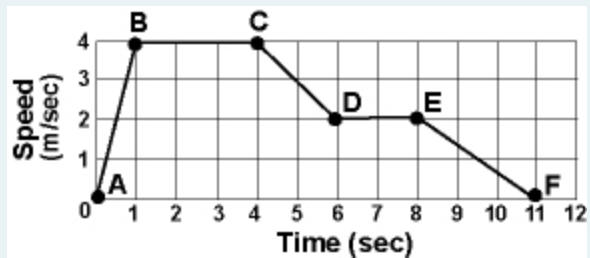
The graph below represents the speed-time relationship for a 2.0-kilogram mass moving along a horizontal frictionless surface:Figure 2-1AAccording to Figure 2-1A, during which interval is the object accelerating at the greatest rate?
A to B
85
New cards
A student is asked to solve a problem: An object falls from a height for 2.0 s, at which point it is still 60 m above the ground. What will be the velocity of the object when it hits the ground? Which of the following provides the correct order of kinematic equations that can be used to solve the problem?
First use 𝑣=𝑣0+𝑎𝑡v=v0+at, then use 𝑣2=𝑣20+2𝑎𝑑
86
New cards
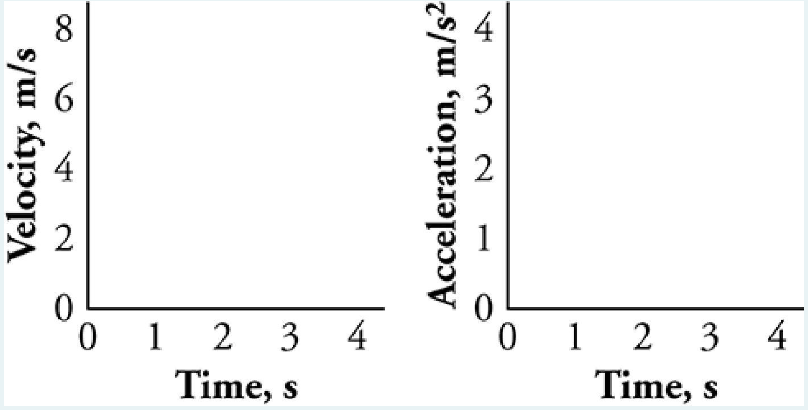
When plotted on the blank plots, which answer choice would show the motion of an object that has uniformly accelerated from 2 m/s to 8 m/s in 3 s? See the figure below. (Question 24)
The plot on the left shows a line from (0,2) to (3,8) while the plot on the right shows a line from (0,2) to (3,2).
87
New cards
Suppose you throw a ball downward in the absence of air resistance. Make a statement about the ball's acceleration after it has left your hand.
Its acceleration is constant.
88
New cards
Which pair of graphs represents the same motion?
A

89
New cards
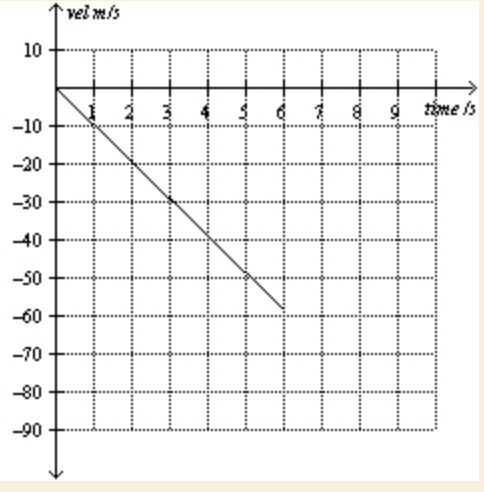
A ball is dropped from the top of a building. In the absence of air resistance which of the following could be a velocity time graph for the falling ball?
1st graph
90
New cards
Skydivers are affected by acceleration due to gravity and by air resistance. Eventually, they reach a speed where the force of gravity is almost equal to the force of air resistance. As they approach that point, their acceleration decreases in magnitude to near zero. Part A. Describe the shape of the graph of the magnitude of the acceleration versus time for a falling skydiver. Part B. Describe the shape of the graph of the magnitude of the velocity versus time for a falling skydiver. Part C. Describe the shape of the graph of the magnitude of the displacement versus time for a falling skydiver.
Part A. Begins with a nonzero y-intercept with a downward slope that levels off at zero;Part B. Begins at zero with an upward slope that decreases in magnitude until the curve levels off;Part C. Begins at zero with an upward slope that increases in magnitude until it becomes a positive constant
91
New cards
What could the acceleration of an object represent?
all of the above (slowing down, gaining speed, changing direction)
92
New cards
Which kinematic equation would you use to find the velocity of a skydiver 2.0s after she jumps from a plane and before she opens her parachute? Assume the positive direction is downward.
𝑣=𝑣0+𝑎𝑡
93
New cards
How is the vector arrow representing an acceleration of magnitude 3 m/s2different from the vector arrow representing a negative acceleration of magnitude 3 m/s2?
They point in opposite directions.
94
New cards
What are the SI units of acceleration?
m/s2
95
New cards
When is a plot of velocity versus time a straight line and when is it a curved line?
It is a straight line when acceleration is constant and is a curved line when acceleration is changing.
96
New cards
If an object is accelerated, all of the following may occur EXCEPT:
it remains motionless.
97
New cards
For the motion of a falling object, which graphs are straight lines?
Velocity versus time and acceleration versus time
98
New cards
Suppose a ball is thrown straight up. Make a statement about the velocity and the acceleration when the ball reaches the highest point.
Its velocity is zero and its acceleration is not zero.
99
New cards
If a plot of displacement versus time is linear, what can be said about the acceleration?
Acceleration is 0
100
New cards
Imagine that a car is traveling from your left to your right at a constant velocity. Which two actions could the driver take that may be represented as (a) a velocity vector and an acceleration vector both pointing to the right and then (b) changing so the velocity vector points to the right and the acceleration vector points to the left?
(a) Push down on the accelerator and then (b) push down again on the accelerator a second time.