GEC 1: UNDERSTANDING THE SELF
 Call Kai
 Learn
Learn Practice Test
 Spaced Repetition
 Match
Match Flashcards
 Knowt Play
1/68

Earn XP
Name | Mastery | Learn | Test | Matching | Spaced | Call with Kai | Chat |
|---|
No analytics yet
Send a link to your students to track their progress
69 Terms
Father of American Psychology
William James
I-Self
puts the attitude into action: where attitude is the initiator, and overt is the observative behavior
Me-Self
more subjective. based on people’s perspective upon you.
Sigmund Freud
founder of psychodynamic approach—otherwise known as Psychoanalytic Theory
Three Levels of Consciousness
Pre-Conscious, Conscious, Unconscious
What type of consciousness where one have his fears, violent motives, and irrationality?
Unconscious
Conscious
Level of consciousness where one is aware of his thoughts and perceptions.
It is where memories and knowledge store in terms of our level of consciousness
Pre-conscious/Subconscious
Behavior is shaped by unconscious desires and ——?
Childhood experiences
ID
I Do Not Care mindset.
Ego
Self needs, sense of self-importance.
Super Ego
ethical component of the personality and provides the moral standards by which the ego operates
Carl Ransom Rogers
the ones who introduced Client Centered Theory. Through this, he believed that people themselves are the best expert on their own lives. This is also where self awareness is introduced.
D. W. Winnicott
where true vs. false self is identified
True Self
based on authentic experience which flourishes in infancy through his positive relationship on his mother.
False Self
feelings in order to survive: defense mechanism
Self
simply who is me.
Healthy False Self
simply committed to himself and serves only as a protection to shield his identity.
Unhealthy False Self
compliance rather than adapt.
Psychology
a scientific field where it studies how people behave, think, and feel.
Philosophy
study of creation of theories and knowledge
Etymology of Philosophy
Greek word where “philos” is love and “sophia” is wisdom.
Ancient Philosophy
Also referred as cosmological universe
Medieval Philosophy
Known as Theological as it focuses on gods and goddesses.
Modern Philosophy is also known as..
Humanistic Philosophy
Contemporary Philosophy
Deconstruct center where there is no longer a centre. Now, it focuses on broader and wider aspect.
In ancient times, there are three famous philosophers recognized. The triumvirates are:
Socrates, Plato, Aristotle
Socrates
who shaped the Western thought. He also believe that the soul is immortal.
Socrates
He died at the age of 70 by drinking a cup of prison hemlock.
Socratic method
process of questioning or asking. The unexamined life is not worth living.
Virtue = knowledge
Socrates
Plato
student of Socrates. Theory of Forms — the physical world is just a shadow of a perfect, unchanging, non-physical reality (“Forms” or “Ideas”).True knowledge comes from understanding these eternal Forms, not from sensory experience.
Soul
most divine aspect of human being.
There are three aspects of soul based on Plato
Appetitive (sensual), Rational (reasoning), Spirited (feeling)
The most dangerous part of the soul.
Appetitive (sensual)
Part of our soul where it cherishes the truth and regulates sensual
Rational (reasoning)
Inclined to reason but understands the need for passion: honor and victory
Spirited (feeling)
Aristotle
student of Plato. He believes that body and soul are inseparable.
Theory of Hylomorphism
We are all different as we have different soul.
Man is composed of:
Matter hyle in Greek - human body and Form morphe in Greek - soul
Sociology
study of the society
Social life, change, and cause and consequences happen through:
Socialization
Charles Cooley
Looking glass theory
Looking Glass Theory
self identity is based on other’s perspective
George Mead
individual roles of society/norms
Culture Relativism
what’s acceptable to our society is not applicable to other society.
Preparatory Stage
Imitation and observation
Play stage
begins to do his role through imitation
Game Stage
learns several roles and knows how these interact in order to maintain an ordain society.
“ I “
Spontaneous Self
“Me”
social self
Marcel Mauss
Moi (pronounced as mwa) and Person
Moi
Basic identity. e.g. Female
Personne
composed of self concept: roles. e.g. to nurture a child
Assimilation
innate
Accommodation
accept and recognize concepts. Adaptive Behavior
Anthropology
study of human societies and their development. how culture and biology process shapes human.
Anthropological Perspectives of Self
Egocentric and Sociocentric
Egocentric
one’s opinion is a sole basis of truth. more on personality is inherited, not shaped.
Socio-centric
defines through relationship and memberships
Ewing (1989)
Self is illusory: what we view to ourselves isn’t who we really are.
Joseph Le Doux, 2002
conceptualized implicit self & explicit self
Implicit Self
not immediately available to consciousness
Explicit Self
consciously aware
Independent and Interdependent
In accordance to cultural psychologists, there exist two concepts;
Independent
prioritizes privacy
Interdependence
collectivist and has strong family and community bonds.
Johari Window
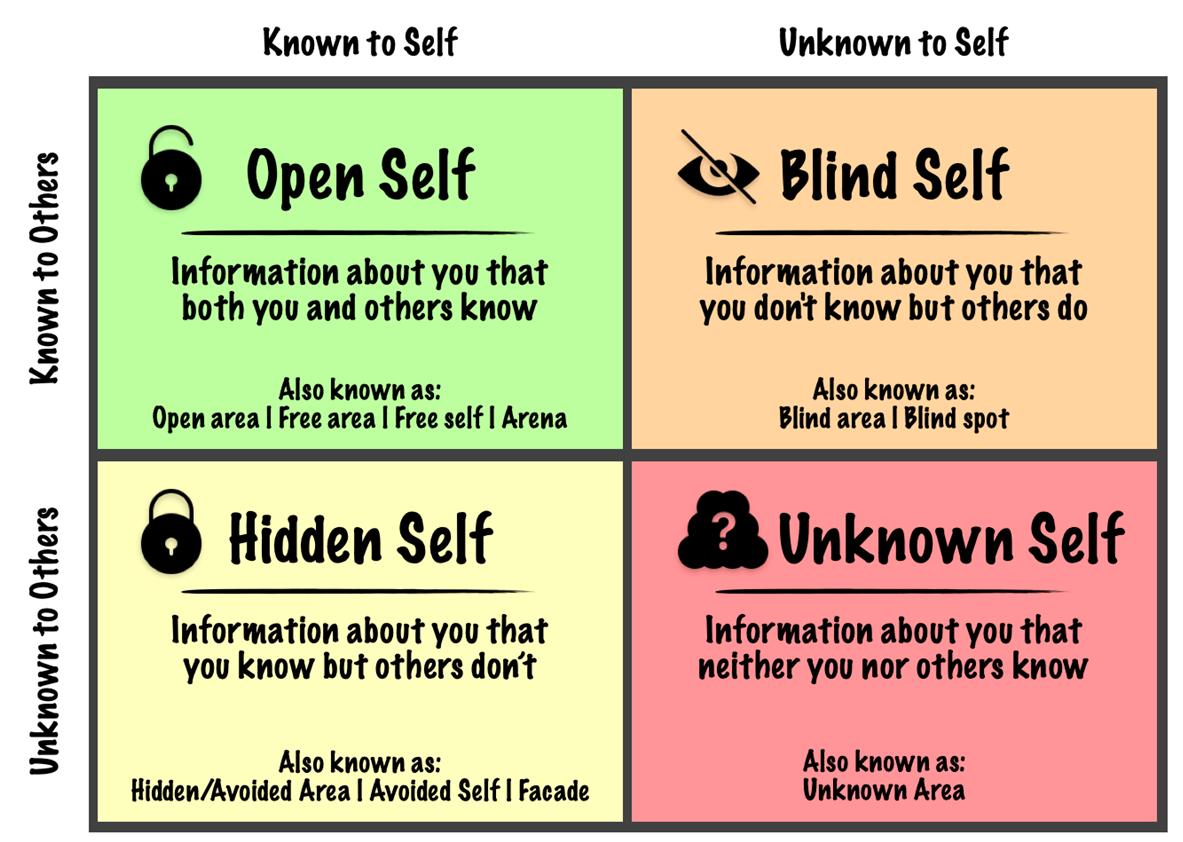
Basic Dimensions of Personality
O.C.E.A. N (Openness to Experience, Conscientiousness, Extraversion, Agreeableness, Neuroticism)