LM 16: Photosynthesis
 Studied by 0 people
 Call with Kai
 Learn
Learn Practice Test
 Spaced Repetition
 Match
Match Flashcards
 Knowt Play
1/13

There's no tags or description
Looks like no tags are added yet.
Name | Mastery | Learn | Test | Matching | Spaced | Call with Kai |
|---|
No study sessions yet.
14 Terms
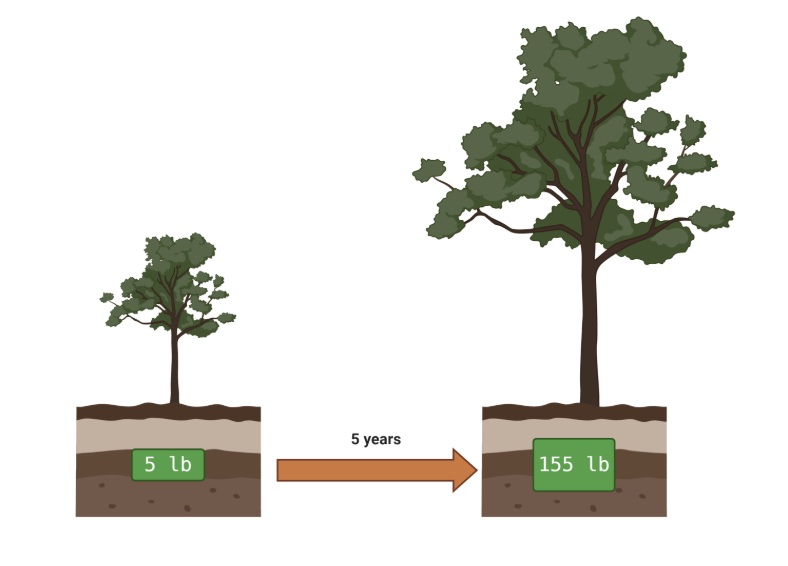
What best explains the increase in mass of the tree?
Plants take in CO2 through their leaves
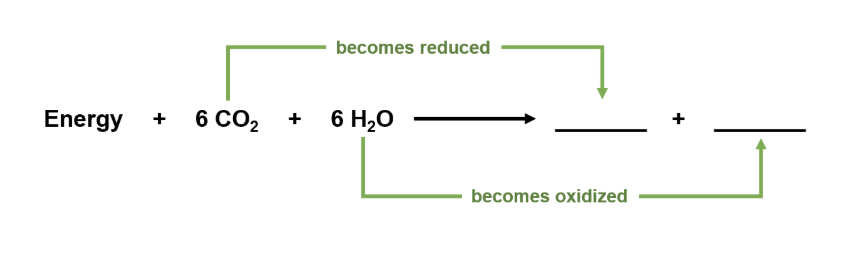
During photosynthesis, CO2 is reduced to ______, while H2O is oxidized to _______.
C6H12O6 O2
Stomata
small openings in the leaves of plants that allow for the diffusion of CO2, H2O, and O2.
Chloroplasts
organelles within plant cells that are the site of photosynthesis.
Thylakoid
membrane-bound sacs within the chloroplasts that are the site of photon capture, the electron transport chain, and ATP synthase.
Stroma
fluid within chloroplasts surrounding the thylakoid membrane that is the site of carbon fixation and the reduction of CO2 into sugar.
Where do plants get the carbon they use as a reactant during photosynthesis?
Through their leaves from the gaseous carbon dioxide in the air.
What is an example of the transmission of visible light?
Light shining through a window
During the light reactions, water is oxidized to O2. Where do the hydrogens go?
Used in the synthesis of ATP by chemiosmosis.
What correctly describes the linear pathway of electrons in the light reactions of photosynthesis?
H2O to PSII to PSI to NADP+
In the carbon fixation reactions, how many molecules of CO2 enter the cycle before 2 molecules of G3P are made?
6
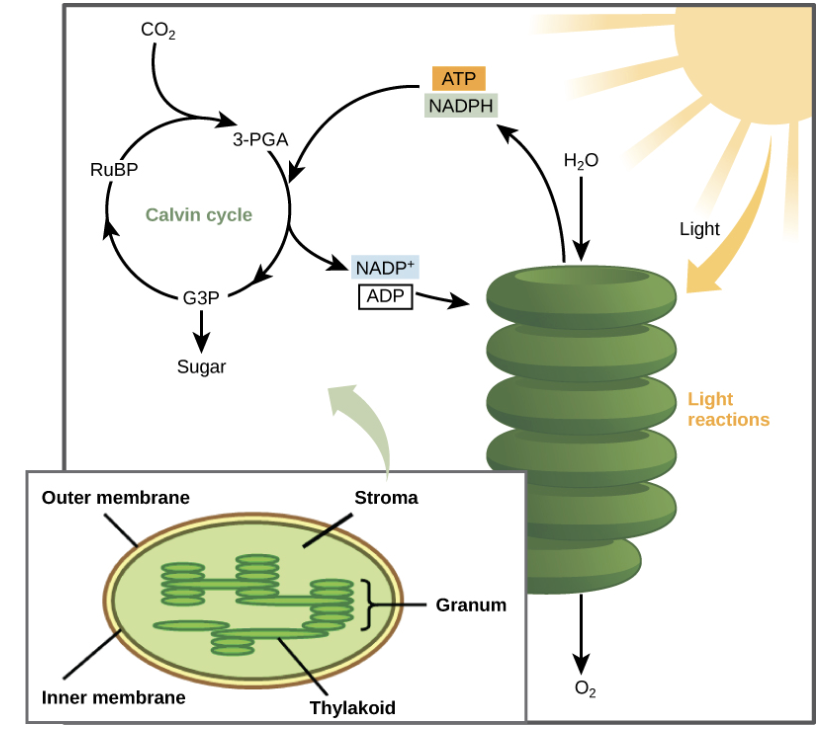
The light reactions generate ATP via photophosphorylation which is used to power the carbon fixation reactions. All the ATP synthesized in the light reactions is hydrolyzed in the stroma. In which of the following stages is ATP hydrolyzed?
Regeneration of the CO2 acceptor, and Reduction and sugar formation
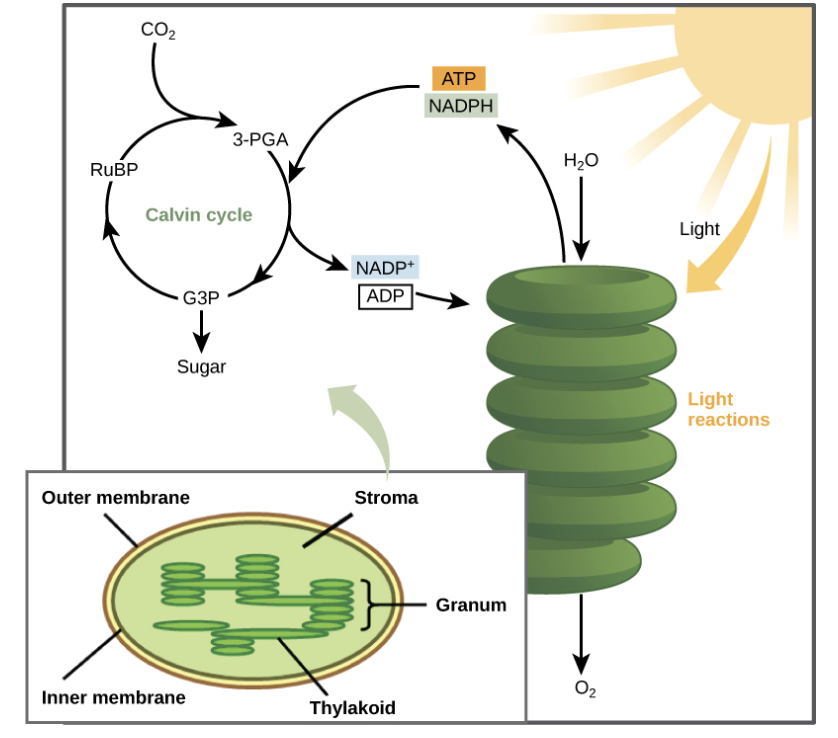
The light reactions split water and use hydrogen atoms to reduce NADP+ to NADPH. In the stroma, NADPH is oxidized as carbon compounds are reduced. In which of the following stages of the carbon fixation reactions is NADPH oxidized?
Reduction and sugar formation.
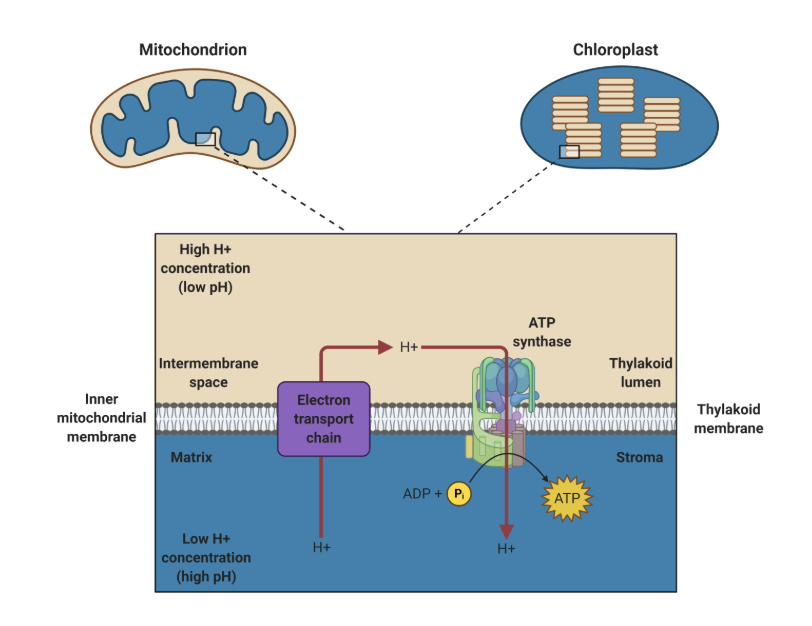
Both chloroplasts and mitochondria generate ATP using chemiosmosis; mitochondria use this process in oxidative phosphorylation, while chloroplasts use it in photophosphorylation. Which of the following is NOT a true statement of similarity between these two processes?
The method of excitation and source of the electrons passing down the electron transport chain.
 Note
Note  Flashcards (59)