Reversible reactions and equilibria
 Studied by 0 people
 Call Kai
 Learn
Learn Practice Test
 Spaced Repetition
 Match
Match Flashcards
 Knowt Play
1/22

There's no tags or description
Looks like no tags are added yet.
Name | Mastery | Learn | Test | Matching | Spaced | Call with Kai |
|---|
No analytics yet
Send a link to your students to track their progress
23 Terms
What is a reversible reaction? What is the symbol?
A reaction that can go forwards and backwards (reactants can react to form products and products can react to form reactants)
⇌
Top arrow goes forwards BE CAREFUL WITH THIS
What is a characteristic of reversible reactions?
One way will be exothermic and the other way will be endothermic
Same amount of energy is being transferred (exo side: temp inc by 5°C and endo temp dec by 5°C)
Describe the reversible reaction of copper(II) sulfate crystals. Equation, which way is exothermic, which way endo, describe what will happen
Hydrated copper(II) sulfate ⇌ anhydrous copper(II) sulfate + water
Forward reaction is endothermic (heating is required, energy is absorbed)
Backwards reaction is exothermic (when water is added, heat is released)
If you heat the hydrated copper(II) sulfate, crystals lose their water of crystallisation and turn from blue crystals to white powder of anhydrous copper(II) sulfate
If you add water
It turns blue again
becomes warm (releases heat)
Describe the reversible reaction of ammonium chloride. What is the name of the actual reaction?
NH4(s) ⇌ NH3(g) + HCl(g)
Forward reaction is endothermic
Backwards reaction is exothermic
If you heat ammonium chloride in a test tube, white crystals of ammonium chloride disappear from the bottom of the tube and reappear further up. In between there is a colourless gas of ammonia and hydrogen chloride
This reaction is thermal decomposition
Heating causes ammonium chloride to thermally decompose into ammonia and hydrogen chloride (HCl) gas
The gases recombine further up the tube, where it is cooler to form a white solid of ammonium chloride
Explain why this is a thermal decomposition reaction and not sublimation
It is the heating of a larger molecule until it breaks down into smaller molecules
Bonds are being broken and then made
Key point
This is a reaction between ____
an acid (HCl) and a base (NH3)
In theory HCl gas is not acidic bc it cannot dissociate but it could dissolve a bit in water vapour
TRIPLE CONTENT (ya no hay más double en este topic):
A reversible reaction can reach dynamic equilibrium under what conditions?
In a closed system in a sealed container: no substances are added to the reaction mixture and no substances escape from it. However, heat may be given or absorbed
Reversible reactions will eventually reach a state of equilibrium in a sealed container
What is meant by the term ‘dynamic equilibrium’?
The forward and reverse reactions occur at the same rate
the concentrations of reactants and products remain constant
IMPORTANT: DO NOT SAY ‘equal’ or ‘conc are the same’
It doesn’t seem like the reversible reaction of the thermal decomposition of ammonium chloride is happening if we look at it with the naked eye.
Stages of a reversible reaction
In a reversible reaction, at the start only reactants are present so the rate of the forward reaction is at its highest as the concentration of reactants are at their highest
as the concentration of product increases, the rate of forward reaction decreases because the conc of the reactants has decreased
However, the conc of the product is increasing so the rate of the reverse reaction will also increase
Eventually, both forward and reverse reactions are going at the same rate
The reaction has reached dynamic equilibrium
Although the conc of chemicals isn’t changing, reactions are still happening
Learn this phrase
When you change a condition, the reaction …
the reaction always sets about counteracting any changes you make
Effect of changing temperature
When there is a reversible reaction showing an enthalpy change, it shows the ΔH for the forward/backward reaction
what does this mean about the backwards/reverse reaction?
forward
the enthalpy change being negative means that the forward reaction is exothermic and
the backwards/reverse reaction will be endothermic by the same amount
What happens if the temperature is increased in this reaction?
A(g) + 2B(g) ⇌ 3C(g) ΔH = 500 kJ/mol
If the temperature is increased, the position of the equilibrium shifts to the left because it is the endothermic direction. The yield of product C will increase
It removes extra heat by absorbing it in an endothermic change
Changing pressure only affects reactions where ____ and ___
where at least one of the reactants or products is a gas AND the total number of gas molecules on both sides of the equation are different
Why do changes in pressure not affect solids and liquids?
Particles are very close together
What causes pressure?
Molecules hitting the walls of their container.
What is the effect of increasing pressure in this reaction?
N2(g) + 3H2 (g) ⇌ 2NH3 (g)
Position of equilibrium will shift towards the right because there are fewer gas molecules. Yield of ammonia increases
What is the effect of decreasing pressure in this reaction?
H2(g) + I2(g) ⇌ 2HI(g)
Changing the pressure will make no difference to the position of equilibrium because there is the same number of gaseous molecules on both sides of the equation
What is the effect of adding a catalyst to a reversible reaction?
It will speed the forward and reverse reactions by the same proportion
The net effect of this is that there is no change in the position of the equilibrium
VERY IMPORTANT:
The equilibrium doesn’t change. The POSITION of equilibrium changes
Even though adding a catalyst won’t affect the position of the equilibrium, what will it do to a reversible reaction that has not yet reached dynamic equilibrium?
It increases the rate at which equilibrium is reached
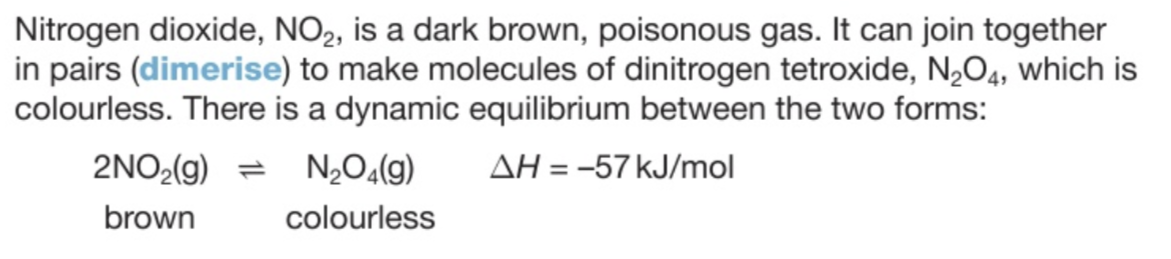
What changes can you see when you increased/decreased temperature?
Decrease
Position of equilibrium shifts to the right towards the exothermic direction
Yield of dinitrogen tetroxide increases
Colour of the reaction mixture will fade
Increase, al revés
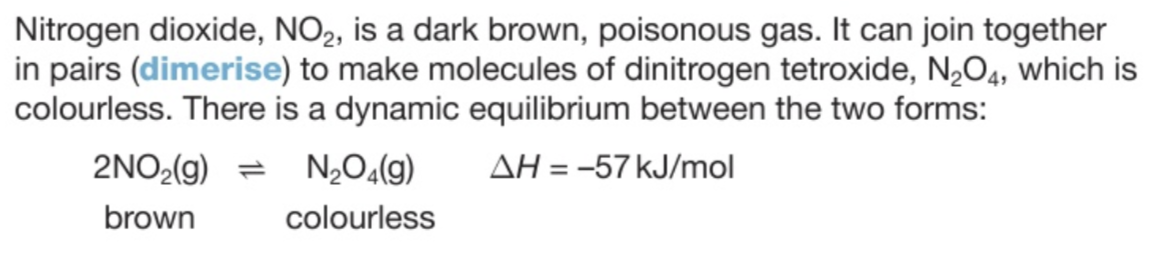
What changes will you see when you increase pressure?
If you increase the pressure
Position of equilibrium shifts to the right where there are fewer gas molecules
Yield of dinitrogen tetroxide increases
Colour will darken initially because the same number of molecules of brown nitrogen dioxide are being squeezed into a smaller space.
Then it will fade a bit as the equilibrium re-establishes, but not to its original colour (it will be lighter) because the equilibrium shift reduces the proportion of brown NO₂ in favor of colourless N₂O₄.
The gases are still compressed.
 Note
Note  Flashcards (27)