U5 Lec2 - basal ganglia
 Studied by 0 people
 Call Kai
 Learn
Learn Practice Test
 Spaced Repetition
 Match
Match Flashcards
 Knowt Play
1/25

There's no tags or description
Looks like no tags are added yet.
Name | Mastery | Learn | Test | Matching | Spaced |
|---|
No study sessions yet.
26 Terms
Basal Ganglia
a group of nuclei located at the base of the cerebral cortex made of 7 functional parts involved in movement control
what nuclei make up the basal ganglia
caudate
putamen
globus pallidus (interal and external)
sibstantia nigra (paras compacta and paras reticulata)
subthalamic nucleus

whihc nuclei are not anatomocially apart of basal ganglia, but functionaly very interconected
substantia nigra (para compacta and paras reticulata)
subthalamic nucleus
Striatum
the combined structure of the caudate + putamen and the main input area of the basal ganglia
Lentiform (lenticular) nucleus
the combined structure of the globus pallidus + putamen, cone-shaped
Function of basal ganglia
controls movement by planning, sequencing, and regulating VOLUNTARY/ slef initiates movements actions and controls habitual and skill based behaviours
acts as a "brake" that suppresses unwanted movements
what is the basal ganglia interconnected with
acts INDIRECTLY on lower motor neurons and highly interconected with motor cortical areas
what happens if any basal ganglia components get damages
dysfunction in any component leads to dyskinesia (excess or reduced movement) but not paralysis
Eg. movements havppping that you dont want (positive sign) or movements not happing that you do want (negative signs)
Caudate nucleus
a C-shaped input nucleus divided into head, body, and tail, main inphut of the basal ganglia
degenerates in Huntington's disease

Putamen
lateral "shell" oof basal ganglia with cellular bridges to caudate nucleus
also major input in basal ganglia
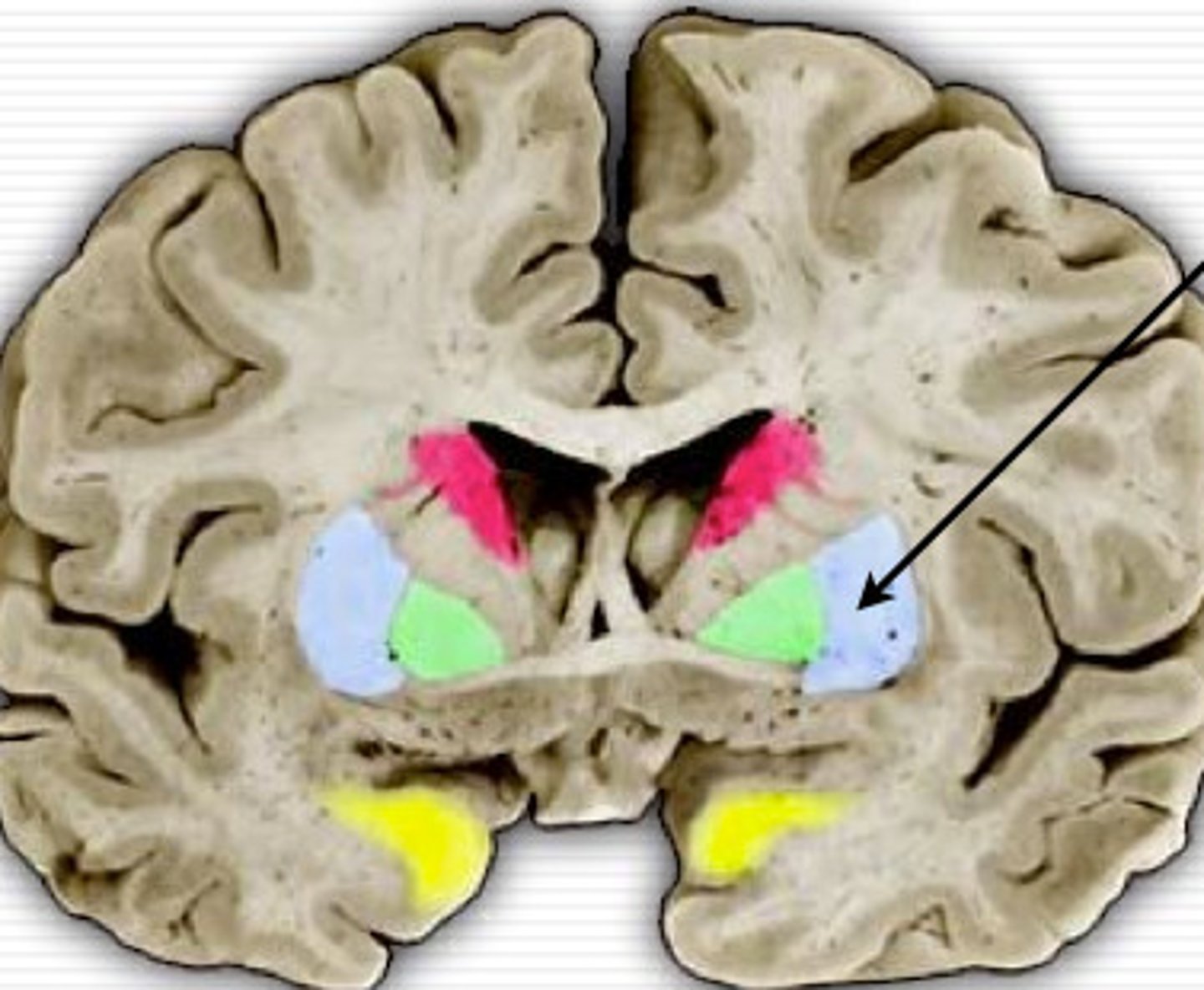
Globus pallidus (segments, location and roles)
2segments
GPi (internal) → medial
GPe (external) → lateral
Medial to putamen
One of the major outputs
Has inhibitory connections with thalamus
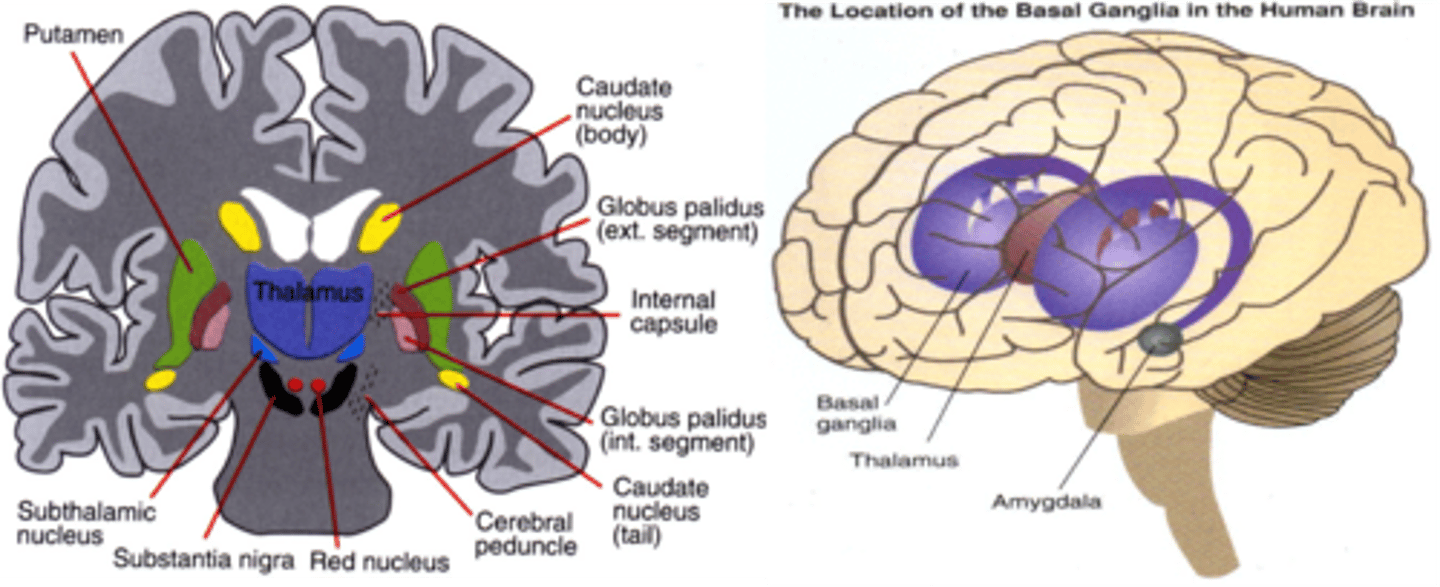
Subthalamic nucleus location and role
Inferior to thalamus
Splidle or lens shaped
Communicates with globus pallidus
Substantia nigra segments and their loaction and role
Pars compacta → contains darkly pigented dopaminergic neurons (more dorsal)
Pars reticulata → involved in output for eye movements, inhibits thalamus (more ventral)
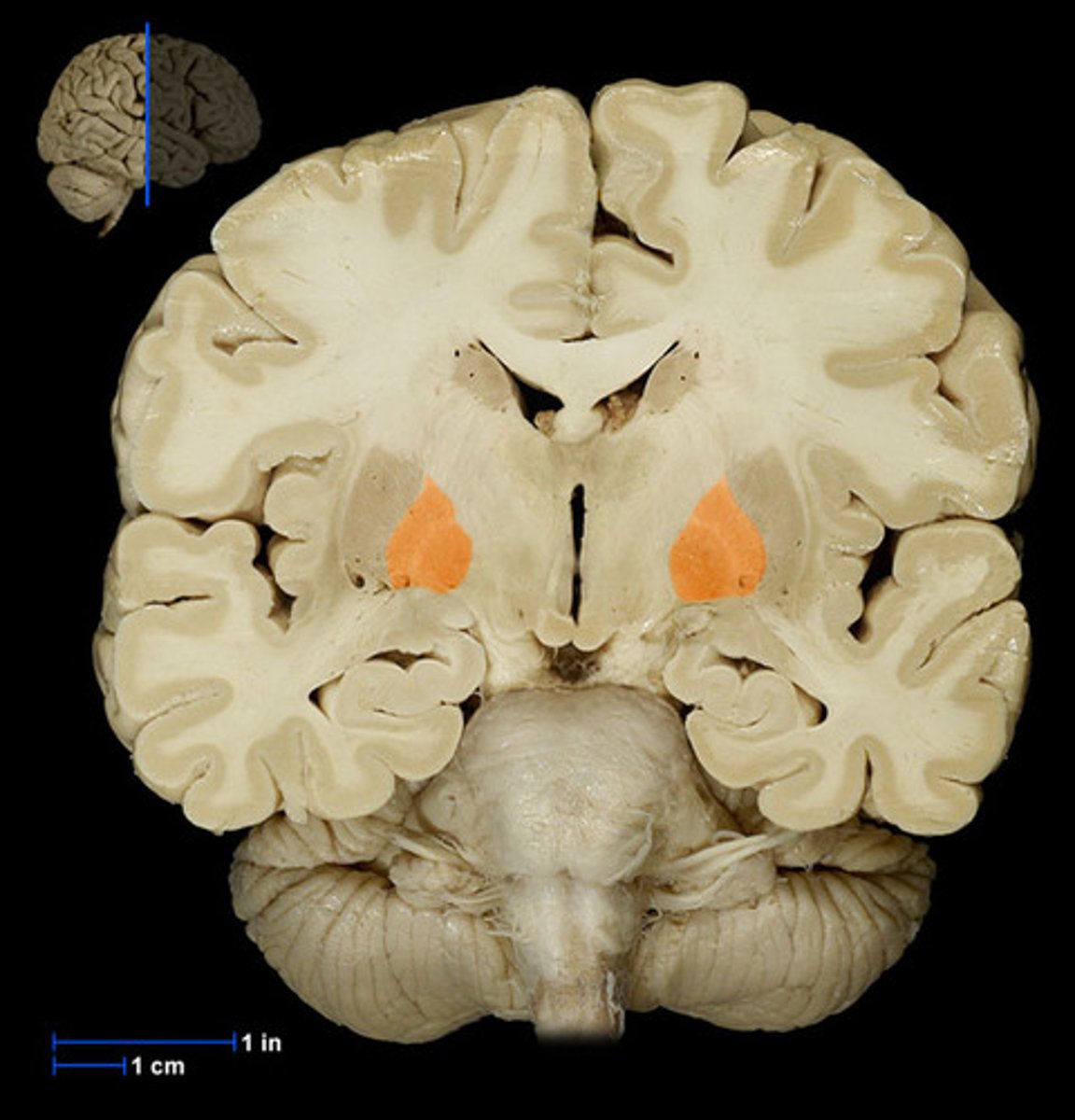
Input nuclei of basal ganglia
striatum (caudate + putamen) serve as the major input structures
Output nuclei of basal ganglia
GPi and substantia nigra pars reticulata which send inhibitory (GABAergic) output
Basal ganglia receives input from
sensory areas, motor areas, association areas, and the thalamus
Basal ganglia outputs to
the thalamus and superior colliculus
what is the basal ganglias default output by what pathway
its out via the GPi and SNpr send inhibatory output signal to the thalamus to reduce signal to a motor neurons --> this output is tonic
what are the 2 main pathways of the basal ganglia
direct --> enable actions
indirect --> stops innapropriate action
direct pathway
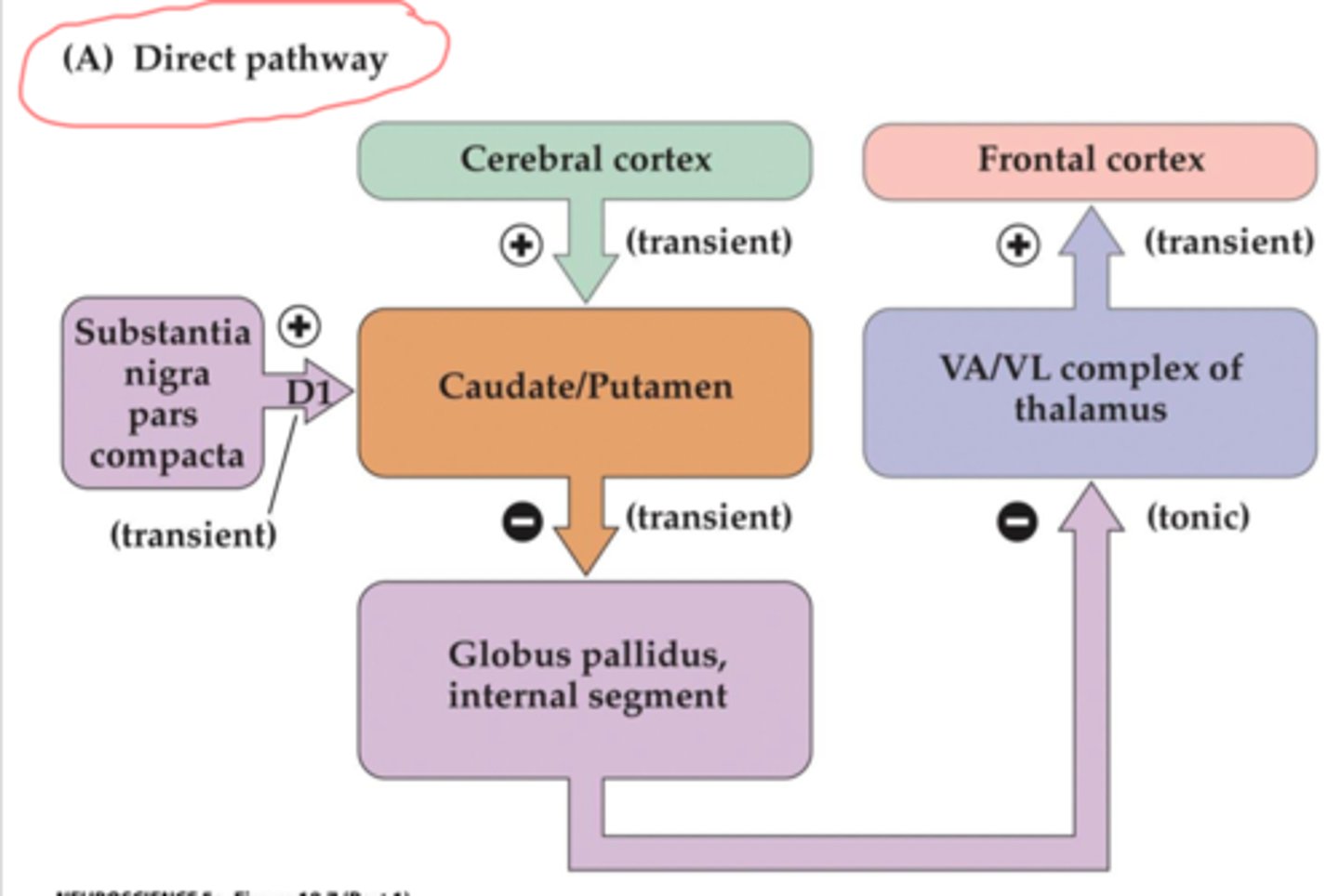
cortex, sensory areas, frontal lobe sends excitatory signal --> striatum disinhibits GPi. GPi cannot inhibit thalamus so thalamus send excitatory signal to cortex which send drive along descending tracts to lower motor neurons --> so yes movemnet!
indirect pathway
indirect neurons from cortex send excitatory signals to striatum. striatum disinhibits GPe so it can not inhibit thew subthalamic nucleus. subthalamic nucleus excites the GPi which enhances gpi inhibatory signal to the thalamus decreasing the descending drive to the lower motor neurons disabling movement
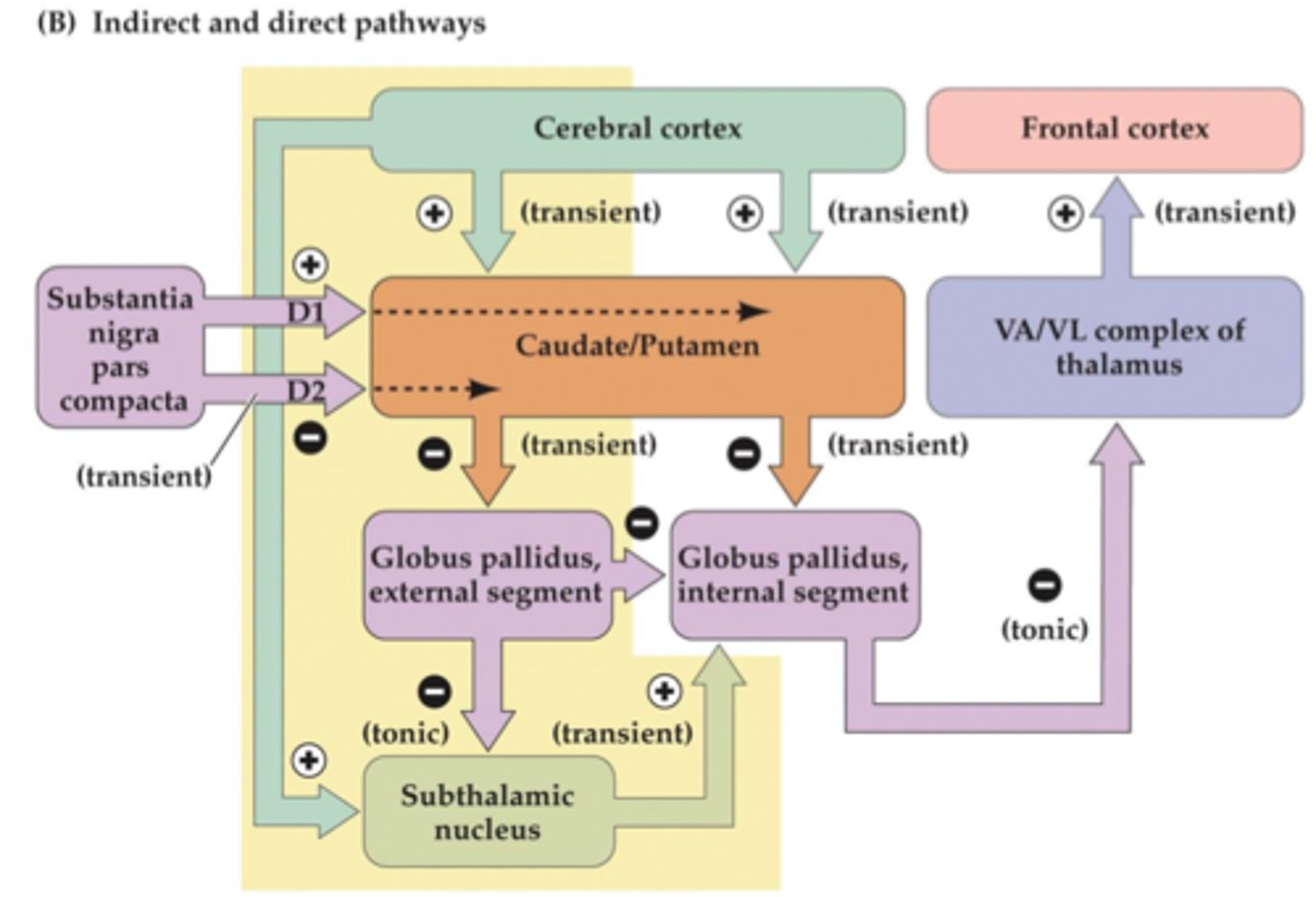
2 dif dopamin receptors in striatum
D1 receptor - apart of direct oathway, when recieve dop they send EPSP to striatum axtivating it
D2 receptor - apart of indirect pathway, when recevie dop send IPSP signals to inhibit striatum
what is the effect of dopamine on the direct pathway AND INDIRECT pathway
ACTIVATES DIRECT PATHWAY: by activating D1 receptors --> striatum gets activated --> GPi gets disinhibited --> INC MOVEMENT
INHIBITS INDIRECT PATHWAY: activates D2 receptors which inhibits striatum --> GPe doesnt get inhibited
basal ganglia dysfunction - parkinsons
caused by: neuron death in SN --> loss of dopamine --> underactivation of direct pathways and over activation of indirect pathway --> akinesia and bradykiinesia
sympotoms of parkinsons
- akinesia (lack of movement) and bradykinesia (slowness of movement)
:dopamine isnt helping the stritium to reach threshold than sending the epsps or ipsps is so much harder as cortex has to work harder to get to that same threshold
- resting tremor
there are threshold that manage oscillating system and since these threshold get mess up leads to tremor
-ridgitiy
- posture instability
- stooped poster, shuffling gait - freezing, difficulty turning, diminshed arm swing while walking
- micrographia (writing smaller)
- hyponia (cant speek as loud)
- himinished facial expression
Huntingtons disease - break pedal not push down enough
degeneration of indirect pathway neurons in striatum (caudate) leading to underactive indirect pathway and overactive direct pathways --> less inhibition of movement
symptoms:
hyperkinetic movement like chorea and dystonia
THERE MIGHT BE A CURE

 Note
Note  Flashcards (26)